Peru Stacker Market Size Growth Rate
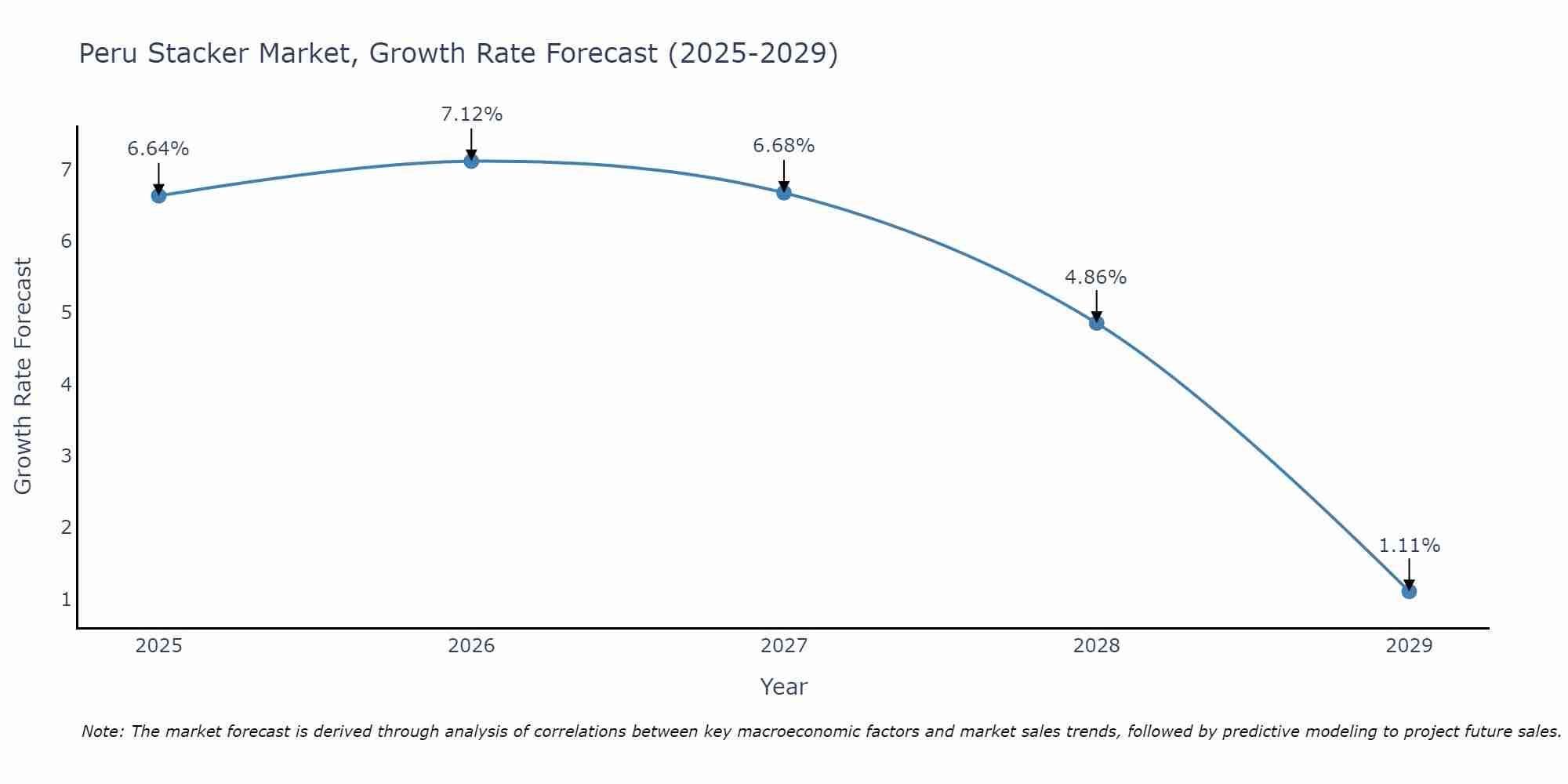
The Peru Stacker Market is projected to witness mixed growth rate patterns during 2025 to 2029. Starting at 6.64% in 2025, the market peaks at 7.12% in 2026, and settles at 1.11% by 2029.
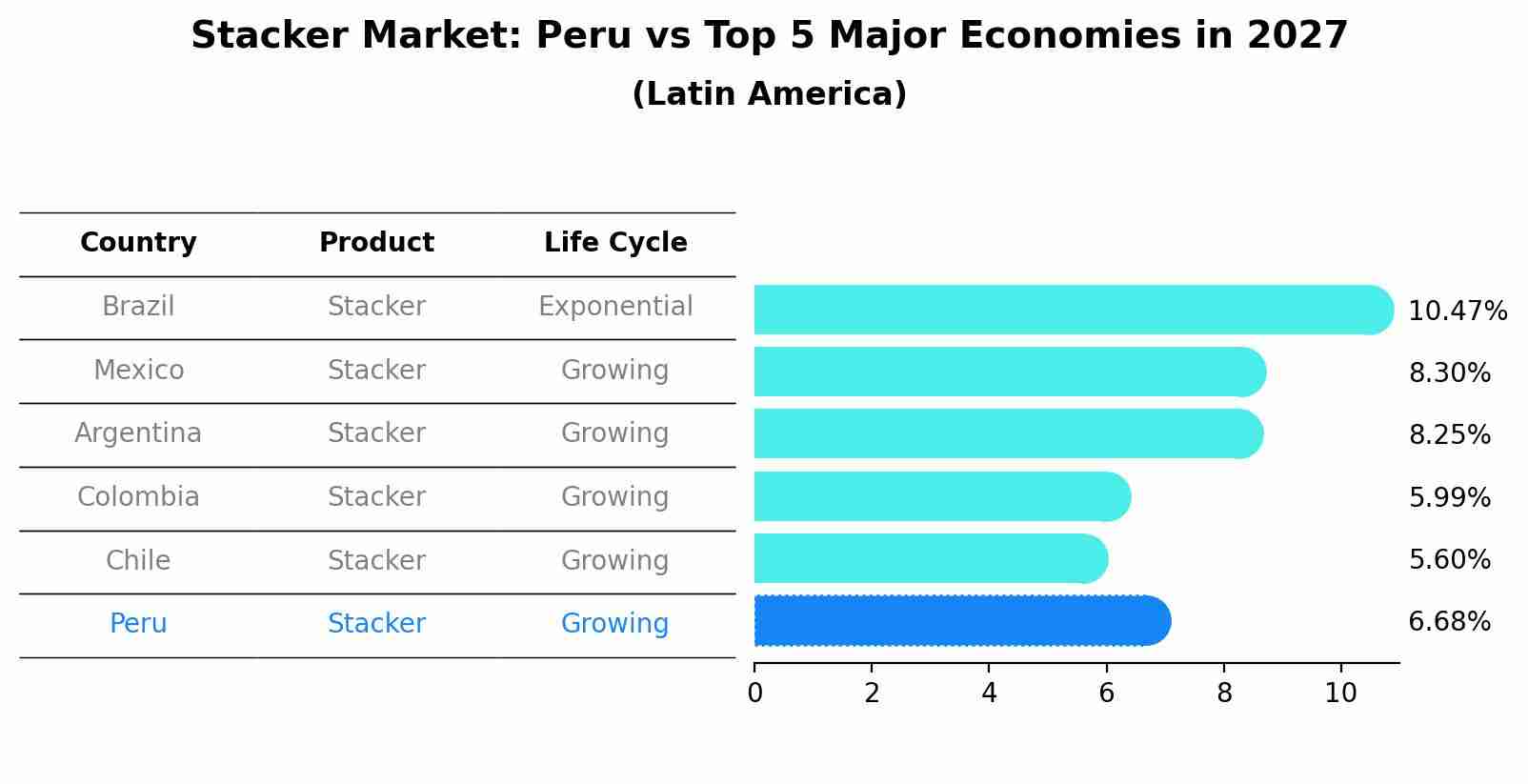
Stacker Market: Peru vs Top 5 Major Economies in 2027 (Latin America)
By 2027, the Stacker market in Peru is anticipated to reach a growth rate of 6.68%, as part of an increasingly competitive Latin America region, where Brazil remains at the forefront, supported by Mexico, Argentina, Colombia and Chile, driving innovations and market adoption across sectors.
Peru Stacker Market Synopsis
The Peru Stacker Market is experiencing steady growth driven by factors such as increasing demand for efficient storage solutions in various industries like manufacturing, logistics, and retail. Stacker systems offer space-saving benefits, improved inventory management, and enhanced workflow efficiency, making them popular among businesses looking to optimize their operations. The market is characterized by a range of stacker types, including manual, semi-automated, and fully automated models, catering to diverse customer needs. Key players in the Peru Stacker Market compete based on product innovation, quality, and pricing strategies to gain a competitive edge. With the ongoing industrial development and the need for streamlined material handling processes, the Peru Stacker Market is anticipated to continue its growth trajectory in the coming years.
Peru Stacker Market Trends
The Peru Stacker Market is experiencing a trend towards eco-friendly and sustainable materials, with a growing demand for stackers made from recycled plastics or wood. Consumers are increasingly conscious of the environmental impact of their purchases and are seeking products that are both durable and environmentally friendly. In addition, there is a rising interest in stackers that offer multi-functionality and versatility, allowing for creative and customizable stacking configurations. Educational stackers that promote cognitive development and learning through play are also gaining popularity among parents and educators. Overall, the Peru Stacker Market is seeing a shift towards eco-conscious and innovative products that cater to both the environmental concerns and developmental needs of children.
Peru Stacker Market Challenges
In the Peru Stacker Market, several challenges are faced including increasing competition from both domestic and international brands, fluctuating raw material prices, and changing consumer preferences. The market also grapples with the need for innovation to stay ahead of competitors, as well as meeting stringent quality standards and regulations. Additionally, economic instability and currency fluctuations can impact the purchasing power of consumers, leading to fluctuations in demand for stacker products. To succeed in this market, companies need to constantly adapt to changing market dynamics, invest in research and development, and effectively manage their supply chain to ensure consistent product availability and pricing.
Peru Stacker Market Investment Opportunities
Peru`s Stacker Market presents promising investment opportunities due to the country`s growing construction and mining industries. As demand for efficient material handling equipment increases, there is a need for advanced stacker solutions to optimize operations and boost productivity. Investors can explore opportunities in providing technologically advanced stackers that offer automation, improved safety features, and energy efficiency. Additionally, with Peru being a key player in the global mining sector, there is a potential for stacker manufacturers to cater to the specialized requirements of mining operations. Collaborating with local distributors and forming partnerships with industry players can help investors tap into this market effectively. Overall, investing in the Peru Stacker Market offers the potential for growth and profitability in alignment with the country`s industrial development.
Jordan Agar Market Government Policies
Government policies related to the Peru Stacker Market include regulations on safety standards, import tariffs, and environmental sustainability. The government of Peru has implemented strict safety requirements for stacker equipment to ensure the protection of workers and prevent accidents in industrial settings. Import tariffs on stacker machinery are in place to promote domestic manufacturing and support local industries. Additionally, environmental sustainability is a key focus, with policies encouraging the use of energy-efficient stackers and promoting eco-friendly practices within the industry. Overall, the government`s policies in Peru aim to balance safety, economic growth, and environmental responsibility in the stacker market.
Peru Stacker Market Future Outlook
The Peru Stacker Market is poised for solid growth in the coming years. Increasing industrialization and the rise in construction activities are driving the demand for stackers in the country. Additionally, the growing emphasis on warehouse automation and efficiency is expected to further boost the market. Technological advancements in stacker equipment, such as the integration of IoT and automation features, will also contribute to market growth. Moreover, the government`s focus on infrastructure development and the expansion of industries like logistics and e-commerce are creating a favorable environment for the Peru Stacker Market. Overall, the market is anticipated to experience steady growth as companies seek to enhance their operational efficiency and productivity through the adoption of advanced stacker solutions.
Key Highlights of the Report:
- Peru Stacker Market Outlook
- Market Size of Peru Stacker Market, 2021
- Forecast of Peru Stacker Market, 2031
- Historical Data and Forecast of Peru Stacker Revenues & Volume for the Period 2018 - 2031
- Peru Stacker Market Trend Evolution
- Peru Stacker Market Drivers and Challenges
- Peru Stacker Price Trends
- Peru Stacker Porter's Five Forces
- Peru Stacker Industry Life Cycle
- Historical Data and Forecast of Peru Stacker Market Revenues & Volume By Type for the Period 2018 - 2031
- Historical Data and Forecast of Peru Stacker Market Revenues & Volume By Electric for the Period 2018 - 2031
- Historical Data and Forecast of Peru Stacker Market Revenues & Volume By Manual/Hydraulic for the Period 2018 - 2031
- Historical Data and Forecast of Peru Stacker Market Revenues & Volume By Semi-Electric for the Period 2018 - 2031
- Historical Data and Forecast of Peru Stacker Market Revenues & Volume By End-User for the Period 2018 - 2031
- Historical Data and Forecast of Peru Stacker Market Revenues & Volume By Retail & Wholesale for the Period 2018 - 2031
- Historical Data and Forecast of Peru Stacker Market Revenues & Volume By Logistics for the Period 2018 - 2031
- Historical Data and Forecast of Peru Stacker Market Revenues & Volume By Automobile for the Period 2018 - 2031
- Historical Data and Forecast of Peru Stacker Market Revenues & Volume By Food & Beverages for the Period 2018 - 2031
- Historical Data and Forecast of Peru Stacker Market Revenues & Volume By Others for the Period 2018 - 2031
- Peru Stacker Import Export Trade Statistics
- Market Opportunity Assessment By Type
- Market Opportunity Assessment By End-User
- Peru Stacker Top Companies Market Share
- Peru Stacker Competitive Benchmarking By Technical and Operational Parameters
- Peru Stacker Company Profiles
- Peru Stacker Key Strategic Recommendations






































