Peru Work Order Management Systems Market Size & Growth Rate (2026-2032)
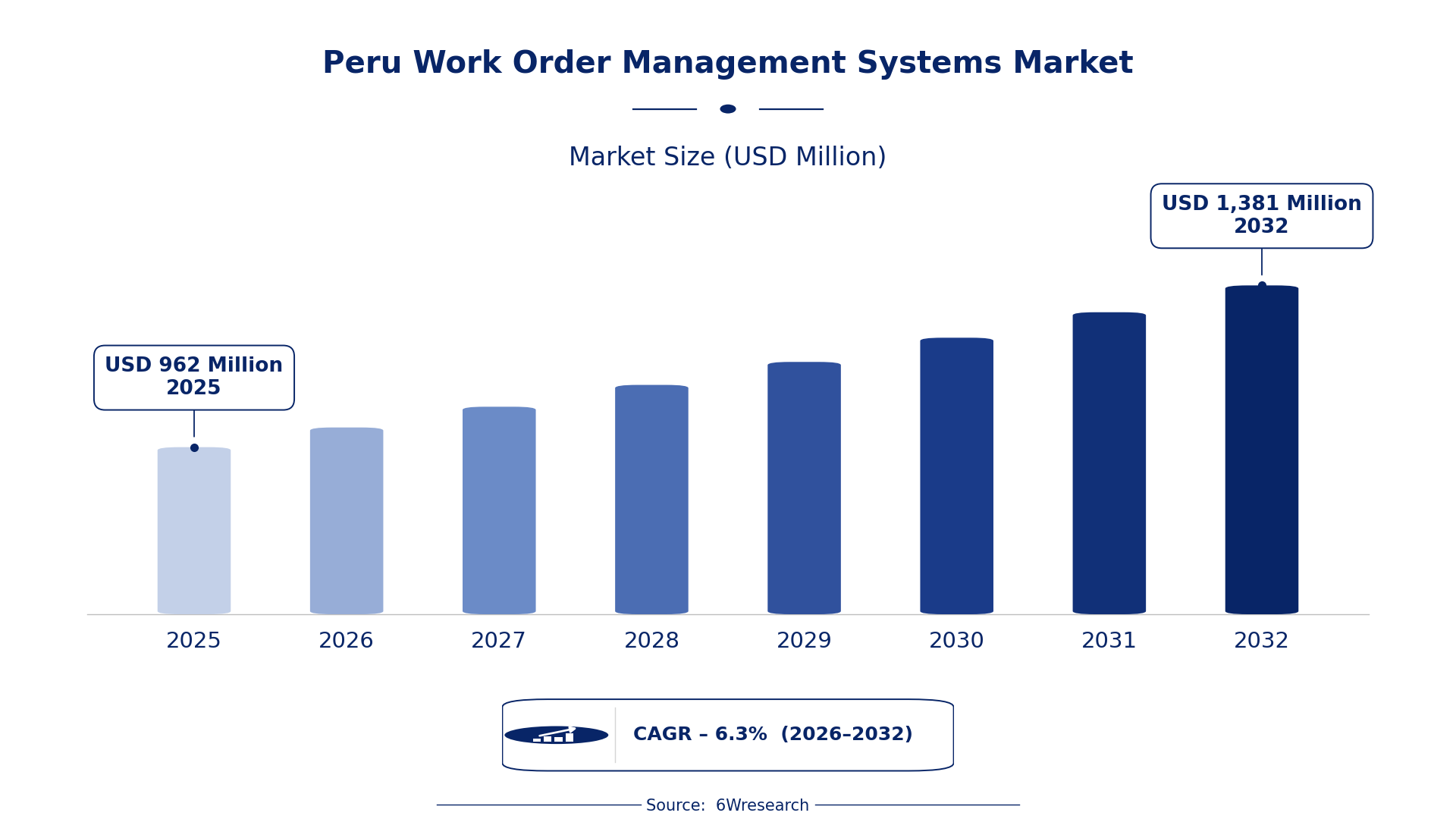
The Peru Work Order Management Systems Market was estimated at USD 962 Million in 2025 and is projected to reach USD 1381 Million by 2032, growing at a CAGR of 6.3% from 2026 to 2032.
Peru Work Order Management Systems Market Synopsis
As businesses in Peru increasingly embrace digital solutions, the demand for work order management systems has surged. This trend is particularly strong among industries that require precise tracking and efficient management of tasks, such as manufacturing and utilities.
The competitive environment is marked by both local and international software providers, each offering tailored solutions to meet the diverse operational needs of Peruvian companies. The move towards cloud-based systems is gaining traction, appealing to businesses for their scalability and cost-effectiveness.
Peru Work Order Management Systems Market Year-wise Growth Rate and Key Drivers
This graph illustrates the annual growth rates of the Peru Work Order Management Systems Market from 2021 to 2032, highlighting a steady upward trajectory and projected expansion over the forecast period.
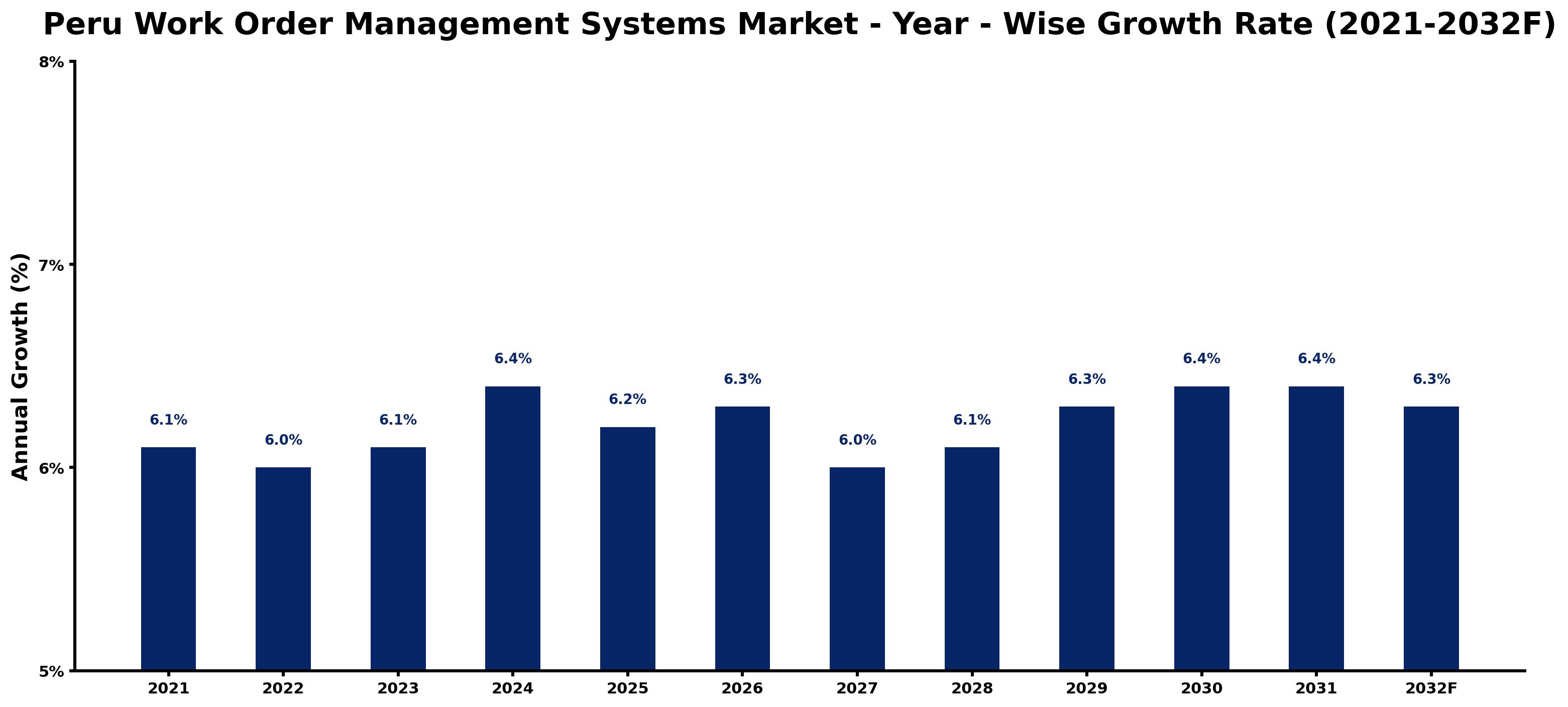
The table below presents the year‑wise growth rates along with the key drivers influencing the market
| Year | Growth Rate | Major Drivers |
| 2021 | 6.1% | Government initiatives to digitize public service workflows. |
| 2022 | 6.0% | Increased investments in telecommunications infrastructure for connectivity. |
| 2023 | 6.1% | Local demand for sustainability in agricultural operations management. |
| 2024 | 6.4% | Surge in e-commerce leading to operational management needs. |
| 2025 | 6.2% | Regulatory push for compliance tracking in various industries. |
| 2026 | 6.3% | Growing awareness of digital transformation benefits across sectors. |
| 2027 | 6.0% | Emergence of cloud solutions tailored to local SMEs. |
| 2028 | 6.1% | Rise of digital training programs enhancing workforce capabilities. |
| 2029 | 6.3% | Partnerships between tech firms and local businesses expanding solutions. |
| 2030 | 6.4% | Increasing focus on project management in construction sector. |
| 2031 | 6.4% | Adoption of IoT applications improving asset management practices. |
| 2032 | 6.3% | Continued urbanization driving maintenance and facility management needs. |
Note: Market size estimations and growth projections presented in this report are based on 6Wresearch's proprietary forecasting methodology, utilizing the latest available industry data, government publications, and primary research inputs.
Peru Work Order Management Systems Market Key Takeaways
Below are some of the specific key takeaways from the market, including:
- Cloud-based solutions are increasingly preferred due to their flexibility and reduced upfront costs.
- Real-time tracking and mobile compatibility are becoming essential features demanded by businesses.
- Integration with existing business applications is a critical factor for adoption.
- AI and IoT technologies are emerging as key components for enhancing operational efficiency.
- Government initiatives are actively promoting the use of work order management systems in public projects.
Evaluation of Restraints in Peru Work Order Management Systems Market
The Peru Work Order Management Systems Market faces several challenges that could hinder growth. One major restraint is the difficulty of integrating new systems with existing ERP and CRM platforms, which can lead to operational disruptions if not managed correctly. Additionally, there's a noticeable gap in awareness, especially among smaller businesses, regarding the benefits of adopting digital solutions. These companies often lack the resources for training and education, which complicates their transition to more efficient systems. on top of that, data security concerns and compliance with local regulations remain significant hurdles, particularly for firms operating in more remote areas where connectivity can be inconsistent.
Peru Work Order Management Systems Market Trends
A shift towards cloud-based solutions is defining the current state of the Peru Work Order Management Systems Market. Businesses are prioritizing systems that provide real-time data access and mobile functionalities. Additionally, the integration of advanced technologies, such as artificial intelligence and IoT, is becoming a focal point as organizations seek to optimize operations and resource allocation. The emphasis on predictive maintenance is also gaining traction, as companies aim to enhance productivity and reduce downtime.
Peru Work Order Management Systems Market Opportunities
Growth opportunities abound for software providers in this market, particularly in tailoring solutions for various sectors such as construction, maintenance, and field service. The demand for customized systems that cater to specific industry needs presents a chance for innovation. Additionally, addressing the digital divide by focusing on smaller businesses can open new avenues for expansion. As operational efficiency becomes a more significant priority, there is also room for collaborative projects with government entities to enhance public infrastructure management.
Government Initiatives in the Peru Work Order Management Systems Market
The Peruvian government is actively shaping the Work Order Management Systems Market through various initiatives aimed at modernizing public infrastructure management. By mandating the use of digital solutions in public projects, the government seeks to enhance efficiency and accountability. These efforts are critical as they not only promote technological adoption but also encourage public-private partnerships that leverage private sector expertise.
- A recently completed initiative involved the integration of work order management systems in local government infrastructure projects to streamline execution and oversight.
- A current initiative focuses on training public sector employees on effective use and integration of digital management tools, enhancing skill sets across various agencies.
- Planned for the upcoming year is a national program aimed at expanding access to cloud-based work order solutions across rural areas, addressing connectivity issues.
- Public-private partnerships are being encouraged to support infrastructure investments, with an emphasis on utilizing work order management systems for transparency.
Future Insights of the Peru Work Order Management Systems Market
Looking ahead, the Peru Work Order Management Systems Market is set for considerable growth as organizations increasingly recognize the value of digital solutions. The drive for operational efficiency will continue to be a major factor influencing adoption rates. As businesses become more aware of the cost-saving benefits associated with these systems, the integration of advanced technologies will likely become standard practice. The expected rise in public-sector projects utilizing work order management systems will further bolster market expansion.
Peru Work Order Management Systems Market Latest Developments
Recent activity in the Peru Work Order Management Systems Market indicates a strong push towards digital transformation. Over the past year, various initiatives have emerged that reflect the sector's growing importance in enhancing operational efficiency across industries.
- A major technology vendor launched a new cloud-based work order management solution in early 2025, focusing on scalability for small to medium-sized businesses.
- An ongoing initiative started in mid-2025 aims to implement real-time tracking features for maintenance operations in the public sector.
- A planned rollout of a new mobile application designed for field technicians is expected to begin in Q3 2025, enhancing task management capabilities.
- In early 2025, a public-private partnership was established to develop a comprehensive training program for employees in the construction sector.
Peru Work Order Management Systems Market - Key Attractiveness of the Report
- 10 Years of Market Numbers
- Historical Data Starting from 2022 to 2025
- Base Year: 2025
- Forecast Data until 2032
- Key Performance Indicators Impacting the Market
- Major Upcoming Developments and Projects
Key Highlights of the Report:
- Peru Work Order Management Systems Market Outlook
- Market Size of Peru Work Order Management Systems Market, 2025
- Forecast of Peru Work Order Management Systems Market, 2032
- Historical Data and Forecast of Peru Work Order Management Systems Revenues & Volume for the Period 2022-2032F
- Peru Work Order Management Systems Market Trend Evolution
- Peru Work Order Management Systems Market Drivers and Challenges
- Peru Work Order Management Systems Price Trends
- Peru Work Order Management Systems Porter's Five Forces
- Peru Work Order Management Systems Industry Life Cycle
- Historical Data and Forecast of Peru Work Order Management Systems Market Revenues & Volume By Component for the Period 2022-2032F
- Historical Data and Forecast of Peru Work Order Management Systems Market Revenues & Volume By Solution for the Period 2022-2032F
- Historical Data and Forecast of Peru Work Order Management Systems Market Revenues & Volume By Services for the Period 2022-2032F
- Historical Data and Forecast of Peru Work Order Management Systems Market Revenues & Volume By Deployment Type for the Period 2022-2032F
- Historical Data and Forecast of Peru Work Order Management Systems Market Revenues & Volume By Cloud for the Period 2022-2032F
- Historical Data and Forecast of Peru Work Order Management Systems Market Revenues & Volume By On-premises for the Period 2022-2032F
- Historical Data and Forecast of Peru Work Order Management Systems Market Revenues & Volume By Industry Vertical for the Period 2022-2032F
- Historical Data and Forecast of Peru Work Order Management Systems Market Revenues & Volume By Manufacturing for the Period 2022-2032F
- Historical Data and Forecast of Peru Work Order Management Systems Market Revenues & Volume By Energy and Utilities for the Period 2022-2032F
- Historical Data and Forecast of Peru Work Order Management Systems Market Revenues & Volume By Transportation and Logistics for the Period 2022-2032F
- Historical Data and Forecast of Peru Work Order Management Systems Market Revenues & Volume By Construction and Real Estate for the Period 2022-2032F
- Historical Data and Forecast of Peru Work Order Management Systems Market Revenues & Volume By Consumer Goods and Retail for the Period 2022-2032F
- Historical Data and Forecast of Peru Work Order Management Systems Market Revenues & Volume By Healthcare and Life Sciences for the Period 2022-2032F
- Historical Data and Forecast of Peru Work Order Management Systems Market Revenues & Volume By Banking, Financial Services, and Insurance (BFSI) for the Period 2022-2032F
- Historical Data and Forecast of Peru Work Order Management Systems Market Revenues & Volume By Telecom and IT for the Period 2022-2032F
- Historical Data and Forecast of Peru Work Order Management Systems Market Revenues & Volume By Organization Size for the Period 2022-2032F
- Historical Data and Forecast of Peru Work Order Management Systems Market Revenues & Volume By Small and Medium-sized Enterprises for the Period 2022-2032F
- Historical Data and Forecast of Peru Work Order Management Systems Market Revenues & Volume By Large Enterprises for the Period 2022-2032F
- Peru Work Order Management Systems Import Export Trade Statistics
- Market Opportunity Assessment By Component
- Market Opportunity Assessment By Deployment Type
- Market Opportunity Assessment By Industry Vertical
- Market Opportunity Assessment By Organization Size
- Peru Work Order Management Systems Top Companies Market Share
- Peru Work Order Management Systems Competitive Benchmarking By Technical and Operational Parameters
- Peru Work Order Management Systems Company Profiles
- Peru Work Order Management Systems Key Strategic Recommendations






































