Philippines 2D Gesture Recognition Market (2026-2032) | Pricing Analysis, Growth, Strategic Insights, Analysis, Segments, Challenges, Outlook, Strategy, Segmentation, Share, Forecast, Demand, Revenue, Value, Industry, Consumer Insights, Competition, Drivers, Competitive, Opportunities, Trends, Companies, Investment Trends, Supply, Size, Restraints
Market Forecast By Technology Type (Touch-Based, Touchless), By Application (Consumer Electronics, Automotive, Healthcare), By Device Type (Wearable, Non-Wearable), By End User (Gaming, Automotive, Industrial) And Competitive Landscape
| Product Code: ETC11433697 | Publication Date: Apr 2025 | Updated Date: May 2026 | Product Type: Market Research Report | |
| Publisher: 6Wresearch | Author: Bhawna Singh | No. of Pages: 65 | No. of Figures: 34 | No. of Tables: 19 |
Philippines 2D Gesture Recognition Market Growth Rate
According to 6Wresearch internal database and industry insights, the Philippines 2D Gesture Recognition Market is projected to grow at a compound annual growth rate (CAGR) of 8% during the forecast period from 2026 to 2032.
Philippines 2D Gesture Recognition Market Year-wise Growth Rate and Key Drivers
This graph highlights how the Philippines 2D Gesture Recognition Market has steadily grown over the past five years, supported by major growth factors.
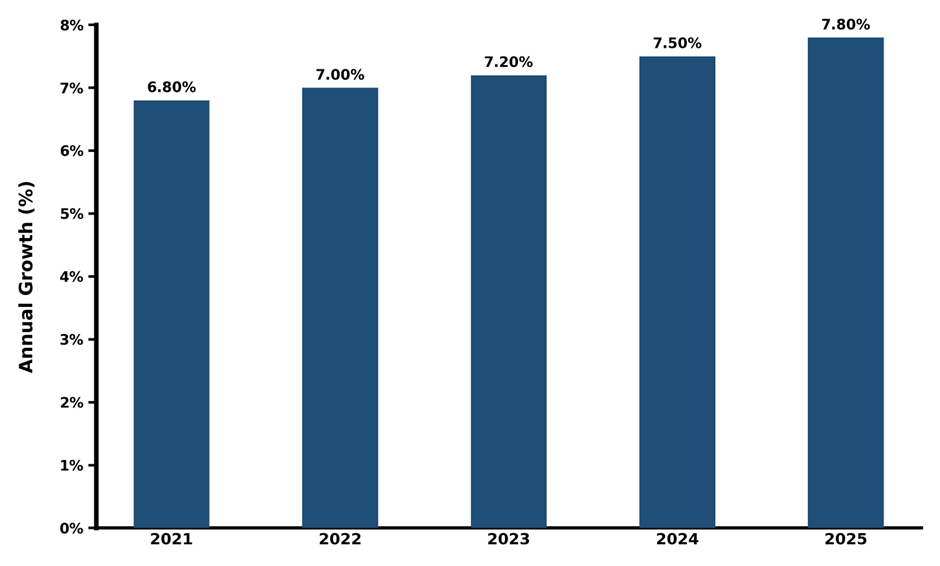
The table below presents the year‑wise growth rates along with the key drivers influencing the market
| Years | Est. Annual Growth in % | Growth Drivers |
| 2021 | 6.8% | Increased demand for touchless interaction in consumer electronics. |
| 2022 | 7% | Rise in adoption of gesture-controlled devices in automotive applications. |
| 2023 | 7.2% | The healthcare field is experiencing increased interest for its rehabilitation applications. |
| 2024 | 7.5% | Technological advancements in sensor technologies and improved accuracy. |
| 2025 | 7.8% | Expansion of gesture recognition applications in gaming and industrial sectors. |
Topics Covered in the Philippines 2D Gesture Recognition Market Report
The Philippines 2D Gesture Recognition Market report thoroughly covers the market by technology type, application, device type, and end user, providing an unbiased and detailed analysis of ongoing market trends, opportunities, challenges, and market drivers, helping stakeholders align their strategies with current and future market dynamics.
Philippines 2D Gesture Recognition Market Highlights
| Report Name | Philippines 2D Gesture Recognition Market |
| Forecast period | 2026-2032 |
| CAGR | 8% |
| Growing Sector | Gesture Recognition Technology |
Philippines 2D Gesture Recognition Market Synopsis
The Philippines 2D Gesture Recognition Market is experiencing rapid growth due to increasing demand for touchless interaction across various industries, including automotive, consumer electronics, healthcare, and gaming while the market is supported by advancements in sensor technologies and the increasing adoption of gesture recognition systems for controlling devices without physical contact. The market is driven by the demand for seamless, intuitive user experiences in both consumer and industrial applications, along with the rising awareness of health and safety benefits.
Evaluation of Growth Drivers in the Philippines 2D Gesture Recognition Market ( 2026-2032)
Below mentioned are some prominent drivers and their impact on the market dynamics:
| Drivers | Primary Segments Affected | Why It Matters (Evidence) |
| Increased Demand for Touchless Interfaces | Consumer Electronics, Automotive, Healthcare | Touchless systems are gaining popularity for hygiene and ease of use, driving market growth. |
| Technological Advancements in Sensors | All Segments | The development of new sensor technologies enables gesture recognition systems to achieve higher accuracy and operational performance. |
| Rise in Adoption in Automotive Applications | Automotive | The use of gesture recognition technology has become essential for improving both user experience and vehicle safety. |
| Growing Use in Healthcare and Rehabilitation | Healthcare | The healthcare field now uses gesture-based systems to monitor patients and help them with their rehabilitation process. |
| Expansion in Gaming Applications | Gaming | Gesture-controlled devices are enhancing gaming experiences, driving their adoption. |
The Philippines 2D Gesture Recognition Market is projected to grow at a CAGR of 8% from 2026 to 2032. The Philippines 2D Gesture Recognition Market is growing due to rising demand for touchless interfaces, advancements in sensor technologies, and widespread applications in automotive, healthcare, and gaming while gesture recognition systems offer intuitive, efficient, and hygienic interaction methods, making them popular in various sectors as these systems gain traction across diverse industries, their adoption is expected to fuel sustained market growth, driving innovation and expanding their usage across multiple platforms and consumer-facing technologies.
Evaluation of Restraints in the Philippines 2D Gesture Recognition Market
Below mentioned are some major restraints and their influence on the market dynamics:
| Restraints | Primary Segments Affected | What This Means (Evidence) |
| High Initial Investment Costs | All Segments | The high costs of implementing gesture recognition systems may limit adoption in certain sectors. |
| Integration Challenges | Consumer Electronics, Automotive, Healthcare | Integration of gesture recognition systems with existing technology can be complex and costly. |
| Privacy and Security Concerns | Automotive, Consumer Electronics | Concerns over data security and privacy may hinder widespread acceptance of gesture technologies. |
| Limited Awareness and Expertise | All Segments | The consumer's risk aversion and the liability under the contractual law were significant factors impeding the acceptance of the gesture recognition systems. |
| Technical Limitations | Consumer Electronics, Automotive | The accuracy and reliability of gesture recognition systems may be affected by environmental factors, limiting their effectiveness in some applications. |
Philippines 2D Gesture Recognition Market Challenges
The Philippines 2D Gesture Recognition Industry faces several challenges through its high technology costs, integration difficulties and its privacy and data security concerns. These issues could further slowdown adoption, especially among price-sensitive consumers and smaller businesses, who want to pay less for the product. The manufacturers must achieve goals in order to solve these problems which include the need to decrease their expenses while making their systems function better and creating strong security systems and the manufacturers can achieve goals through their solution.
Philippines 2D Gesture Recognition Market Trends
Here are some major trends changing the Philippines 2D Gesture Recognition Market Growth dynamics:
- Advancements in Sensor Technologies - Innovations in sensor technologies are making gesture recognition systems more accurate and responsive, driving adoption across industries.
- Increased Use in Automotive Applications - Gesture recognition is enhancing user interfaces in vehicles, contributing to an improved driving experience and greater safety.
- Growing Healthcare Applications - Touchless interaction through gesture recognition technology has emerged as an effective solution for patient monitoring and rehabilitation purposes within the healthcare industry.
Investment Opportunities in the Philippines 2D Gesture Recognition Market
The Philippines 2D Gesture Recognition Market presents several investment opportunities, including:
- Research and Development in Sensor Technology: Market growth requires businesses to invest in research and development efforts which will enhance the accuracy and cost-effectiveness and operational capabilities of gesture recognition sensors.
- E-Commerce Integration: Companies can invest in expanding e-commerce platforms to reach a larger consumer base for gesture-controlled devices which provide greater convenience for buyers.
- Healthcare and Rehabilitation Applications: The healthcare sector will experience substantial growth through the implementation of gesture recognition technology for patient monitoring and rehabilitation activities.
Top 5 Leading Players in the Philippines 2D Gesture Recognition Market
Below is the list of prominent companies leading the Philippines 2D Gesture Recognition Market Share:
Microsoft Corporation
| Company Name | Microsoft Corporation |
| Established Year | 1975 |
| Headquarters | Redmond, Washington, USA |
| Official Website | Click Here |
Microsoft is a major technology company specializing in software, hardware, and cloud services, with advanced contributions to gesture recognition technologies, including the Kinect platform for gaming and interactive systems.
Intel Corporation
| Company Name | Intel Corporation |
| Established Year | 1968 |
| Headquarters | Santa Clara, California, USA |
| Official Website | Click Here |
Intel develops high-performance processors and technologies, including gesture recognition systems, enabling touchless interfaces in various industries such as automotive and consumer electronics.
Leap Motion
| Company Name | Leap Motion |
| Established Year | 2010 |
| Headquarters | San Francisco, California, USA |
| Official Website | - |
Leap Motion specializes in motion sensing technology, providing high-precision gesture recognition solutions for applications in gaming, healthcare, and consumer electronics.
Ultraleap
| Company Name | Ultraleap |
| Established Year | 2019 |
| Headquarters | Bristol, United Kingdom |
| Official Website | Click Here |
Ultraleap focuses on advanced gesture and touchless interaction technologies, creating solutions for automotive, retail, and healthcare applications, with a strong emphasis on user experience.
Stereolabs
| Company Name | Stereolabs |
| Established Year | 2012 |
| Headquarters | San Francisco, California, USA |
| Official Website | Click Here |
Stereolabs develops innovative 3D vision-based technology, providing gesture recognition systems for robotics, healthcare, and virtual reality applications.
Government Regulations Introduced in the Philippines 2D Gesture Recognition Market
According to the Filipino government data, the Department of Information and Communications Technology (DICT) has implemented guidelines for the ethical use and privacy of technologies like gesture recognition systems the compliance is monitored by local regulatory bodies to ensure safe and effective deployment of these systems in consumer and industrial applications for instance, the National Privacy Commission (NPC) ensures that data collection through gesture recognition systems adheres to privacy and data protection standards, helping to enhance market growth and consumer trust.
Future Insights of the Philippines 2D Gesture Recognition Market
The outlook for the Philippines 2D Gesture Recognition Market is positive, driven by ongoing advancements in sensor technologies and growing demand across various sectors while the automotive, healthcare, and gaming industries are expected to be the largest adopters of gesture recognition systems. As the technology becomes more accessible and affordable, it will further penetrate consumer electronics, smart homes, and industrial applications. Additionally, increasing awareness of health and safety benefits associated with touchless interfaces will continue to drive adoption.
Market Segmentation Analysis
The report offers a comprehensive study of the following market segments and their leading categories:
By Technology Type – Touchless to Dominate the Market
According to Ritika Kalra, Senior Research Analyst, 6Wresearch, the market currently belongs to touchless technology as its use continues to grow across various fields including automotive, healthcare and industrial sectors. People use the technology as it provides them with hygienic features and convenient functionality.
By Application - Consumer Electronics to Dominate the Market
Consumer Electronics dominates the market, driven by the growing demand for gesture recognition in devices like smartphones, smart TVs, and gaming consoles. The trend of touchless interactions in smart devices further boosts this segment.
By Device Type- Non-Wearable to Dominate the Market
Non-Wearable devices dominate the market particularly in applications like automotive and consumer electronics, where hands-free operation is highly valued. The devices provide users with better convenience as they work together with existing technologies.
By End User – Gaming to Dominate the Market
Gaming is the dominant end user, with gesture recognition being widely used to enhance interactive and immersive gaming experiences. The rise of VR and AR gaming further drives the demand for gesture-based controls.
Key Attractiveness of the Report
- 10 Years of Market Numbers
- Historical Data Starting from 2022 to 2025
- Base Year: 2025
- Forecast Data until 2032
- Key Performance Indicators Impacting the Market
- Major Upcoming Developments and Projects
Key Highlights of the Report:
- Philippines 2D Gesture Recognition Market Outlook
- Market Size of Philippines 2D Gesture Recognition Market, 2025
- Forecast of Philippines 2D Gesture Recognition Market, 2032
- Historical Data and Forecast of Philippines 2D Gesture Recognition Revenues & Volume for the Period 2022-2032
- Philippines 2D Gesture Recognition Market Trend Evolution
- Philippines 2D Gesture Recognition Market Drivers and Challenges
- Philippines 2D Gesture Recognition Price Trends
- Philippines 2D Gesture Recognition Porter's Five Forces
- Philippines 2D Gesture Recognition Industry Life Cycle
- Historical Data and Forecast of Philippines 2D Gesture Recognition Market Revenues & Volume By Technology Type for the Period 2022-2032
- Historical Data and Forecast of Philippines 2D Gesture Recognition Market Revenues & Volume By Touch-Based for the Period 2022-2032
- Historical Data and Forecast of Philippines 2D Gesture Recognition Market Revenues & Volume By Touchless for the Period 2022-2032
- Historical Data and Forecast of Philippines 2D Gesture Recognition Market Revenues & Volume By Application for the Period 2022-2032
- Historical Data and Forecast of Philippines 2D Gesture Recognition Market Revenues & Volume By Consumer Electronics for the Period 2022-2032
- Historical Data and Forecast of Philippines 2D Gesture Recognition Market Revenues & Volume By Automotive for the Period 2022-2032
- Historical Data and Forecast of Philippines 2D Gesture Recognition Market Revenues & Volume By Healthcare for the Period 2022-2032
- Historical Data and Forecast of Philippines 2D Gesture Recognition Market Revenues & Volume By Device Type for the Period 2022-2032
- Historical Data and Forecast of Philippines 2D Gesture Recognition Market Revenues & Volume By Wearable for the Period 2022-2032
- Historical Data and Forecast of Philippines 2D Gesture Recognition Market Revenues & Volume By Non-Wearable for the Period 2022-2032
- Historical Data and Forecast of Philippines 2D Gesture Recognition Market Revenues & Volume By End User for the Period 2022-2032
- Historical Data and Forecast of Philippines 2D Gesture Recognition Market Revenues & Volume By Gaming for the Period 2022-2032
- Historical Data and Forecast of Philippines 2D Gesture Recognition Market Revenues & Volume By Automotive for the Period 2022-2032
- Historical Data and Forecast of Philippines 2D Gesture Recognition Market Revenues & Volume By Industrial for the Period 2022-2032
- Philippines 2D Gesture Recognition Import Export Trade Statistics
- Market Opportunity Assessment By Technology Type
- Market Opportunity Assessment By Application
- Market Opportunity Assessment By Device Type
- Market Opportunity Assessment By End User
- Philippines 2D Gesture Recognition Top Companies Market Share
- Philippines 2D Gesture Recognition Competitive Benchmarking By Technical and Operational Parameters
- Philippines 2D Gesture Recognition Company Profiles
- Philippines 2D Gesture Recognition Key Strategic Recommendations
Market Covered
The report offers a comprehensive study of the subsequent market segments:
By Technology Type
- Touch-Based
- Touchless
By Application
- Consumer Electronics
- Automotive
- Healthcare
By Device Type
- Wearable
- Non-Wearable
By End User
- Gaming
- Automotive
- Industrial
Philippines 2D Gesture Recognition Market (2026-2032) : FAQs
The Philippines 2D Gesture Recognition Market is projected to grow at a CAGR of 8% between 2026-2032.
The touchless technology segment is expected to dominate due to its application in automotive and healthcare industries.
The main investment sectors focus on technological advancements for sensors and healthcare system development and automotive system integration.
The Department of Information and Communications Technology (DICT) controls gesture technology usage through its ethical regulations while the National Privacy Commission (NPC) enforces privacy protection laws.
6Wresearch actively monitors the Philippines 2D Gesture Recognition Market and publishes its comprehensive annual report, highlighting emerging trends, growth drivers, revenue analysis, and forecast outlook. Our insights help businesses to make data-backed strategic decisions with ongoing market dynamics. Our analysts track relevent industries related to the Philippines 2D Gesture Recognition Market, allowing our clients with actionable intelligence and reliable forecasts tailored to emerging regional needs.
Yes, we provide customisation as per your requirements. To learn more, feel free to contact us on sales@6wresearch.com
| 1 Executive Summary |
| 2 Introduction |
| 2.1 Key Highlights of the Report |
| 2.2 Report Description |
| 2.3 Market Scope & Segmentation |
| 2.4 Research Methodology |
| 2.5 Assumptions |
| 3 Philippines 2D Gesture Recognition Market Overview |
| 3.1 Philippines Country Macro Economic Indicators |
| 3.2 Philippines 2D Gesture Recognition Market Revenues & Volume, 2022 & 2032F |
| 3.3 Philippines 2D Gesture Recognition Market - Industry Life Cycle |
| 3.4 Philippines 2D Gesture Recognition Market - Porter's Five Forces |
| 3.5 Philippines 2D Gesture Recognition Market Revenues & Volume Share, By Technology Type, 2022 & 2032F |
| 3.6 Philippines 2D Gesture Recognition Market Revenues & Volume Share, By Application, 2022 & 2032F |
| 3.7 Philippines 2D Gesture Recognition Market Revenues & Volume Share, By Device Type, 2022 & 2032F |
| 3.8 Philippines 2D Gesture Recognition Market Revenues & Volume Share, By End User, 2022 & 2032F |
| 4 Philippines 2D Gesture Recognition Market Dynamics |
| 4.1 Impact Analysis |
| 4.2 Market Drivers |
| 4.2.1 Increasing demand for touchless technology due to hygiene concerns. |
| 4.2.2 Growing adoption of gesture recognition technology in consumer electronics and automotive sectors. |
| 4.2.3 Rising investments in research and development for enhancing gesture recognition technology. |
| 4.3 Market Restraints |
| 4.3.1 High initial costs associated with implementing gesture recognition technology. |
| 4.3.2 Limited awareness and low consumer acceptance of gesture recognition technology. |
| 4.3.3 Technical limitations related to accuracy and reliability of 2D gesture recognition systems. |
| 5 Philippines 2D Gesture Recognition Market Trends |
| 6 Philippines 2D Gesture Recognition Market, By Types |
| 6.1 Philippines 2D Gesture Recognition Market, By Technology Type |
| 6.1.1 Overview and Analysis |
| 6.1.2 Philippines 2D Gesture Recognition Market Revenues & Volume, By Technology Type, 2022 - 2032F |
| 6.1.3 Philippines 2D Gesture Recognition Market Revenues & Volume, By Touch-Based, 2022 - 2032F |
| 6.1.4 Philippines 2D Gesture Recognition Market Revenues & Volume, By Touchless, 2022 - 2032F |
| 6.2 Philippines 2D Gesture Recognition Market, By Application |
| 6.2.1 Overview and Analysis |
| 6.2.2 Philippines 2D Gesture Recognition Market Revenues & Volume, By Consumer Electronics, 2022 - 2032F |
| 6.2.3 Philippines 2D Gesture Recognition Market Revenues & Volume, By Automotive, 2022 - 2032F |
| 6.2.4 Philippines 2D Gesture Recognition Market Revenues & Volume, By Healthcare, 2022 - 2032F |
| 6.3 Philippines 2D Gesture Recognition Market, By Device Type |
| 6.3.1 Overview and Analysis |
| 6.3.2 Philippines 2D Gesture Recognition Market Revenues & Volume, By Wearable, 2022 - 2032F |
| 6.3.3 Philippines 2D Gesture Recognition Market Revenues & Volume, By Non-Wearable, 2022 - 2032F |
| 6.4 Philippines 2D Gesture Recognition Market, By End User |
| 6.4.1 Overview and Analysis |
| 6.4.2 Philippines 2D Gesture Recognition Market Revenues & Volume, By Gaming, 2022 - 2032F |
| 6.4.3 Philippines 2D Gesture Recognition Market Revenues & Volume, By Automotive, 2022 - 2032F |
| 6.4.4 Philippines 2D Gesture Recognition Market Revenues & Volume, By Industrial, 2022 - 2032F |
| 7 Philippines 2D Gesture Recognition Market Import-Export Trade Statistics |
| 7.1 Philippines 2D Gesture Recognition Market Export to Major Countries |
| 7.2 Philippines 2D Gesture Recognition Market Imports from Major Countries |
| 8 Philippines 2D Gesture Recognition Market Key Performance Indicators |
| 8.1 Average response time of 2D gesture recognition systems. |
| 8.2 Rate of false positives and false negatives in gesture recognition. |
| 8.3 Percentage increase in the number of applications integrating 2D gesture recognition technology. |
| 9 Philippines 2D Gesture Recognition Market - Opportunity Assessment |
| 9.1 Philippines 2D Gesture Recognition Market Opportunity Assessment, By Technology Type, 2022 & 2032F |
| 9.2 Philippines 2D Gesture Recognition Market Opportunity Assessment, By Application, 2022 & 2032F |
| 9.3 Philippines 2D Gesture Recognition Market Opportunity Assessment, By Device Type, 2022 & 2032F |
| 9.4 Philippines 2D Gesture Recognition Market Opportunity Assessment, By End User, 2022 & 2032F |
| 10 Philippines 2D Gesture Recognition Market - Competitive Landscape |
| 10.1 Philippines 2D Gesture Recognition Market Revenue Share, By Companies, 2025 |
| 10.2 Philippines 2D Gesture Recognition Market Competitive Benchmarking, By Operating and Technical Parameters |
| 11 Company Profiles |
| 12 Recommendations |
| 13 Disclaimer |
Global Go To Market Strategy - 2030
Export potential enables firms to identify high-growth global markets with greater confidence by combining advanced trade intelligence with a structured quantitative methodology. The framework analyzes emerging demand trends and country-level import patterns while integrating macroeconomic and trade datasets such as GDP and population forecasts, bilateral import–export flows, tariff structures, elasticity differentials between developed and developing economies, geographic distance, and import demand projections. Using weighted trade values from 2020–2024 as the base period to project country-to-country export potential for 2030, these inputs are operationalized through calculated drivers such as gravity model parameters, tariff impact factors, and projected GDP per-capita growth. Through an analysis of hidden potentials, demand hotspots, and market conditions that are most favorable to success, this method enables firms to focus on target countries, maximize returns, and global expansion with data, backed by accuracy.
By factoring in the projected importer demand gap that is currently unmet and could be potential opportunity, it identifies the potential for the Exporter (Country) among 190 countries, against the general trade analysis, which identifies the biggest importer or exporter.
To discover high-growth global markets and optimize your business strategy:
Click Here
Pricing
- Single User License$ 1,995
- Department License$ 2,400
- Site License$ 3,120
- Global License$ 3,795

Leadership Perspectives from Industry Events
Search
Thought Leadership and Analyst Meet





Our Clients








6WResearch In News
- Doha a strategic location for EV manufacturing hub: IPA Qatar
- Demand for luxury TVs surging in the GCC, says Samsung
- Empowering Growth: The Thriving Journey of Bangladesh’s Cable Industry
- Demand for luxury TVs surging in the GCC, says Samsung
- Video call with a traditional healer? Once unthinkable, it’s now common in South Africa
- Intelligent Buildings To Smooth GCC’s Path To Net Zero
Latest Reports
- Taiwan Airport Wireless Infrastructure Market (2026-2032)
- Vietnam Airport Wireless Infrastructure Market (2026-2032)
- Thailand Airport Wireless Infrastructure Market (2026-2032)
- South Korea Airport Wireless Infrastructure Market (2026-2032)
- Romania Airport Wireless Infrastructure Market (2026-2032)
- Qatar Airport Wireless Infrastructure Market (2026-2032)
- Philippines Airport Wireless Infrastructure Market (2026-2032)
- Japan Airport Wireless Infrastructure Market (2026-2032)
- Taiwan Airport Winter Services Market (2026-2032)
- Vietnam Airport Winter Services Market (2026-2032)
Industry Events and Analyst Meet

HIMTEX 2026

India Refining Summit 2026

India EV Show 2026

EV tech India Expo 2026

Auto Tech Asia 2026
Whitepaper
- Middle East & Africa Commercial Security Market Click here to view more.
- Middle East & Africa Fire Safety Systems & Equipment Market Click here to view more.
- GCC Drone Market Click here to view more.
- Middle East Lighting Fixture Market Click here to view more.
- GCC Physical & Perimeter Security Market Click here to view more.


