Philippines 3D Printing in Emerging Economies Market Growth Rate
According to 6Wresearch internal database and industry insights, the Philippines 3D Printing in Emerging Economies Market is projected to grow at a compound annual growth rate (CAGR) of 14.7% during the forecast period from 2026 to 2032.
Philippines 3D Printing in Emerging Economies Market Year Wise Growth Rate with Key Drivers
This graph highlights how the Philippines 3D Printing in Emerging Economies Market has steadily grown over the past five years, supported by major growth factors.
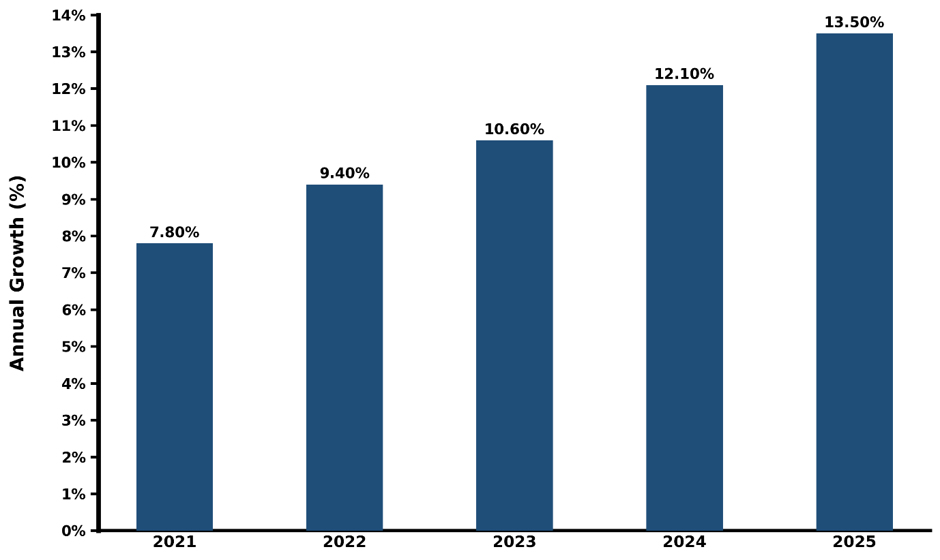
Below mentioned are the evaluation of year-wise growth rate along with key drivers:
| Years | Est. Annual Growth in % | Growth Drivers |
| 2021 | 7.8% | Growing adoption of 3D printing for industrial prototype work and small batch making. |
| 2022 | 9.4% | Increase in the demand for cheaper manufacturing methods and fast prototyping. |
| 2023 | 10.6% | Higher focus on stronger feedstock, advanced materials and automation collectively for industrial uses. |
| 2024 | 12.1% | Increased government and private sector investment in 3D printing research and development. |
| 2025 | 13.5% | Expansion of educational programs and training initiatives to build skilled 3D printing workforce. |
Topics Covered in the Philippines 3D Printing in Emerging Economies Market Report
The Philippines 3D Printing in Emerging Economies Market report thoroughly covers the market by technology, material, and application, providing an unbiased and detailed analysis of ongoing market trends, opportunities, challenges, and market drivers, helping stakeholders align their strategies with current and future market dynamics.
Philippines 3D Printing in Emerging Economies Market Highlights
| Report Name | Philippines 3D Printing in Emerging Economies Market |
| Forecast period | 2026-2032 |
| CAGR | 14.7% |
| Growing Sector | 3D Printing in Emerging Economies |
Philippines 3D Printing in Emerging Economies Market Synopsis
The Philippines 3D Printing in Emerging Economies Market is witnessing steady growth, fuelled by increasing industrial automation, rising efficiency of manufacturing and innovation-driven sectors and 3D printing technologies which allow manufacturers to cut down on prototyping time, reduce material waste and optimize production cycles. The government and private sector are investing in infrastructure, training programs and innovation hubs for additive manufacturing to bolster the local 3D printing ecosystem. The market expansion is also driven by rising adoption in industrial prototyping, small-scale manufacturing, and education. New printable plastics, metals and ceramics and advances in FDM, SLA and SLS technologies are helping to drive wider adoption and improve efficiency of the process.
Evaluation of Growth Drivers in the Philippines 3D Printing in Emerging Economies Market (2026-2032)
Below mentioned are some prominent drivers and their impact on the market dynamics:
| Drivers | Primary Segments Affected | Why It Matters (Evidence) |
| Industrial Automation | Manufacturing | Faster production cycles, reduced labor dependency, and higher customization in production lines. |
| Advanced Material Development | Material Segments | Improved durability, performance, and versatility of printed components increase adoption. |
| Skill Development & Education | Education Sector | Training programs and academic courses boost local expertise and help the 3D printing workforce to feel more prepared and be ready to work. |
| Government Initiatives | Infrastructure & Research | Supportive policies, grants for innovation and public-private partnerships encourage the adoption of 3D printing. |
| Cost Reduction | Prototyping & Small Manufacturing | Less material waste and shorter production times improve competitiveness. |
The Philippines 3D Printing in Emerging Economies Market Size is projected to grow at a CAGR of 14.7% from 2026 to 2032. The growth of the market in the Philippines 3D Printing in Emerging Economies Market is driven by increasing investments in industrial automation, research and development and specialized training programs which are enhancing local capabilities and expertise. The advantages of additive manufacturing, including shorter lead times, more customization and less material waste, are better understood, leading to wider adoption across industries. Furthermore, the market is expected to grow and find broader industrial and educational applications owing to ongoing developments in FDM, SLA and SLS technologies as well as the emergence of new plastics, metals and ceramic materials.
Evaluation of Restraints in the Philippines 3D Printing in Emerging Economies Market
Below mentioned are some major restraints and their influence on the market dynamics:
| Restraints | Primary Segments Affected | What This Means (Evidence) |
| High Equipment Cost | All Product Segments | Industrial 3D printing systems require significant initial capital expenditure. |
| Limited Skilled Workforce | Technology Segments | Lack of trained personnel slows adoption, especially in SLA and SLS technologies. |
| Regulatory Gaps | Manufacturing and Education | Standards for industrial 3D printed components are still evolving. |
| Material Availability Constraints | Plastics, Metals, Ceramics | Local supply of advanced 3D printing materials remains limited. |
| Technology Awareness Gap | SMEs | Small manufacturers may be hesitant to adopt additive manufacturing due to limited knowledge of benefits. |
Philippines 3D Printing in Emerging Economies Market Challenges
The Philippines 3D Printing in Emerging Economies Industry faces several challenges such as high capital expenditure, shortage of skilled operators and limited availability of specialized materials. To address these issues, collaboration between the industry and educational institutions is essential to develop the skills and standardize the 3D printing materials while public-private partnerships are essential in creating affordable solutions and promoting widespread adoption. Furthermore, there is a need for extensive research on locally produced plastics, metals and ceramics to ensure a steady supply of materials and to foster the growth of a sustainable industry.
Philippines 3D Printing in Emerging Economies Market Trends
Here are some major trends changing the Philippines 3D Printing in Emerging Economies Market Growth dynamics:
- Expansion of Industrial Prototyping Services – Manufacturers are increasingly using 3D printing to accelerate product development cycles.
- Adoption of High-Performance Materials – Advanced metals and ceramics are being developed for functional, durable, and lightweight components.
- Educational Integration – 3D Printing is being brought into STEM curricula in schools, and universities, so they can build local technical.
- Collaborative R&D Hubs – Public-private partnerships are helping to develop research into 3D printing technologies and industrial applications.
Investment Opportunities in the Philippines 3D Printing in Emerging Economies Market
The Philippines 3D Printing in Emerging Economies Market presents several investment opportunities, including:
- Industrial 3D Printer Manufacturing – Developing local manufacturing of FDM, SLA and SLS systems to reduce costs and improve access.
- Next generation material development – Investing in plastics metals, and ceramics optimized for industrial use.
- Education & Training Programs – Development of academic and vocational programs to provide skilled operators and designers.
- Innovation Hubs & R&D Centers – Supporting research in additive manufacturing and industrial prototyping.
Top 5 Leading Players in the Philippines 3D Printing in Emerging Economies Market
Below is the list of prominent companies leading the Philippines 3D Printing in Emerging Economies Market Share:
Stratasys Ltd.
| Company Name | Stratasys Ltd. |
| Established Year | 1989 |
| Headquarters | Eden Prairie, Minnesota, USA |
| Official Website | Click Here |
Stratasys develops a wide range of 3D printing solutions, including FDM and PolyJet technologies, for industrial prototyping, manufacturing, and educational applications.
3D Systems Corporation
| Company Name | 3D Systems Corporation |
| Established Year | 1986 |
| Headquarters | Rock Hill, South Carolina, USA |
| Official Website | Click Here |
3D Systems provides additive manufacturing systems and materials across industrial, healthcare, and educational sectors, enabling rapid prototyping and production solutions.
EOS GmbH
| Company Name | EOS GmbH |
| Established Year | 1989 |
| Headquarters | Krailling, Germany |
| Official Website | Click Here |
EOS specializes in industrial-scale additive manufacturing solutions using metals and polymers, supporting complex manufacturing and functional prototyping.
Formlabs Inc.
| Company Name | Formlabs Inc. |
| Established Year | 2011 |
| Headquarters | Somerville, Massachusetts, USA |
| Official Website | Click Here |
Formlabs develops SLA and SLS 3D printers and materials for precision prototyping, manufacturing components, and educational purposes.
Markforged Inc.
| Company Name | Markforged Inc. |
| Established Year | 2013 |
| Headquarters | Watertown, Massachusetts, USA |
| Official Website | Click Here |
Markforged provides advanced metal and composite 3D printing systems for industrial production, R&D, and educational training programs.
Government Regulations Introduced in the Philippines 3D Printing in Emerging Economies Market
According to Filipino government data, the government is pushing hard to promote additive manufacturing with several initiatives to boost the country’s 3D printing ecosystem. The Department of Science and Technology (DOST) promotes research and development in industrial 3D printing and advanced materials and the Department of Trade and Industry (DTI) is helping small and medium enterprises embrace additive manufacturing through grant, training and innovation hubs. The Commission on Higher Education (CHED), likewise, integrates 3D printing technologies in STEM and technical education programs to develop a skilled workforce and foster innovation.
Future Insights of the Philippines 3D Printing in Emerging Economies Market
The Philippines 3D Printing in Emerging Economies Market is forecast to grow positively as a result of greater use in manufacturing, prototyping, and educational purposes. Developments in FDM, SLA and SLS printers as well as the availability of high-performance plastics, metals and ceramics will increase efficiency and reduce manufacturing costs while continued collaboration between government, private sector and educational institutions will further accelerate adoption and technical expertise as additive manufacturing is poised to be a strategic enabler of industrial and educational growth in the Philippines.
Market Segmentation Analysis
The report offers a comprehensive study of the following market segments and their leading categories:
According to Ritika Kalra, Senior Research Analyst, 6Wresearch, By Technology – Fused Deposition Modeling (FDM) dominated the market in 2025 with a share of 54.3%, driven by low operational costs, scalability, and suitability for industrial prototyping and small-batch production. FDM is projected to grow at a CAGR of 15.2% during 2026–2032 due to its cost efficiency and broad material compatibility.
By Material – Plastics accounted for 61.7% of the market revenue in 2025, due to low cost, versatility, and widespread adoption in prototyping and educational applications while the demand for low-weight functional parts and custom components will drive plastics to grow by 14.9% CAGR through 2032.
By Application – Prototyping captured the largest share of 48.2% in 2025, supported by demand for rapid product development cycles in manufacturing and research sectors. Prototyping is expected to grow at a CAGR of 15.6% during 2026–2032 due to faster adoption of additive manufacturing in product design and industrial testing.
Note: Market size estimations and growth projections presented in this report are based on 6Wresearch’s advanced forecasting approach, validated with industry datasets as of June 2026.
Key Attractiveness of the Report
- 10 Years of Market Numbers
- Historical Data Starting from 2022 to 2025
- Base Year: 2025
- Forecast Data until 2032
- Key Performance Indicators Impacting the Market
- Major Upcoming Developments and Projects
Key Highlights of the Report:
- Philippines 3D Printing in Emerging Economies Market Outlook
- Market Size of Philippines 3D Printing in Emerging Economies Market, 2025
- Forecast of Philippines 3D Printing in Emerging Economies Market, 2032
- Historical Data and Forecast of Philippines 3D Printing in Emerging Economies Revenues & Volume for the Period 2022- 2032
- Philippines 3D Printing in Emerging Economies Market Trend Evolution
- Philippines 3D Printing in Emerging Economies Market Drivers and Challenges
- Philippines 3D Printing in Emerging Economies Price Trends
- Philippines 3D Printing in Emerging Economies Porter's Five Forces
- Philippines 3D Printing in Emerging Economies Industry Life Cycle
- Historical Data and Forecast of Philippines 3D Printing in Emerging Economies Market Revenues & Volume By Technology for the Period 2022- 2032
- Historical Data and Forecast of Philippines 3D Printing in Emerging Economies Market Revenues & Volume By Fused Deposition Modeling (FDM) for the Period 2022- 2032
- Historical Data and Forecast of Philippines 3D Printing in Emerging Economies Market Revenues & Volume By Stereolithography (SLA) for the Period 2022- 2032
- Historical Data and Forecast of Philippines 3D Printing in Emerging Economies Market Revenues & Volume By Selective Laser Sintering (SLS) for the Period 2022- 2032
- Historical Data and Forecast of Philippines 3D Printing in Emerging Economies Market Revenues & Volume By Material for the Period 2022- 2032
- Historical Data and Forecast of Philippines 3D Printing in Emerging Economies Market Revenues & Volume By Plastics for the Period 2022- 2032
- Historical Data and Forecast of Philippines 3D Printing in Emerging Economies Market Revenues & Volume By Metals for the Period 2022- 2032
- Historical Data and Forecast of Philippines 3D Printing in Emerging Economies Market Revenues & Volume By Ceramics for the Period 2022- 2032
- Historical Data and Forecast of Philippines 3D Printing in Emerging Economies Market Revenues & Volume By Application for the Period 2022- 2032
- Historical Data and Forecast of Philippines 3D Printing in Emerging Economies Market Revenues & Volume By Prototyping for the Period 2022- 2032
- Historical Data and Forecast of Philippines 3D Printing in Emerging Economies Market Revenues & Volume By Manufacturing for the Period 2022- 2032
- Historical Data and Forecast of Philippines 3D Printing in Emerging Economies Market Revenues & Volume By Education for the Period 2022- 2032
- Philippines 3D Printing in Emerging Economies Import Export Trade Statistics
- Market Opportunity Assessment By Technology
- Market Opportunity Assessment By Material
- Market Opportunity Assessment By Application
- Philippines 3D Printing in Emerging Economies Top Companies Market Share
- Philippines 3D Printing in Emerging Economies Competitive Benchmarking By Technical and Operational Parameters
- Philippines 3D Printing in Emerging Economies Company Profiles
- Philippines 3D Printing in Emerging Economies Key Strategic Recommendations
Market Covered
The report offers a comprehensive study of the subsequent market segments:
By Technology
- FDM
- SLA
- SLS
By Material
- Plastics
- Metals
- Ceramics
By Application
- Prototyping
- Manufacturing
- Education































