Philippines 5G Radio Access Network Market Growth Rate
According to 6Wresearch internal databases and industry insights, the Philippines 5G Radio Access Network Market is projected to grow at a strong compound annual growth rate (CAGR) of 3.57% during the forecast period 2026–2032.
Philippines 5G Radio Access Network Market Year-wise Growth Rate and Key Drivers
This graph highlights how the Philippines 5G Radio Access Network Market has expanded rapidly over 2021–2032, supported by spectrum allocation reforms, rising mobile data consumption, and operator-led 5G investments.
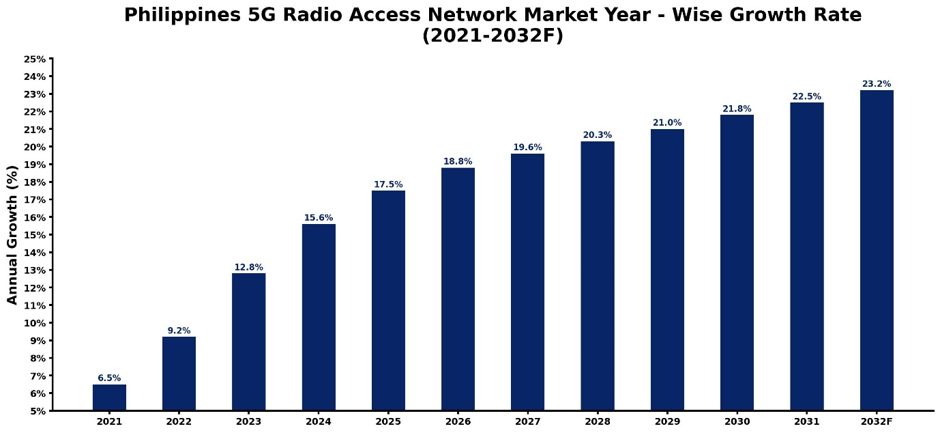
The table below presents the year wise growth rates along with the key drivers influencing the market.
| Year | Estimated Growth (%) | Market Rationale |
| 2021 | 6.5% | First commercial 5G starts with big telecom operators, initially limited to urban areas. |
| 2022 | 9.2% | 5G sites installed in Metro Manila and key cities with initial enterprise adoption. |
| 2023 | 12.8% | Better spectrum utilization and growing consumer demand for high-speed data. |
| 2024 | 15.6% | Solid mid-band 5G RAN infrastructure rolling out across urban clusters. |
| 2025 | 17.5% | Increased investment in cloud-native RAN architecture and network densification. |
| 2026 | 18.8% | Government digitalization programs expanding coverage to secondary cities. |
| 2027 | 19.6% | Broader adoption of Open RAN and increased network function virtualization. |
| 2028 | 20.3% | Strong enterprise 5G use cases in smart manufacturing, logistics, and fintech. |
| 2029 | 21% | Improved rural connectivity projects and infrastructure-sharing models. |
| 2030 | 21.8% | AI-driven network optimization and advanced 5G-Advanced deployments. |
| 2031 | 22.5% | Rapid deployment of private 5G networks in industrial zones. |
| 2032 | 23.2% | Market maturity phase with widespread nationwide 5G coverage and densification. |
Topics Covered in the Philippines 5G Radio Access Network Market Report
The report analyzes the Philippines 5G Radio Access Network Market by RAN Type, Frequency, and Deployment Type highlighting key trends such as Open RAN adoption, network virtualization, small cell densification, and AI-driven network optimization. It focuses on large-scale 5G rollout, infrastructure modernization, and enterprise connectivity expansion across urban and semi-urban regions.
Philippines 5G Radio Access Network Market Highlights
| Report Name | Philippines 5G Radio Access Network Market |
| Forecast period | 2026-2032 |
| CAGR | 3.57% |
| Growing Sector | Telecom Infrastructure & Network Virtualization |
Philippines 5G Radio Access Network Market Synopsis
Philippines 5G Radio Access Network Market is expected to exhibit a robust growth rate during the forecast period due to the swift digital transformation, rising mobile broadband penetration, and aggressive infrastructure investments by telecom operators. Growth is being supported by increasing demand for low latency applications such as cloud gaming, smart cities, IoT ecosystems and enterprise private networks, while further capitalize this momentum by improving connectivity infrastructure and speeding adoption of advanced digital services across consumer and enterprise segments, driving sustained long-term market growth and innovation across the Philippines telecommunications ecosystem.
Evaluation of Growth Drivers in Philippines 5G Radio Access Network Market (2026–2032)
Below are some major drivers and their influence on the market dynamics:
| Drivers | Primary Segment Affected | Why It Matters (Evidence) |
| Spectrum Liberalization & Policy Support | Telecom Operators | Government reforms enable faster deployment of 5G mid-band and mmWave spectrum. |
| Rising Mobile Data Consumption | Consumers | High video streaming and social media usage drives densified RAN deployment. |
| Open RAN Adoption | Network Vendors | Reduces infrastructure cost and increases vendor flexibility. |
| Enterprise Digital Transformation | Enterprises | Accelerates demand for private 5G networks in logistics, ports, and manufacturing. |
| Cloud-native Network Evolution | IT & Telecom Operators | Enables scalable, software-defined RAN architectures. |
The Philippines 5G Radio Access Network Market is projected to grow at a CAGR of 3.57% during 2026–2032. The Philippines 5G Radio Access Network Market is driven by the rapid consumption of mobile data, accelerated digital transformation and strong government support for nationwide connectivity through the National Broadband Plan while, telecom operators are investing heavily in the expansion of 5G infrastructure, spectrum liberalization and network densification. The increasing need for low-latency applications like cloud gaming, IoT and smart city solutions further speeds up deployment. Additionally, enterprise adoption of private 5G networks and increasing use of Open RAN and cloud-native architectures are strengthening overall market growth momentum.
Evaluation of Restraints in Philippines 5G Radio Access Network Market
Below are some major restraints and their influence on the market dynamics:
| Restraints | Primary Segment Affected | What This Means |
| High Infrastructure Deployment Cost | Telecom Operators | Dense small-cell deployment increases CAPEX requirements. |
| Geographic Complexity | Network Rollout | Archipelagic structure increases backhaul and coverage challenges. |
| Limited Rural Fiber Connectivity | Infrastructure Providers | Slows down full 5G RAN integration in remote islands. |
| Vendor Dependency | Operators | Reliance on global OEMs impacts pricing flexibility. |
| Power Supply Constraints | Network Sites | Energy reliability issues affect tower uptime in remote areas. |
Philippines 5G Radio Access Network Market Challenges
Despite the positive growth in the Philippines 5G Radio Access Network Industry, it faces multiple challenges including high rollout costs, complex geographical conditions, low fiber penetration in rural areas, and growing cybersecurity risks in virtualized RAN environments another key operational challenge for telecom operators is to balance the rapid densification of urban areas with the need for inclusive rural connectivity. The combination of the above constraints leads to low deployment efficiency, high capital expenditure requirements and an inequitable quality of the network as between urban and remote areas.
Philippines 5G Radio Access Network Market Trends
Major trends responsible for Philippines 5G Radio Access Network Market Growth includes
- Open RAN Expansion: Increasing adoption of interoperable hardware and software ecosystems is enabling greater vendor flexibility, lower deployment costs, and faster 5G rollout across operators.
- Network Virtualization: The shift toward cloud-native RAN and centralized baseband processing is improving scalability, operational efficiency, and network performance optimization.
- Private 5G Networks: The expansion of private 5G networks is being driven in part by the need for high-speed secure connectivity among businesses operating on industrial sites and logistics hubs.
- AI-driven Network Optimization: Machine learning has played an increasingly important role in optimizing traffic management through predictive maintenance, improving energy efficiency and enhancing overall network intelligence and reliability.
Investment Opportunities in the Philippines 5G Radio Access Network Market
Below are the investment opportunities available in Philippines 5G Radio Access Network Market:
- Open RAN Infrastructure Development: Increasing investments in multi-vendor interoperable RAN ecosystems will enhance an operator's flexibility, scaling solutions, and cost efficiencies through 5G rollout.
- Investing in Fiber Backhaul and Nation-wide, Inter-Island Fiber Networks; Strengthens High-Capacity Data Transport and Provides Robust 5G Performance Nationwide.
- Private 5G Enterprise Solutions: The Rapid Deployment of Dedicated, Private 5G Networks is Supporting Dedicated Industrial Campuses, Ports and Logistics Hubs and Providing the Foundation for Continued Evolution of Enterprise Digital Transformation.
- Expansion of Low Latency Edge Nodes Enables Real-Time Processing of Data and Provides a Platform for Advanced Applications Such as IoT and Autonomous Solutions.
Top 5 Leading Players in Philippines 5G Radio Access Network Market
Below are some of the leading companies in the Philippines 5G Radio Access Network Market Share:
Ericsson
| Company Name | Ericsson |
| Established Year | 1876 |
| Headquarters | Stockholm, Sweden |
| Official Website | Click Here |
Ericsson is a primary 5G technology vendor supporting telecom operators with advanced RAN solutions, including 5G Standalone networks, Open RAN capabilities, and network automation tools. The company plays a key role in enabling scalable, high-performance mobile infrastructure and enterprise connectivity solutions across global and emerging markets.
Nokia
| Company Name | Nokia |
| Established Year | 1865 |
| Headquarters | Espoo, Finland |
| Official Website | Click Here |
Nokia supplies 5G AirScale Radio Access Network solutions to telecom operators, supporting network modernization and expansion. Its portfolio includes cloud RAN, Open RAN, and private wireless solutions designed to improve coverage, capacity, and energy efficiency for nationwide and enterprise deployments.
Huawei Technologies
| Company Name | Huawei Technologies |
| Established Year | 1987 |
| Headquarters | Shenzhen, China |
| Official Website | Click Here |
Huawei Technologies provides end-to-end 5G infrastructure including Active Antenna Units (AAUs), radio access networks, and integrated telecom solutions. The company supports large-scale 5G deployments and enterprise digital transformation through high-capacity, efficient, and intelligent network technologies.
ZTE Corporation
| Company Name | ZTE Corporation |
| Established Year | 1985 |
| Headquarters | Shenzhen, China |
| Official Website | Click Here |
ZTE Corporation delivers Uni-RAN and advanced 5G infrastructure solutions to telecom operators, enabling efficient network deployment and modernization. The company focuses on Open RAN, cloud-based architectures, and integrated wireless systems to support large-scale connectivity expansion.
Samsung Electronics
| Company Name | Samsung Electronics |
| Established Year | 1969 |
| Headquarters | Seoul, South Korea |
| Official Website | Click Here |
Samsung Electronics provides virtualized RAN (vRAN) and 5G network solutions to mobile operators, enabling flexible and software-driven network architectures. Its portfolio supports next-generation connectivity through Open RAN development, network virtualization, and high-performance radio solutions.
Government Initiatives the Philippines 5G Radio Access Network Market
According to Filipino government data, through the National Telecommunications Commission (NTC), the government is promoting faster spectrum allocation, infrastructure sharing, and digital inclusion programs and important initiatives like the National Broadband Plan and policies that promote tower sharing are accelerating the 5G deployment across the country. Such efforts help to reduce barriers to rollout, improve network coverage and increase competition among telecom operators, ultimately enabling faster and more cost-efficient expansion of 5G infrastructure across urban and rural areas of the Philippines.
Future Insights of the Philippines 5G Radio Access Network Market
The Philippines 5G Radio Access Network Market is expected to evolve into a highly densified and software-driven ecosystem. Growth will be driven by private networks, smart city deployments, and enterprise digital transformation initiatives across industries. The transition toward Open RAN and AI-enabled networks will further improve efficiency, scalability, and cost optimization. Additionally, increasing demand for low-latency applications and cloud-native telecom architectures will strengthen long-term market expansion and innovation in the country’s telecommunications sector.
Market Segmentation Analysis
The report offers a comprehensive study of the following market segments and their leading categories:
By RAN Type – Market Dominated by Virtualized RAN, Open RAN Set for Fastest Expansion
According to Bhawna Singh, Senior Research Analyst, 6Wresearch, Virtualized RAN (vRAN) secured a dominant 38.6% share of the Philippines 5G Radio Access Network Market value in 2025, driven by rapid operator migration toward software-defined network architectures, improved spectrum efficiency, and the need to reduce long-term infrastructure operating costs through centralized cloud-native baseband processing.
By Frequency – Market Dominated by Sub-6 GHz, mmWave Set for Rapid Expansion
By frequency, Sub-6 GHz spectrum captured a dominant 72.15% share of the Philippines 5G Radio Access Network Market in 2025, owing to its wide-area coverage capability, superior indoor penetration, and cost-efficient deployment across the country’s archipelagic geography, making it the primary layer for nationwide 5G connectivity expansion.
By Deployment Type – Market Dominated by Hybrid Deployment, Cloud-Based Set for Strongest Growth
By deployment model, The Philippines market was led by Hybrid 5G RAN architecture, holding a 46.7% share in 2025, supported by its balanced approach of on-premise control with cloud scalability, allowing telecom operators to achieve cost efficiency while ensuring network reliability across geographically dispersed islands.
Note: Market size estimations and growth projections presented in this report are based on 6Wresearch’s advanced forecasting approach, validated with industry datasets as of June 2026.
Key Attractiveness of the Report:
- 10 Years of Market Numbers
- Historical Data Starting from 2022 to 2025
- Base Year: 2025
- Forecast Data until 2032
- Key Performance Indicators Impacting the Market
- Major Upcoming Developments and Projects
Key Highlights of the Report:
- Philippines 5G Radio Access Network Market Outlook
- Market Size of Philippines 5G Radio Access Network Market, 2025
- Forecast of Philippines 5G Radio Access Network Market, 2032
- Historical Data and Forecast of Philippines 5G Radio Access Network Revenues & Volume for the Period 2022- 2032
- Philippines 5G Radio Access Network Market Trend Evolution
- Philippines 5G Radio Access Network Market Drivers and Challenges
- Philippines 5G Radio Access Network Price Trends
- Philippines 5G Radio Access Network Porter's Five Forces
- Philippines 5G Radio Access Network Industry Life Cycle
- Historical Data and Forecast of Philippines 5G Radio Access Network Market Revenues & Volume By RAN Type for the Period 2022- 2032
- Historical Data and Forecast of Philippines 5G Radio Access Network Market Revenues & Volume By Centralized RAN for the Period 2022- 2032
- Historical Data and Forecast of Philippines 5G Radio Access Network Market Revenues & Volume By Open RAN for the Period 2022- 2032
- Historical Data and Forecast of Philippines 5G Radio Access Network Market Revenues & Volume By Virtualized RAN for the Period 2022- 2032
- Historical Data and Forecast of Philippines 5G Radio Access Network Market Revenues & Volume By Distributed RAN for the Period 2022- 2032
- Historical Data and Forecast of Philippines 5G Radio Access Network Market Revenues & Volume By Frequency for the Period 2022- 2032
- Historical Data and Forecast of Philippines 5G Radio Access Network Market Revenues & Volume By Sub-6 GHz for the Period 2022- 2032
- Historical Data and Forecast of Philippines 5G Radio Access Network Market Revenues & Volume By mmWave for the Period 2022- 2032
- Historical Data and Forecast of Philippines 5G Radio Access Network Market Revenues & Volume By 26-39 GHz for the Period 2022- 2032
- Historical Data and Forecast of Philippines 5G Radio Access Network Market Revenues & Volume By Above 39 GHz for the Period 2022- 2032
- Historical Data and Forecast of Philippines 5G Radio Access Network Market Revenues & Volume By Deployment Type for the Period 2022- 2032
- Historical Data and Forecast of Philippines 5G Radio Access Network Market Revenues & Volume By Cloud-based for the Period 2022- 2032
- Historical Data and Forecast of Philippines 5G Radio Access Network Market Revenues & Volume By Hybrid for the Period 2022- 2032
- Historical Data and Forecast of Philippines 5G Radio Access Network Market Revenues & Volume By Software-defined for the Period 2022- 2032
- Historical Data and Forecast of Philippines 5G Radio Access Network Market Revenues & Volume By On-Premise for the Period 2022- 2032
- Philippines 5G Radio Access Network Import Export Trade Statistics
- Market Opportunity Assessment By RAN Type
- Market Opportunity Assessment By Frequency
- Market Opportunity Assessment By Deployment Type
- Philippines 5G Radio Access Network Top Companies Market Share
- Philippines 5G Radio Access Network Competitive Benchmarking By Technical and Operational Parameters
- Philippines 5G Radio Access Network Company Profiles
- Philippines 5G Radio Access Network Key Strategic Recommendations
Market Covered
The report offers an extensive study of the following market segments:
By RAN Type
- Centralized RAN
- Open RAN
- Virtualized RAN
- Distributed RAN
By Frequency
- Sub-6 GHz
- mmWave
- 26–39 GHz
- Above 39 GHz
By Deployment Type
- Cloud-based
- Hybrid
- Software-defined
- On-Premise






































