Philippines Active Phased Array Radar Market Growth Rate
According to 6Wresearch internal database and industry insights, the Philippines Active Phased Array Radar Market is projected to grow at a compound annual growth rate (CAGR) of around 7.6% during the forecast period of 2026–2032.
Philippines Active Phased Array Radar Market Year-wise Growth Rate and Key Drivers (2022-2032)
This graph illustrates the annual growth rates of the Philippines Active Phased Array Radar Market from 2022 to 2032, highlighting a steady upward trajectory and projected market expansion over the forecast period.
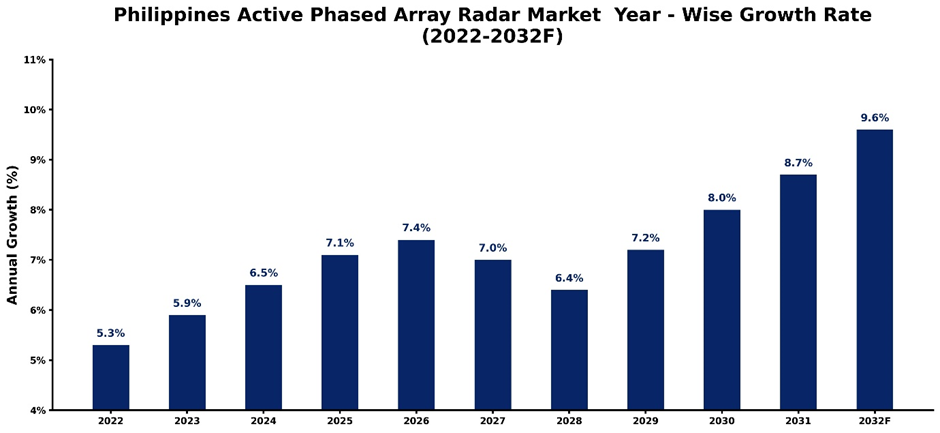
The following table summarizes the historical and forecasted growth rates of the Philippines Active Phased Array Radar Market, along with the rationale behind each year’s performance.
| Year | Estimated Growth (%) | Market Rationale |
| 2022 | 5.3% | Rising defense modernization investments and demand for improved airspace monitoring systems. |
| 2023 | 5.9% | Expansion of military communication networks and increasing requirements for real-time threat detection. |
| 2024 | 6.5% | Growing procurement of advanced radar systems for territorial monitoring and defense applications. |
| 2025 | 7.1% | Increased modernization programs, aerospace investments, and adoption of digital radar technologies. |
| 2026 | 7.4% | Start of forecast period; rising demand for electronically scanned radar systems in defense applications. |
| 2027 | 7% | Increasing deployment of multi-function radar systems for surveillance and military operations. |
| 2028 | 6.4% | Growth supported by naval modernization, air defense requirements, and advanced detection capabilities. |
| 2029 | 7.2% | Higher adoption of active electronically scanned array radar systems across defense platforms. |
| 2030 | 8% | Expansion of aerospace surveillance infrastructure and integration of AI-enabled radar solutions. |
| 2031 | 8.7% | Increasing demand for network-centric warfare systems and advanced command-and-control technologies. |
| 2032 | 9.6% | Mature growth phase supported by widespread deployment of next-generation radar and surveillance systems. |
Topics Covered in the Philippines Active Phased Array Radar Market Report
The Philippines Active Phased Array Radar Market report covers the market by Type and End User. The report provides a detailed analysis of ongoing trends in defense modernization and advanced radar technology adoption, along with key growth drivers and opportunities that will help stakeholders align strategies with current and future market dynamics.
Philippines Active Phased Array Radar Market Highlights
| Report Name | Philippines Active Phased Array Radar Market |
| Forecast period | 2026-2032 |
| CAGR | 7.6% |
| Growing Sector | Defense & Aerospace Surveillance |
Philippines Active Phased Array Radar Market Synopsis
The Philippines Active Phased Array Radar Market is expected to grow due to rising defense modernization, maritime security requirements, and demand for advanced surveillance systems. Electronically scanned radar technologies are being used more widely in naval, aerospace and military applications due to their faster scanning, accurate detection and multi-target tracking capabilities. The market is driven by increasing investments in defense electronics, border monitoring and network-centric security platforms. Moreover, the modernization programs of armed forces are creating opportunities for providers of advanced radar solutions.
Evaluation of Growth Drivers in Philippines Active Phased Array Radar Market (2026–2032)
Below mentioned are some major drivers and their influence on the market dynamics:
| Drivers | Primary Segment | What This Means |
| Defense Modernization Programs | Military & Defense | Increasing investments in surveillance, air defense, and military communication systems are driving demand for advanced radar technologies. |
| Maritime Security Requirements | Naval Defense | Growing focus on monitoring territorial waters and coastal areas is increasing demand for high-performance radar systems. |
| Aerospace Surveillance Expansion | Aerospace/Civil Aviation | Rising air traffic and aviation safety requirements are supporting adoption of advanced radar solutions. |
| Digital Radar Technology Adoption | Defense & Aerospace | Transition toward electronically scanned and software-defined radar systems is improving detection and tracking capabilities. |
| Border and Infrastructure Protection | Government/Security | Increasing requirements for continuous monitoring of strategic locations are encouraging radar deployment. |
The Philippines Active Phased Array Radar Market growth is projected to reach a CAGR of 7.6% during 2026–2032. The development profile is supported by rising defense modernization, increasing security investments, and growing demand for advanced surveillance systems. The strategic location of the Philippines in Southeast Asia with over 36,000 km of coastline is creating needs for maritime surveillance and airspace defense. The use of radar is being driven by the increasing investment in command-and-control systems, aerospace technologies and defense electronics. Also, modernization programmes and technology partnerships are creating opportunities for active phased array radar solutions in military and civilian security applications.
Evaluation of Restraints in Philippines Active Phased Array Radar Market
Below are some major restraints and their influence on the market dynamics:
| Restraints | Primary Segment | What This Means |
| High Acquisition Cost | Defense | Advanced phased array radar systems require significant capital investment, limiting adoption among budget-constrained organizations. |
| Dependence on Imported Technology | Military & Aerospace | The procurement is complicated by the involvement of foreign suppliers of radar components and systems. |
| Technical Expertise Requirements | Defense Operations | Operations Operating and maintaining advanced radar platforms takes special skills and also trained personnel. |
| Long Procurement Cycles | Government Defense | Long procurement cycles often show up in government defense programs, where defense acquisition processes drag on with evaluation and approval. |
| Integration Challenges | Military Systems | Connecting new radar systems with existing defense infrastructure requires customized solutions and technical expertise. |
Philippines Active Phased Array Radar Market Challenges
The Philippines Active Phased Array Radar Industry faces challenge such as high technology costs. Advanced AESA radar systems typically involve substantial investments in hardware, software, and lifecycle support. Over 80% of advanced defence electronics are supplied internationally through international technology partnerships, putting in place import dependency risks and radar also needs trained specialists to operate them. The new radars are using complex signal processing and network integration. Case studies of countries employing AESA platforms underscore the significance of local training, maintenance capacity, and strategic partnerships for operational effectiveness.
Trends in the Philippines Active Phased Array Radar Market
Below mentioned are some of the trends shaping the Philippines Active Phased Array Radar Market Growth are:
- The move toward the use of digital and AESA radar technology: The utilization of Active Electronically Scanned Array (AESA) radar systems is on the rise due to to better scanning speed, better target tracking, and the capability to conduct a number of missions simultaneously.
- Increasing Focus on Maritime Domain Awareness: With the Philippines’ extensive coastline and strategic location in the Indo-Pacific region, maritime surveillance has become a key priority. Naval platforms and coastal monitoring networks are being equipped with advanced phased array radar systems to enhance vessel tracking and the security of territories.
- The incorporation of artificial intelligence and data analytics: Threat detection, reduced reaction time and improved decision-making capabilities are achieved with the use of radar systems along with artificial intelligence, machine learning and automated signal processing technologies.
Investment Opportunities in Philippines Active Phased Array Radar Market
The following are some of the investment opportunities driving in Philippines Active Phased Array Radar Market:
- Local Defense Electronics Development – Growing government attention to defence modernisation offers opportunities to firms developing radar components, electronic systems and local technology capabilities.
- Advanced Radar Maintenance and Support Services: Growing deployment of sophisticated radar systems creates demand for maintenance, upgrades, calibration, and lifecycle management services. Companies providing technical support solutions can benefit from long-term defense contracts.
- AI Powered Radar Software Solutions: The growing adoption of intelligent surveillance systems is creating opportunities for software providers that are developing AI enabled radar analytics, automated tracking solutions and advanced threat detection platforms.
Top Leading Players in Philippines Active Phased Array Radar Market
Stated below are some of the leading companies and organizations boosting the Philippines Active Phased Array Radar Market share:
1. Lockheed Martin Corporation
| Company Name | Lockheed Martin Corporation |
|---|---|
| Established Year | 1995 |
| Headquarters | Bethesda, Maryland, USA |
| Official Website | Click Here |
Lockheed Martin is a leading defense technology company providing advanced radar, surveillance, and integrated defense solutions.
2. RTX Corporation (formerly Raytheon Technologies Corporation)
| Company Name | RTX Corporation |
|---|---|
| Established Year | 2020 |
| Headquarters | Arlington, Virginia, USA |
| Official Website | Click Here |
RTX provides advanced radar systems, including electronically scanned array technologies, used in air defense, aerospace, and military surveillance applications.
3. Northrop Grumman Corporation
| Company Name | Northrop Grumman Corporation |
|---|---|
| Established Year | 1994 |
| Headquarters | Falls Church, Virginia, USA |
| Official Website | Click Here |
Northrop Grumman develops advanced radar and electronic warfare solutions used in aerospace and defense applications.
4. Thales Group
| Company Name | Thales Group |
|---|---|
| Established Year | 2000 |
| Headquarters | Paris, France |
| Official Website | Click Here |
Thales provides advanced radar systems for defense, aerospace, and civil aviation sectors.
Government Initiatives in the Philippines Active Phased Array Radar Market
According to Filipino government data, Active phased array radar market is growing owing to the investments in the surveillance, communication and security technologies in defense modernization programs. The Armed Forces of the Philippines Modernization Program includes procurement of advanced radar systems for maritime domain awareness and air defense. DICT, DOST projects boost secure connectivity, electronics research, tech capabilities. BOI investment programs aim to promote defense-related manufacturing and engineering activities, while coastal surveillance and aviation infrastructure projects present opportunities for advanced radar system suppliers.
Future Insights of the Philippines Active Phased Array Radar Market
The Philippines Active Phased Array Radar Market is being driven by the increase in defense spending as the world increases use of AESA radar on combat planes, ships and air defense systems. The Philippines, with a coastline of over 36,000 kilometers, requires advanced maritime surveillance solutions. Programs such as the Armed Forces Modernization Programs have a focus on radar based situational awareness. Countries that have implemented AESA systems have reported improved multi-target tracking and faster threat detection. Investments in AI-enabled surveillance, interoperability and skilled workforce development will offer future market opportunities.
Market Segmentation Analysis
This report presents a detailed analysis of the market segments along with their leading categories.
By Type – Market Dominated by Digital Radar, Expected to Gain Further Adoption Through 2032
According to Bhawna Singh, Senior Research Analyst, 6Wresearch, till 2025, Digital Radar dominated the Philippines Active Phased Array Radar Market with an estimated 62% market share, driven by increasing demand for software-defined radar systems, improved signal processing capabilities, and enhanced compatibility with modern defense networks. From 2026–2032, Digital Radar is expected to remain the leading segment, growing at a CAGR of 7.8%, supported by rising investments in advanced surveillance systems, AI-enabled radar processing, and multi-function defense platforms.
By End User – Market Dominated by Military & Defense, Expected to Maintain Leadership Through 2032
Till 2025, Military & Defense dominated the Philippines Active Phased Array Radar Market with a share of around 58% in 2023. The increasing focus on national security, maritime domain awareness, defense modernization programs, and improvement of surveillance capabilities are some of the factors contributing to the market dominance. The Military & Defense segment is expected to maintain its dominance as the largest end-user segment over the forecast period 2026-2032, growing at a CAGR of 7.9% owing to continuous investments in radar systems, air defense technologies, and advanced military communication infrastructure.
Note: Market size estimations and growth projections presented in this report are based on 6Wresearch's proprietary forecasting methodology, utilizing the latest available industry data, government publications, and primary research inputs.
Key Attractiveness of the Report:
- 10 Years of Market Numbers
- Historical Data Starting from 2022 to 2025
- Base Year: 2025
- Forecast Data until 2032
- Key Performance Indicators Impacting the Market
- Major Upcoming Developments and Projects
Key Highlights of the Report:
- Philippines Active Phased Array Radar Market Outlook
- Market Size of Philippines Active Phased Array Radar Market, 2025
- Forecast of Philippines Active Phased Array Radar Market, 2032
- Historical Data and Forecast of Philippines Active Phased Array Radar Revenues & Volume for the Period 2022-2032
- Philippines Active Phased Array Radar Market Trend Evolution
- Philippines Active Phased Array Radar Market Drivers and Challenges
- Philippines Active Phased Array Radar Price Trends
- Philippines Active Phased Array Radar Porter's Five Forces
- Philippines Active Phased Array Radar Industry Life Cycle
- Historical Data and Forecast of Philippines Active Phased Array Radar Market Revenues & Volume By Type for the Period 2022-2032
- Historical Data and Forecast of Philippines Active Phased Array Radar Market Revenues & Volume By Analog Radar for the Period 2022-2032
- Historical Data and Forecast of Philippines Active Phased Array Radar Market Revenues & Volume By Digital Radar for the Period 2022-2032
- Historical Data and Forecast of Philippines Active Phased Array Radar Market Revenues & Volume By End User for the Period 2022-2032
- Historical Data and Forecast of Philippines Active Phased Array Radar Market Revenues & Volume By Military & Defense for the Period 2022-2032
- Historical Data and Forecast of Philippines Active Phased Array Radar Market Revenues & Volume By Aerospace for the Period 2022-2032
- Historical Data and Forecast of Philippines Active Phased Array Radar Market Revenues & Volume By Automotive for the Period 2022-2032
- Historical Data and Forecast of Philippines Active Phased Array Radar Market Revenues & Volume By Civil Aviation for the Period 2022-2032
- Philippines Active Phased Array Radar Import Export Trade Statistics
- Market Opportunity Assessment By Type
- Market Opportunity Assessment By End User
- Philippines Active Phased Array Radar Top Companies Market Share
- Philippines Active Phased Array Radar Competitive Benchmarking By Technical and Operational Parameters
- Philippines Active Phased Array Radar Company Profiles
- Philippines Active Phased Array Radar Key Strategic Recommendations
Market Covered
The report offers an extensive study of the following market segments:
By Type
- Analog Radar
- Digital Radar
By End User
- Military & Defense
- Aerospace
- Automotive
- Civil Aviation






































