Philippines Aerobridge Market Growth Rate
According to 6Wresearch internal database and industry insights, the Philippines Aerobridge Market is projected to grow at a compound annual growth rate (CAGR) of around 5.8% during the forecast period of 2026–2032.
Philippines Aerobridge Market Year-wise Growth Rate and Key Drivers (2022-2032)
This graph illustrates the annual growth rates of the Philippines Aerobridge Market from 2022 to 2032, highlighting a steady upward trajectory and projected market expansion over the forecast period.
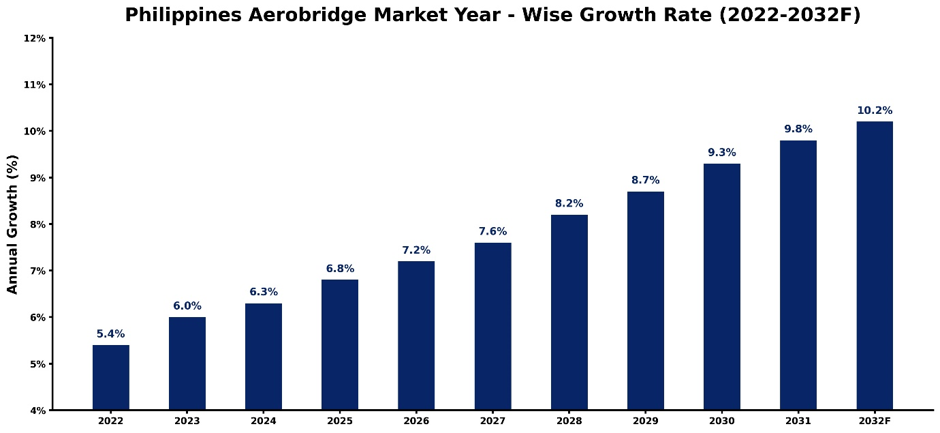
The following table presents the estimated annual growth rates of the market for each year, along with the key factors influencing market performance during the respective period. The values are intended to highlight year-wise drivers rather than provide a direct comparison between individual years.
| Year | Estimated Annual Growth (%) | Market Rationale |
| 2022 | 5.4% | Increasing domestic air travel demand and renewed investments in airport terminal facilities. |
| 2023 | 6% | Expansion of passenger handling capacity and modernization of regional airports supporting aerobridge adoption. |
| 2024 | 6.3% | Rising airport infrastructure upgrades and increased focus on passenger convenience and operational efficiency. |
| 2025 | 6.8% | Stronger airport development projects and replacement of conventional boarding systems with advanced passenger boarding bridges. |
| 2026 | 7.2% | Start of forecast period; increasing investments in airport modernization and terminal expansion projects. |
| 2027 | 7.6% | Growing demand for automated and technologically advanced aerobridge systems at major airports. |
| 2028 | 8.2% | Expansion of smart airport technologies and integration of advanced passenger handling solutions. |
| 2029 | 8.7% | Increased deployment of aerobridges in emerging regional airports and upgraded aviation hubs. |
| 2030 | 9.3% | Growth supported by airport digitalization, sustainability initiatives, and enhanced passenger infrastructure. |
| 2031 | 9.8% | Rising adoption of automated boarding systems and modernization of airport operations. |
| 2032 | 10.2% | Mature market growth driven by widespread airport infrastructure enhancement and smart aviation solutions. |
Topics Covered in the Philippines Aerobridge Market Report
The Philippines Aerobridge Market report provides comprehensive coverage of the industry based on Type, Operation Mode, and End User. The report offers detailed insights of ongoing market trends, growth drivers, emerging opportunities, competitive developments, and high-growth segments to help stakeholders make informed business decisions and develop effective strategies aligned with the evolving aviation infrastructure landscape.
Philippines Aerobridge Market Highlights
| Report Name | Philippines Aerobridge Market |
| Forecast period | 2026-2032 |
| CAGR | 5.8% |
| Growing Sector | Airport Infrastructure & Aviation Modernization |
Philippines Aerobridge Market Synopsis
Philippines Aerobridge Market is projected to grow at a steady pace owing to airport modernization, growing passenger movement and investment in aviation infrastructure. An Aerobridge is a moveable, enclosed passenger boarding system that directly connects the airport terminal to the aircraft door, allowing for the safe and efficient transfer of passengers, protected from the weather. Large airports are increasingly using sophisticated aerobridges, thus increasing the operational efficiency and minimizing the need for ground boarding. The increase of regional airports and the need for automated and energy efficient boarding solutions are further driving the market growth across the country.
Evaluation of Growth Drivers in Philippines Aerobridge Market (2026–2032)
Below mentioned are some major drivers and their influence on the market dynamics:
| Drivers | Primary Segment | What This Means |
| Airport Infrastructure Expansion | Airports | Airport modernization increases demand for advanced aerobridges and terminal capacity enhancement. |
| Rising Air Passenger Traffic | Airports/Airlines | Growing passenger volumes encourage upgrades in boarding facilities and handling efficiency. |
| Smart Airport Technology Adoption | Airport Automation | Sophisticated automated aerobridge systems are being introduced, driven by digital controls and sensors. |
| Terminal Expansion Projects | Airport Infrastructure | More aerobridges are required at new terminals to move aircraft and passengers efficiently. |
| Focus on Passenger Comfort and Safety | Airlines/Airports | Aerobridges improve passenger safety, convenience, and protected boarding experiences. |
The Philippines Aerobridge Market growth is projected to reach a CAGR of 5.8% strongly during 2026–2032, the development profile is supported by growing aviation connectivity, tourism expansion and rising airport infrastructure investments. The passenger demand is driven by increasing urbanization, growing disposable income and increasing preference for air transportation. In addition, government measures to develop transportation infrastructure and the construction of regional airports are expected to provide a steady base for the growth of the aerobridge market.
Evaluation of Restraints in Philippines Aerobridge Market
Below are some major restraints and their influence on the market dynamics:
| Restraints | Primary Segment | What This Means |
| High Installation and Maintenance Cost | Airports | Requires high investment for installation, maintenance, and periodic aerobridge system upgrades. |
| Limited Regional Airport Budgets | Regional Airports | Budget constraints delay modernization projects and aerobridge deployment across smaller airports. |
| Complex Installation Requirements | Airport Infrastructure | Needs technical planning, evaluation of aircraft compatibility and specialized installation expertise. |
| Dependence on Imported Equipment | Supply Chain | It increases procurement costs and poses challenges for the availability of spare parts. |
| Technical Training Requirements | Airport Operations | Requires skilled personnel for efficient operation and advanced system maintenance. |
Philippines Aerobridge Market Challenges
The Philippines Aerobridge Industry is expected to grow well, but operational and technical challenges continue to hinder market growth. However, high capital investment is still a big challenge as new boarding bridges need large costs for installation and maintenance. The substitution of a major terminal, in general, involves investments of tens of millions of pesos. The renovation of the NAIA Terminal 1, for instance, involved the replacement of its aged boarding bridges to enhance passenger safety and operational efficiency. There are also technical problems such as compatibility of aircrafts, maintenance and dependence on imported components.
Trends in the Philippines Aerobridge Market
Below mentioned are some of the trends shaping the Philippines Aerobridge Market Growth are:
- Smart Airport Integration and Automation: Airports in the Philippines are increasingly adopting smart technologies to improve operational efficiency and passenger experience. Airports are trying to shorten the time it takes an aircraft to turnaround, as well as improve safety standards.
- Expansion of Regional Airports and Aviation Connectivity: The modernization and expansion of regional airports are generating new avenues for the use of aerobridges. With expansion of air connectivity beyond the major aviation networks, airports are investing modern terminal infrastructures to deal with the increasing passenger influx and improve access to various parts around it.
- Sustainable and Energy-Efficient Aerobridge Solutions: Airport operators are using energy-efficient aerobridge systems with optimized energy consumption and increased efficiency to build environmentally-friendly infrastructures and lessen the burden of the ecosystem.
Investment Opportunities in Philippines Aerobridge Market
The following are some of the investment opportunities driving in Philippines Aerobridge Market:
- Airport Modernization Projects: Increasing investments in airport renovation, terminal expansion, and capacity enhancement projects present significant opportunities for aerobridge manufacturers and infrastructure solution providers.
- Automated Aerobridge Solutions: Increased emphasis on smart airports and operational automation offers investment opportunities in automated passenger boarding bridge systems with sensors, digital monitoring and intelligent control technologies.
- Regional Airport Expansion: Regional aviation infrastructure expansion provides opportunities for suppliers to be involved in new airport construction and modernization projects. Airports in developing cities are likely to need modern passenger boarding solutions to improve connectivity and operational standards.
Leading Players in Philippines Aerobridge Market
Stated below are some of the leading companies and organizations boosting the Philippines Aerobridge Market Share:
1. CIMC Tianda Holdings
| Company Name | CIMC Tianda Holdings |
| Established Year | 1992 |
| Headquarters | Shenzhen, China |
| Official Website | Click Here |
CIMC Tianda Holdings is a world-leading manufacturer of airport equipment, specializing in highly advanced passenger boarding bridges, automated logistics systems, and smart airport solutions.
2. TK Airport Solutions S.
| Company Name | TK Airport Solutions S.A. |
| Established Year | 1999 |
| Headquarters | Madrid, Spain |
| Official Website | Click Here |
TK Airport Solutions S.A. delivers advanced passenger boarding bridges, gate operating systems, and comprehensive airport logistics solutions.
3. ADELTE Group S.L.
| Company Name | ADELTE Group S.L. |
| Established Year | 1963 |
| Headquarters | Barcelona, Spain |
| Official Website | Click Here |
ADELTE Group S.L. is an engineering and service company that specializes in designing, manufacturing, and maintaining custom passenger boarding bridges for airports and seaports.
4. ShinMaywa Industries, Ltd.
| Company Name | ShinMaywa Industries, Ltd. |
| Established Year | 1949 |
| Headquarters | Hyogo, Japan |
| Official Website | Click Here |
ShinMaywa Industries, Ltd. is a diversified industrial conglomerate known for its high-performance "PAXWAY" passenger boarding bridges.
5. Oshkosh AeroTech
| Company Name | Oshkosh AeroTech |
| Established Year | 1961 |
| Headquarters | Orlando, Florida, USA |
| Official Website | Click Here |
Oshkosh AeroTech is a major global provider of aviation ground support equipment, gate systems, and airport services.
Government Initiatives in the Philippines Aerobridge Market
According to Filipino government data, several aviation infrastructure programs have been launched to increase airport capacity, improve passenger experience and upgrade transportation infrastructure. The Department of Transportation (DOTr) and Civil Aviation Authority of the Philippines (CAAP) are supporting airport development programs that include terminal upgrades, runway improvements and modernization of passenger facilities that are creating opportunities for the adoption of aerobridge. For example, the government’s airport modernization programs cover expansion and rehabilitation projects at the major airports such as the Ninoy Aquino International Airport and regional aviation facilities to boost passenger handling capacity.
Future Insights of the Philippines Aerobridge Market
The Philippines Aerobridge Market is expected to experience continuous development as airports increasingly focus on modernization, automation, and passenger-centric infrastructure. The country handled over 60 million air passengers annually before recent aviation disruptions, highlighting the need for upgraded terminal facilities. Major airport modernization efforts have focused on adding passenger boarding bridges, automated gate systems and improving aircraft turnaround efficiency. Smart monitoring systems, predictive maintenance technologies and energy efficient designs will help future adoption.
Market Segmentation Analysis
The report offers a comprehensive study of the following market segments and their leading categories in the Philippines Aerobridge Market:
By Type – Market Dominated by Fixed Aerobridges, Expected to Gain Momentum Toward Movable Aerobridges
According to Bhawna Singh, Assistant Manager at 6Wresearch, till 2025, Fixed Aerobridges dominated the Philippines Aerobridge Market with an estimated 52% market share, driven by their widespread installation across major airports due to structural stability, lower operational complexity, and suitability for high-frequency aircraft boarding operations. From 2026 to 2032, Movable Aerobridges are expected to witness faster growth, growing at a CAGR of 6.2%, supported by increasing airport expansion projects and rising demand for adaptable passenger boarding infrastructure across regional airports.
By Operation Mode – Market Dominated by Manual Aerobridges, Expected to Shift Toward Automatic Aerobridges
Manual Aerobridges are expected to have the largest share of the Philippines Aerobridge Market at around 48% through 2025 due to lower installation costs, simpler operational requirements and continued use in a number of domestic and regional airport facilities. However, Automatic Aerobridges is estimated to be the fastest growing segment with 6.5% CAGR between 2026 and 2032 due to the initiatives of smart airports and improved aircraft docking precision.
By End User – Market Dominated by Airports, Expected to Maintain Leadership Through Airport Modernization Programs
Airports led the Philippines Aerobridge Market with an estimated market share of 55% till 2025 due to continuous investments in terminal infrastructure upgrades, passenger capacity enhancement, and modernization of aviation facilities. Airports are anticipated to hold the market dominance during the forecast period from 2026 to 2032, with a CAGR of 5.9%. This is attributed to the government-led airport development programs and increasing adoption of advanced passenger boarding infrastructure.
Note: Market size estimations and growth projections presented in this report are based on 6Wresearch's proprietary forecasting methodology, utilizing the latest available industry data, government publications, and primary research inputs.
Key Attractiveness of the Report:
- 10 Years of Market Numbers
- Historical Data Starting from 2022 to 2025
- Base Year: 2025
- Forecast Data until 2032
- Key Performance Indicators Impacting the Market
- Major Upcoming Developments and Projects
Key Highlights of the Report:
- Philippines Aerobridge Market Outlook
- Market Size of Philippines Aerobridge Market, 2025
- Forecast of Philippines Aerobridge Market, 2032
- Historical Data and Forecast of Philippines Aerobridge Revenues & Volume for the Period 2022-2032
- Philippines Aerobridge Market Trend Evolution
- Philippines Aerobridge Market Drivers and Challenges
- Philippines Aerobridge Price Trends
- Philippines Aerobridge Porter's Five Forces
- Philippines Aerobridge Industry Life Cycle
- Historical Data and Forecast of Philippines Aerobridge Market Revenues & Volume By Type for the Period 2022-2032
- Historical Data and Forecast of Philippines Aerobridge Market Revenues & Volume By Fixed Aerobridges for the Period 2022-2032
- Historical Data and Forecast of Philippines Aerobridge Market Revenues & Volume By Movable Aerobridges for the Period 2022-2032
- Historical Data and Forecast of Philippines Aerobridge Market Revenues & Volume By Others for the Period 2022-2032
- Historical Data and Forecast of Philippines Aerobridge Market Revenues & Volume By Operation Mode for the Period 2022-2032
- Historical Data and Forecast of Philippines Aerobridge Market Revenues & Volume By Manual for the Period 2022-2032
- Historical Data and Forecast of Philippines Aerobridge Market Revenues & Volume By Automatic for the Period 2022-2032
- Historical Data and Forecast of Philippines Aerobridge Market Revenues & Volume By Others for the Period 2022-2032
- Historical Data and Forecast of Philippines Aerobridge Market Revenues & Volume By End User for the Period 2022-2032
- Historical Data and Forecast of Philippines Aerobridge Market Revenues & Volume By Airports for the Period 2022-2032
- Historical Data and Forecast of Philippines Aerobridge Market Revenues & Volume By Airlines for the Period 2022-2032
- Historical Data and Forecast of Philippines Aerobridge Market Revenues & Volume By Others for the Period 2022-2032
- Philippines Aerobridge Import Export Trade Statistics
- Market Opportunity Assessment By Type
- Market Opportunity Assessment By Operation Mode
- Market Opportunity Assessment By End User
- Philippines Aerobridge Top Companies Market Share
- Philippines Aerobridge Competitive Benchmarking By Technical and Operational Parameters
- Philippines Aerobridge Company Profiles
- Philippines Aerobridge Key Strategic Recommendations
Market Covered
The report offers an extensive study of the following market segments:
By Type
- Fixed Aerobridges
- Movable Aerobridges
- Others
By Operation Mode
- Manual
- Automatic
- Others
By End User
- Airports
- Airlines
- Others






































