Philippines AI in Telecommunication Market Size & Growth Rate (2026-2032)
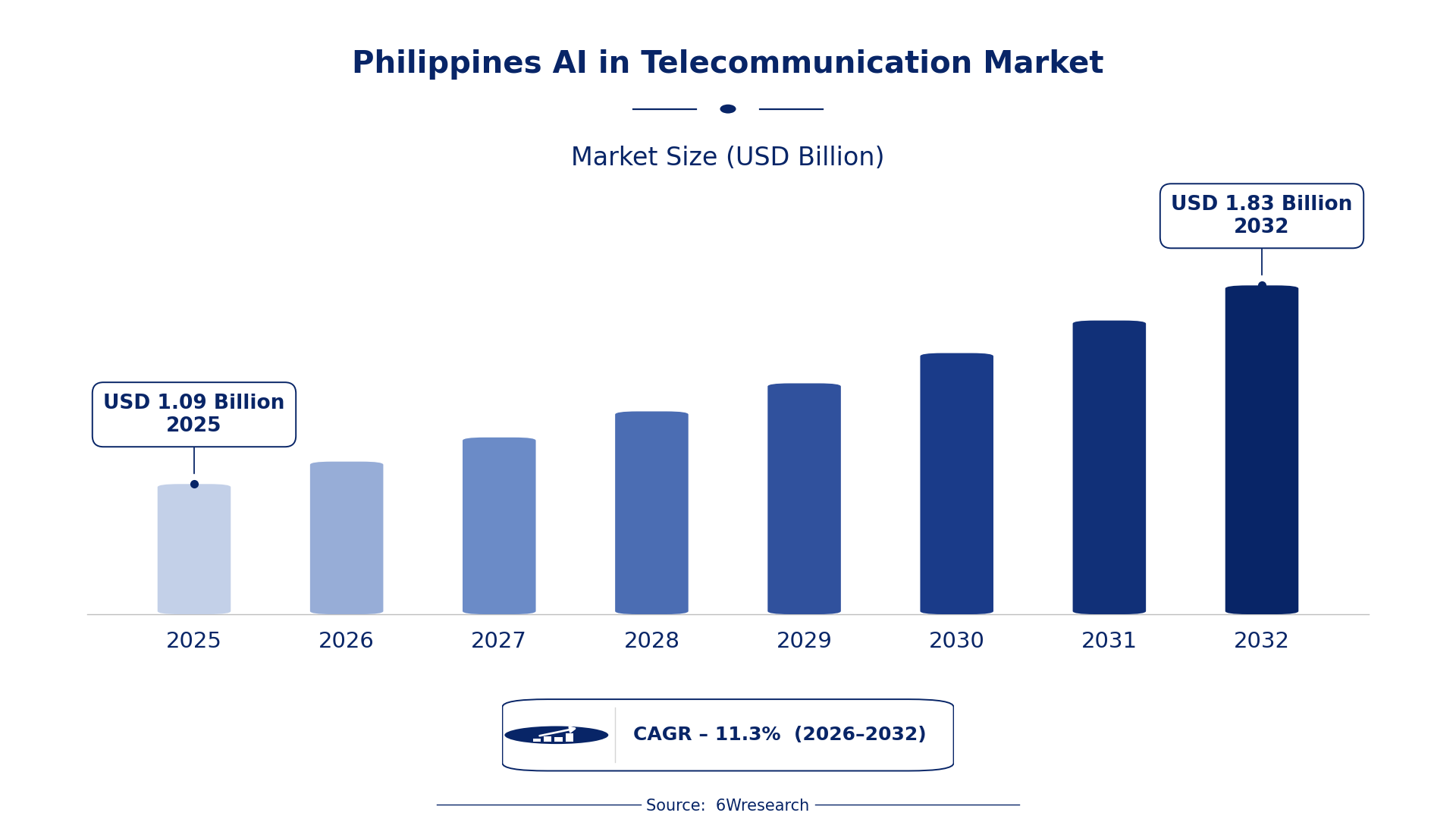
The Philippines AI in Telecommunication Market was estimated at USD 1087 Million in 2025 and is projected to reach USD 1833 Million by 2032, growing at a CAGR of 11.3% from 2026 to 2032.
Philippines AI in Telecommunication Market Synopsis
The Philippines AI in Telecommunication Market is experiencing a dynamic shift as telecom companies adapt to the rapidly evolving demands of digital consumers. Recent advancements in AI have enabled providers to enhance customer experiences while optimizing operational efficiencies, marking a critical transformation in service delivery.
Looking ahead, the market is expected to expand significantly, driven by the growing reliance on data services and connectivity. With more Filipinos gaining access to smartphones and high-speed internet, the integration of AI technologies is likely to shape the future of telecommunications in the region.
Philippines AI in Telecommunication Market Year-wise Growth Rate and Key Drivers
This graph illustrates the annual growth rates of the Philippines AI in Telecommunication Market from 2021 to 2032, highlighting a steady upward trajectory and projected expansion over the forecast period.
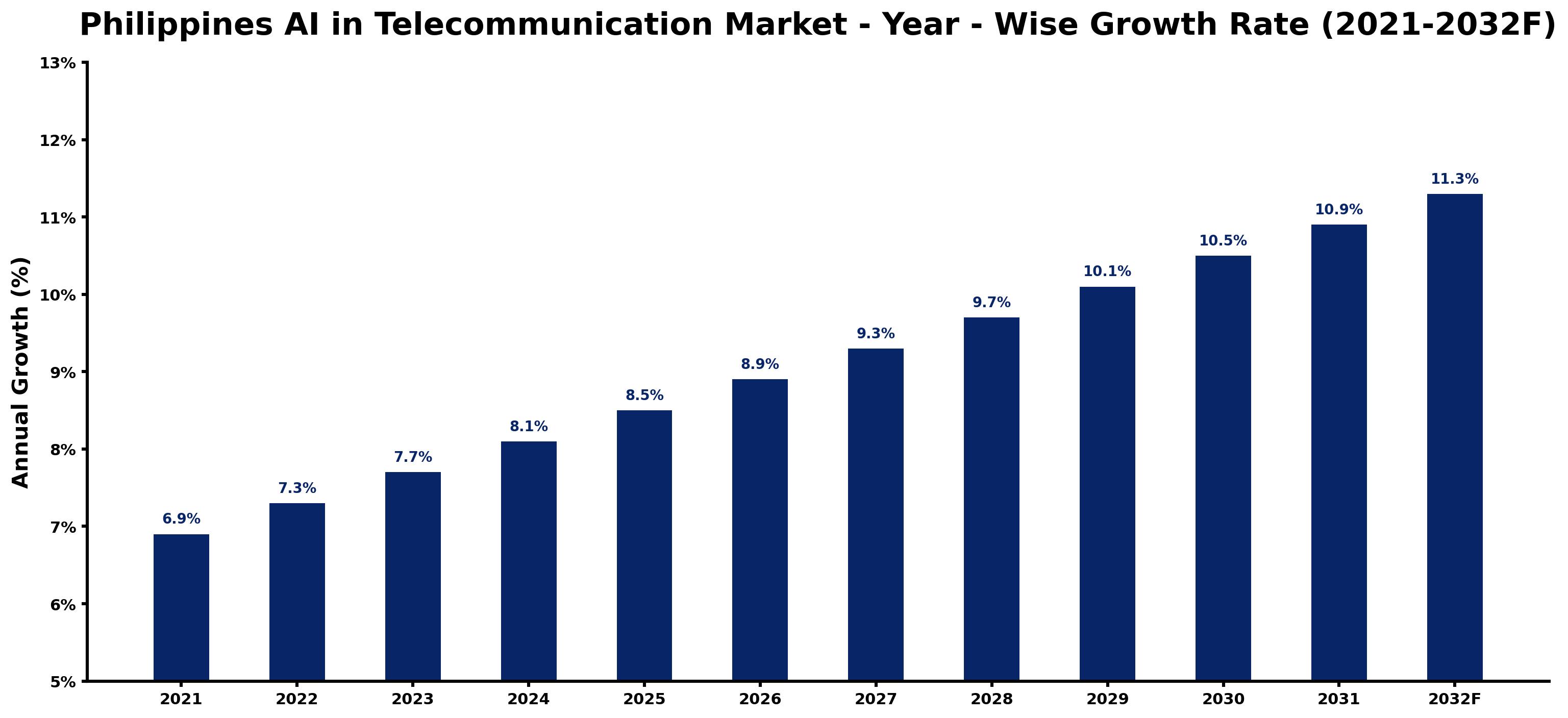
The table below presents the year‑wise growth rates along with the key drivers influencing the market
| Year | Growth Rate | Major Drivers |
| 2021 | 6.9% | National Broadband Plan enhancing telecom infrastructure investment. |
| 2022 | 7.3% | Rise of mobile-first consumers driving AI telecommunication solutions. |
| 2023 | 7.7% | 5G rollout accelerating adoption of AI-driven services. |
| 2024 | 8.1% | Government support for digital transformation in telecom industry. |
| 2025 | 8.5% | Increased competition prompting AI deployment for customer retention. |
| 2026 | 8.9% | Telecom companies leveraging AI for enhanced network efficiency. |
| 2027 | 9.3% | Regulatory initiatives promoting AI compliance in telecommunications. |
| 2028 | 9.7% | Young population boosting demand for AI-powered telecom innovations. |
| 2029 | 10.1% | Smart city projects increasing AI integration in telecommunications. |
| 2030 | 10.5% | Government incentives for AI research in the telecom sector. |
| 2031 | 10.9% | Demand for AI chatbots improving customer service in telecom. |
| 2032 | 11.3% | Increased cybersecurity threats driving AI solutions for telecom security. |
Note: Market size estimations and growth projections presented in this report are based on 6Wresearch's proprietary forecasting methodology, utilizing the latest available industry data, government publications, and primary research inputs.
Philippines AI in Telecommunication Market Key Takeaways
Below are some of the specific key takeaways from the market, including:
- AI is enhancing customer service through automated support systems, improving response times and user satisfaction.
- Network management is becoming increasingly efficient as AI algorithms help in optimizing resource allocation and service quality.
- The demand for AI-driven analytics is rising as telecom operators seek insights into consumer behavior and service usage patterns.
- Telecom companies face data scarcity, limiting the training of AI models and the effectiveness of deployments.
- Government policies are actively shaping the adoption of AI technologies in telecommunications through various initiatives.
Evaluation of Restraints in Philippines AI in Telecommunication Market
Several genuine constraints are impacting the Philippines AI in Telecommunication Market. A critical barrier is the limited availability of high-quality telecom data, which is essential for training robust AI models. Without sufficient data, the effectiveness of AI applications in network management and customer service is significantly reduced. Furthermore, many telecom companies grapple with outdated infrastructure, which complicates the seamless integration of advanced AI solutions. The skill gap among professionals adept in AI technologies also hinders the swift adoption necessary to meet rising consumer expectations.
Philippines AI in Telecommunication Market Trends
Emerging trends in the Philippines AI in Telecommunication Market underscore a shift towards personalization and predictive analytics. Companies are increasingly using AI to analyze customer data, allowing for tailored services and promotions that align with user preferences. Another trend is the growing implementation of AI-powered chatbots, which are enhancing customer support by providing instant responses to queries, thus reducing wait times and improving overall satisfaction. Additionally, there's an uptick in AI applications in fraud detection, as telecom operators aim to safeguard their networks against emerging threats.
Philippines AI in Telecommunication Market Opportunities
Opportunities within the Philippines AI in Telecommunication Market are promising. With the continuous growth of data consumption, telecom providers have a window to invest in AI technologies that enhance data analytics capabilities. Furthermore, the increasing smartphone penetration opens avenues for developing AI applications tailored to mobile users, such as location-based services and customized content delivery. Partnerships with technology firms specializing in AI could expedite the adoption of innovative solutions, driving efficiency and revenue growth in the sector.
Government Initiatives in the Philippines AI in Telecommunication Market
Government initiatives are crucial in shaping the trajectory of the Philippines AI in Telecommunication Market. The regulatory framework emphasizes enhancing digital infrastructure, which is vital for enabling AI applications in telecom. Ongoing public sector priorities include ensuring that telecom services remain accessible and affordable, fostering a conducive environment for technology adoption.
- A national digital infrastructure upgrade programme was completed recently, improving connectivity across rural and urban areas.
- Currently, a regulatory framework is being implemented to mandate transparency in telecom billing, enhancing consumer trust.
- Plans for a public-private partnership initiative are underway, aiming to expand telecom infrastructure access by 2028.
- A recently launched AI initiative aims to support local telecom operators in adopting machine learning technologies for network optimization.
Future Insights of the Philippines AI in Telecommunication Market
From 2026 to 2032, the Philippines AI in Telecommunication Market is likely to evolve with the integration of more sophisticated AI technologies. As telecom providers harness advanced analytics and machine learning capabilities, they will be better positioned to predict trends and consumer needs. The anticipated expansion of 5G networks will also serve as a catalyst for AI adoption, enabling faster and more reliable services. As competition intensifies, players will increasingly invest in innovative solutions to enhance customer retention and operational efficiency.
Philippines AI in Telecommunication Market Latest Developments
Recent developments in the Philippines AI in Telecommunication Market indicate a strong focus on digital transformation among telecom operators. Companies are investing heavily in AI technologies to bolster their service offerings and enhance operational capabilities. The trend reflects an adaptive approach to meeting evolving consumer demands in a highly competitive landscape.
- A major telecom operator launched an AI-driven chatbot in Q1 2025 to streamline customer service operations and reduce response times.
- In mid-2025, a telecom company initiated a project focusing on AI analytics for fraud detection, improving security protocols significantly.
- An ongoing initiative that began in early 2025 aims to upgrade existing network infrastructure to support AI applications more effectively.
- A rollout of a personalized mobile service using AI technology is scheduled for Q3 2026, aimed at enhancing user engagement.
Philippines AI in Telecommunication Market - Key Attractiveness of the Report
- 10 Years of Market Numbers
- Historical Data Starting from 2022 to 2025
- Base Year: 2025
- Forecast Data until 2032
- Key Performance Indicators Impacting the Market
- Major Upcoming Developments and Projects
Key Highlights of the Report:
- Philippines AI in Telecommunication Market Outlook
- Market Size of Philippines AI in Telecommunication Market, 2025
- Forecast of Philippines AI in Telecommunication Market, 2032
- Historical Data and Forecast of Philippines AI in Telecommunication Revenues & Volume for the Period 2022-2032F
- Philippines AI in Telecommunication Market Trend Evolution
- Philippines AI in Telecommunication Market Drivers and Challenges
- Philippines AI in Telecommunication Price Trends
- Philippines AI in Telecommunication Porter's Five Forces
- Philippines AI in Telecommunication Industry Life Cycle
- Historical Data and Forecast of Philippines AI in Telecommunication Market Revenues & Volume By Application for the Period 2022-2032F
- Historical Data and Forecast of Philippines AI in Telecommunication Market Revenues & Volume By Customer analytics for the Period 2022-2032F
- Historical Data and Forecast of Philippines AI in Telecommunication Market Revenues & Volume By Network security for the Period 2022-2032F
- Historical Data and Forecast of Philippines AI in Telecommunication Market Revenues & Volume By Network optimization for the Period 2022-2032F
- Historical Data and Forecast of Philippines AI in Telecommunication Market Revenues & Volume By Self-diagnostics for the Period 2022-2032F
- Historical Data and Forecast of Philippines AI in Telecommunication Market Revenues & Volume By Virtual assistance for the Period 2022-2032F
- Historical Data and Forecast of Philippines AI in Telecommunication Market Revenues & Volume By Others (contact center analytics and marketing campaign analytics) for the Period 2022-2032F
- Historical Data and Forecast of Philippines AI in Telecommunication Market Revenues & Volume By Component for the Period 2022-2032F
- Historical Data and Forecast of Philippines AI in Telecommunication Market Revenues & Volume By Solutions for the Period 2022-2032F
- Historical Data and Forecast of Philippines AI in Telecommunication Market Revenues & Volume By Services for the Period 2022-2032F
- Historical Data and Forecast of Philippines AI in Telecommunication Market Revenues & Volume By Deployment Mode for the Period 2022-2032F
- Historical Data and Forecast of Philippines AI in Telecommunication Market Revenues & Volume By Cloud for the Period 2022-2032F
- Historical Data and Forecast of Philippines AI in Telecommunication Market Revenues & Volume By On-premises for the Period 2022-2032F
- Historical Data and Forecast of Philippines AI in Telecommunication Market Revenues & Volume By Technology for the Period 2022-2032F
- Historical Data and Forecast of Philippines AI in Telecommunication Market Revenues & Volume By Machine learning and deep learning for the Period 2022-2032F
- Historical Data and Forecast of Philippines AI in Telecommunication Market Revenues & Volume By Natural Language Processing (NLP) for the Period 2022-2032F
- Philippines AI in Telecommunication Import Export Trade Statistics
- Market Opportunity Assessment By Application
- Market Opportunity Assessment By Component
- Market Opportunity Assessment By Deployment Mode
- Market Opportunity Assessment By Technology
- Philippines AI in Telecommunication Top Companies Market Share
- Philippines AI in Telecommunication Competitive Benchmarking By Technical and Operational Parameters
- Philippines AI in Telecommunication Company Profiles
- Philippines AI in Telecommunication Key Strategic Recommendations






































