Philippines Air Traffic Control (ATC) Equipment Market Size, Share & Growth Rate
The Philippines Air Traffic Control (ATC) Equipment Market was estimated at USD 511 Million in 2025 and is projected to reach USD 866 Million by 2032, growing at a CAGR of 7.8% from 2026 to 2032. This growth trajectory is fueled by the Philippines' strategic position as a regional aviation hub, coupled with the increasing demand for advanced air traffic management solutions. As air travel gains momentum post-pandemic, stakeholders are prioritizing the modernization of ATC systems to enhance operational efficiency and safety.
Philippines Air Traffic Control (ATC) Equipment Market Year-wise Growth Rate and Key Drivers
This graph highlights how the Philippines Air Traffic Control (ATC) Equipment Market has steadily grown over the years, supported by major growth factors.
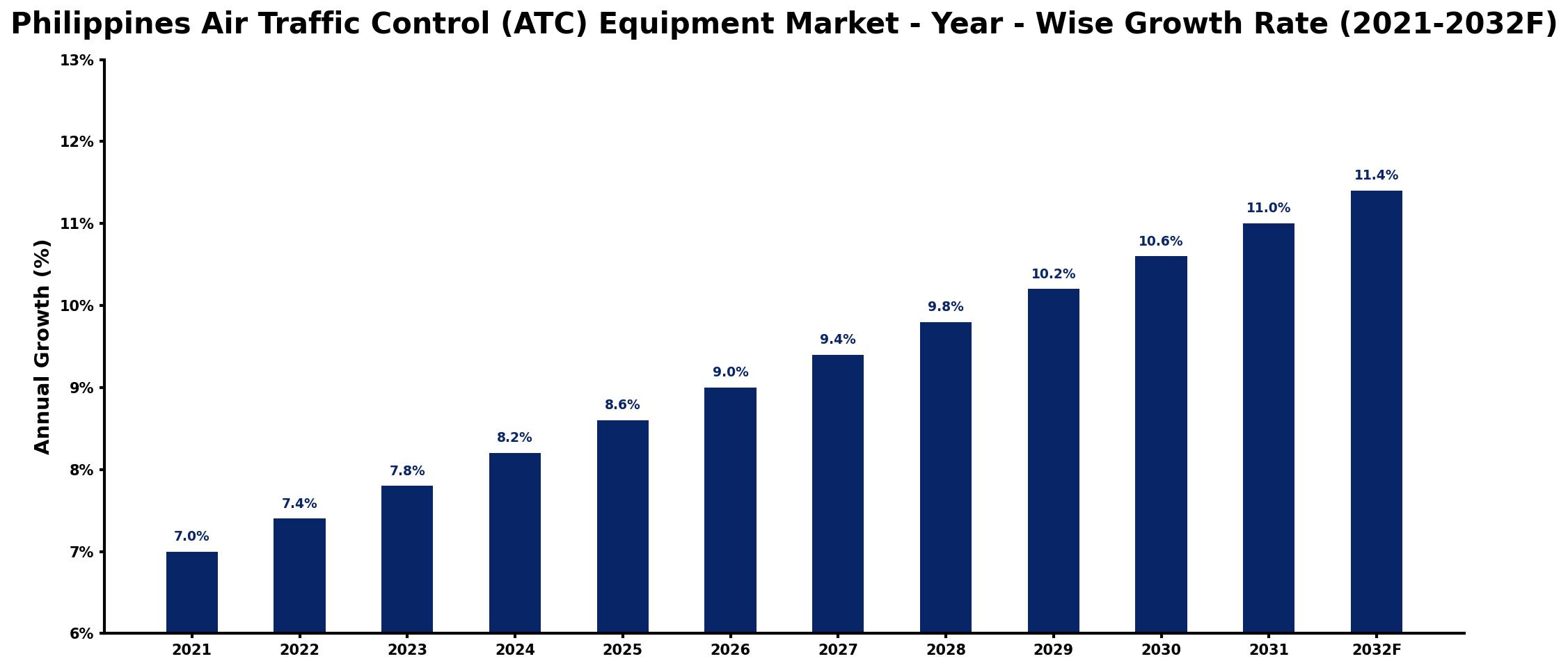
The table below presents the year‑wise growth rates along with the key drivers influencing the market
| Year | Growth Rate | Major Drivers |
| 2021 | 7.0% | Increased investments in aviation infrastructure |
| 2022 | 7.4% | Growing passenger travel demand recovery |
| 2023 | 7.8% | Expansion of regional flight services |
| 2024 | 8.2% | Rise in cargo transportation needs |
| 2025 | 8.6% | Enhanced safety regulation implementations |
| 2026 | 9.0% | Technological advancements in navigation |
| 2027 | 9.4% | Increased government funding initiatives |
| 2028 | 9.8% | Growth in tourism sector activity |
| 2029 | 10.2% | growing commercial sector adoption |
| 2030 | 10.6% | Rising demand for smart solutions |
| 2031 | 11.0% | Strengthened international aviation partnerships |
| 2032 | 11.4% | Emergence of next-gen technologies |
Note: Market size estimations and growth projections presented in this report are based on 6Wresearch's proprietary forecasting methodology, utilizing the latest available industry data, government publications, and primary research inputs.
Philippines Air Traffic Control (ATC) Equipment Market Synopsis
The Philippine air traffic control equipment sector is witnessing a pivotal transformation, prompted by the rapid expansion of the aviation industry. Heightened air traffic levels necessitate sophisticated ATC systems capable of managing complexities associated with increased flight volumes effectively.
Recent technological advancements have set the stage for a shift toward more automated and digitally enhanced ATC solutions. This transition not only enhances efficiency but also significantly improves safety protocols, making it imperative for the Philippines to upgrade its existing infrastructure to stay competitive in the region.
Philippines Air Traffic Control (ATC) Equipment Market Key Takeaways
- The market is driven by the increasing volume of air traffic in both domestic and international segments.
- Technological advancements are pushing the shift toward automated air traffic control solutions.
- Modernization of aging ATC infrastructure is a priority to ensure efficient airspace management.
- The sector faces challenges related to workforce training and regulatory compliance.
- Growing emphasis on safety and operational efficiency is shaping market dynamics.
Evaluation of Restraints in Philippines Air Traffic Control (ATC) Equipment Market
Despite the growth potential, the Philippines ATC equipment market is constrained by several significant factors. One primary restraint is the integration of diverse technologies and systems in a rapidly evolving aviation landscape. The effort to maintain and upgrade aging infrastructure is not only financially taxing but requires meticulous planning and resource allocation. Furthermore, regulatory hurdles and the need for cybersecurity measures add complexity to the operational environment. A skilled workforce adept at managing sophisticated ATC systems remains a critical challenge, as training and retention are often overlooked amidst pressing technological demands.
Philippines Air Traffic Control (ATC) Equipment Market Trends
As the air traffic control landscape evolves, several key trends are shaping the market. Notably, the shift towards digitalization and automation is gaining traction, leading to more efficient airspace management systems. Additionally, the application of data analytics in monitoring and decision-making processes is becoming increasingly popular, allowing for real-time adjustments in response to air traffic fluctuations. Furthermore, enhanced communication equipment and surveillance solutions are gaining prominence as safety remains a top priority within the industry.
Philippines Air Traffic Control (ATC) Equipment Market Opportunities
The Philippines ATC equipment market holds significant opportunities for growth and investment. Stakeholders can capitalize on government initiatives aimed at modernizing aviation infrastructure. Investment in advanced technologies, such as AI and machine learning for predictive analytics, offers potential solutions to improve operational efficiency. Moreover, partnerships with global technology providers can facilitate knowledge transfer and provide access to innovative solutions tailored to the unique needs of the Philippine aviation sector.
Government Initiatives in the Philippines Air Traffic Control (ATC) Equipment Market
The Philippine government is actively pursuing initiatives to enhance the aviation sector, focusing on upgrading air traffic control systems. Policy frameworks have been established to facilitate investment in modern ATC technologies, reflecting a commitment to improving safety and efficiency. Public spending is being directed towards infrastructure upgrades, and programs encouraging technological advancement within the industry are underway, illustrating the government's proactive stance in fostering a resilient aviation environment.
Future Insights of the Philippines Air Traffic Control (ATC) Equipment Market
Looking ahead to 2026-2032, the Philippines ATC equipment market is positioned for robust growth. As air travel continues to rebound, the demand for sophisticated ATC systems will only intensify. The integration of next-generation technologies, particularly in automation and data analytics, will be paramount in addressing future challenges. Furthermore, a focus on international partnerships and collaboration will enable the Philippines to enhance its airspace management capabilities, ensuring it remains a competitive player in the Asia-Pacific region.
Philippines Air Traffic Control (ATC) Equipment Market Latest Developments (2025 - 2026)
The air traffic control equipment sector in the Philippines is undergoing notable developments. Recent focus has been placed on integrating automated systems to streamline operations while enhancing safety measures. Moreover, increased collaborations with international technology providers have emerged, facilitating access to cutting-edge solutions tailored for the Philippines' unique challenges. Regulatory frameworks continue to evolve, emphasizing the importance of compliance and cybersecurity within the ATC landscape.
Philippines Air Traffic Control (ATC) Equipment Market - Key Attractiveness of the Report
- 10 Years of Market Numbers
- Historical Data Starting from 2022 to 2025
- Base Year: 2025
- Forecast Data until 2032
- Key Performance Indicators Impacting the Market
- Major Upcoming Developments and Projects
Key Highlights of the Report:
- Philippines Air Traffic Control (ATC) Equipment Market Outlook
- Market Size of Philippines Air Traffic Control (ATC) Equipment Market, 2025
- Forecast of Philippines Air Traffic Control (ATC) Equipment Market, 2032
- Historical Data and Forecast of Philippines Air Traffic Control (ATC) Equipment Revenues & Volume for the Period 2022-2032F
- Philippines Air Traffic Control (ATC) Equipment Market Trend Evolution
- Philippines Air Traffic Control (ATC) Equipment Market Drivers and Challenges
- Philippines Air Traffic Control (ATC) Equipment Price Trends
- Philippines Air Traffic Control (ATC) Equipment Porter's Five Forces
- Philippines Air Traffic Control (ATC) Equipment Industry Life Cycle
- Historical Data and Forecast of Philippines Air Traffic Control (ATC) Equipment Market Revenues & Volume By Product for the Period 2022-2032F
- Historical Data and Forecast of Philippines Air Traffic Control (ATC) Equipment Market Revenues & Volume By Communications Equipment for the Period 2022-2032F
- Historical Data and Forecast of Philippines Air Traffic Control (ATC) Equipment Market Revenues & Volume By Navigation Equipment for the Period 2022-2032F
- Historical Data and Forecast of Philippines Air Traffic Control (ATC) Equipment Market Revenues & Volume By Surveillance Equipment for the Period 2022-2032F
- Historical Data and Forecast of Philippines Air Traffic Control (ATC) Equipment Market Revenues & Volume By Air Traffic Control Equipment Application Outlook (USD Million, 2023-2032) for the Period 2022-2032F
- Historical Data and Forecast of Philippines Air Traffic Control (ATC) Equipment Market Revenues & Volume By Commercial Aircraft for the Period 2022-2032F
- Historical Data and Forecast of Philippines Air Traffic Control (ATC) Equipment Market Revenues & Volume By Private Aircraft for the Period 2022-2032F
- Historical Data and Forecast of Philippines Air Traffic Control (ATC) Equipment Market Revenues & Volume By Military Aircraft for the Period 2022-2032F
- Philippines Air Traffic Control (ATC) Equipment Import Export Trade Statistics
- Market Opportunity Assessment By Product
- Philippines Air Traffic Control (ATC) Equipment Top Companies Market Share
- Philippines Air Traffic Control (ATC) Equipment Competitive Benchmarking By Technical and Operational Parameters
- Philippines Air Traffic Control (ATC) Equipment Company Profiles
- Philippines Air Traffic Control (ATC) Equipment Key Strategic Recommendations






































