Philippines Anti Reflective Glass Market Top 5 Importing Countries and Market Competition (HHI) Analysis
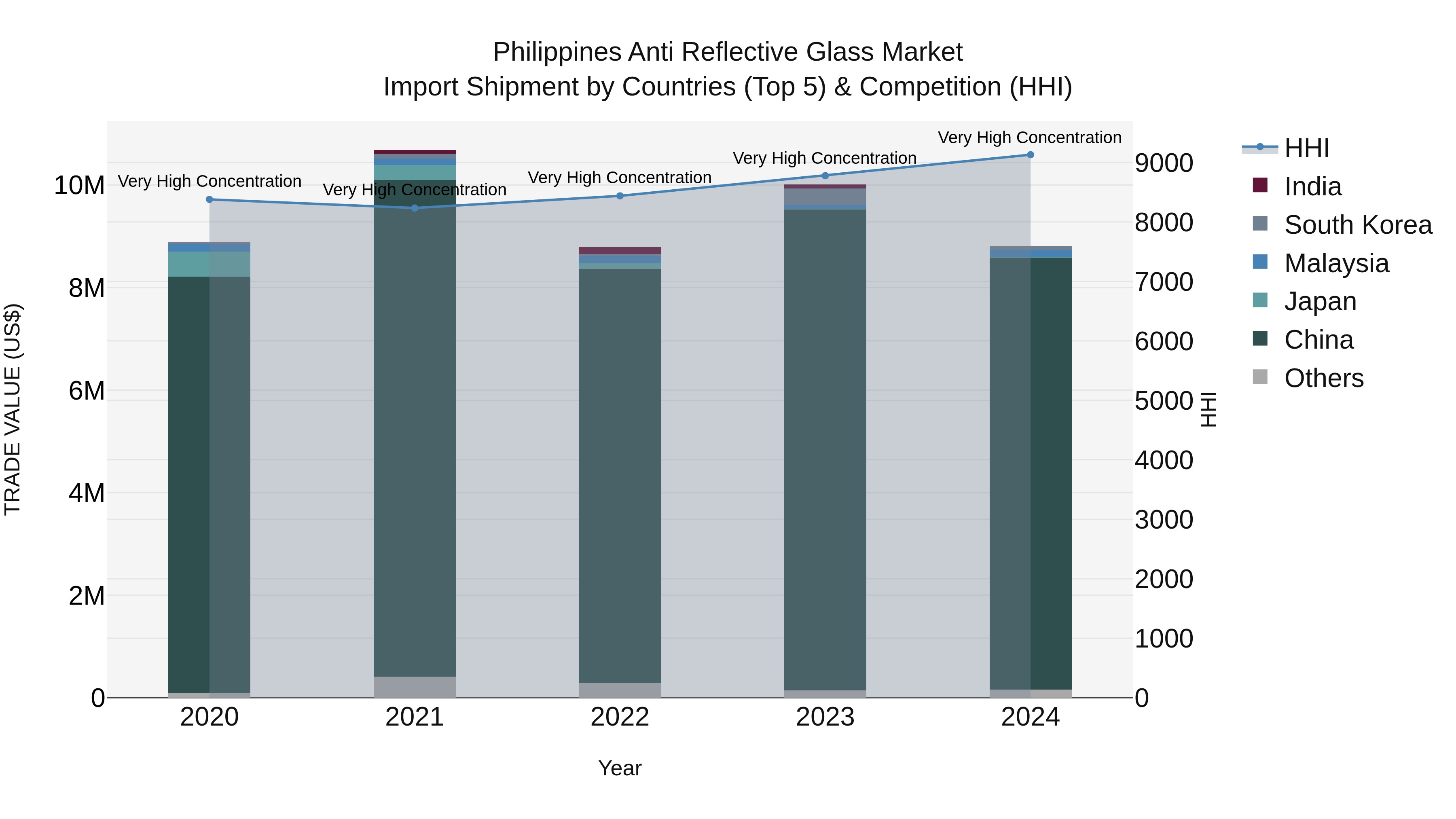
The Philippines continues to rely on imports of anti-reflective glass, with top suppliers in 2024 being China, Malaysia, South Korea, Italy, and the UAE. Despite a high Herfindahl-Hirschman Index (HHI) indicating market concentration, the industry saw a slight decline with a compound annual growth rate (CAGR) of -0.23% from 2020 to 2024. However, the sector experienced a significant drop in growth rate from 2023 to 2024 at -12.0%, suggesting potential challenges or shifts in market dynamics.
philippines anti reflective glass market Synopsis
The Philippines anti-reflective glass market was valued at USD 28 million in 2025 and is expected to reach a value of approximately USD 32 million by 2031, growing at a CAGR of 2. 3% during the forecast period. The major driving factor for this growth can be attributed to government initiatives such as tax incentives and supportive policies that are boosting investments in the construction sector. Additionally, rising urbanization has led to an increase in demand for energy-efficient buildings with improved aesthetics which have also propelled the growth of this market.
Drivers of the Market
The Philippines anti-reflective glass market is projected to see positive growth owing to its increasing adoption in industries like electronics, automotive, and solar energy. Anti-reflective glass is known for its ability to reduce glare and enhance visibility, making it suitable for display panels, electronic devices, and solar panels. As these industries advance and technology improves, the demand for anti-reflective glass is anticipated to rise, contributing to market expansion.
Challenges of the Market
Limited awareness among consumers about the benefits of anti-reflective glass might result in slower adoption rates. The higher production costs associated with manufacturing anti-reflective coatings could be a hurdle.
COVID-19 Impact on the Market
The pandemic led to supply chain disruptions and reduced consumer spending, affecting demand. As economic conditions improve, the market for anti-reflective glass is likely to rebound.
Key Players in the Market
Anti-reflective glass finds applications in optical devices, architectural glass, and electronics. The Philippines` market for anti-reflective glass is likely influenced by industries such as electronics, telecommunications, and high-end architecture. Key players could include AGC Inc., SCHOTT AG, and PPG Industries.
Key Highlights of the Report:
- Philippines Anti Reflective Glass Market Outlook
- Market Size of Philippines Anti Reflective Glass Market, 2024
- Forecast of Philippines Anti Reflective Glass Market, 2031
- Historical Data and Forecast of Philippines Anti Reflective Glass Revenues & Volume for the Period 2021-2031
- Philippines Anti Reflective Glass Market Trend Evolution
- Philippines Anti Reflective Glass Market Drivers and Challenges
- Philippines Anti Reflective Glass Price Trends
- Philippines Anti Reflective Glass Porter's Five Forces
- Philippines Anti Reflective Glass Industry Life Cycle
- Historical Data and Forecast of Philippines Anti Reflective Glass Market Revenues & Volume By Type for the Period 2021-2031
- Historical Data and Forecast of Philippines Anti Reflective Glass Market Revenues & Volume By Double Layers for the Period 2021-2031
- Historical Data and Forecast of Philippines Anti Reflective Glass Market Revenues & Volume By Four Layers for the Period 2021-2031
- Historical Data and Forecast of Philippines Anti Reflective Glass Market Revenues & Volume By Others for the Period 2021-2031
- Historical Data and Forecast of Philippines Anti Reflective Glass Market Revenues & Volume By Application for the Period 2021-2031
- Historical Data and Forecast of Philippines Anti Reflective Glass Market Revenues & Volume By Architectural Windows for the Period 2021-2031
- Historical Data and Forecast of Philippines Anti Reflective Glass Market Revenues & Volume By Instrumentation Windows for the Period 2021-2031
- Historical Data and Forecast of Philippines Anti Reflective Glass Market Revenues & Volume By Electronic Displays for the Period 2021-2031
- Historical Data and Forecast of Philippines Anti Reflective Glass Market Revenues & Volume By Picture Framing Glass for the Period 2021-2031
- Historical Data and Forecast of Philippines Anti Reflective Glass Market Revenues & Volume By Showcase Glass for the Period 2021-2031
- Historical Data and Forecast of Philippines Anti Reflective Glass Market Revenues & Volume By Cold Storage Displays for the Period 2021-2031
- Historical Data and Forecast of Philippines Anti Reflective Glass Market Revenues & Volume By Lamps Glass for the Period 2021-2031
- Historical Data and Forecast of Philippines Anti Reflective Glass Market Revenues & Volume By Others for the Period 2021-2031
- Philippines Anti Reflective Glass Import Export Trade Statistics
- Market Opportunity Assessment By Type
- Market Opportunity Assessment By Application
- Philippines Anti Reflective Glass Top Companies Market Share
- Philippines Anti Reflective Glass Competitive Benchmarking By Technical and Operational Parameters
- Philippines Anti Reflective Glass Company Profiles
- Philippines Anti Reflective Glass Key Strategic Recommendations






































