Philippines Aquaculture & Marine Products Market Top 5 Importing Countries and Market Competition (HHI) Analysis
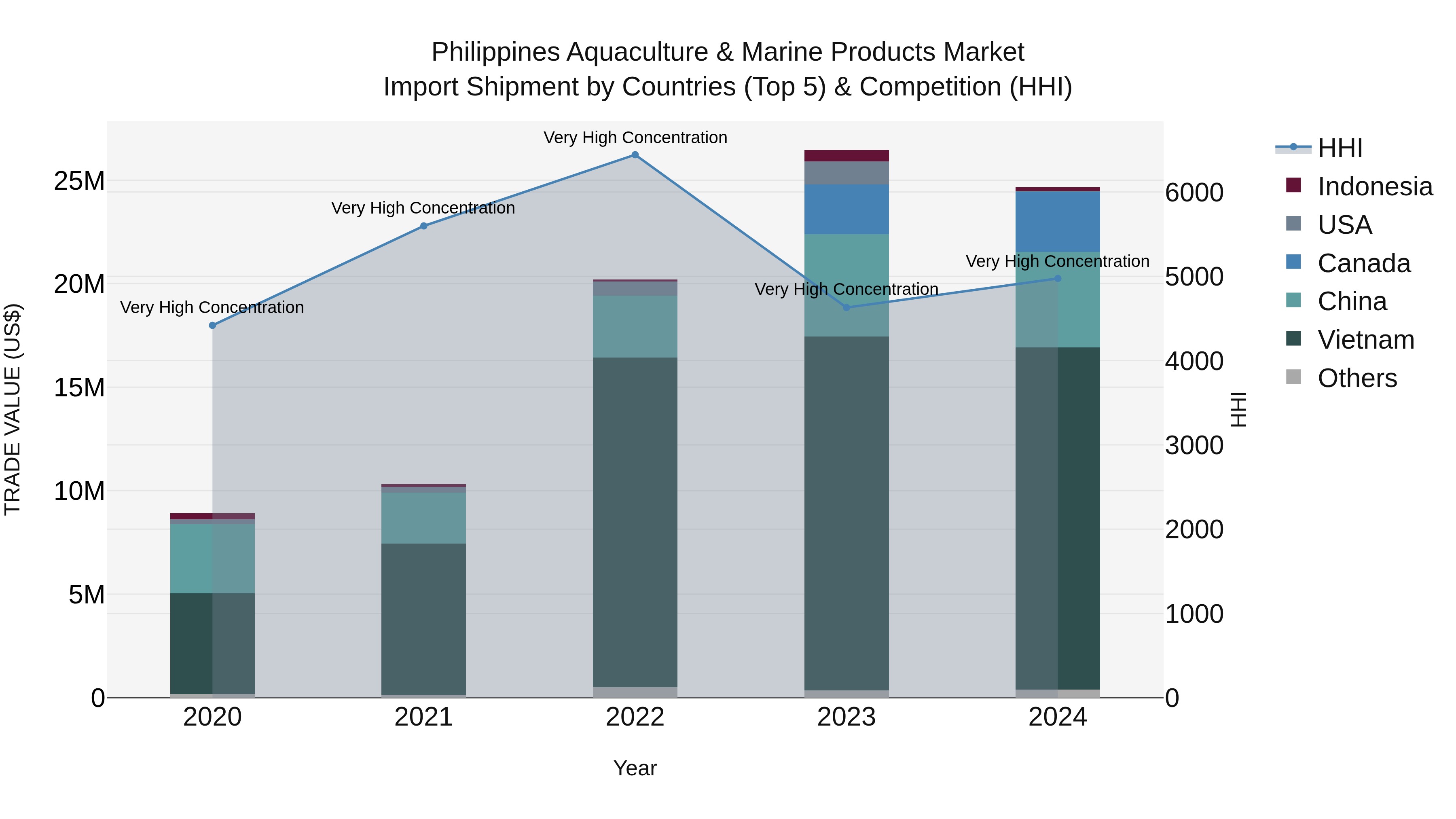
The Philippines continues to be a key player in the aquaculture and marine products market, with top import sources including Vietnam, China, Canada, Indonesia, and Myanmar in 2024. Despite a slight decline in growth rate from 2023 to 2024, the industry still maintains a high concentration with a high Herfindahl-Hirschman Index (HHI). The impressive compound annual growth rate (CAGR) of 29.01% from 2020 to 2024 indicates sustained market expansion and opportunities for further development in the coming years.
philippines aquaculture marine products market Synopsis
The Philippines is the world`s second largest producer of aquaculture marine products, with an estimated production volume of 1. 2 million metric tons in 2018 and a market value of US$3. 5 billion in 2025. The top five species produced are milkfish (Chanos chanos), black tiger shrimp (Penaeus monodon), Indian mackerel (Rastrelliger kanagurta), white shrimp (Litopenaeus vannamei) and groupers (Epinephelus sp. ). The country?s leading export markets for aquaculture marine products include Japan, South Korea, United States, China and Australia.
Drivers of the Market
The Philippines aquaculture marine products market is driven by the country`s rich marine resources and the global demand for seafood. As one of the world`s top fish-producing nations, the Philippines has a competitive advantage in aquaculture. The market is influenced by factors such as increasing consumption of seafood, export opportunities, technological advancements in aquaculture practices, and sustainable resource management. The expansion of aquaculture activities and the diversification of marine product offerings contribute to market growth.
Challenges of the Market
The Philippines aquaculture marine products market is a vital component of the country`s seafood industry. Challenges include environmental concerns linked to overfishing, pollution, and habitat degradation. Sustainable practices are increasingly important to maintain long-term viability. Market access and international trade regulations present complexities for exporting marine products. Additionally, disease management within aquaculture systems remains a persistent challenge, as outbreaks can lead to significant economic losses.
COVID-19 Impact on the Market
The Philippines aquaculture marine products market faced difficulties during the pandemic, as restrictions on transportation and exports impacted the seafood supply chain. The closure of restaurants and reduced consumer spending also affected domestic sales. As the country opens up and international trade improves, the market is expected to recover, driven by the resumption of seafood exports and a rebound in the foodservice sector.
Key Players in the Market
The aquaculture marine products market in the Philippines is prominent due to the country`s rich marine resources. Key players include seafood companies like Alliance Select Foods International and RD Corporation. These players engage in sustainable aquaculture practices, farming various marine species like shrimp, fish, and seaweed. They contribute to the Philippines` seafood exports while ensuring the conservation of marine ecosystems.
Key Highlights of the Report:
- Philippines Aquaculture & Marine Products Market Outlook
- Market Size of Philippines Aquaculture & Marine Products Market, 2024
- Forecast of Philippines Aquaculture & Marine Products Market, 2031
- Historical Data and Forecast of Philippines Aquaculture & Marine Products Revenues & Volume for the Period 2021-2031
- Philippines Aquaculture & Marine Products Market Trend Evolution
- Philippines Aquaculture & Marine Products Market Drivers and Challenges
- Philippines Aquaculture & Marine Products Price Trends
- Philippines Aquaculture & Marine Products Porter's Five Forces
- Philippines Aquaculture & Marine Products Industry Life Cycle
- Historical Data and Forecast of Philippines Aquaculture & Marine Products Market Revenues & Volume By Rearing Product Type for the Period 2021-2031
- Historical Data and Forecast of Philippines Aquaculture & Marine Products Market Revenues & Volume By Equipment for the Period 2021-2031
- Historical Data and Forecast of Philippines Aquaculture & Marine Products Market Revenues & Volume By Chemicals for the Period 2021-2031
- Historical Data and Forecast of Philippines Aquaculture & Marine Products Market Revenues & Volume By Pharmaceuticals for the Period 2021-2031
- Historical Data and Forecast of Philippines Aquaculture & Marine Products Market Revenues & Volume By Fertilizers for the Period 2021-2031
- Historical Data and Forecast of Philippines Aquaculture & Marine Products Market Revenues & Volume By Others for the Period 2021-2031
- Historical Data and Forecast of Philippines Aquaculture & Marine Products Market Revenues & Volume By Type for the Period 2021-2031
- Historical Data and Forecast of Philippines Aquaculture & Marine Products Market Revenues & Volume By Fisheries for the Period 2021-2031
- Historical Data and Forecast of Philippines Aquaculture & Marine Products Market Revenues & Volume By Seaweeds for the Period 2021-2031
- Historical Data and Forecast of Philippines Aquaculture & Marine Products Market Revenues & Volume By Microalgae for the Period 2021-2031
- Historical Data and Forecast of Philippines Aquaculture & Marine Products Market Revenues & Volume By Crustaceans for the Period 2021-2031
- Historical Data and Forecast of Philippines Aquaculture & Marine Products Market Revenues & Volume By Molluscs for the Period 2021-2031
- Historical Data and Forecast of Philippines Aquaculture & Marine Products Market Revenues & Volume By Others for the Period 2021-2031
- Historical Data and Forecast of Philippines Aquaculture & Marine Products Market Revenues & Volume By Production Type for the Period 2021-2031
- Historical Data and Forecast of Philippines Aquaculture & Marine Products Market Revenues & Volume By Small-Scale for the Period 2021-2031
- Historical Data and Forecast of Philippines Aquaculture & Marine Products Market Revenues & Volume By Medium & Large Scale for the Period 2021-2031
- Historical Data and Forecast of Philippines Aquaculture & Marine Products Market Revenues & Volume By Culture for the Period 2021-2031
- Historical Data and Forecast of Philippines Aquaculture & Marine Products Market Revenues & Volume By Freshwater for the Period 2021-2031
- Historical Data and Forecast of Philippines Aquaculture & Marine Products Market Revenues & Volume By Brackish Water for the Period 2021-2031
- Historical Data and Forecast of Philippines Aquaculture & Marine Products Market Revenues & Volume By Marine for the Period 2021-2031
- Philippines Aquaculture & Marine Products Import Export Trade Statistics
- Market Opportunity Assessment By Rearing Product Type
- Market Opportunity Assessment By Type
- Market Opportunity Assessment By Production Type
- Market Opportunity Assessment By Culture
- Philippines Aquaculture & Marine Products Top Companies Market Share
- Philippines Aquaculture & Marine Products Competitive Benchmarking By Technical and Operational Parameters
- Philippines Aquaculture & Marine Products Company Profiles
- Philippines Aquaculture & Marine Products Key Strategic Recommendations






































