Philippines Automotive Drive Shaft Market Size, Share & Growth Rate
The Philippines Automotive Drive Shaft Market was estimated at USD 191 Million in 2025 and is projected to reach USD 250 Million by 2032, growing at a CAGR of 3.9% from 2026 to 2032. This growth trajectory can be attributed to rising automobile production driven by increased disposable incomes among Filipino consumers, which fuels demand for automotive components, including drive shafts. Additionally, the push for innovations in vehicle designs and a greater adoption of electric and hybrid vehicles further energizes this segment, indicating a dynamic future.
Philippines Automotive Drive Shaft Market Year-wise Growth Rate and Key Drivers
This graph highlights how the Philippines Automotive Drive Shaft Market has steadily grown over the years, supported by major growth factors.
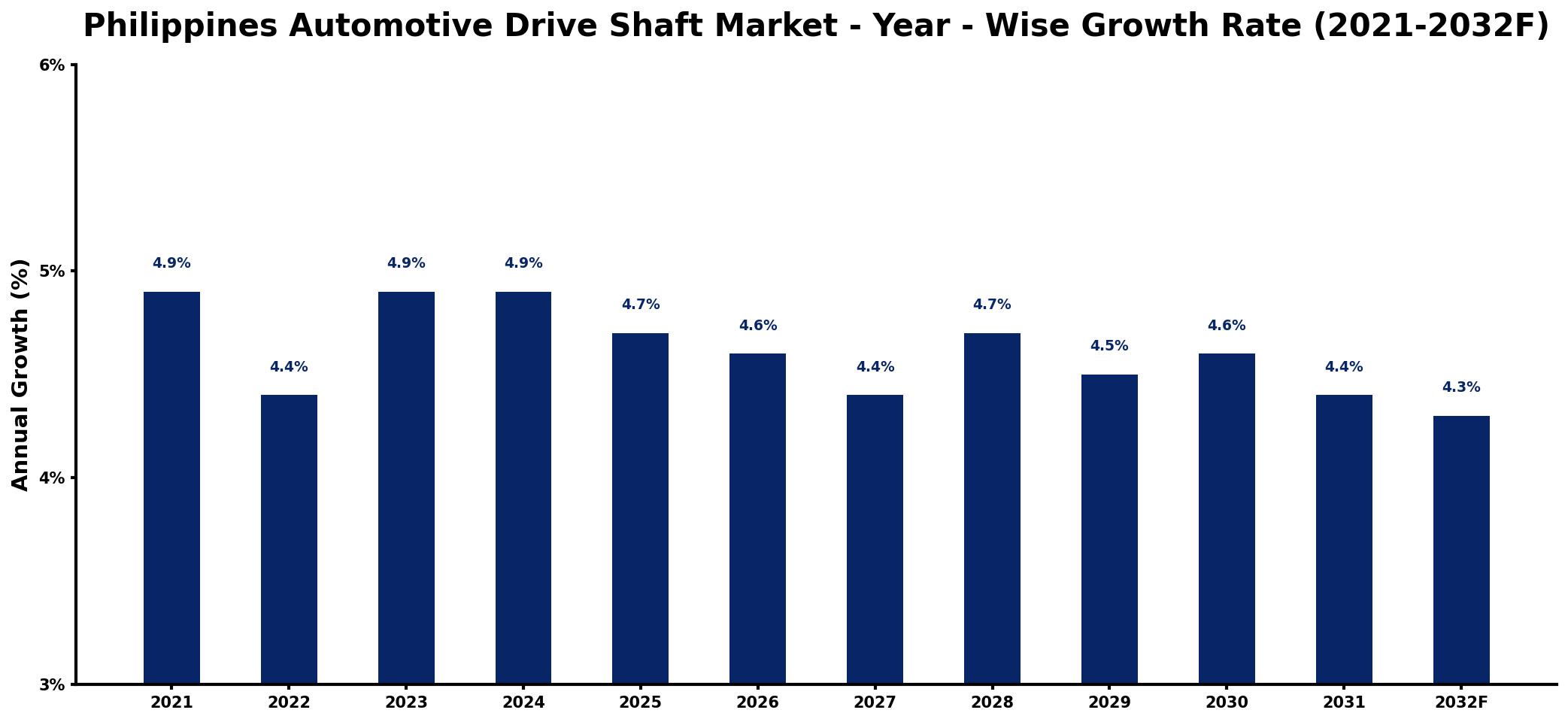
The table below presents the year‑wise growth rates along with the key drivers influencing the market
| Year | Growth Rate | Major Drivers |
| 2021 | 4.9% | Rising demand for transportation solutions |
| 2022 | 4.4% | Increased investments in manufacturing facilities |
| 2023 | 4.9% | growing regional consumption patterns |
| 2024 | 4.9% | Growth in electric vehicle market |
| 2025 | 4.7% | Higher consumer spending on vehicles |
| 2026 | 4.6% | Strengthening e-commerce logistics networks |
| 2027 | 4.4% | Emergence of new transportation technologies |
| 2028 | 4.7% | Revitalization of public transportation systems |
| 2029 | 4.5% | increased capital investment inflows |
| 2030 | 4.6% | Advancements in vehicle safety standards |
| 2031 | 4.4% | Increased focus on sustainable mobility |
| 2032 | 4.3% | Demand for enhanced vehicle performance |
Note: Market size estimations and growth projections presented in this report are based on 6Wresearch's proprietary forecasting methodology, utilizing the latest available industry data, government publications, and primary research inputs.
Philippines Automotive Drive Shaft Market Synopsis
The Philippine automotive drive shaft market has experienced robust momentum, propelled by a surge in automobile production and a growing middle class with rising purchasing power. As the market heads toward 2032, it reflects a landscape increasingly influenced by innovations in vehicle technology and a shift toward sustainability.
Looking forward, the market's growth will be shaped not only by demand from new vehicle production but also by the evolving aftermarket sector, driven by consumer preferences for maintenance and upgrades in existing vehicles. As a result, manufacturers will need to be agile in adapting their offerings to meet the changing needs of the automotive landscape.
Philippines Automotive Drive Shaft Market Key Takeaways
- The market is projected to grow from USD 191 Million in 2025 to USD 250 Million by 2032.
- Rising disposable incomes and a growing automotive industry fuel demand for drive shafts.
- Innovative vehicle designs, including electric and hybrid models, are transforming market dynamics.
- Government initiatives aimed at lighter vehicle components may benefit market players.
- Continuous advancements in manufacturing processes are crucial for maintaining competitive advantage.
Evaluation of Restraints in Philippines Automotive Drive Shaft Market
The Philippines automotive drive shaft market faces certain restraints that could hinder its potential. The rapid evolution of vehicle designs necessitates manufacturers to continuously adapt their products, ensuring compatibility and performance with newer technologies. Additionally, precision engineering is critical to minimize issues of noise and vibration, demanding significant investment in research and development. These challenges compel market players to enhance their operational capabilities and invest strategically to remain competitive.
Philippines Automotive Drive Shaft Market Trends
Several key trends are shaping the Philippines automotive drive shaft market. The increasing adoption of lightweight materials, such as aluminum and composites, is becoming prevalent as manufacturers seek to improve fuel efficiency and meet environmental regulations. Furthermore, advancements in electric and hybrid vehicle technologies are prompting a reevaluation of drive shaft designs to accommodate unique powertrain requirements. A growing focus on local sourcing and supply chain resilience post-COVID-19 is also influencing manufacturers to seek more localized solutions.
Philippines Automotive Drive Shaft Market Opportunities
The evolving automotive landscape presents substantial growth and investment opportunities within the Philippines automotive drive shaft market. As electric vehicles gain traction, manufacturers have the chance to innovate with drive shafts that cater specifically to the unique dynamics of electric drivetrains. Additionally, the aftermarket segment is ripe for expansion, with opportunities for companies to offer enhanced performance and lightweight drive shafts that align with consumer preferences for customization and efficiency. Moreover, public-private partnerships aimed at strengthening the automotive sector could open new pathways for investment and development.
Government Initiatives in the Philippines Automotive Drive Shaft Market
The Philippine government has been proactive in promoting the growth of the automotive industry through various policies and initiatives. Programs aimed at reducing vehicle weight and improving fuel efficiency often encourage manufacturers to develop lighter components, including drive shafts. Incentives for research and development in automotive technology are being offered, fostering an environment where innovation can thrive. These governmental efforts play a crucial role in shaping a robust automotive ecosystem that benefits local and international stakeholders alike.
Future Insights of the Philippines Automotive Drive Shaft Market
Looking ahead to 2026-2032, the Philippines automotive drive shaft market is poised for steady growth, driven by a combination of increased local vehicle production and advancements in automotive technology. The rising demand for electric and hybrid vehicles will likely shift the focus of manufacturers toward innovative designs and lightweight materials. Furthermore, as consumer expectations continue to evolve, the emphasis on enhancing driving experience through high-performance components will be a critical factor in market expansion. Companies that align with these trends will undoubtedly find success in this dynamic market landscape.
Philippines Automotive Drive Shaft Market Latest Developments (2025 - 2026)
In recent months, the automotive industry in the Philippines has seen significant activity as manufacturers explore new technologies and materials to enhance product offerings. Innovations in drive shaft designs are emerging, especially tailored for electric vehicles, reflecting a shift in industry focus. Additionally, partnerships between local manufacturers and international companies are fostering knowledge transfer and capacity building, further positioning the market for growth. Efforts to streamline supply chains are also being implemented to mitigate disruptions experienced during recent global challenges.
Philippines Automotive Drive Shaft Market - Key Attractiveness of the Report
- 10 Years of Market Numbers
- Historical Data Starting from 2022 to 2025
- Base Year: 2025
- Forecast Data until 2032
- Key Performance Indicators Impacting the Market
- Major Upcoming Developments and Projects
Key Highlights of the Report:
- Philippines Automotive Drive Shaft Market Outlook
- Market Size of Philippines Automotive Drive Shaft Market, 2025
- Forecast of Philippines Automotive Drive Shaft Market, 2032
- Historical Data and Forecast of Philippines Automotive Drive Shaft Revenues & Volume for the Period 2022-2032F
- Philippines Automotive Drive Shaft Market Trend Evolution
- Philippines Automotive Drive Shaft Market Drivers and Challenges
- Philippines Automotive Drive Shaft Price Trends
- Philippines Automotive Drive Shaft Porter's Five Forces
- Philippines Automotive Drive Shaft Industry Life Cycle
- Historical Data and Forecast of Philippines Automotive Drive Shaft Market Revenues & Volume By Design Type for the Period 2022-2032F
- Historical Data and Forecast of Philippines Automotive Drive Shaft Market Revenues & Volume By Hollow Shaft for the Period 2022-2032F
- Historical Data and Forecast of Philippines Automotive Drive Shaft Market Revenues & Volume By Solid Shaft for the Period 2022-2032F
- Historical Data and Forecast of Philippines Automotive Drive Shaft Market Revenues & Volume By Position Type for the Period 2022-2032F
- Historical Data and Forecast of Philippines Automotive Drive Shaft Market Revenues & Volume By Rear Axle for the Period 2022-2032F
- Historical Data and Forecast of Philippines Automotive Drive Shaft Market Revenues & Volume By Front Axle for the Period 2022-2032F
- Historical Data and Forecast of Philippines Automotive Drive Shaft Market Revenues & Volume By Vehicle Type for the Period 2022-2032F
- Historical Data and Forecast of Philippines Automotive Drive Shaft Market Revenues & Volume By Passenger Cars for the Period 2022-2032F
- Historical Data and Forecast of Philippines Automotive Drive Shaft Market Revenues & Volume By Commercial Vehicles for the Period 2022-2032F
- Philippines Automotive Drive Shaft Import Export Trade Statistics
- Market Opportunity Assessment By Design Type
- Market Opportunity Assessment By Position Type
- Market Opportunity Assessment By Vehicle Type
- Philippines Automotive Drive Shaft Top Companies Market Share
- Philippines Automotive Drive Shaft Competitive Benchmarking By Technical and Operational Parameters
- Philippines Automotive Drive Shaft Company Profiles
- Philippines Automotive Drive Shaft Key Strategic Recommendations






































