Philippines Ball Bearings Market Summary
The philippines ball bearings market was estimated at USD 181 Million in 2025 and is projected to reach USD 241 Million by 2032, growing at a CAGR of 4.9% from 2026 to 2032.
Philippines Ball Bearings Market Year-wise Growth Rate and Key Drivers
This graph highlights how the Philippines Ball Bearings Market has steadily grown over the past five years, supported by major growth factors.
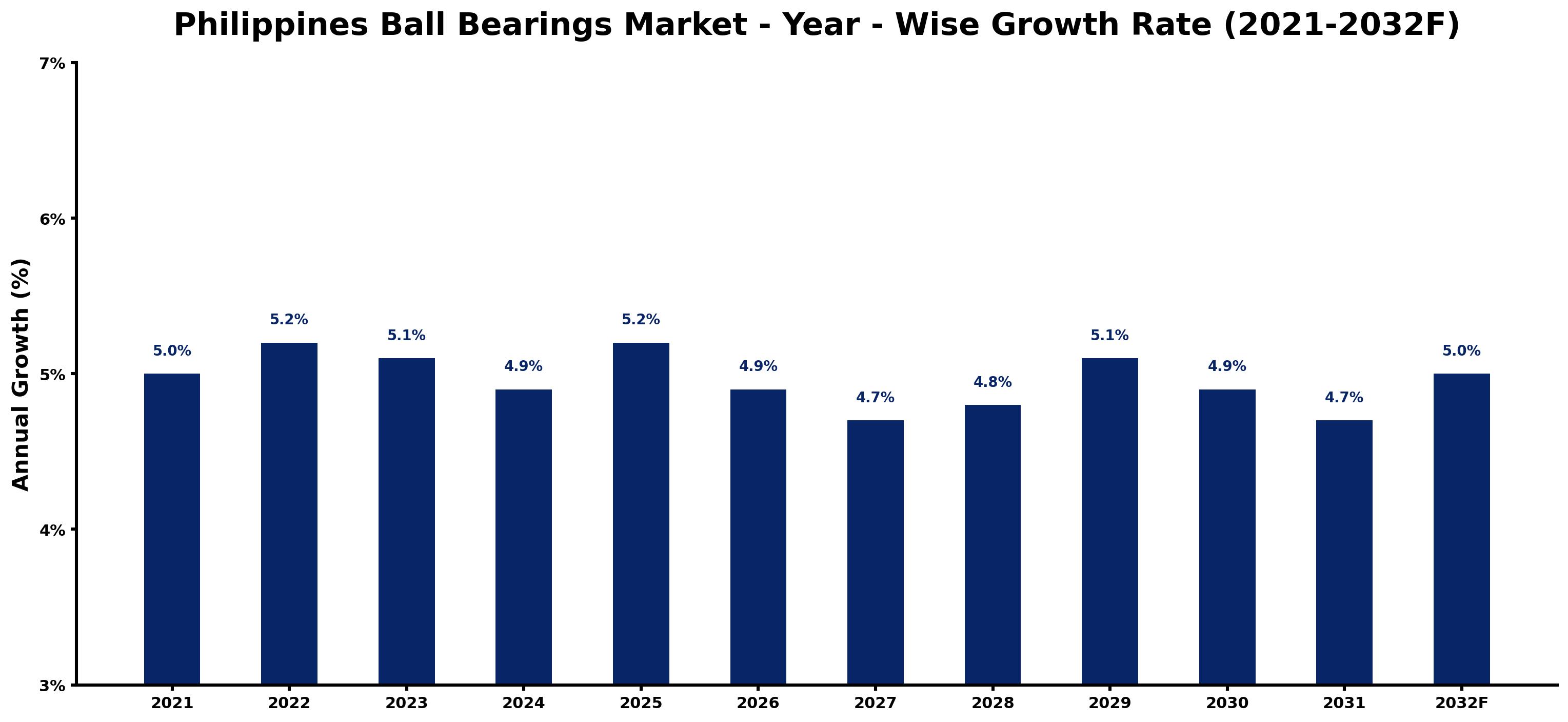
The table below presents the year wise growth rates along with the key drivers influencing the market
| Year | Growth Rate | Major Drivers |
| 2021 | 5.0% | Post-lockdown industrial activities indicated a gradual recovery in manufacturing sectors. |
| 2022 | 5.2% | Local manufacturers sought to enhance product quality amidst fierce competition globally. |
| 2023 | 5.1% | Infrastructure development projects gained momentum, highlighting the need for durable ball bearings. |
| 2024 | 4.9% | Emerging electric vehicle market demands innovative bearing solutions for energy efficiency. |
| 2025 | 5.2% | Urbanization trends increased, with construction projects requiring high-performance bearing applications. |
| 2026 | 4.9% | Technological upgrades in machinery created opportunities for advanced bearing designs. |
| 2027 | 4.7% | Export potential expanded as Philippine manufacturers targeted ASEAN and global markets. |
| 2028 | 4.8% | Rising popularity of renewable energy led to unique bearing requirements for wind turbines. |
| 2029 | 5.1% | Corporate investments in local manufacturing facilities boosted demand for reliable components. |
| 2030 | 4.9% | A shift towards automation in various industries necessitated innovative bearing technologies. |
| 2031 | 4.7% | Sustainability trends influenced manufacturers to develop eco-friendly bearing solutions. |
| 2032 | 5.0% | Economic diversification efforts encouraged growth in sectors reliant on efficient ball bearings. |
Note - Market size estimations and growth projections presented in this report are based on 6Wresearch's advanced forecasting approach, validated with industry datasets as of June 2026.
Philippines Ball Bearings Market Synopsis
The Philippines Ball Bearings Market is projected to reach 4.9% and witness significant growth during the forecast period (2026-2032). This growth trajectory is primarily fueled by the escalating demand for ball bearings in automotive, machine tools, and various industrial applications across the region. Additionally, supportive government initiatives, such as the Make-in-India program, are expected to bolster the market further. The rise of advanced technologies, including the Internet of Things (IoT) and automation, is also driving higher adoption rates of ball bearings among manufacturers, thereby augmenting market expansion in the coming years.
Philippines Ball Bearings Market Growth Drivers
The growth of the Philippines Ball Bearings Market is underpinned by several key drivers:
- The burgeoning population and an expanding middle class are significantly increasing the demand for automobiles, which in turn propels the consumption of ball bearings used in critical automotive components like engine and transmission systems.
- Technological advancements, particularly in IoT and automation, are prompting manufacturers to integrate sophisticated technologies into their production lines, thereby increasing efficiency and reducing manual errors, which ultimately enhances product quality.
- The government's strategic initiatives aimed at boosting the manufacturing sector through better tax incentives and financing options have attracted both domestic and foreign investments, leading to an increased need for high-precision machinery parts.
- The increasing focus on sustainability and energy efficiency in manufacturing processes is driving the demand for high-grade bearing balls that meet stringent quality and performance standards.
- Rising industrialization across various sectors, including construction and energy, is also contributing to the heightened demand for robust and reliable ball bearings.
Philippines Ball Bearings Market Trends and Opportunities
The Philippines Ball Bearings Market is witnessing several trends that present opportunities for growth:
- The rise of electric vehicles (EVs) is creating a new segment of demand for specialized ball bearings that support high-performance components, thereby opening avenues for innovation in design and manufacturing.
- There is a growing emphasis on smart manufacturing practices, encouraging the integration of IoT solutions that foster real-time monitoring and predictive maintenance, which can drive the adoption of advanced ball bearings.
- Manufacturers are increasingly investing in R&D to develop next-generation ball bearings that offer enhanced durability and performance, catering to the evolving needs of end users across various industries.
- The trend towards automation in production facilities is pushing manufacturers to adopt robotic systems that necessitate high-quality bearing solutions, further enhancing the product offering in the market.
- Collaboration and partnerships among manufacturers and technology providers are gaining momentum, facilitating knowledge transfer and the development of innovative ball-bearing solutions.
Philippines Ball Bearings Market Challenges and Restraints
Despite the promising growth prospects, the Philippines Ball Bearings Market faces several challenges:
- Stringent regulations regarding quality standards imposed by governments globally can create barriers for manufacturers seeking to comply with these requirements, potentially hindering market entry for new players.
- The fluctuating prices of raw materials essential for manufacturing ball bearings can lead to uncertainties in production costs, affecting profit margins across the industry.
- The competitive landscape is intensifying, with numerous players vying for market share, creating pressure on prices and profit margins.
- Supply chain disruptions, exacerbated by global events, can impede the availability of essential components and materials, affecting production timelines and delivery schedules.
- The rapid pace of technological evolution necessitates continuous investment in upgrading machinery and processes, which may strain the financial resources of smaller manufacturers.
Philippines Ball Bearings Market Government Investment and Initiatives
The Philippine government has recognized the pivotal role of the manufacturing sector in fostering economic growth and job creation. Several initiatives have been launched to support the ball bearings market:
- The Make-in-India initiative aims to promote manufacturing within the country, enhancing the attractiveness of the Philippines as a manufacturing hub for various industries, including ball bearings.
- Public investments in infrastructure development are expected to facilitate smoother logistics and distribution channels, directly benefiting the ball bearings market.
- Government policies focused on skill development through the Skill India mission aim to enhance the capabilities of the workforce, ensuring that manufacturers have access to skilled labor for production processes.
- Tax incentives and subsidies for manufacturers are designed to encourage investments in advanced machinery and technology, enabling the production of high-quality ball bearings.
- The government is also promoting research and development efforts, encouraging collaborations between public and private sectors to foster innovation in manufacturing practices and materials used in ball bearings.
Philippines Ball Bearings Market Latest Developments (May 2025 - June 2026)
The Philippines Ball Bearings Market has seen notable developments from May 2025 to June 2026:
- Recent advancements in manufacturing technologies have led to increased efficiency and reduced production costs, enabling manufacturers to offer competitive pricing for ball bearings.
- The growing emphasis on green manufacturing practices has prompted companies to explore eco-friendly materials and processes in the production of ball bearings.
- Collaborations between manufacturers and technology firms have resulted in innovative ball-bearing designs that cater to the specific needs of emerging sectors, such as renewable energy and electric vehicles.
- Industry conferences and expos have become platforms for showcasing technological advancements and fostering dialogues among stakeholders in the ball bearings market.
- The market has experienced a surge in investment activities aimed at expanding production capacities and enhancing technological capabilities in response to increasing demand.
Philippines Ball Bearings Market - Key Attractiveness of the Report
- 10 Years of Market Numbers
- Historical Data Starting from 2022 to 2025
- Base Year: 2025
- Forecast Data until 2032
- Key Performance Indicators Impacting the Market
- Major Upcoming Developments and Projects
- What is the forecast growth rate of the Philippines Ball Bearings Market?
- What are the main applications driving demand in the Philippines Ball Bearings Market?
- How do government initiatives impact the Philippines Ball Bearings Market?
- What technological advancements are influencing the Philippines Ball Bearings Market?
Key Highlights of the Report:
- Philippines Ball Bearings Market Outlook
- Market Size of Philippines Ball Bearings Market, 2025
- Forecast of Philippines Ball Bearings Market, 2032
- Historical Data and Forecast of Philippines Ball Bearings Revenues & Volume for the Period 2022-2032F
- Philippines Ball Bearings Market Trend Evolution
- Philippines Ball Bearings Market Drivers and Challenges
- Philippines Ball Bearings Price Trends
- Philippines Ball Bearings Porter's Five Forces
- Philippines Ball Bearings Industry Life Cycle
- Historical Data and Forecast of Philippines Ball Bearings Market Revenues & Volume By Product for the Period 2022-2032F
- Historical Data and Forecast of Philippines Ball Bearings Market Revenues & Volume By Deep groove for the Period 2022-2032F
- Historical Data and Forecast of Philippines Ball Bearings Market Revenues & Volume By Angular contact for the Period 2022-2032F
- Historical Data and Forecast of Philippines Ball Bearings Market Revenues & Volume By Self-aligning for the Period 2022-2032F
- Historical Data and Forecast of Philippines Ball Bearings Market Revenues & Volume By Others for the Period 2022-2032F
- Historical Data and Forecast of Philippines Ball Bearings Market Revenues & Volume By End-user for the Period 2022-2032F
- Historical Data and Forecast of Philippines Ball Bearings Market Revenues & Volume By Automotive industry for the Period 2022-2032F
- Historical Data and Forecast of Philippines Ball Bearings Market Revenues & Volume By Heavy industry for the Period 2022-2032F
- Historical Data and Forecast of Philippines Ball Bearings Market Revenues & Volume By Aerospace and railway industry for the Period 2022-2032F
- Historical Data and Forecast of Philippines Ball Bearings Market Revenues & Volume By Others for the Period 2022-2032F
- Philippines Ball Bearings Import Export Trade Statistics
- Market Opportunity Assessment By Product
- Market Opportunity Assessment By End-user
- Philippines Ball Bearings Top Companies Market Share
- Philippines Ball Bearings Competitive Benchmarking By Technical and Operational Parameters
- Philippines Ball Bearings Company Profiles
- Philippines Ball Bearings Key Strategic Recommendations






































