Philippines Cargo Shipping Market Size, Share & Growth Rate
The Philippines Cargo Shipping Market was estimated at USD 453 Million in 2025 and is projected to reach USD 640 Million by 2032, growing at a CAGR of 5.1% from 2026 to 2032. This anticipated growth is fueled by increasing investments in maritime infrastructure, alongside a marked rise in international trade. The surge in demand for efficient transportation of both raw materials and finished goods is further propelling market dynamics.
Philippines Cargo Shipping Market Year-wise Growth Rate and Key Drivers
This graph highlights how the Philippines Cargo Shipping Market has steadily grown over the years, supported by major growth factors.
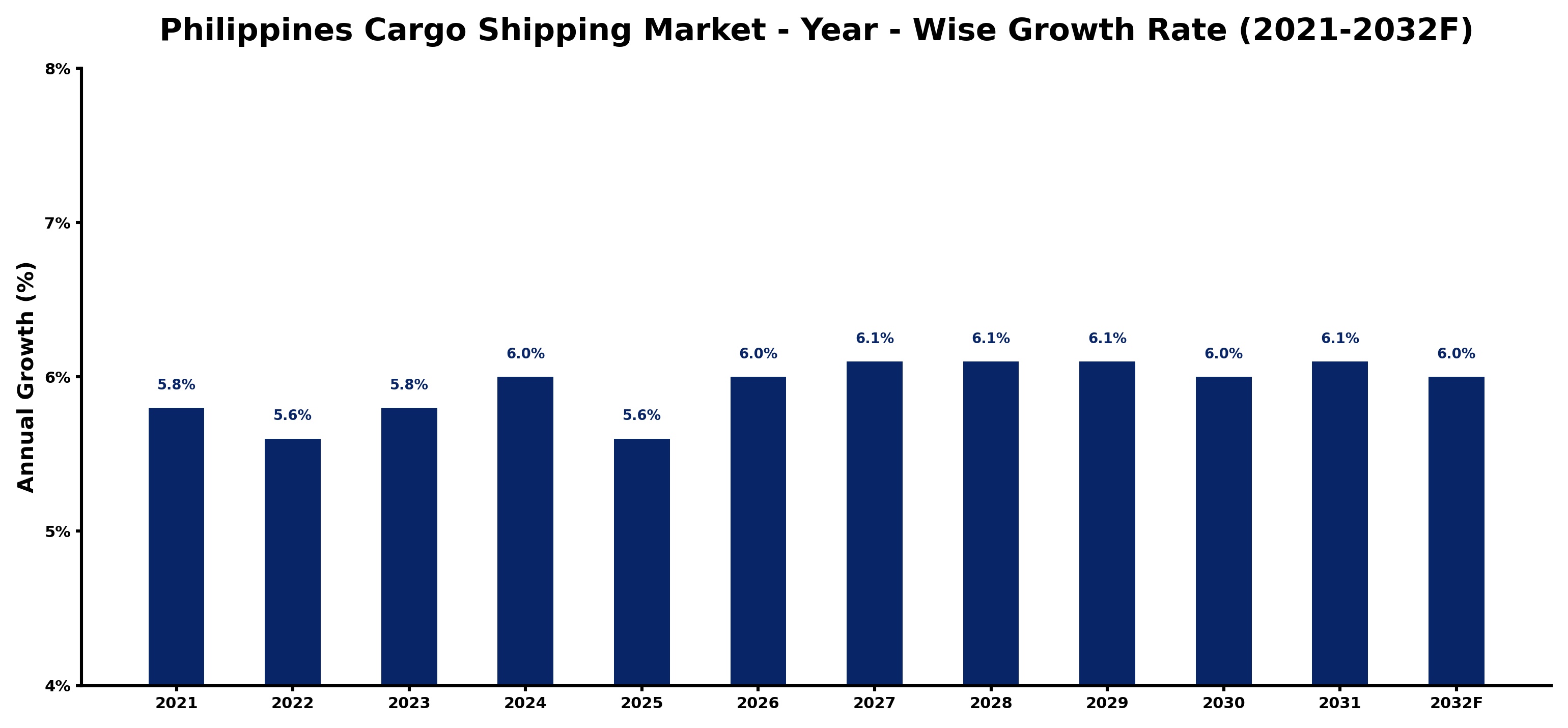
The table below presents the year‑wise growth rates along with the key drivers influencing the market
| Year | Growth Rate | Major Drivers |
| 2021 | 5.8% | Expansion of transportation and logistics networks |
| 2022 | 5.6% | Rising electricity demand across industries |
| 2023 | 5.8% | Increasing adoption of advanced technologies |
| 2024 | 6.0% | Increasing industrial infrastructure investments |
| 2025 | 5.6% | Increasing smart city development projects |
| 2026 | 6.0% | Increasing industrial infrastructure investments |
| 2027 | 6.1% | Rapid growth in telecom and data center sectors |
| 2028 | 6.1% | Growing renewable energy integration projects |
| 2029 | 6.1% | Increasing smart city development projects |
| 2030 | 6.0% | Increasing industrial infrastructure investments |
| 2031 | 6.1% | Expansion of commercial construction activities |
| 2032 | 6.0% | Increasing smart city development projects |
Note - Market size estimations and growth projections presented in this report are based on 6Wresearch's advanced forecasting approach, validated with industry datasets as of June 2026.
Philippines Cargo Shipping Market Synopsis
Recently, the Philippines cargo shipping market has experienced a notable uptick in activity, driven by governmental initiatives and robust consumer spending. However, this momentum must be contrasted with challenges like port congestion and storage inadequacies that threaten to hinder short-term expansion. As the nation looks forward, strategic investments in logistics and infrastructure development will be crucial for sustainable growth.
The current landscape is marked by ambitious government programs, including the "Build Build Build" initiative aimed at enhancing domestic manufacturing capacities. This focus on infrastructure is set to bolster port activities and facilitate smoother cargo handling, ultimately shaping a more competitive cargo shipping environment.
Philippines Cargo Shipping Market Key Takeaways
- Significant growth anticipated as international trade expands and consumer spending rises.
- Government initiatives, such as infrastructure investment, are essential for market development.
- Challenges like port congestion and inadequate storage facilities are impacting operational efficiencies.
- Foreign direct investments are expected to further stimulate import-export activities.
- Technological advancements are likely to shape operational practices within the industry.
Evaluation of Restraints in Philippines Cargo Shipping Market
Despite the positive growth outlook, the Philippines cargo shipping market faces several critical restraints. One prominent issue is the inadequate storage facilities at ports, which frequently leads to congestion. This congestion can cause significant delays in loading and unloading operations, adversely impacting vessel turnaround times and increasing overall shipping costs. Furthermore, ongoing economic uncertainties and fluctuations in public and private sector spending have created challenges for existing players in the market, making it difficult to attract new investors and secure long-term contracts.
Philippines Cargo Shipping Market Trends
A growing trend within the Philippines cargo shipping market is the adoption of advanced technology to improve operational efficiency. Companies are increasingly leveraging digital tools and data analytics to optimize routing, enhance cargo tracking, and streamline supply chain management. Additionally, there is a noticeable shift towards sustainability, with operators exploring greener shipping solutions to minimize environmental impact.
Philippines Cargo Shipping Market Opportunities
Significant opportunities for growth and investment exist within the Philippines cargo shipping sector. The expansion of regional trade agreements and increasing foreign investments present avenues for enhancing import-export capabilities. Additionally, port modernization initiatives open doors for new technologies and innovations that can enhance service delivery and operational performance.
Government Initiatives in the Philippines Cargo Shipping Market
The Philippine government has implemented various initiatives to foster growth within the cargo shipping market. The "Build Build Build" program is a centerpiece of these efforts, focusing on improving transport infrastructure, which includes port facilities. Public spending is increasingly directed towards enhancing maritime logistics, thereby encouraging private sector participation and investment, which collectively aim to improve the efficiency of cargo handling and overall shipping operations.
Future Insights of the Philippines Cargo Shipping Market
Looking ahead to the period between 2026 and 2032, the Philippines cargo shipping market is poised for substantial growth driven by a combination of infrastructure enhancements and an increase in international trade activity. Ongoing government support for maritime development, coupled with rising consumer demand and a focus on technological adoption, will likely position the market for robust expansion. Companies that adapt to these dynamics and invest in capabilities will be well-equipped to thrive in the evolving landscape.
Philippines Cargo Shipping Market Latest Developments (May 2025 - June 2026)
Recent developments in the Philippines cargo shipping market indicate a shift towards modernization and enhanced operational capabilities. Efforts are being made to upgrade port facilities and improve logistical processes, which are expected to alleviate congestion issues. Furthermore, there is an observable increase in partnerships between the public and private sectors aimed at bolstering maritime infrastructure, thereby reinforcing the overall competitive position of the industry.
Philippines Cargo Shipping Market - Key Attractiveness of the Report
- 10 Years of Market Numbers
- Historical Data Starting from 2022 to 2025
- Base Year: 2025
- Forecast Data until 2032
- Key Performance Indicators Impacting the Market
- Major Upcoming Developments and Projects
Key Highlights of the Report:
- Philippines Cargo Shipping Market Outlook
- Market Size of Philippines Cargo Shipping Market, 2025
- Forecast of Philippines Cargo Shipping Market, 2032F
- Historical Data and Forecast of Philippines Cargo Shipping Revenues & Volume for the Period 2022-2032F
- Philippines Cargo Shipping Market Trend Evolution
- Philippines Cargo Shipping Market Drivers and Challenges
- Philippines Cargo Shipping Price Trends
- Philippines Cargo Shipping Porter's Five Forces
- Philippines Cargo Shipping Industry Life Cycle
- Historical Data and Forecast of Philippines Cargo Shipping Market Revenues & Volume By Cargo Infrastructure for the Period 2022-2032F
- Historical Data and Forecast of Philippines Cargo Shipping Market Revenues & Volume By Port Developments in Asia for the Period 2022-2032F
- Historical Data and Forecast of Philippines Cargo Shipping Market Revenues & Volume By Port Developments in Europe for the Period 2022-2032F
- Historical Data and Forecast of Philippines Cargo Shipping Market Revenues & Volume By Port Developments in North America for the Period 2022-2032F
- Historical Data and Forecast of Philippines Cargo Shipping Market Revenues & Volume By Port Developments in South America for the Period 2022-2032F
- Historical Data and Forecast of Philippines Cargo Shipping Market Revenues & Volume By Port Developments in Africa for the Period 2022-2032F
- Historical Data and Forecast of Philippines Cargo Shipping Market Revenues & Volume By Cargo Type for the Period 2022-2032F
- Historical Data and Forecast of Philippines Cargo Shipping Market Revenues & Volume By Container Cargo for the Period 2022-2032F
- Historical Data and Forecast of Philippines Cargo Shipping Market Revenues & Volume By Bulk Cargo for the Period 2022-2032F
- Historical Data and Forecast of Philippines Cargo Shipping Market Revenues & Volume By General Cargo for the Period 2022-2032F
- Historical Data and Forecast of Philippines Cargo Shipping Market Revenues & Volume By Oil & Gas for the Period 2022-2032F
- Historical Data and Forecast of Philippines Cargo Shipping Market Revenues & Volume By Industry Type for the Period 2022-2032F
- Historical Data and Forecast of Philippines Cargo Shipping Market Revenues & Volume By Food, Manufacturing for the Period 2022-2032F
- Historical Data and Forecast of Philippines Cargo Shipping Market Revenues & Volume By Oil & Ores for the Period 2022-2032F
- Historical Data and Forecast of Philippines Cargo Shipping Market Revenues & Volume By Electrical & Electronics for the Period 2022-2032F
- Philippines Cargo Shipping Import Export Trade Statistics
- Market Opportunity Assessment By Cargo Infrastructure
- Market Opportunity Assessment By Cargo Type
- Market Opportunity Assessment By Industry Type
- Philippines Cargo Shipping Top Companies Market Share
- Philippines Cargo Shipping Competitive Benchmarking By Technical and Operational Parameters
- Philippines Cargo Shipping Company Profiles
- Philippines Cargo Shipping Key Strategic Recommendations






































