Philippines Castor Oil Market Top 5 Importing Countries and Market Competition (HHI) Analysis
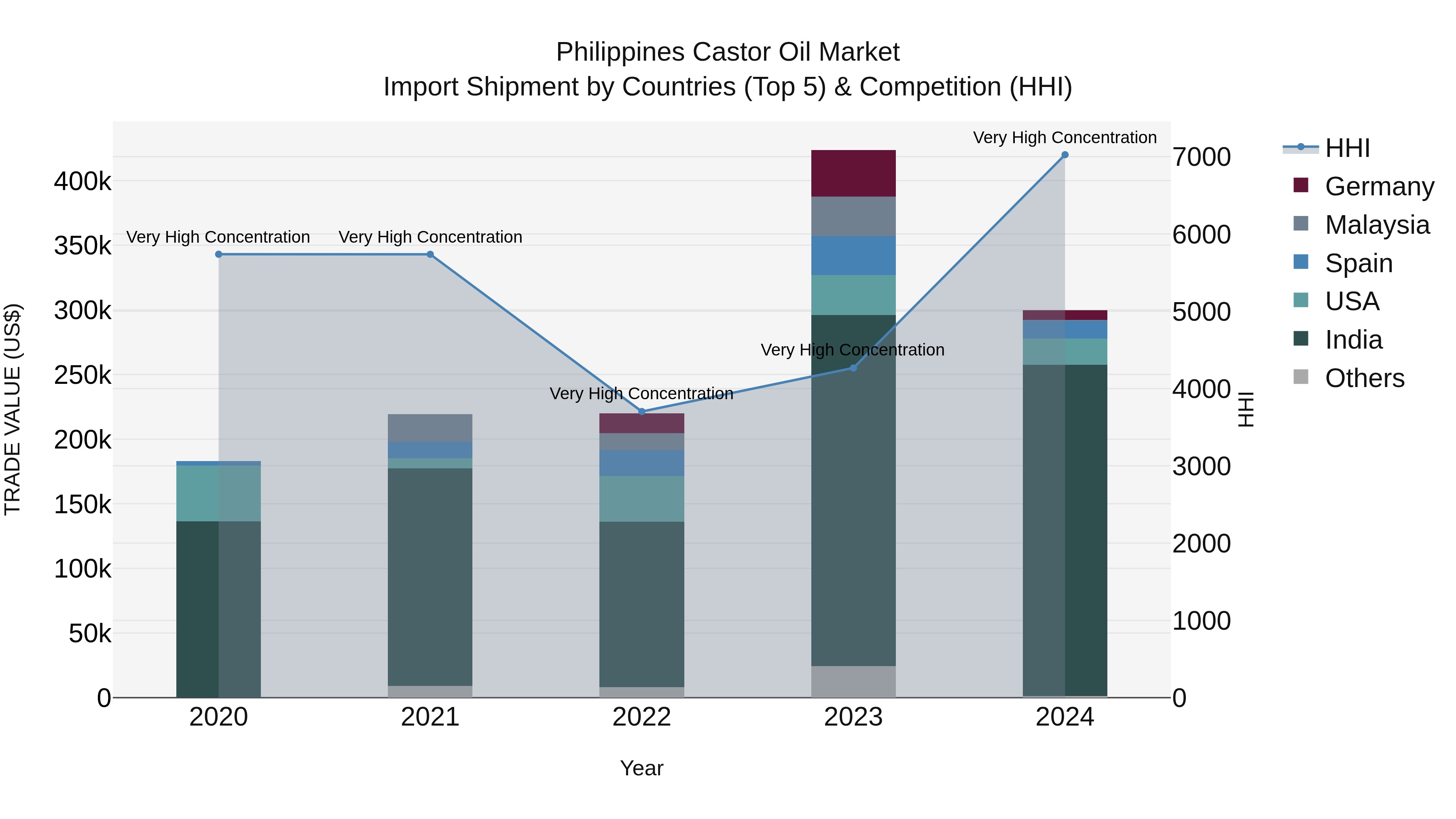
In 2024, the Philippines continued to see robust import shipments of castor oil, with top exporters including India, USA, Spain, Germany, and Belgium. Despite the high concentration of the market, the industry experienced a strong compound annual growth rate (CAGR) of 13.13% from 2020 to 2024. However, there was a notable decline in the growth rate from 2023 to 2024 at -29.21%, indicating a potential shift in market dynamics. Monitoring these trends closely will be crucial for stakeholders in the castor oil import market in the Philippines.
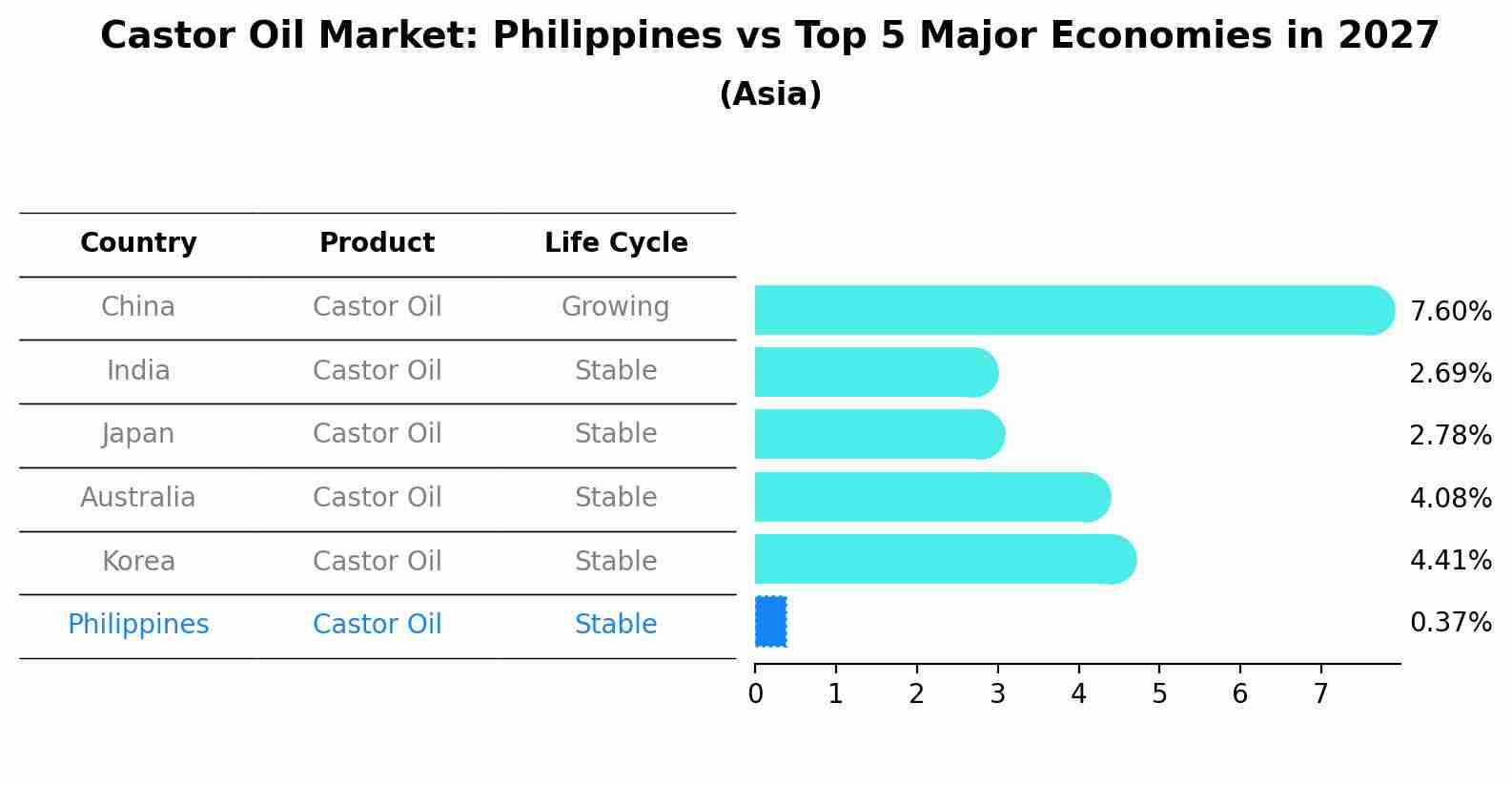
Castor Oil Market: Philippines vs Top 5 Major Economies in 2027 (Asia)
By 2027, the Castor Oil market in Philippines is anticipated to reach a growth rate of 0.37%, as part of an increasingly competitive Asia region, where China remains at the forefront, supported by India, Japan, Australia and South Korea, driving innovations and market adoption across sectors.
philippines castor oil market Synopsis
The market for castor oil, a versatile vegetable oil known for its industrial and medicinal applications, is also notable in the Philippines. Castor oil`s use in sectors such as cosmetics, pharmaceuticals, and manufacturing has kept its demand resilient. Its renewable nature and potential for bio-based industries contribute to its market stability.
Drivers of the Market
The Philippines Castor Oil market growth is influenced by the various industrial applications of castor oil, including cosmetics, pharmaceuticals, and manufacturing. Castor oil`s unique properties, such as its viscosity and lubricating capabilities, make it valuable in different sectors. Moreover, the increasing demand for sustainable and bio-based products further drives the use of castor oil in various applications, contributing to the market`s expansion.
Challenges of the Market
The Philippines castor oil market encounters challenges associated with seed availability, oil extraction technology, and market awareness. Castor oil is derived from castor beans, and securing a consistent supply of high-quality seeds can be challenging. Efficient and environmentally friendly oil extraction methods are essential for maintaining product quality. Moreover, educating consumers about the benefits and applications of castor oil is necessary for building market demand. Promoting sustainable castor cultivation practices and improving seed varieties are strategies for overcoming these challenges.
COVID-19 Impact on the Market
The COVID-19 pandemic had varying impacts on the Philippines castor oil market. The closure of cosmetic, pharmaceutical, and industrial facilities affected demand for castor oil in these sectors. However, the health and wellness trend increased interest in natural products, including castor oil, potentially opening new market opportunities. Supply chain disruptions and export challenges, coupled with reduced consumer spending, shaped the market`s dynamics during the pandemic.
Key Players in the Market
The key players in the Philippines castor oil market are Kama Ayurveda Private Limited, B&T Industries Limited, Amoli Organics Pvt Ltd., Dehradun Surucas India Pvt Ltd., VEDIKA OILS & FATS PVT LTD, ONV Natural Oils & Flours LLP, Rekah Pharmaceuticals Pvt Ltd., Indo-World Trade Links Corporation and Prakash Chemicals International Private Limited.
Key Highlights of the Report:
- Philippines Castor Oil Market Outlook
- Market Size of Philippines Castor Oil Market, 2024
- Forecast of Philippines Castor Oil Market, 2031
- Historical Data and Forecast of Philippines Castor Oil Revenues & Volume for the Period 2021-2031
- Philippines Castor Oil Market Trend Evolution
- Philippines Castor Oil Market Drivers and Challenges
- Philippines Castor Oil Price Trends
- Philippines Castor Oil Porter's Five Forces
- Philippines Castor Oil Industry Life Cycle
- Historical Data and Forecast of Philippines Castor Oil Market Revenues & Volume By End Use for the Period 2021-2031
- Historical Data and Forecast of Philippines Castor Oil Market Revenues & Volume By Pharmaceuticals for the Period 2021-2031
- Historical Data and Forecast of Philippines Castor Oil Market Revenues & Volume By Lubricants for the Period 2021-2031
- Historical Data and Forecast of Philippines Castor Oil Market Revenues & Volume By Paints for the Period 2021-2031
- Historical Data and Forecast of Philippines Castor Oil Market Revenues & Volume By Soaps for the Period 2021-2031
- Historical Data and Forecast of Philippines Castor Oil Market Revenues & Volume By Others for the Period 2021-2031
- Philippines Castor Oil Import Export Trade Statistics
- Market Opportunity Assessment By End Use
- Philippines Castor Oil Top Companies Market Share
- Philippines Castor Oil Competitive Benchmarking By Technical and Operational Parameters
- Philippines Castor Oil Company Profiles
- Philippines Castor Oil Key Strategic Recommendations






































