Philippines Cattle Feed Market Top 5 Importing Countries and Market Competition (HHI) Analysis
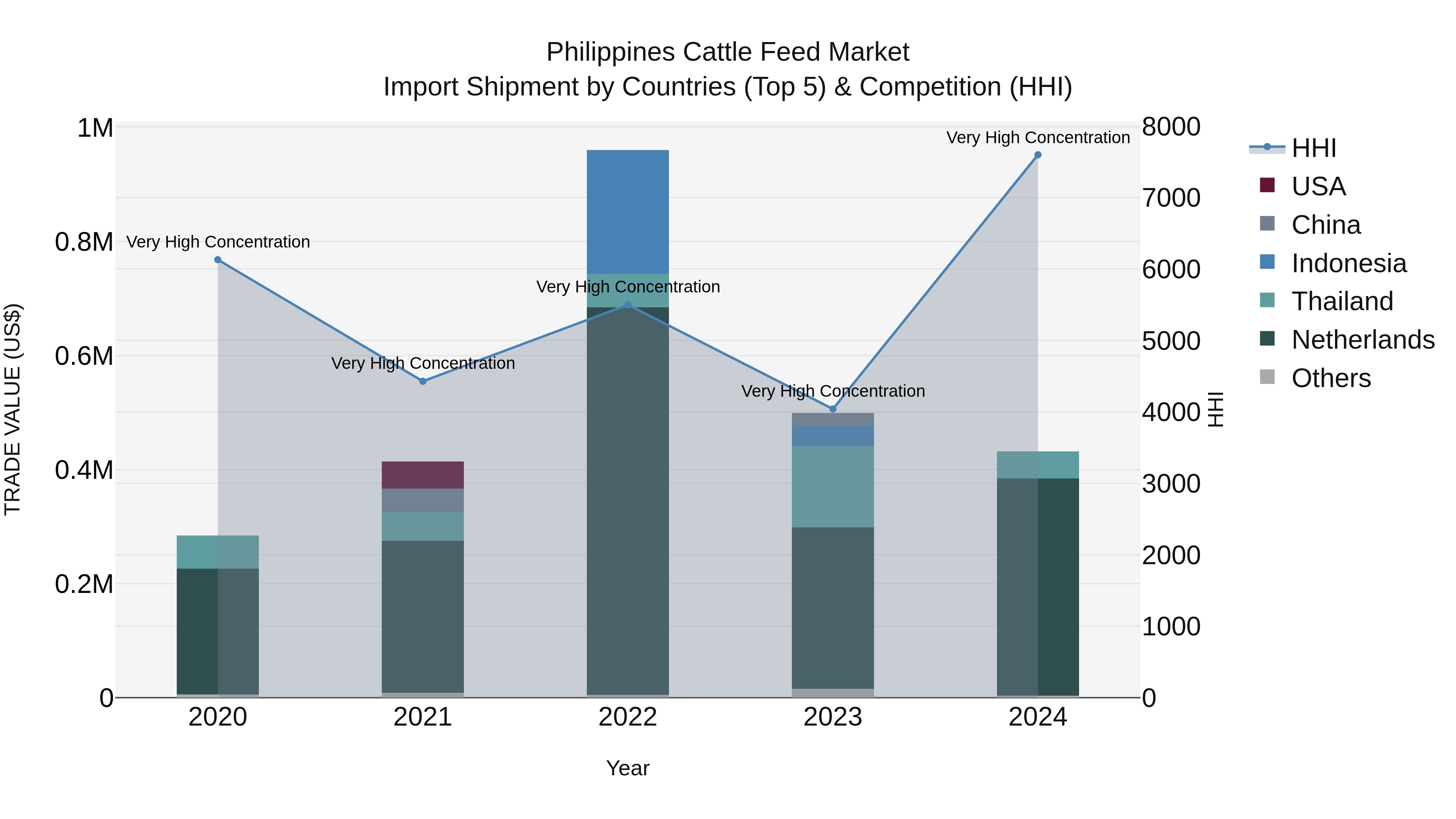
The Philippines cattle feed import market continues to be dominated by a handful of key players, with the top exporting countries in 2024 being the Netherlands, Thailand, UK, Germany, and Belgium. Despite a slight decline in growth rate from 2023 to 2024, the market has shown strong overall growth with a CAGR of 11.0% from 2020 to 2024. The high concentration of the Herfindahl-Hirschman Index (HHI) indicates the continued dominance of these major exporting countries in the market, highlighting the importance of understanding and monitoring their impact on the Philippines` cattle feed industry.
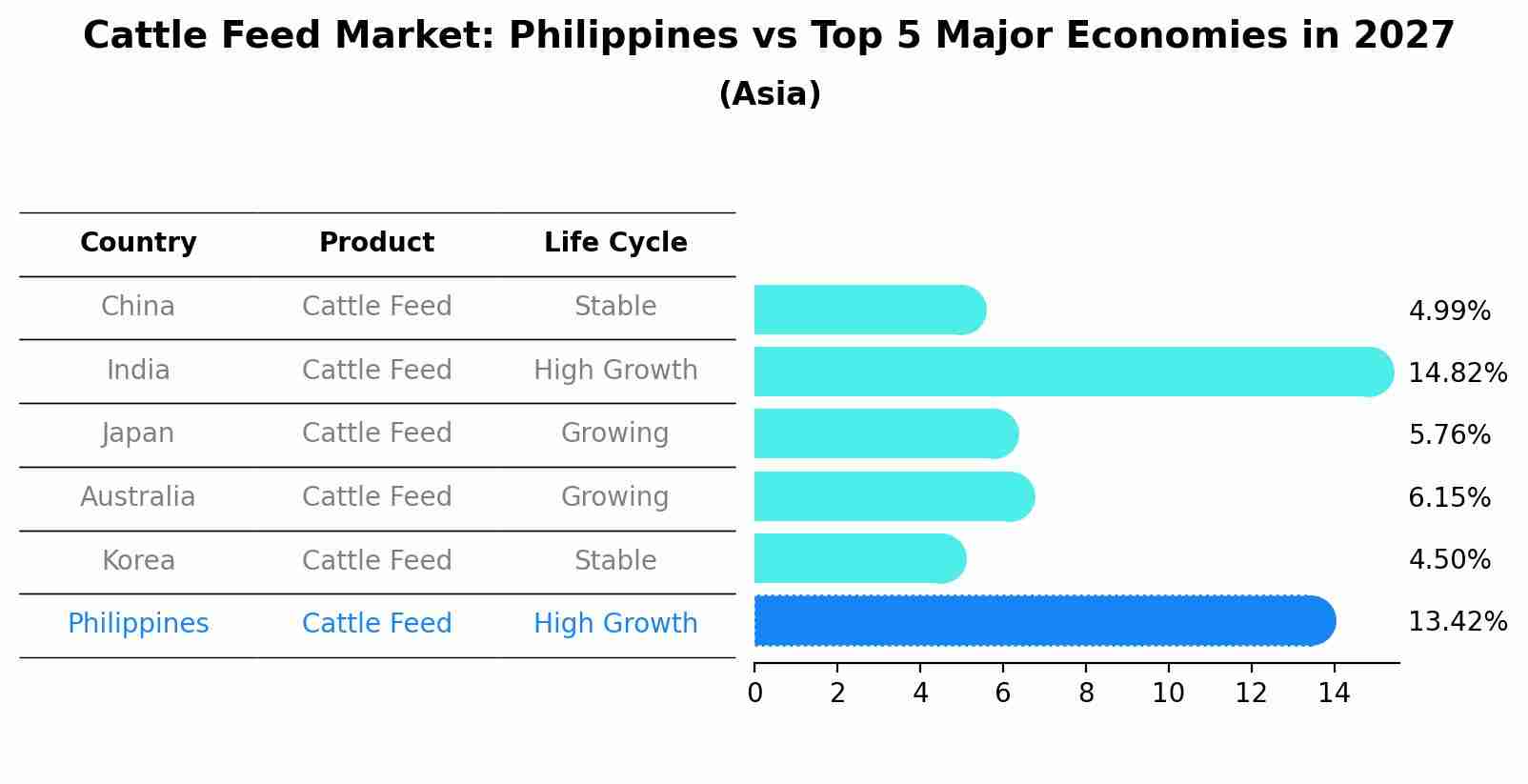
Cattle Feed Market: Philippines vs Top 5 Major Economies in 2027 (Asia)
By 2027, the Cattle Feed market in Philippines is anticipated to reach a growth rate of 13.42%, as part of an increasingly competitive Asia region, where China remains at the forefront, supported by India, Japan, Australia and South Korea, driving innovations and market adoption across sectors.
philippines cattle feed market Synopsis
The cattle feed industry has witnessed steady growth over recent years on account of rising meat consumption attributed primarily due healthier diets among urban consumers coupled with sustainable government policies towards livestock production management which includes initiatives such as providing subsidized feeds for farmers & encouraging use of balanced nutrition feed through various schemes provided under Department Of Agriculture (DOA). As per latest reports, total revenue generated through sale of cattle feed reached approximately US$520 million in 2025 while it?s expected to grow steadily at an approximate rate 7. 1% during the forecast period driven mainly by developments associated with industrialization & automation including mechanized farming practices boosting efficiency levels within farms thereby enabling significant reduction cost incurred towards labor expenditure.
Drivers of the Market
The Philippines cattle feed market is primarily driven by the country`s livestock industry and the need for efficient and balanced feed formulations. With the growing population`s demand for meat products, the cattle sector plays a significant role. The market is influenced by factors such as optimized nutrition, animal health concerns, and the desire to enhance meat quality and production efficiency. Additionally, the implementation of modern farming practices further drives the demand for cattle feed.
Challenges of the Market
In the Philippines cattle feed market, fluctuations in the prices of raw materials like corn and soybean meal pose significant challenges. These price changes can impact the overall production costs for cattle feed manufacturers, making it difficult to maintain stable pricing for consumers. Moreover, ensuring consistent quality control in the production process across different batches of feed is another challenge, as variations can affect cattle health and growth.
COVID-19 Impact on the Market
The Philippines cattle feed market faced fluctuations due to the COVID-19 pandemic. The disruption of supply chains and restrictions on movement impacted the availability of feed ingredients. The closure of restaurants and reduced demand from food service establishments also influenced the market. However, as the agriculture sector gradually adapted to the new normal, including changes in distribution and sales channels, the market showed signs of recovery. The resilience of the cattle feed market was linked to the broader revival of the livestock and dairy industries.
Key Players in the Market
San Miguel Foods, Inc., Universal Robina Corporation, Cargill Philippines, and Vitarich Corporation.
Key Highlights of the Report:
- Philippines Cattle Feed Market Outlook
- Market Size of Philippines Cattle Feed Market, 2024
- Forecast of Philippines Cattle Feed Market, 2031
- Historical Data and Forecast of Philippines Cattle Feed Revenues & Volume for the Period 2021-2031
- Philippines Cattle Feed Market Trend Evolution
- Philippines Cattle Feed Market Drivers and Challenges
- Philippines Cattle Feed Price Trends
- Philippines Cattle Feed Porter's Five Forces
- Philippines Cattle Feed Industry Life Cycle
- Historical Data and Forecast of Philippines Cattle Feed Market Revenues & Volume By Source for the Period 2021-2031
- Historical Data and Forecast of Philippines Cattle Feed Market Revenues & Volume By Organic for the Period 2021-2031
- Historical Data and Forecast of Philippines Cattle Feed Market Revenues & Volume By Conventional for the Period 2021-2031
- Historical Data and Forecast of Philippines Cattle Feed Market Revenues & Volume By Application for the Period 2021-2031
- Historical Data and Forecast of Philippines Cattle Feed Market Revenues & Volume By Agriculture for the Period 2021-2031
- Historical Data and Forecast of Philippines Cattle Feed Market Revenues & Volume By Industrial for the Period 2021-2031
- Historical Data and Forecast of Philippines Cattle Feed Market Revenues & Volume By Sales Channel for the Period 2021-2031
- Historical Data and Forecast of Philippines Cattle Feed Market Revenues & Volume By Direct Sales for the Period 2021-2031
- Historical Data and Forecast of Philippines Cattle Feed Market Revenues & Volume By Indirect Sales for the Period 2021-2031
- Philippines Cattle Feed Import Export Trade Statistics
- Market Opportunity Assessment By Source
- Market Opportunity Assessment By Application
- Market Opportunity Assessment By Sales Channel
- Philippines Cattle Feed Top Companies Market Share
- Philippines Cattle Feed Competitive Benchmarking By Technical and Operational Parameters
- Philippines Cattle Feed Company Profiles
- Philippines Cattle Feed Key Strategic Recommendations






































