Philippines Ceramic Substrate Market Top 5 Importing Countries and Market Competition (HHI) Analysis
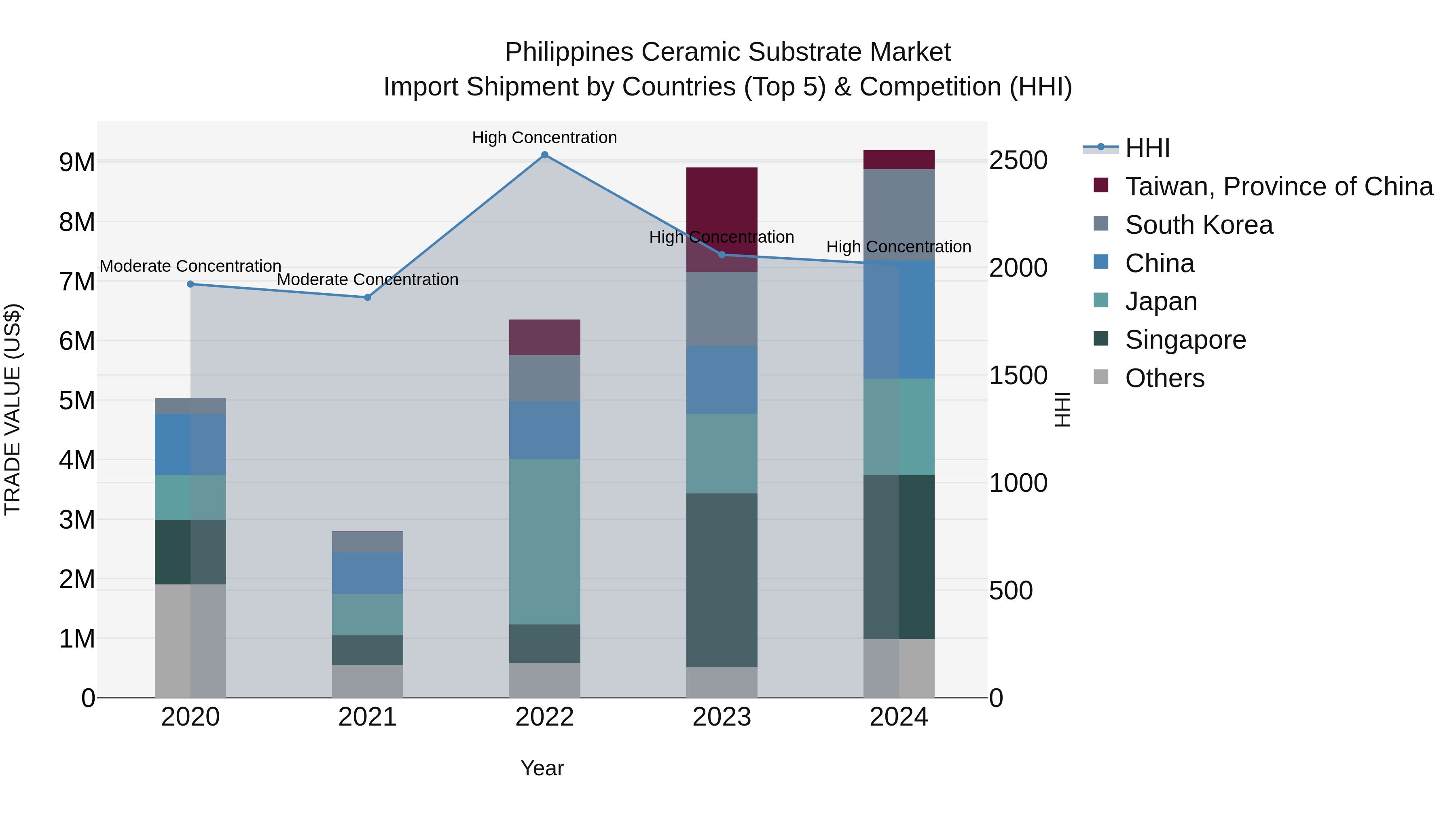
The Philippines` ceramic substrate import market in 2024 continued to showcase strong growth, with top exporting countries including Singapore, China, Japan, South Korea, and the USA. The high Herfindahl-Hirschman Index (HHI) indicates a concentrated market, while the impressive Compound Annual Growth Rate (CAGR) of 16.24% from 2020 to 2024 reflects sustained expansion. Despite a slightly lower growth rate of 3.27% from 2023 to 2024, the overall outlook remains positive, emphasizing the significance of these key importing nations in driving the ceramic substrate trade in the Philippines.
Philippines Ceramic Substrate Market Overview
The ceramic substrate market in the Philippines is growing alongside the electronics and automotive industries. Ceramic substrates provide excellent thermal conductivity, electrical insulation, and mechanical strength, making them essential in circuits, sensors, and LED applications. Advances in electric vehicles and 5G technologies are expected to drive further demand.
Trends of the market
The ceramic substrate market is growing, supported by rising demand in electronics, automotive, and LED industries. Trends show a shift toward substrates with superior thermal conductivity and miniaturization capabilities, which are critical for modern high-performance electronic devices.
Challenges of the market
The Ceramic Substrate Market in the Philippines faces challenges related to the high production costs of ceramic materials, which are compounded by limited local manufacturing capabilities. Additionally, the market`s growth is restricted by a lack of awareness of the importance of ceramic substrates in electronics and other industries. The high competition from alternative substrate materials and the rising demand for more efficient products in the electronics sector put additional pressure on the market.
Investment opportunities in the Market
The ceramic substrate market in the Philippines holds strong investment potential, especially with the increasing demand for electronic components and high-performance materials. Ceramic substrates are crucial for the manufacturing of electronic devices, particularly in industries such as automotive, telecommunications, and consumer electronics. With the Philippines positioning itself as a growing hub for electronics manufacturing, there is a growing need for reliable, high-quality ceramic substrates. Investors can explore opportunities in the production of advanced ceramic substrates, focusing on innovations that improve electrical performance, thermal conductivity, and miniaturization.
Government Policy of the market
In the ceramic substrate market, the Philippine government encourages research and development in advanced materials for use in electronics and other high-tech applications. Policies promote the local production of ceramic substrates used in electronic devices and support the creation of production hubs. Tax incentives and research funding are available for companies focused on innovation in materials science. The government also works on strengthening local supply chains to ensure the availability of quality materials.
Key Highlights of the Report:
- Philippines Ceramic Substrate Market Outlook
- Market Size of Philippines Ceramic Substrate Market, 2024
- Forecast of Philippines Ceramic Substrate Market, 2031
- Historical Data and Forecast of Philippines Ceramic Substrate Revenues & Volume for the Period 2021- 2031
- Philippines Ceramic Substrate Market Trend Evolution
- Philippines Ceramic Substrate Market Drivers and Challenges
- Philippines Ceramic Substrate Price Trends
- Philippines Ceramic Substrate Porter's Five Forces
- Philippines Ceramic Substrate Industry Life Cycle
- Historical Data and Forecast of Philippines Ceramic Substrate Market Revenues & Volume By Product Type for the Period 2021- 2031
- Historical Data and Forecast of Philippines Ceramic Substrate Market Revenues & Volume By Alumina Substrates for the Period 2021- 2031
- Historical Data and Forecast of Philippines Ceramic Substrate Market Revenues & Volume By Aluminum Nitride Substrates for the Period 2021- 2031
- Historical Data and Forecast of Philippines Ceramic Substrate Market Revenues & Volume By Beryllium Oxide Substrates for the Period 2021- 2031
- Historical Data and Forecast of Philippines Ceramic Substrate Market Revenues & Volume By Silicon Nitride Substrates for the Period 2021- 2031
- Historical Data and Forecast of Philippines Ceramic Substrate Market Revenues & Volume By Other for the Period 2021- 2031
- Historical Data and Forecast of Philippines Ceramic Substrate Market Revenues & Volume By End-Use for the Period 2021- 2031
- Historical Data and Forecast of Philippines Ceramic Substrate Market Revenues & Volume By Consumer Electronics for the Period 2021- 2031
- Historical Data and Forecast of Philippines Ceramic Substrate Market Revenues & Volume By Automotive for the Period 2021- 2031
- Historical Data and Forecast of Philippines Ceramic Substrate Market Revenues & Volume By Telecom for the Period 2021- 2031
- Historical Data and Forecast of Philippines Ceramic Substrate Market Revenues & Volume By Military & Avionics for the Period 2021- 2031
- Historical Data and Forecast of Philippines Ceramic Substrate Market Revenues & Volume By Industrial for the Period 2021- 2031
- Historical Data and Forecast of Philippines Ceramic Substrate Market Revenues & Volume By Others for the Period 2021- 2031
- Philippines Ceramic Substrate Import Export Trade Statistics
- Market Opportunity Assessment By Product Type
- Market Opportunity Assessment By End-Use
- Philippines Ceramic Substrate Top Companies Market Share
- Philippines Ceramic Substrate Competitive Benchmarking By Technical and Operational Parameters
- Philippines Ceramic Substrate Company Profiles
- Philippines Ceramic Substrate Key Strategic Recommendations






































