Philippines Cladding Market Top 5 Importing Countries and Market Competition (HHI) Analysis
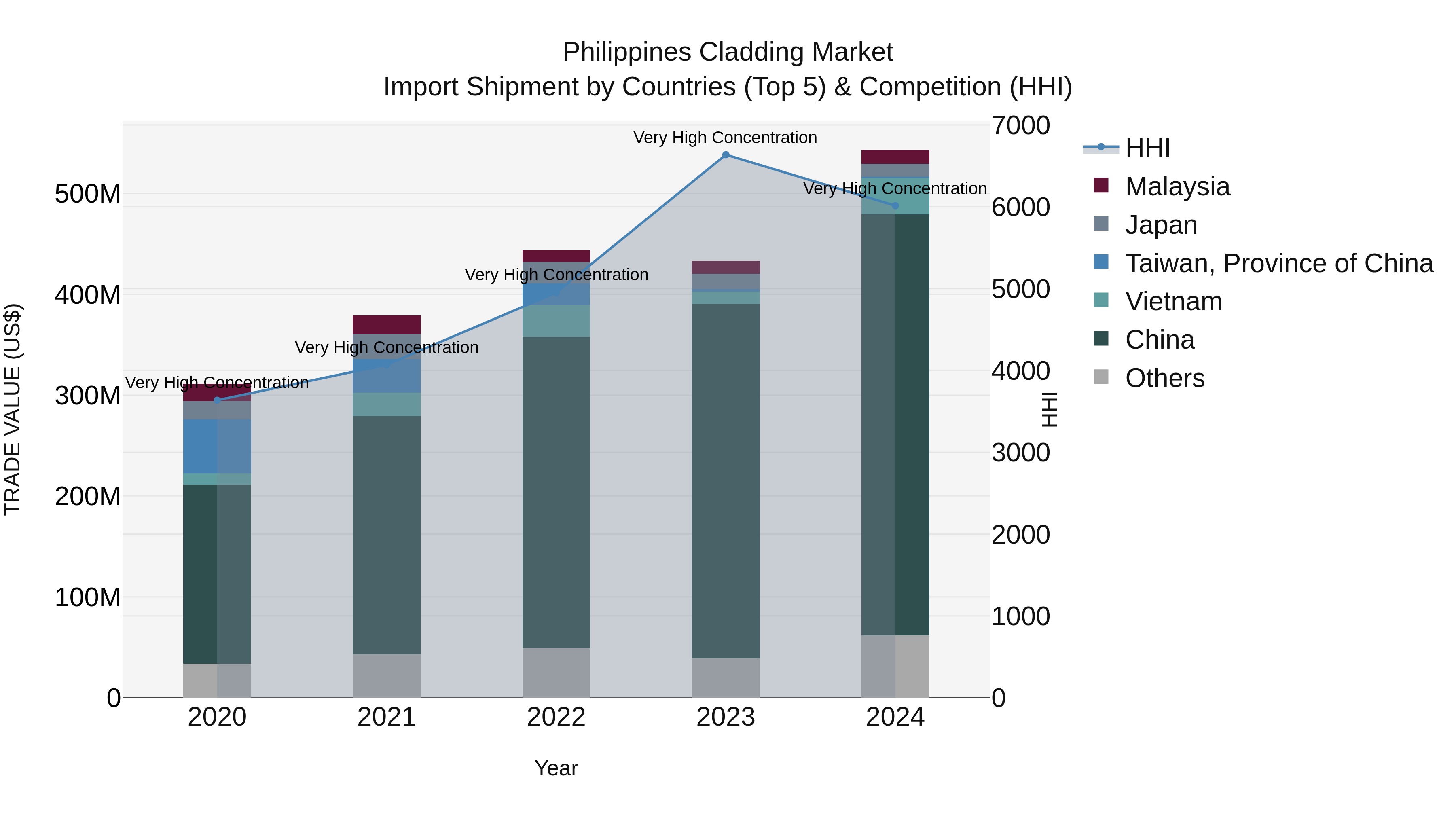
The Philippines continues to be a key market for cladding import shipments, with top exporters in 2024 being China, Vietnam, UK, Malaysia, and Japan. Despite high concentration with a high Herfindahl-Hirschman Index (HHI) in 2024, the industry shows strong growth potential with a Compound Annual Growth Rate (CAGR) of 14.92% from 2020 to 2024. The growth rate from 2023 to 2024 surged by 25.39%, indicating increasing demand for cladding materials in the Philippines market. This trend suggests a positive outlook for the cladding import sector in the coming years.
Philippines Cladding Market Overview
The cladding market in the Philippines is expanding with the boom in commercial and residential construction. Cladding enhances building aesthetics and provides thermal insulation and weather protection. The market sees rising demand for innovative materials, such as composite and metal cladding, aligned with modern architectural trends.
Trends of the market
The Cladding market in the Philippines is growing as the construction industry expands and developers focus on both aesthetic and functional building materials. Cladding, used to protect and enhance the appearance of buildings, is gaining popularity in both residential and commercial construction projects. The shift towards energy-efficient and sustainable buildings is also boosting the demand for high-quality cladding materials.
Challenges of the market
Cladding faces hurdles related to building safety regulations and environmental concerns, especially after high-profile fire incidents. High installation costs and limited skilled workforce slow down market growth.
Investment opportunities in the Market
The Philippines Cladding Market is expanding due to the increasing demand for aesthetic and functional building materials in construction and renovation projects. Investors can take advantage of opportunities in providing cladding solutions for both residential and commercial properties, focusing on energy efficiency, sustainability, and innovative designs. The growing construction industry and the need for improved building exteriors provide solid growth potential.
Government Policy of the market
The Philippine government encourages the use of high-quality cladding materials through building codes and regulations focused on safety, durability, and energy efficiency. The Department of Public Works and Highways (DPWH) and local government units enforce standards for building facades, which boost demand for modern cladding solutions. Initiatives to promote sustainable and disaster-resilient buildings also contribute to market growth, as developers seek innovative cladding products that meet both aesthetic and regulatory requirements.
Key Highlights of the Report:
- Philippines Cladding Market Outlook
- Market Size of Philippines Cladding Market, 2024
- Forecast of Philippines Cladding Market, 2031
- Historical Data and Forecast of Philippines Cladding Revenues & Volume for the Period 2021- 2031
- Philippines Cladding Market Trend Evolution
- Philippines Cladding Market Drivers and Challenges
- Philippines Cladding Price Trends
- Philippines Cladding Porter's Five Forces
- Philippines Cladding Industry Life Cycle
- Historical Data and Forecast of Philippines Cladding Market Revenues & Volume By Product for the Period 2021- 2031
- Historical Data and Forecast of Philippines Cladding Market Revenues & Volume By Steel for the Period 2021- 2031
- Historical Data and Forecast of Philippines Cladding Market Revenues & Volume By Aluminum for the Period 2021- 2031
- Historical Data and Forecast of Philippines Cladding Market Revenues & Volume By Composite Material for the Period 2021- 2031
- Historical Data and Forecast of Philippines Cladding Market Revenues & Volume By Fiber Cement for the Period 2021- 2031
- Historical Data and Forecast of Philippines Cladding Market Revenues & Volume By Terracotta for the Period 2021- 2031
- Historical Data and Forecast of Philippines Cladding Market Revenues & Volume By Ceramic for the Period 2021- 2031
- Historical Data and Forecast of Philippines Cladding Market Revenues & Volume By Others for the Period 2021- 2031
- Historical Data and Forecast of Philippines Cladding Market Revenues & Volume By Application for the Period 2021- 2031
- Historical Data and Forecast of Philippines Cladding Market Revenues & Volume By Residential for the Period 2021- 2031
- Historical Data and Forecast of Philippines Cladding Market Revenues & Volume By Industrial for the Period 2021- 2031
- Historical Data and Forecast of Philippines Cladding Market Revenues & Volume By Commercial for the Period 2021- 2031
- Historical Data and Forecast of Philippines Cladding Market Revenues & Volume By Offices for the Period 2021- 2031
- Historical Data and Forecast of Philippines Cladding Market Revenues & Volume By Institutional for the Period 2021- 2031
- Philippines Cladding Import Export Trade Statistics
- Market Opportunity Assessment By Product
- Market Opportunity Assessment By Application
- Philippines Cladding Top Companies Market Share
- Philippines Cladding Competitive Benchmarking By Technical and Operational Parameters
- Philippines Cladding Company Profiles
- Philippines Cladding Key Strategic Recommendations






































