Philippines Cocktail Mixers Market Top 5 Importing Countries and Market Competition (HHI) Analysis
The Philippines continues to rely on imports for cocktail mixers, with top exporters in 2024 being Malaysia, USA, Indonesia, Thailand, and Italy. Despite the diversity of sources, the market shows low concentration with a low Herfindahl-Hirschman Index (HHI) in 2024. The industry experienced a slight decline with a compound annual growth rate (CAGR) of -0.25% from 2020 to 2024. However, there was a positive growth rate of 7.36% from 2023 to 2024, indicating potential for recovery and expansion in the coming years.
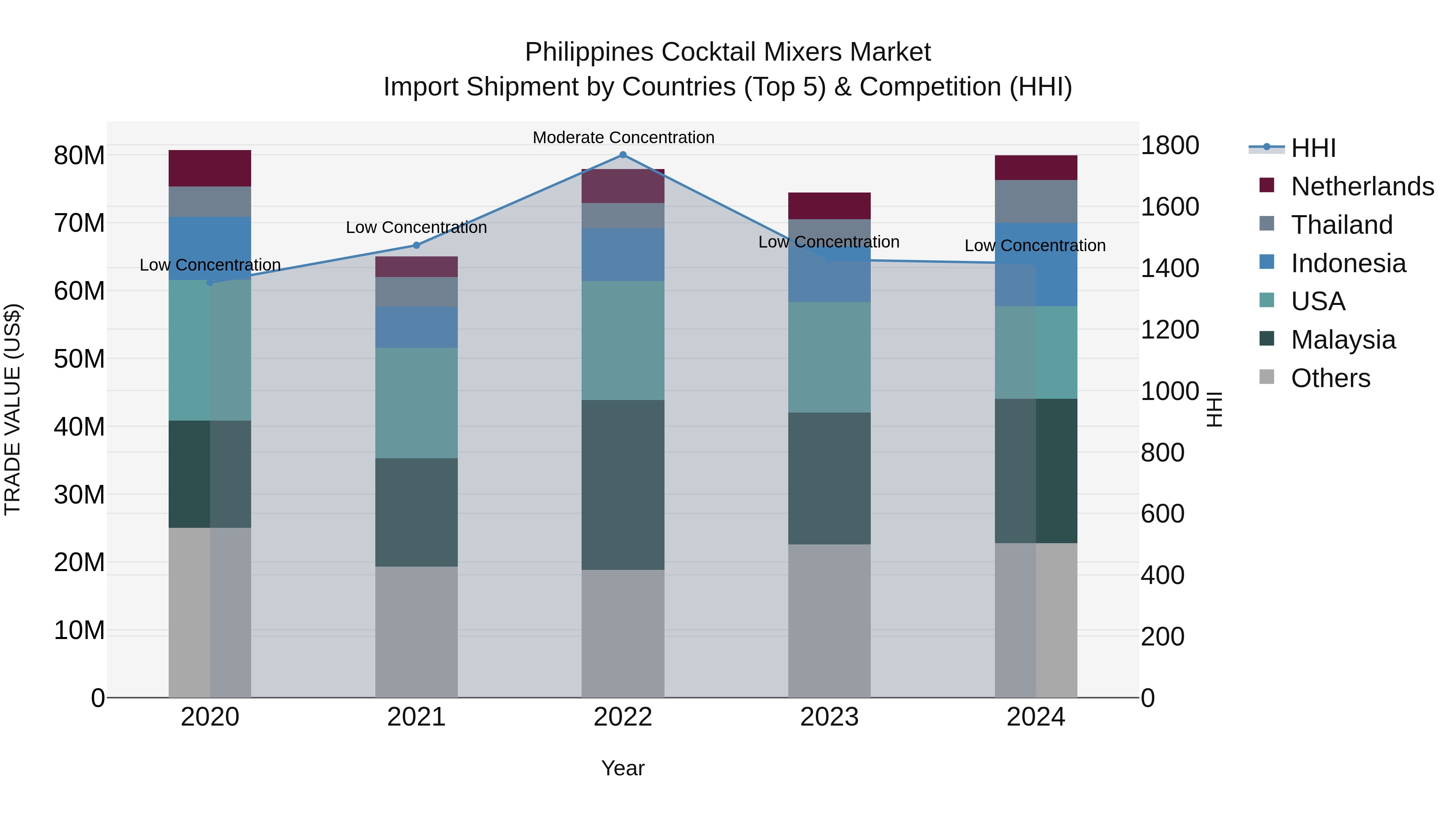
Philippines Cocktail Mixers Market Synopsis
As the local hospitality and entertainment sectors rebound, the cocktail mixers market in the Philippines is expanding. A rise in home mixology trends and increasing popularity of Western drinking culture contribute to this growth. Both alcoholic and non-alcoholic mixers are in demand, with a focus on premium and artisanal products.
Trends of the market
The cocktail mixers market in the Philippines is gaining popularity due to the rise of at-home mixology, a vibrant nightlife culture, and expanding hospitality venues. With more consumers experimenting with cocktails, there is growing demand for ready-to-use mixers, premium flavors, and non-alcoholic blends. E-commerce platforms are also facilitating access to niche mixer brands. However, the market is seasonal and sensitive to fluctuations in alcohol consumption patterns.
Challenges of the market
The cocktail mixers market is hampered by inconsistent demand tied to tourism and nightlife trends, both of which are vulnerable to economic downturns and regulatory changes. High import costs and a limited local production base increase prices. Furthermore, alcohol-related regulations and licensing challenges can restrict marketing and sales, while consumer awareness of premium mixer options remains underdeveloped.
Investment opportunities in the Market
The growing cocktail culture in urban centers like Manila is driving demand for premium and artisanal cocktail mixers. Investment opportunities exist in developing local brands, expanding online alcohol delivery platforms, and distributing imported mixers to bars, hotels, and retail outlets. Private-label products for bars and supermarkets offer a scalable revenue model, especially as tourism and nightlife revive post-pandemic.
Government Policy of the market
The cocktail mixers market falls under the DTIs Food and Beverage Industry Roadmap. Food safety and labeling policies are regulated by the Food and Drug Administration (FDA). There is active promotion of value-added agri-products, including mixers based on local fruits and botanicals. Export-oriented manufacturers of mixers may benefit from branding support, packaging innovation grants, and simplified licensing through the One Town, One Product and Go Lokal programs.
Key Highlights of the Report:
- Philippines Cocktail Mixers Market Outlook
- Market Size of Philippines Cocktail Mixers Market, 2024
- Forecast of Philippines Cocktail Mixers Market, 2031
- Historical Data and Forecast of Philippines Cocktail Mixers Revenues & Volume for the Period 2021- 2031
- Philippines Cocktail Mixers Market Trend Evolution
- Philippines Cocktail Mixers Market Drivers and Challenges
- Philippines Cocktail Mixers Price Trends
- Philippines Cocktail Mixers Porter's Five Forces
- Philippines Cocktail Mixers Industry Life Cycle
- Historical Data and Forecast of Philippines Cocktail Mixers Market Revenues & Volume By Product for the Period 2021- 2031
- Historical Data and Forecast of Philippines Cocktail Mixers Market Revenues & Volume By Tonic Water for the Period 2021- 2031
- Historical Data and Forecast of Philippines Cocktail Mixers Market Revenues & Volume By Club Soda for the Period 2021- 2031
- Historical Data and Forecast of Philippines Cocktail Mixers Market Revenues & Volume By Ginger for the Period 2021- 2031
- Historical Data and Forecast of Philippines Cocktail Mixers Market Revenues & Volume By Others for the Period 2021- 2031
- Historical Data and Forecast of Philippines Cocktail Mixers Market Revenues & Volume By Distribution Channel for the Period 2021- 2031
- Historical Data and Forecast of Philippines Cocktail Mixers Market Revenues & Volume By On-trade for the Period 2021- 2031
- Historical Data and Forecast of Philippines Cocktail Mixers Market Revenues & Volume By Off-trade for the Period 2021- 2031
- Philippines Cocktail Mixers Import Export Trade Statistics
- Market Opportunity Assessment By Product
- Market Opportunity Assessment By Distribution Channel
- Philippines Cocktail Mixers Top Companies Market Share
- Philippines Cocktail Mixers Competitive Benchmarking By Technical and Operational Parameters
- Philippines Cocktail Mixers Company Profiles
- Philippines Cocktail Mixers Key Strategic Recommendations






































