Philippines Construction and Mining Equipment Market Size, Share & Growth Rate
The Philippines Construction and Mining Equipment Market was estimated at USD 1097 Million in 2025 and is projected to reach USD 1599 Million by 2032, growing at a CAGR of 5.5% from 2026 to 2032. This growth trajectory is primarily driven by robust infrastructure development initiatives and increased investment in mining activities, reflecting the governments commitment to enhancing national productivity. The rising need for modern machinery to meet project timelines further underscores the burgeoning demand in this sector.
Philippines Construction and Mining Equipment Market Year-wise Growth Rate and Key Drivers
This graph highlights how the Philippines Construction and Mining Equipment Market has steadily grown over the years, supported by major growth factors.
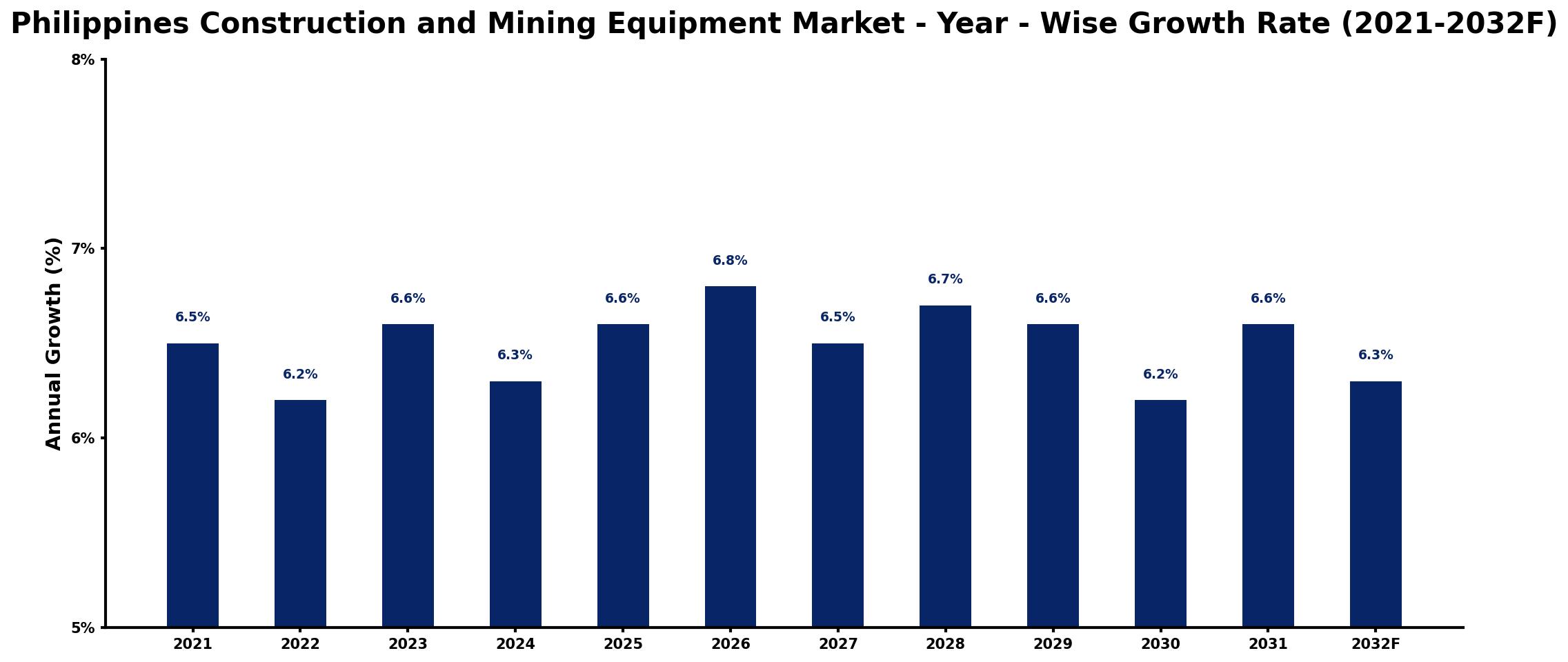
The table below presents the year‑wise growth rates along with the key drivers influencing the market
| Year | Growth Rate | Major Drivers |
| 2021 | 6.5% | Infrastructure projects gaining momentum |
| 2022 | 6.2% | Increased foreign investments flowing |
| 2023 | 6.6% | Rising urbanization driving demand |
| 2024 | 6.3% | Government spending on infrastructure |
| 2025 | 6.6% | Sustainable development initiatives growing |
| 2026 | 6.8% | Technological advancements enhancing efficiency |
| 2027 | 6.5% | Local industries expanding operations rapidly |
| 2028 | 6.7% | Public-private partnerships flourishing significantly |
| 2029 | 6.6% | strengthening international trade flows |
| 2030 | 6.2% | Renewable energy projects emerging strongly |
| 2031 | 6.6% | Rising population boosting housing needs |
| 2032 | 6.3% | Economic growth fostering new projects |
Note: Market size estimations and growth projections presented in this report are based on 6Wresearch's proprietary forecasting methodology, utilizing the latest available industry data, government publications, and primary research inputs.
Philippines Construction and Mining Equipment Market Synopsis
A significant force shaping the Philippines Construction and Mining Equipment Market is the governments escalating investment in infrastructure projects. As the nation strives to bolster its economic framework, key initiatives in road and rail development are driving a heightened demand for construction machinery.
Additionally, the mining sector is witnessing a resurgence, fueled by global demand for minerals and resources. This revival is further propelled by advancements in technology, leading to enhanced operational efficiencies in equipment usage within both construction and mining domains.
Philippines Construction and Mining Equipment Market Key Takeaways
- The market is poised for steady growth, influenced by government infrastructure investments and a revitalized mining sector.
- Advanced machinery is becoming indispensable for enhancing project efficiency and completion speed.
- Public sector spending plays a crucial role in sustaining market momentum and expanding operational capabilities.
- Technological advancements are essential for improving equipment durability and performance in challenging environments.
- The cyclical nature of the construction industry remains a factor for market stakeholders to monitor.
Evaluation of Restraints in Philippines Construction and Mining Equipment Market
While the market presents numerous opportunities, it is also constrained by the cyclical fluctuations typical of the construction and mining industries. Economic uncertainties can lead to stalled projects, directly impacting equipment sales and demand. Moreover, operating machinery in the Philippines challenging environments necessitates a focus on durability and reliability, which can pose a continuous challenge for manufacturers. Ensuring that equipment meets these demands while also being cost-effective is crucial for sustained growth.
Philippines Construction and Mining Equipment Market Trends
Emerging trends in the Philippines Construction and Mining Equipment Market include a growing emphasis on sustainability and efficiency. Companies are increasingly investing in eco-friendly machinery that offers lower emissions and reduced fuel consumption. Additionally, the integration of smart technologies, such as IoT and automation, is transforming traditional equipment into intelligent systems that enhance productivity and operational oversight. This technological evolution is expected to drive future demand for sophisticated machinery in the sector.
Philippines Construction and Mining Equipment Market Opportunities
Opportunities for growth in the Philippines Construction and Mining Equipment Market lie in the increasing infrastructure projects planned across the archipelago. Moreover, the burgeoning mining sector, especially in light of rising global demand for critical minerals, presents avenues for investment. Manufacturers that can deliver innovative, technologically advanced solutions tailored to local conditions are well-positioned to capitalize on these emerging opportunities.
Government Initiatives in the Philippines Construction and Mining Equipment Market
The Philippine government has launched various initiatives aimed at enhancing infrastructure and mining capabilities. Increased public spending and ambitious programs to upgrade transportation networks, including roads and bridges, are pivotal in supporting market growth. Additionally, regulatory frameworks are being developed to promote sustainable practices in mining and construction, fostering an environment conducive to investment and innovation.
Future Insights of the Philippines Construction and Mining Equipment Market
Looking ahead to 2026-2032, the Philippines Construction and Mining Equipment Market is set to experience significant developments driven by continued infrastructure investment and advances in technology. As public-private partnerships gain traction, greater collaboration between government and industry stakeholders will likely result in enhanced project delivery systems. Additionally, the focus on sustainability will further shape equipment design and operational strategies, aligning with global trends toward greener construction and mining practices.
Philippines Construction and Mining Equipment Market Latest Developments (2025 - 2026)
Recent developments in the Philippines Construction and Mining Equipment Market highlight a shift towards innovative technology solutions, with many firms investing in automation and smart machinery. Additionally, there has been a noticeable increase in collaborative projects involving public and private sectors, aimed at addressing the urgent infrastructure needs across the country. This trend indicates a proactive approach to bolstering the sector's capabilities and efficiency.
Philippines Construction and Mining Equipment Market - Key Attractiveness of the Report
- 10 Years of Market Numbers
- Historical Data Starting from 2022 to 2025
- Base Year: 2025
- Forecast Data until 2032
- Key Performance Indicators Impacting the Market
- Major Upcoming Developments and Projects
Key Highlights of the Report:
- Philippines Construction and Mining Equipment Market Outlook
- Market Size of Philippines Construction and Mining Equipment Market, 2025
- Forecast of Philippines Construction and Mining Equipment Market, 2032
- Historical Data and Forecast of Philippines Construction and Mining Equipment Revenues & Volume for the Period 2022-2032F
- Philippines Construction and Mining Equipment Market Trend Evolution
- Philippines Construction and Mining Equipment Market Drivers and Challenges
- Philippines Construction and Mining Equipment Price Trends
- Philippines Construction and Mining Equipment Porter's Five Forces
- Philippines Construction and Mining Equipment Industry Life Cycle
- Historical Data and Forecast of Philippines Construction and Mining Equipment Market Revenues & Volume By Product Type for the Period 2022-2032F
- Historical Data and Forecast of Philippines Construction and Mining Equipment Market Revenues & Volume By Loaders for the Period 2022-2032F
- Historical Data and Forecast of Philippines Construction and Mining Equipment Market Revenues & Volume By Dozers for the Period 2022-2032F
- Historical Data and Forecast of Philippines Construction and Mining Equipment Market Revenues & Volume By Excavators for the Period 2022-2032F
- Historical Data and Forecast of Philippines Construction and Mining Equipment Market Revenues & Volume By Crushing for the Period 2022-2032F
- Historical Data and Forecast of Philippines Construction and Mining Equipment Market Revenues & Volume By Pulverizing & Screening Equipment for the Period 2022-2032F
- Historical Data and Forecast of Philippines Construction and Mining Equipment Market Revenues & Volume By Others for the Period 2022-2032F
- Historical Data and Forecast of Philippines Construction and Mining Equipment Market Revenues & Volume By Application for the Period 2022-2032F
- Historical Data and Forecast of Philippines Construction and Mining Equipment Market Revenues & Volume By Infrastructure for the Period 2022-2032F
- Historical Data and Forecast of Philippines Construction and Mining Equipment Market Revenues & Volume By Mineral Mining for the Period 2022-2032F
- Historical Data and Forecast of Philippines Construction and Mining Equipment Market Revenues & Volume By Residential Building for the Period 2022-2032F
- Historical Data and Forecast of Philippines Construction and Mining Equipment Market Revenues & Volume By Metal Mining for the Period 2022-2032F
- Historical Data and Forecast of Philippines Construction and Mining Equipment Market Revenues & Volume By Others for the Period 2022-2032F
- Philippines Construction and Mining Equipment Import Export Trade Statistics
- Market Opportunity Assessment By Product Type
- Market Opportunity Assessment By Application
- Philippines Construction and Mining Equipment Top Companies Market Share
- Philippines Construction and Mining Equipment Competitive Benchmarking By Technical and Operational Parameters
- Philippines Construction and Mining Equipment Company Profiles
- Philippines Construction and Mining Equipment Key Strategic Recommendations






































