Philippines Cultivator and Tiller Machinery Market Size, Share & Growth Rate
The Philippines Cultivator and Tiller Machinery Market was estimated at USD 413 Million in 2025 and is projected to reach USD 552 Million by 2032, growing at a CAGR of 4.2% from 2026 to 2032. This growth trajectory is primarily fueled by ongoing modernization efforts within the country's agricultural sector, where increased mechanization is paramount for enhancing productivity. The push towards mechanized farming is increasingly being embraced, as farmers recognize the significant efficiency gains cultivators and tillers can provide, particularly in soil preparation.
Philippines Cultivator and Tiller Machinery Market Year-wise Growth Rate and Key Drivers
This graph highlights how the Philippines Cultivator and Tiller Machinery Market has steadily grown over the years, supported by major growth factors.
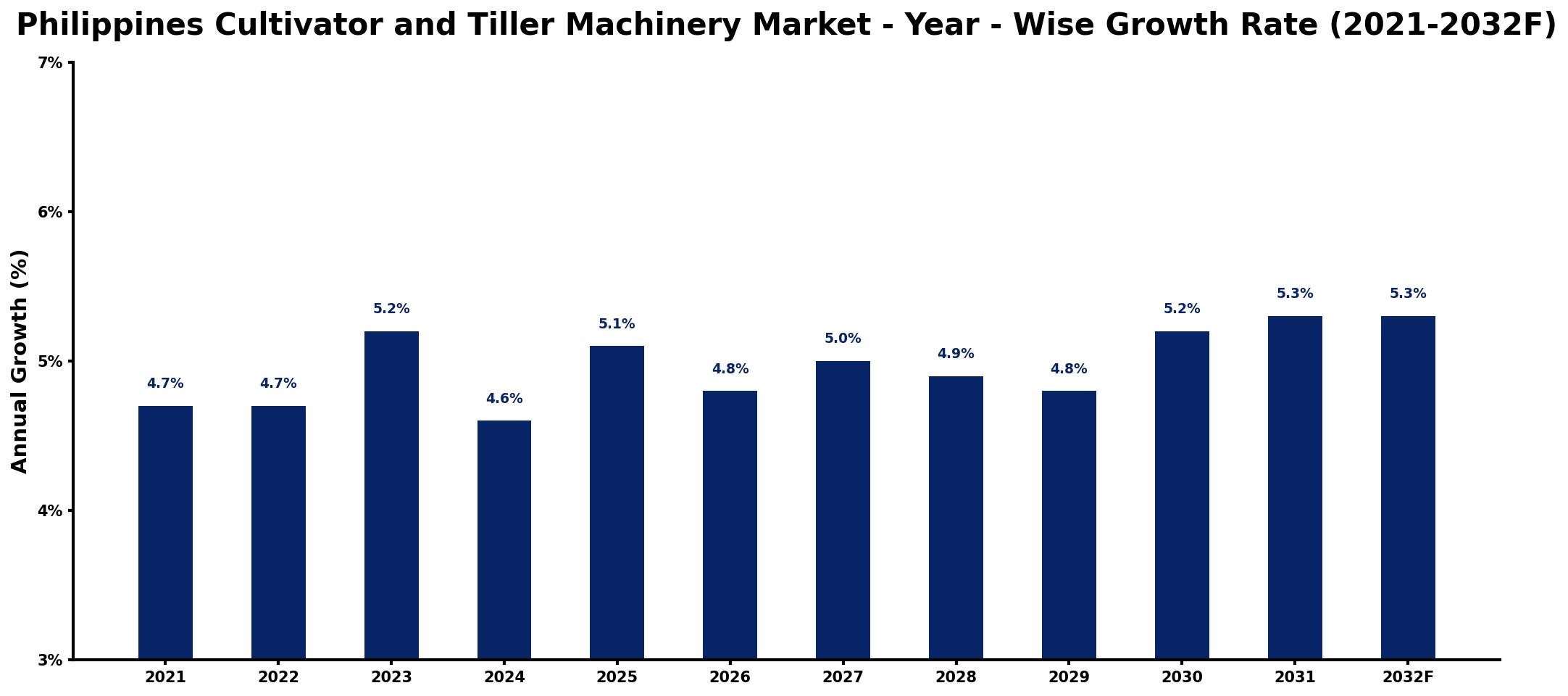
The table below presents the year‑wise growth rates along with the key drivers influencing the market
| Year | Growth Rate | Major Drivers |
| 2021 | 4.7% | Rising agricultural investment trends |
| 2022 | 4.7% | Increased mechanization in farming |
| 2023 | 5.2% | Expansion of export opportunities |
| 2024 | 4.6% | Growing demand for efficiency |
| 2025 | 5.1% | Advancements in agricultural technology |
| 2026 | 4.8% | Surge in smallholder farming |
| 2027 | 5.0% | Focus on sustainable practices |
| 2028 | 4.9% | Emergence of cooperative farming models |
| 2029 | 4.8% | Adoption of precision agriculture techniques |
| 2030 | 5.2% | Strengthening rural infrastructure projects |
| 2031 | 5.3% | Enhanced government support initiatives |
| 2032 | 5.3% | Growing consumer preference for local |
Note: Market size estimations and growth projections presented in this report are based on 6Wresearch's proprietary forecasting methodology, utilizing the latest available industry data, government publications, and primary research inputs.
Philippines Cultivator and Tiller Machinery Market Synopsis
The Philippines cultivator and tiller machinery market has recently witnessed substantial momentum driven by advancements in agricultural practices and a rising demand for efficient farming solutions. As traditional farming methods gradually transition to more modern approaches, the market is positioned for sustained growth, reflecting the agricultural sector's need to boost productivity and secure food resources.
Looking ahead, this market is expected to continue its upward trajectory, propelled by technological innovations and a deeper focus on smart farming solutions. The increasing interest in automation within agriculture further enhances the relevance of cultivators and tillers, suggesting a dynamic future as farmers adopt these essential tools to enhance operational efficiency.
Philippines Cultivator and Tiller Machinery Market Key Takeaways
- Significant market growth is driven by modernization efforts in the agricultural sector.
- The shift from traditional to mechanized farming practices is reshaping the industry landscape.
- Technological advancements are paving the way for increased efficiency and productivity.
- Adaptability of machinery to suit small-scale farms remains a critical factor for market success.
- The recovery from pandemic-related disruptions is creating new opportunities in the market.
Evaluation of Restraints in Philippines Cultivator and Tiller Machinery Market
The cultivator and tiller machinery market in the Philippines faces several restraints that could hinder its expansion. The predominant challenge lies in the fragmented nature of agricultural landholdings, as many farmers operate on small plots that may not justify the investment in mechanized equipment. Additionally, the design and adaptability of machinery must consider the diverse needs and resources of small-scale farmers. These factors necessitate innovative solutions that ensure accessibility while remaining cost-effective for a large segment of the farming population.
Philippines Cultivator and Tiller Machinery Market Trends
Several key trends are influencing the Philippines cultivator and tiller machinery market. Firstly, the integration of technology, such as precision agriculture tools and data analytics, is gaining traction among farmers looking to maximize productivity. Secondly, there is a growing emphasis on sustainability and environmentally friendly practices, prompting demand for machinery that minimizes ecological impact. Lastly, the rise of digital platforms for equipment leasing and sharing is reshaping how farmers access and utilize these vital tools, catering to the needs of the burgeoning smallholder sector.
Philippines Cultivator and Tiller Machinery Market Opportunities
The market presents a wealth of opportunities for growth and innovation. With the demand for mechanization on the rise, companies that develop versatile and affordable cultivators and tillers tailored for small-scale farmers are well-positioned for success. Moreover, the increasing focus on agritech solutions offers significant avenues for investment, as companies look to leverage smart technologies to create more efficient and sustainable farming practices. Partnerships with local farmers and cooperatives can also facilitate market penetration and bolster brand loyalty.
Government Initiatives in the Philippines Cultivator and Tiller Machinery Market
The Philippine government has embarked on various initiatives aimed at promoting agricultural modernization, which directly benefits the cultivator and tiller machinery market. These initiatives include funding programs designed to assist farmers in acquiring modern agricultural equipment and investments in infrastructure that enhance market access. Additionally, there are public-private partnerships focusing on research and development of innovative farming technologies, which further support the growth of this market.
Future Insights of the Philippines Cultivator and Tiller Machinery Market
As we look towards 2026-2032, the Philippines cultivator and tiller machinery market is set for robust development, driven by ongoing modernization and the adoption of advanced technologies. Farmers will increasingly rely on mechanized solutions to improve productivity and efficiency in an evolving agricultural landscape. Moreover, the rise of sustainable practices and the need for enhanced food security are expected to further spur demand, positioning the market for continuous growth and innovation in the coming years.
Philippines Cultivator and Tiller Machinery Market Latest Developments (2025 - 2026)
In recent months, the cultivator and tiller machinery sector has seen a surge in technological advancements, with several companies launching new models that feature enhanced efficiency and user-friendly designs. Industry players are also increasing collaborations with local agricultural cooperatives to better understand the specific needs of Filipino farmers. Additionally, there is a noticeable uptick in the integration of smart technology and data-driven solutions aimed at improving operational efficiency, highlighting the dynamic nature of this market.
Philippines Cultivator and Tiller Machinery Market - Key Attractiveness of the Report
- 10 Years of Market Numbers
- Historical Data Starting from 2022 to 2025
- Base Year: 2025
- Forecast Data until 2032
- Key Performance Indicators Impacting the Market
- Major Upcoming Developments and Projects
Key Highlights of the Report:
- Philippines Cultivator and Tiller Machinery Market Outlook
- Market Size of Philippines Cultivator and Tiller Machinery Market, 2025
- Forecast of Philippines Cultivator and Tiller Machinery Market, 2032
- Historical Data and Forecast of Philippines Cultivator and Tiller Machinery Revenues & Volume for the Period 2022-2032F
- Philippines Cultivator and Tiller Machinery Market Trend Evolution
- Philippines Cultivator and Tiller Machinery Market Drivers and Challenges
- Philippines Cultivator and Tiller Machinery Price Trends
- Philippines Cultivator and Tiller Machinery Porter's Five Forces
- Philippines Cultivator and Tiller Machinery Industry Life Cycle
- Historical Data and Forecast of Philippines Cultivator and Tiller Machinery Market Revenues & Volume By Product Type for the Period 2022-2032F
- Historical Data and Forecast of Philippines Cultivator and Tiller Machinery Market Revenues & Volume By Cultivators for the Period 2022-2032F
- Historical Data and Forecast of Philippines Cultivator and Tiller Machinery Market Revenues & Volume By Tillers for the Period 2022-2032F
- Historical Data and Forecast of Philippines Cultivator and Tiller Machinery Market Revenues & Volume By for the Period 2022-2032F
- Historical Data and Forecast of Philippines Cultivator and Tiller Machinery Market Revenues & Volume By Application for the Period 2022-2032F
- Historical Data and Forecast of Philippines Cultivator and Tiller Machinery Market Revenues & Volume By Agriculture for the Period 2022-2032F
- Historical Data and Forecast of Philippines Cultivator and Tiller Machinery Market Revenues & Volume By Garden for the Period 2022-2032F
- Philippines Cultivator and Tiller Machinery Import Export Trade Statistics
- Market Opportunity Assessment By Product Type
- Market Opportunity Assessment By Application
- Philippines Cultivator and Tiller Machinery Top Companies Market Share
- Philippines Cultivator and Tiller Machinery Competitive Benchmarking By Technical and Operational Parameters
- Philippines Cultivator and Tiller Machinery Company Profiles
- Philippines Cultivator and Tiller Machinery Key Strategic Recommendations






































