Philippines Curtains and Window Blinds Market Size, Share & Growth Rate
The Philippines Curtains and Window Blinds Market was estimated at USD 1335 Million in 2025 and is projected to reach USD 2390 Million by 2032, growing at a CAGR of 8.7% from 2026 to 2032. This promising trajectory is driven by a combination of rising urbanization, increased disposable income, and a growing awareness of interior design aesthetics among consumers. As the demand for stylish yet functional window treatments continues to climb, market players are positioned to capitalize on evolving consumer preferences.
Philippines Curtains and Window Blinds Market Year-wise Growth Rate and Key Drivers
This graph highlights how the Philippines Curtains and Window Blinds Market has steadily grown over the years, supported by major growth factors.
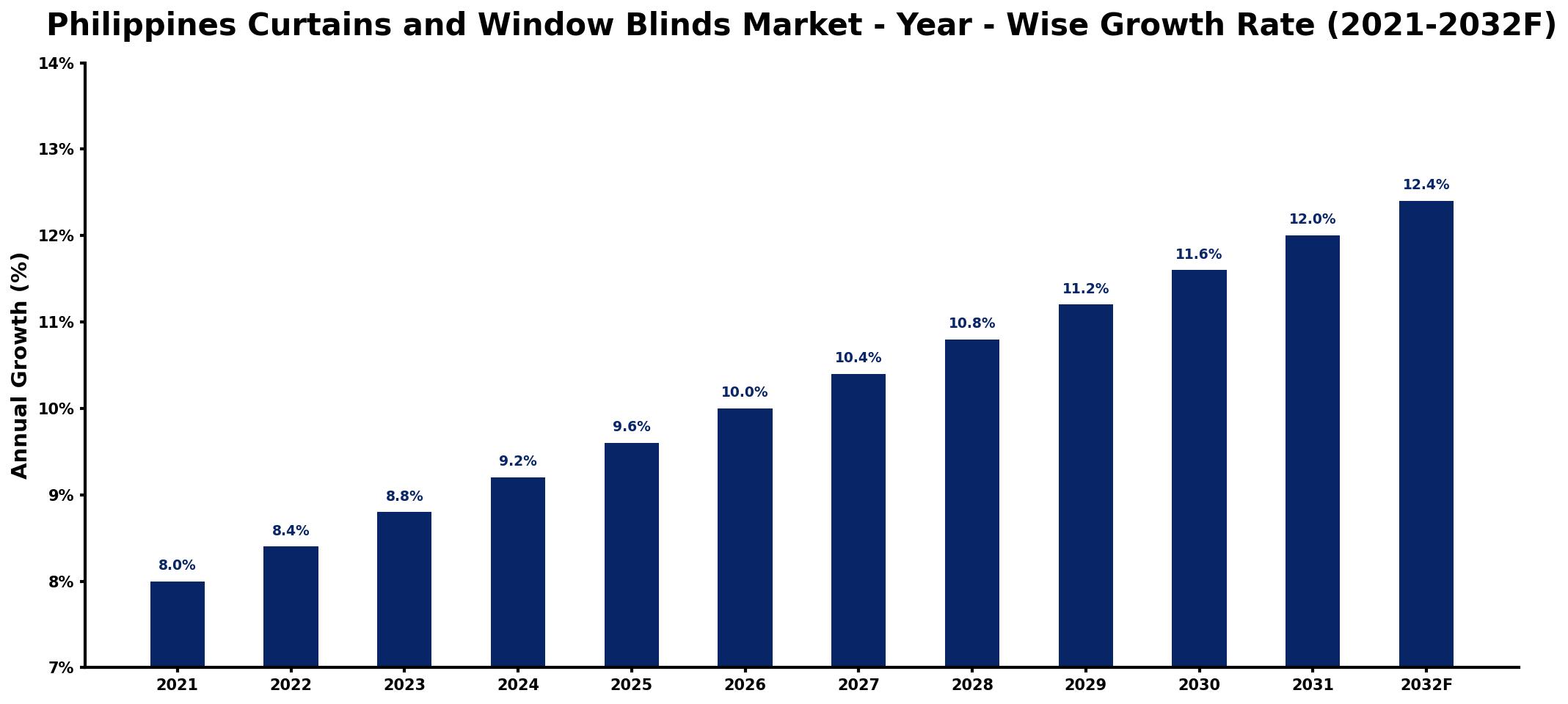
The table below presents the year‑wise growth rates along with the key drivers influencing the market
| Year | Growth Rate | Major Drivers |
| 2021 | 8.0% | Rising demand for home decor |
| 2022 | 8.4% | Increasing urbanization and population growth |
| 2023 | 8.8% | Growth in real estate investments |
| 2024 | 9.2% | Surge in home renovation projects |
| 2025 | 9.6% | Expansion of online retail platforms |
| 2026 | 10.0% | Growing awareness of energy efficiency |
| 2027 | 10.4% | Increasing disposable income levels |
| 2028 | 10.8% | Development of sustainable materials |
| 2029 | 11.2% | Boom in interior design trends |
| 2030 | 11.6% | Enhanced focus on smart homes |
| 2031 | 12.0% | Rise of eco-friendly lifestyles |
| 2032 | 12.4% | Growing influence of social media |
Note: Market size estimations and growth projections presented in this report are based on 6Wresearch's proprietary forecasting methodology, utilizing the latest available industry data, government publications, and primary research inputs.
Philippines Curtains and Window Blinds Market Synopsis
While recent years have shown a marked recovery post-pandemic, the Philippine curtains and window blinds market is set to enter a dynamic growth phase. This growth will be supported by the ongoing trends toward personalized home decor solutions and energy-efficient products.
The market landscape is shifting as consumers increasingly seek options that blend aesthetics with functionality. The continual development in the housing sector is also fostering demand, positioning the curtains and window blinds market for sustained momentum in the coming years.
Philippines Curtains and Window Blinds Market Key Takeaways
- The market is projected to grow significantly, reaching USD 2390 Million by 2032.
- Consumer preferences are shifting towards customized and stylish window treatment solutions.
- Urbanization and higher disposable income are primary drivers of market expansion.
- Energy-efficient products are gaining traction, influencing buying decisions.
- The market is highly competitive, requiring innovation and unique offerings from manufacturers.
Evaluation of Restraints in Philippines Curtains and Window Blinds Market
Despite the positive growth trajectory, the market faces challenges that could hinder progress. Rapidly changing interior design trends can create volatility in consumer preferences, demanding flexibility from manufacturers. Additionally, competition from lower-cost imports may pressure local companies to enhance their unique value propositions. Balancing pricing strategies with the need for high-quality, customizable offerings will be crucial to navigate these challenges successfully.
Philippines Curtains and Window Blinds Market Trends
Several trends are shaping the future of the curtains and window blinds market in the Philippines. First, there is a growing consumer inclination toward sustainable materials and energy-efficient designs, which not only enhance aesthetics but also promote conservation. Furthermore, the rise of e-commerce platforms is revolutionizing how consumers shop for window treatments, offering convenience and a wider selection. Technological advancements in manufacturing processes also allow for more innovative designs and functionalities.
Philippines Curtains and Window Blinds Market Opportunities
As urbanization continues to rise, significant opportunities exist for both local manufacturers and new entrants in the market. The increasing focus on residential remodeling and renovations offers a lucrative space for customized curtains and blinds. Additionally, collaboration with interior designers and home furnishing stores can enhance brand visibility and consumer reach. Investing in advanced technologies, such as smart home integration, could also attract tech-savvy consumers seeking innovative window treatment solutions.
Government Initiatives in the Philippines Curtains and Window Blinds Market
The Philippine government has been actively supporting the real estate and construction sectors through various programs aimed at enhancing housing projects. While specific incentives for the curtains and window blinds industry are limited, broader initiatives to improve infrastructure and promote sustainable building practices could indirectly benefit market growth. Increased public spending on housing development and renovation could create a conducive environment for curtains and window blinds businesses to thrive.
Future Insights of the Philippines Curtains and Window Blinds Market
Looking ahead, the Philippines curtains and window blinds market is poised for dynamic growth from 2026 to 2032. With rising disposable incomes and a burgeoning middle class, the demand for high-quality, stylish window treatments is expected to escalate. Additionally, as consumers become more environmentally conscious, the shift towards sustainable and energy-efficient products will likely define future market offerings. Companies that can adapt to these evolving trends and consumer preferences will find significant opportunities for success.
Philippines Curtains and Window Blinds Market Latest Developments (2025 - 2026)
In the latest developments, the curtains and window blinds market is witnessing a surge in innovative product launches, particularly those incorporating eco-friendly materials and smart home technologies. Brands are increasingly focusing on enhancing their online presence to cater to the growing e-commerce segment. Additionally, partnerships between local manufacturers and international suppliers are becoming more prevalent, aiming to broaden product offerings and leverage diverse design influences.
Philippines Curtains and Window Blinds Market - Key Attractiveness of the Report
- 10 Years of Market Numbers
- Historical Data Starting from 2022 to 2025
- Base Year: 2025
- Forecast Data until 2032
- Key Performance Indicators Impacting the Market
- Major Upcoming Developments and Projects
Key Highlights of the Report:
- Philippines Curtains and Window Blinds Market Outlook
- Market Size of Philippines Curtains and Window Blinds Market, 2025
- Forecast of Philippines Curtains and Window Blinds Market, 2032
- Historical Data and Forecast of Philippines Curtains and Window Blinds Revenues & Volume for the Period 2022-2032F
- Philippines Curtains and Window Blinds Market Trend Evolution
- Philippines Curtains and Window Blinds Market Drivers and Challenges
- Philippines Curtains and Window Blinds Price Trends
- Philippines Curtains and Window Blinds Porter's Five Forces
- Philippines Curtains and Window Blinds Industry Life Cycle
- Historical Data and Forecast of Philippines Curtains and Window Blinds Market Revenues & Volume By Materials for the Period 2022-2032F
- Historical Data and Forecast of Philippines Curtains and Window Blinds Market Revenues & Volume By Curtains (Cotton, Linen, Polyester) for the Period 2022-2032F
- Historical Data and Forecast of Philippines Curtains and Window Blinds Market Revenues & Volume By Window Blinds (Cotton, Linen, Wood, PVC, Metal) for the Period 2022-2032F
- Historical Data and Forecast of Philippines Curtains and Window Blinds Market Revenues & Volume By Product for the Period 2022-2032F
- Historical Data and Forecast of Philippines Curtains and Window Blinds Market Revenues & Volume By Curtains (Box pleat curtains, Pinch pleat curtains & drapery, Goblet pleat curtains & drapery, Eyelet curtains & drapery) for the Period 2022-2032F
- Historical Data and Forecast of Philippines Curtains and Window Blinds Market Revenues & Volume By Window Blinds (Window Shades,, Window Screens, Connected) for the Period 2022-2032F
- Historical Data and Forecast of Philippines Curtains and Window Blinds Market Revenues & Volume By Distribution Channel for the Period 2022-2032F
- Historical Data and Forecast of Philippines Curtains and Window Blinds Market Revenues & Volume By B2B for the Period 2022-2032F
- Historical Data and Forecast of Philippines Curtains and Window Blinds Market Revenues & Volume By B2C for the Period 2022-2032F
- Historical Data and Forecast of Philippines Curtains and Window Blinds Market Revenues & Volume By E-commerce for the Period 2022-2032F
- Historical Data and Forecast of Philippines Curtains and Window Blinds Market Revenues & Volume By Price Range for the Period 2022-2032F
- Historical Data and Forecast of Philippines Curtains and Window Blinds Market Revenues & Volume By High for the Period 2022-2032F
- Historical Data and Forecast of Philippines Curtains and Window Blinds Market Revenues & Volume By Medium for the Period 2022-2032F
- Historical Data and Forecast of Philippines Curtains and Window Blinds Market Revenues & Volume By Low for the Period 2022-2032F
- Philippines Curtains and Window Blinds Import Export Trade Statistics
- Market Opportunity Assessment By Materials
- Market Opportunity Assessment By Product
- Market Opportunity Assessment By Distribution Channel
- Market Opportunity Assessment By Price Range
- Philippines Curtains and Window Blinds Top Companies Market Share
- Philippines Curtains and Window Blinds Competitive Benchmarking By Technical and Operational Parameters
- Philippines Curtains and Window Blinds Company Profiles
- Philippines Curtains and Window Blinds Key Strategic Recommendations






































