Philippines Deodorants And Anti Perspirant Products Market Top 5 Importing Countries and Market Competition (HHI) Analysis
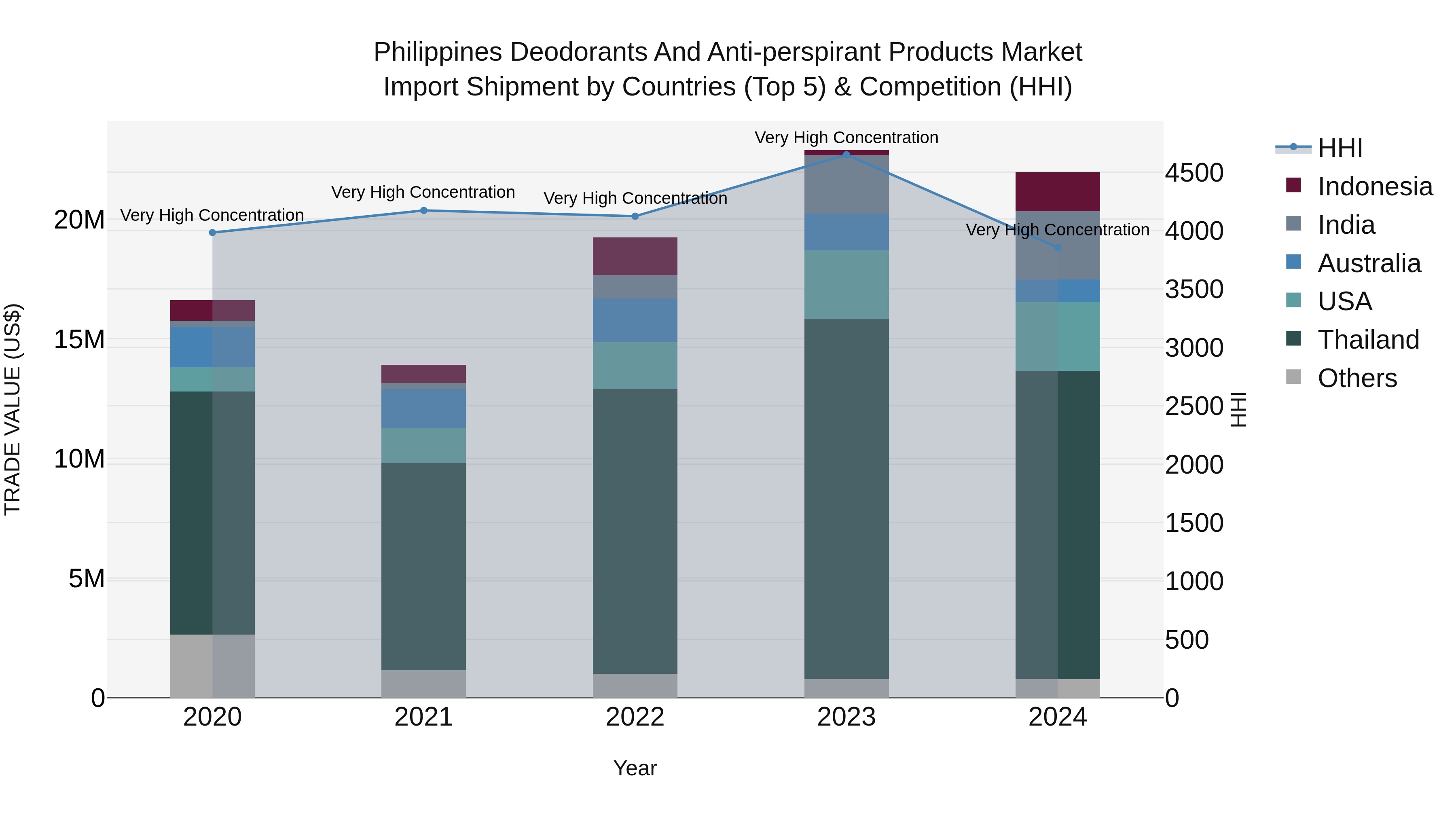
The deodorants and anti-perspirant products import market in the Philippines continued to show strong concentration with top exporters being Thailand, USA, India, Indonesia, and Australia in 2024. Despite a slight decline in growth rate from 2023 to 2024, the industry maintained a healthy CAGR of 7.23% for the period of 2020-2024. This data indicates a stable demand for imported deodorant and anti-perspirant products in the Philippines, with key players consistently supplying the market.
Philippines Deodorants and Anti-Perspirant Products Market Synopsis
The Philippines deodorants and anti-perspirant products market size was estimated to be USD 189 million in 2025. The market is expected to witness a CAGR of 4.1% over the forecast period of 2025-2031. Increasing awareness regarding personal hygiene, rising disposable incomes, increasing demand for long-lasting fragrances, attractive packaging, and innovative product offerings are some of the factors driving the growth of the Filipino deodorants and anti-perspirant products market
Key Trends of The Market
An increasing number of Filipinos are now opting for organic deodorants due to growing health consciousness among consumers which has been driving sales across various retailers in the country. Additionally, the online retailing channel has become a popular choice with many people buying their favorite brands online using mobile phones or laptops. This trend is likely to remain strong during 2025???2025 as more convenience stores are offering delivery services at lower prices than regular stores do.
Key Growth Drivers of the Market
Increased per capita income coupled with higher discretionary income has resulted in increased spending on grooming and beauty care products such as deodorants & antiperspirants among Filipino consumers leading to an increase in demand for these items in recent years.
Key Challenges Faced by The Market
Key Players of The Market
Leading players operating within Philippines Deodorant & Antiperspirant Products Market include Unilever Philippines Inc., Sanicare Hygienics Corporation, Procter & Gamble Co., Kao Corporation Japan , Colgate Palmolive Company , Sysu International Incorporated etc
Covid-19 Impact on the Market
The outbreak led by COVID-19 pandemic had caused disruption across all sectors including FMCG industry wherein companies had faced decrease in sales both offline as well as through ecommerce channels owing towards complete lockdown imposed by government authorities resulting into temporary closure/suspension operations many outlets/retailers thereby causing decline revenue generation
Key Highlights of the Report:
- Philippines Deodorants and Anti-Perspirant Products Market Outlook
- Market Size of Philippines Deodorants and Anti-Perspirant Products Market, 2024
- Forecast of Philippines Deodorants and Anti-Perspirant Products Market, 2031
- Historical Data and Forecast of Philippines Deodorants and Anti-Perspirant Products Revenues & Volume for the Period 2021-2031
- Philippines Deodorants and Anti-Perspirant Products Market Trend Evolution
- Philippines Deodorants and Anti-Perspirant Products Market Drivers and Challenges
- Philippines Deodorants and Anti-Perspirant Products Price Trends
- Philippines Deodorants and Anti-Perspirant Products Porter's Five Forces
- Philippines Deodorants and Anti-Perspirant Products Industry Life Cycle
- Historical Data and Forecast of Philippines Deodorants and Anti-Perspirant Products Market Revenues & Volume By Function for the Period 2021-2031
- Historical Data and Forecast of Philippines Deodorants and Anti-Perspirant Products Market Revenues & Volume By Aerosol Spray for the Period 2021-2031
- Historical Data and Forecast of Philippines Deodorants and Anti-Perspirant Products Market Revenues & Volume By Cream for the Period 2021-2031
- Historical Data and Forecast of Philippines Deodorants and Anti-Perspirant Products Market Revenues & Volume By Roll-On for the Period 2021-2031
- Historical Data and Forecast of Philippines Deodorants and Anti-Perspirant Products Market Revenues & Volume By Gel for the Period 2021-2031
- Historical Data and Forecast of Philippines Deodorants and Anti-Perspirant Products Market Revenues & Volume By Ingredient for the Period 2021-2031
- Historical Data and Forecast of Philippines Deodorants and Anti-Perspirant Products Market Revenues & Volume By Alcohol for the Period 2021-2031
- Historical Data and Forecast of Philippines Deodorants and Anti-Perspirant Products Market Revenues & Volume By Antimicrobials for the Period 2021-2031
- Historical Data and Forecast of Philippines Deodorants and Anti-Perspirant Products Market Revenues & Volume By Conditioner and Moisturizer for the Period 2021-2031
- Historical Data and Forecast of Philippines Deodorants and Anti-Perspirant Products Market Revenues & Volume By Fragrances for the Period 2021-2031
- Historical Data and Forecast of Philippines Deodorants and Anti-Perspirant Products Market Revenues & Volume By Paraben and Propellants for the Period 2021-2031
- Historical Data and Forecast of Philippines Deodorants and Anti-Perspirant Products Market Revenues & Volume By Others for the Period 2021-2031
- Philippines Deodorants and Anti-Perspirant Products Import Export Trade Statistics
- Market Opportunity Assessment By Function
- Market Opportunity Assessment By Ingredient
- Philippines Deodorants and Anti-Perspirant Products Top Companies Market Share
- Philippines Deodorants and Anti-Perspirant Products Competitive Benchmarking By Technical and Operational Parameters
- Philippines Deodorants and Anti-Perspirant Products Company Profiles
- Philippines Deodorants and Anti-Perspirant Products Key Strategic Recommendations






































