Philippines Disposable Paper Cup Market Size Growth Rate
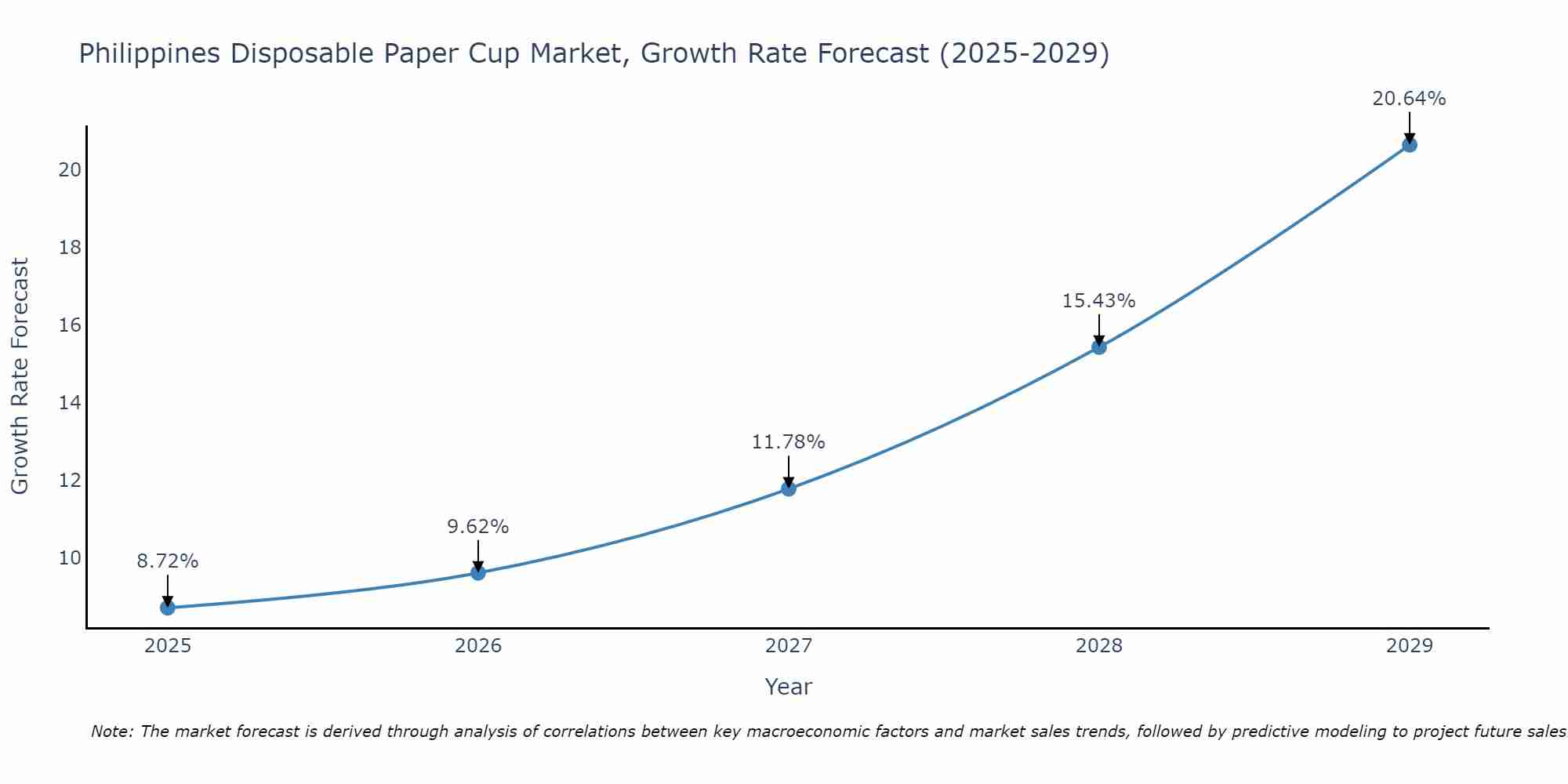
The Philippines Disposable Paper Cup Market is poised for steady growth rate improvements from 2025 to 2029. From 8.72% in 2025, the growth rate steadily ascends to 20.64% in 2029.
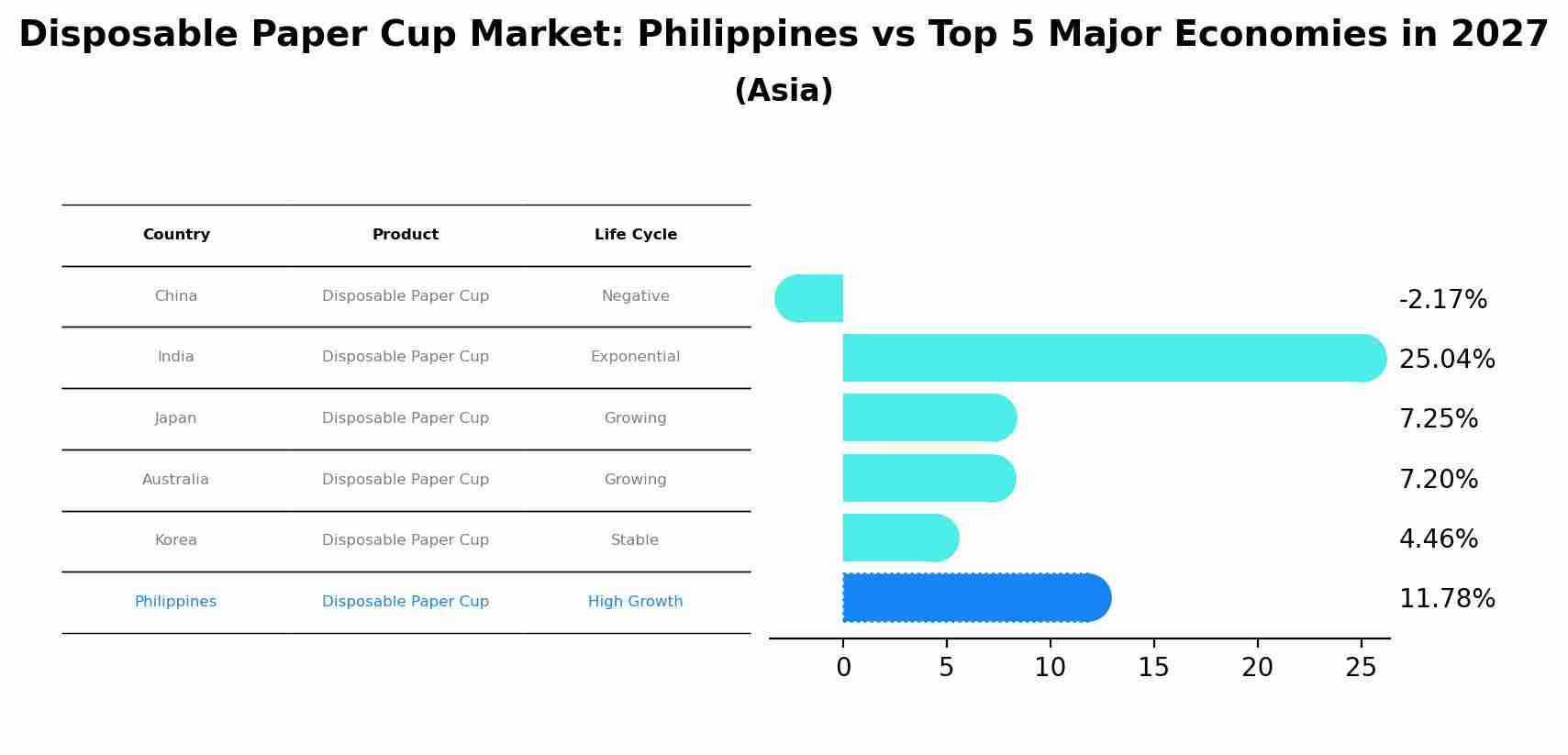
Disposable Paper Cup Market: Philippines vs Top 5 Major Economies in 2027 (Asia)
Philippines's Disposable Paper Cup market is anticipated to experience a high growth rate of 11.78% by 2027, reflecting trends observed in the largest economy China, followed by India, Japan, Australia and South Korea.
Philippines Disposable Paper Cup Market Growth Rate
According to 6Wresearch internal database and industry insights, the Philippines Disposable Paper Cup Market is projected to grow at a compound annual growth rate (CAGR) of 7.2% during the forecast period (2026-2032).
Topics Covered in the Philippines Disposable Paper Cup Market Report
The Philippines Disposable Paper Cup Market report thoroughly covers the market by type, end-user, and distribution channel. The market report provides an unbiased and detailed analysis of ongoing market trends, opportunities/high growth areas, and market drivers, which help stakeholders devise and align their market strategies according to the current and future market dynamics.
Philippines Disposable Paper Cup Market Highlights
| Report Name | Philippines Disposable Paper Cup Market |
| Forecast Period | 2026–2032 |
| CAGR | 7.2% |
| Growing Sector | Cafe & QSR |
Philippines Disposable Paper Cup Market Synopsis
Philippines Disposable Paper Cup Market is experiencing robust growth due to increasing awareness about environmental issues and the need for sustainable packaging. The increasing popularity of Fast-service restaurants and takeaway food has increased demand for convenient and disposable solutions. Government policies that discourage single-use plastics are also driving the shift toward paper-based alternatives. With consumers and businesses both showing strong interest in eco-friendly practices, the market is well-positioned to rise consistently over the coming years.
Evaluation of Growth Drivers in the Philippines Disposable Paper Cup Market
Below mentioned are some prominent drivers and their influence on the market dynamics:
| Drivers | Primary Segments Affected | Why it Matters (Evidence) |
| Expansion of Café & QSR Chains | Poly-coated; Commercial | The rapid growth of beverage outlets and quick service restaurants is increasing bulk demand for disposable cups. |
| Rising Food Delivery & Takeaway Culture | All Types; Online & Offline | Higher spending on convenience and the expansion of delivery platforms have significantly increased demand for disposable packaging. |
| Increasing Urban Population | All Types; Commercial & Corporate | Urbanization is driving higher consumption of ready-to-drink and on-the-go beverages, leading to greater usage of disposable cups. |
| Growing Environmental Awareness | Air Pocket & Eco-friendly Types; Commercial | Businesses and food chains are increasingly shifting toward sustainable and biodegradable alternatives to reduce plastic usage. |
| Corporate & Event Consumption Growth | Poly-coated; Corporate & Events | Rising demand for beverages at offices, conferences, and large events is supporting higher consumption of disposable cups. |
Philippines Disposable Paper Cup Market is expected to grow at the CAGR of 7.2% during the forecast period of 2026-2032. The fast growth of café chains, food delivery services, and trends in drinking in cities are all driving growth. More people want things that are easy to use and clean, which is why businesses are using disposable paper cups more and more. Corporate offices, transportation hubs, and event management companies are also adding to steady bulk demand. As environmental concerns grow and regulations push for less plastic use, the move toward paper-based alternatives is gaining even more support. This creates long-term growth opportunities for manufacturers and suppliers all over the country.
Evaluation of Restraints in the Philippines Disposable Paper Cup Market
Below mentioned are some major restraints and their influence on the market dynamics:
| Restraints | Primary Segments Affected | What This Means (Evidence) |
| Fluctuating Raw Material Costs | All Types; Manufacturers | Volatility in paper pulp prices increases production costs and affects profit margins for manufacturers. |
| Competition from Reusable Alternatives | Commercial; Cafés | Sustainability initiatives and regulations are encouraging businesses to adopt reusable cups, reducing demand for disposable options. |
| Limited Recycling Infrastructure | All Types; Others | Inadequate recycling and waste management systems create environmental concerns related to disposal, limiting the sustainability appeal of paper cups. |
| Dependence on Imported Coating Materials | Poly-coated; Manufacturers | Reliance on imported coating materials increases procurement costs and exposes manufacturers to currency and supply risks. |
| Price Sensitivity Among Small Vendors | Low-cost Types; Offline | Small businesses and local vendors often prefer cheaper alternatives, restricting the adoption of higher-quality or premium paper cups. |
Philippines Disposable Paper Cup Industry Challenges
Despite steady demand growth, The Philippines Disposable Paper Cup Industry is confronted with the problem of the high cost of quality materials, and being dependent on imports, which have an impact on profitability. The lack of a strong recycling system complicates waste management efforts and may turn away eco-aware customers. Lower-priced plastic cups still dominate in some regions, affecting paper cup adoption. Increased pricing in the paper industry creates various obstacles for producers. One of the biggest challenges in utilizing disposable paper cups as a means to reduce plastic waste is coupled with the fact that the lack of awareness about eco, friendly practices amongst consumers is limiting the acceptance of paper cups as a sustainable choice..
Philippines Disposable Paper Cup Market Trends
Some of the major trends that are defining the Philippine Disposable Paper Cup Market Growth include:
- Switch to environment friendly and biodegradable cups: More businesses are turning to recyclable and compostable paper cups as a way to both green their operations and support sustainability.
- Expansion of the market for high end insulated cups: The popularity of air pocket insulated cups is going up especially among coffee chain stores and specialty drink outlets these kinds of products with better heat retention properties do not require one to use sleeves thus customers are happy to save energy.
- Milk Tea & Specialty Beverage Culture: The fast increase of milk tea and speciality drink outlets is resulting in a significant rise in disposable cup usage. These businesses need massive amounts of strong and leak, proof cups for their daily operations.
- Increasing Bulk Purchase from Corporates: Workplaces, co, working spaces, and event organizers are the main purchasers of disposable cups in bulk for everyday use. This trend is intensifying the demand of the corporate and institutional segments.
Investment Opportunities in the Philippines Disposable Paper Cup Market
Key investment opportunities in the Philippines Disposable Paper Cup Market include:
- Local Manufacturing Facilities for Eco-Friendly Cups: Setting up local units for the production of biodegradable and recyclable cups can help to reduce the reliance on imports and also make the products more competitive in terms of cost. Besides, local production is a step towards catering to the increasing demand for green packaging solutions.
- Supply Partnerships with Caf and QSR Chains: Securing long, term agreements with rapidly growing beverage chains will guarantee a steady bulk demand.
- Development of Customized Printing Services: The acquisition of state, of, the, art printing technology will enable suppliers to produce branded and promotional cup materials. Customization solutions will bring in corporate clients and high, end beverage brands.
Top 5 Leading Players in the Philippines Disposable Paper Cup Market
Some leading players operating in the Philippines Disposable Paper Cup Market include:
1. Huhtamaki Oyj
| Company Name | Huhtamaki Oyj |
|---|---|
| Established Year | 1920 |
| Headquarters | Espoo, Finland |
| Official Website | Click Here |
Huhtamaki provides sustainable paper-based food packaging solutions, including disposable cups designed for hot and cold beverages. The company focuses on recyclable materials, large-scale production capabilities, and partnerships with global foodservice and beverage brands.
2. Dart Container Corporation
| Company Name | Dart Container Corporation |
|---|---|
| Established Year | 1960 |
| Headquarters | Michigan, USA |
| Official Website | Click Here |
Dart manufactures a wide range of disposable foodservice packaging products, including insulated paper cups for beverage outlets. The company emphasizes product durability, bulk supply capabilities, and solutions tailored for cafés, restaurants, and institutional buyers.
3. International Paper Company
| Company Name | International Paper Company |
|---|---|
| Established Year | 1898 |
| Headquarters | Tennessee, USA |
| Official Website | Click Here |
International Paper supplies high-quality paper materials and packaging solutions used in disposable cup manufacturing. The company focuses on sustainable forestry practices, reliable raw material supply, and support for environmentally responsible packaging production.
4. Detpak
| Company Name | Detpak |
|---|---|
| Established Year | 1948 |
| Headquarters | South Australia, Australia |
| Official Website | Click Here |
Detpak offers customized paper cup solutions for foodservice and beverage industries, with a strong focus on recyclable and compostable materials. The company supports brand customization and provides packaging solutions designed for commercial and retail applications.
5. Lollicup USA Inc.
| Company Name | Lollicup USA Inc. |
|---|---|
| Established Year | 2000 |
| Headquarters | California, USA |
| Official Website | Click Here |
Lollicup specializes in disposable beverage packaging, including paper cups widely used by milk tea and specialty drink outlets. The company focuses on bulk distribution, customization options, and cost-effective solutions for growing beverage businesses.
Government Regulations Introduced in the Philippines Disposable Paper Cup Market
According to Philippine’s Government data, the disposable paper cup market is being impacted by a variety of environmental policies and refuse management initiatives. The Ecological Solid Waste Management Act (RA 9003) encourages the responsible disposal of waste, recycling, and waste reduction in commercial establishments. Local government units in major cities have also put restrictions on the use of single, use plastics and thus, pushed businesses to look for paper, based alternatives. In addition, the Department of Environment and Natural Resources' sustainability programs are the driving force for the use of eco, friendly packaging materials. Through these regulatory measures, businesses and consumers are being made aware of the importance of using recyclable and biodegradable paper cups and at the same time, the transition to more sustainable foodservice packaging solutions is being supported.
Future Insights of the Philippines Disposable Paper Cup Market
The Philippines Disposable Paper Cup Market is anticipated to experience consistent growth as a result of ongoing product innovation and the escalating environmental concerns. Disposable cups will become more environmentally beneficial in the years ahead as a result of the implementation of biodegradable coatings and efficient recycling processes. The burgeoning fast-service restaurant industry and the increasing trend toward takeaway drinks are driving demand. Through the implementation of digital tools in supply chain and production networks, operations will be expedited and more precise. This market is in a good position to develop in conjunction with worldwide efforts for sustainable, low, impact packaging solutions.
Market Segmentation Analysis
The report offers a comprehensive study of the following market segments and their leading categories:
Air Pocket Insulated to Dominate the Market- By Type
According to Rahul, Senior Research Analyst, 6Wresearch, Air Pocket Insulated paper dominates the market due to its superior insulation capabilities and eco-friendliness. It offers phenomenal temperature retention, so it is the natural option for packaging hot and cold beverages, especially in commercial and food delivery applications. Its use is expanding in both residential and QSR sectors, which factually puts it on top of the market.
Commercial to Dominate the Market- By End user
The Commercial segment owns the biggest share of the market. The demand from restaurants, cafes, catering services and corporate offices is high, especially for the take, away and delivery packaging. These sectors need durable and safe disposable products, thus the consistent usage of insulated and coated paper materials in large volumes is line with that.
Offline to Dominate the Market- By Distribution Channel
The Offline segment is currently dominating the market. Grocery stores, physical retail outlets, and wholesale distributors are considered the main resources for purchasing large quantities, in particular, by commercial buyers. Traditional channels continue to be the choice of many companies because they can get the goods immediately and also have the assurance of product quality, even though the trend of online platforms keeps on rising.
Key Attractiveness of the Report
- 10 Years of Market Numbers.
- Historical Data Starting from 2022 to 2025.
- Base Year: 2025.
- Forecast Data until 2032.
- Key Performance Indicators Impacting the Market.
- Major Upcoming Developments and Projects.
Key Highlights of the Report:
- Philippines Disposable Paper Cup Market Outlook
- Market Size of Philippines Disposable Paper Cup Market, 2025
- Forecast of Philippines Disposable Paper Cup Market, 2032
- Historical Data and Forecast of Philippines Disposable Paper Cup Revenues & Volume for the Period 2022-2032
- Philippines Disposable Paper Cup Market Trend Evolution
- Philippines Disposable Paper Cup Market Drivers and Challenges
- Philippines Disposable Paper Cup Price Trends
- Philippines Disposable Paper Cup Porter's Five Forces
- Philippines Disposable Paper Cup Industry Life Cycle
- Historical Data and Forecast of Philippines Disposable Paper Cup Market Revenues & Volume By Type for the Period 2022-2032
- Historical Data and Forecast of Philippines Disposable Paper Cup Market Revenues & Volume By Air Pocket Insulated for the Period 2022-2032
- Historical Data and Forecast of Philippines Disposable Paper Cup Market Revenues & Volume By Poly-coated Paper for the Period 2022-2032
- Historical Data and Forecast of Philippines Disposable Paper Cup Market Revenues & Volume By Wax-coated Paper for the Period 2022-2032
- Historical Data and Forecast of Philippines Disposable Paper Cup Market Revenues & Volume By Others for the Period 2022-2032
- Historical Data and Forecast of Philippines Disposable Paper Cup Market Revenues & Volume By End-user for the Period 2022-2032
- Historical Data and Forecast of Philippines Disposable Paper Cup Market Revenues & Volume By Residential for the Period 2022-2032
- Historical Data and Forecast of Philippines Disposable Paper Cup Market Revenues & Volume By Commercial for the Period 2022-2032
- Historical Data and Forecast of Philippines Disposable Paper Cup Market Revenues & Volume By Cafe & QSR for the Period 2022-2032
- Historical Data and Forecast of Philippines Disposable Paper Cup Market Revenues & Volume By Transportation Industry for the Period 2022-2032
- Historical Data and Forecast of Philippines Disposable Paper Cup Market Revenues & Volume By Event Management for the Period 2022-2032
- Historical Data and Forecast of Philippines Disposable Paper Cup Market Revenues & Volume By Corporate Sector for the Period 2022-2032
- Historical Data and Forecast of Philippines Disposable Paper Cup Market Revenues & Volume By Distribution Channel for the Period 2022-2032
- Historical Data and Forecast of Philippines Disposable Paper Cup Market Revenues & Volume By Online for the Period 2022-2032
- Historical Data and Forecast of Philippines Disposable Paper Cup Market Revenues & Volume By E-commerce Portal for the Period 2022-2032
- Historical Data and Forecast of Philippines Disposable Paper Cup Market Revenues & Volume By Company Owned Portal for the Period 2022-2032
- Historical Data and Forecast of Philippines Disposable Paper Cup Market Revenues & Volume By Offline for the Period 2022-2032
- Philippines Disposable Paper Cup Import Export Trade Statistics
- Market Opportunity Assessment By Type
- Market Opportunity Assessment By End-user
- Market Opportunity Assessment By Distribution Channel
- Philippines Disposable Paper Cup Top Companies Market Share
- Philippines Disposable Paper Cup Competitive Benchmarking By Technical and Operational Parameters
- Philippines Disposable Paper Cup Company Profiles
- Philippines Disposable Paper Cup Key Strategic Recommendations
Market Covered
The report offers a comprehensive study of the subsequent market segments:
By Type
- Air Pocket Insulated
- Poly-coated Paper
- Wax-coated Paper
- Others
By End-user
- Residential
- Commercial
- Café & QSR
- Transportation Industry
- Event Management
- Corporate Sector
By Distribution Channel
- Online
- E-commerce Portal
- Company Owned Portal
- Offline






































