Philippines Electrolytic Iron Market Size, Share & Growth Rate
The Philippines Electrolytic Iron Market was estimated at USD 400 Million in 2025 and is projected to reach USD 559 Million by 2032, growing at a CAGR of 4.9% from 2026 to 2032. This growth trajectory is largely driven by the expanding needs in steel production processes, particularly for deoxidation and alloying. Additionally, rising demand from electronics and pharmaceutical sectors continues to fuel consumption, as these industries seek high-purity iron to meet stringent quality requirements.
Philippines Electrolytic Iron Market Year-wise Growth Rate and Key Drivers
This graph highlights how the Philippines Electrolytic Iron Market has steadily grown over the years, supported by major growth factors.
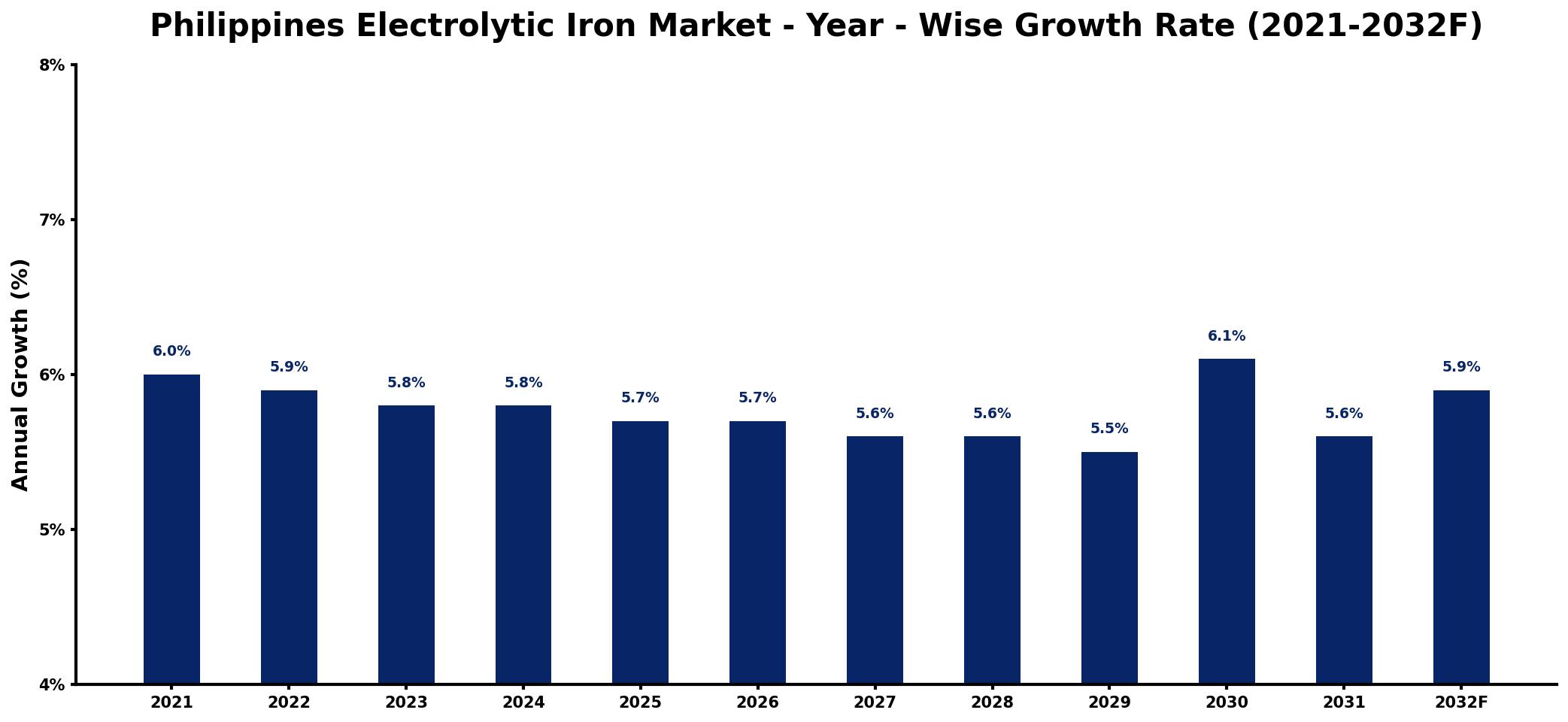
The table below presents the year‑wise growth rates along with the key drivers influencing the market
| Year | Growth Rate | Major Drivers |
| 2021 | 6.0% | Rising construction sector investments |
| 2022 | 5.9% | Increased automotive manufacturing demand |
| 2023 | 5.8% | Growth in renewable energy projects |
| 2024 | 5.8% | Expansion of infrastructure development |
| 2025 | 5.7% | Boost in consumer electronics production |
| 2026 | 5.7% | Surge in industrial machinery needs |
| 2027 | 5.6% | Growing demand from aerospace sector |
| 2028 | 5.6% | Enhancements in technology applications |
| 2029 | 5.5% | Strengthened global trade relations |
| 2030 | 6.1% | Revival of manufacturing activities |
| 2031 | 5.6% | Emerging markets driving consumption |
| 2032 | 5.9% | Advancements in construction technologies |
Note: Market size estimations and growth projections presented in this report are based on 6Wresearch's proprietary forecasting methodology, utilizing the latest available industry data, government publications, and primary research inputs.
Philippines Electrolytic Iron Market Synopsis
The Philippines has seen a marked uptick in electrolytic iron consumption, particularly evident in its strategic application within the steel manufacturing sector. Recent data from the Philippine Statistics Authority (PSA) indicates a 4% increase in consumption, amounting to approximately USD 33 million, showcasing a burgeoning interest in this high-purity metal.
Major importers, primarily China and Taiwan, account for 88% of the market, highlighting the Philippines' reliance on international suppliers. As technological advancements persist across various applications, the demand for electrolytic iron is poised for further enhancement, particularly in industries requiring specialized material properties.
Philippines Electrolytic Iron Market Key Takeaways
- Significant growth projected in the electrolytic iron market with an expected CAGR of 4.9% from 2026 to 2032.
- Major applications in steel production underscore the metal's critical role in deoxidation and alloying processes.
- Electrolytic iron finds diversified uses across electronics, pharmaceuticals, and chemical processes.
- China and Taiwan dominate the import landscape, collectively representing 88% of the market share.
- Market recovery anticipated post-COVID-19 as industrial activities resume and global economic conditions stabilize.
Evaluation of Restraints in Philippines Electrolytic Iron Market
While the electrolytic iron market shows promise, it does face significant challenges, particularly regarding energy consumption and the overall cost of the electrolysis process. High energy demands can impact production costs, affecting pricing strategies. Moreover, ensuring the purity and consistent quality of electrolytic iron is vital for catering to specific industrial requirements. Failure to meet these standards can restrict market growth and diminish competitiveness, necessitating continued advancements in production technologies.
Philippines Electrolytic Iron Market Trends
The demand for electrolytic iron is increasingly influenced by advancements in manufacturing processes across various sectors. The push for high-purity materials in electronics and pharmaceuticals is a notable trend, as companies prioritize quality and performance. Additionally, the growing emphasis on sustainability and eco-friendly practices is prompting manufacturers to explore more efficient production methods. This trend aligns with global movements toward cleaner technologies and energy-efficient processes, which are expected to reshape the landscape of electrolytic iron production in the Philippines.
Philippines Electrolytic Iron Market Opportunities
There are substantial growth opportunities in the Philippines electrolytic iron market, particularly in enhancing local production capabilities. Investing in advanced electrolysis technologies could improve efficiency and reduce costs, thereby making domestic production more viable. Additionally, expanding applications in emerging sectors like renewable energy and battery production could provide new revenue streams. With industrial growth on the rise, aligning with innovations in these areas presents a compelling case for investment.
Government Initiatives in the Philippines Electrolytic Iron Market
The Philippine government has implemented various initiatives aimed at enhancing the local manufacturing landscape, which is particularly relevant for the electrolytic iron market. Policies focusing on infrastructure development, energy efficiency, and technological innovation are critical in fostering a conducive environment for industry growth. Incentives for research and development, as well as public spending on industrial enhancement projects, signal the government's commitment to strengthen this sector.
Future Insights of the Philippines Electrolytic Iron Market
Looking ahead to the period from 2026 to 2032, the Philippines electrolytic iron market is expected to evolve significantly. As industries embrace higher standards for quality and sustainability, the demand for electrolytic iron will likely increase. Innovations in production methods and a focus on energy-efficient processes will drive competitiveness. Additionally, as global supply chains stabilize, the local market could benefit from a renewed emphasis on domestic production, paving the way for sustainable growth.
Philippines Electrolytic Iron Market Latest Developments (2025 - 2026)
In the recent months leading up to mid-2026, the electrolytic iron market has observed a shift towards enhanced production technologies aimed at reducing energy costs. Additionally, a trend toward more stringent quality standards in industries relying on electrolytic iron has emerged, prompting local manufacturers to adapt and innovate. Collaborations between public and private sectors are also becoming more prevalent, aiming to bolster research efforts and improve production efficiencies.
Philippines Electrolytic Iron Market - Key Attractiveness of the Report
- 10 Years of Market Numbers
- Historical Data Starting from 2022 to 2025
- Base Year: 2025
- Forecast Data until 2032
- Key Performance Indicators Impacting the Market
- Major Upcoming Developments and Projects
Key Highlights of the Report:
- Philippines Electrolytic Iron Market Outlook
- Market Size of Philippines Electrolytic Iron Market, 2025
- Forecast of Philippines Electrolytic Iron Market, 2032
- Historical Data and Forecast of Philippines Electrolytic Iron Revenues & Volume for the Period 2022-2032F
- Philippines Electrolytic Iron Market Trend Evolution
- Philippines Electrolytic Iron Market Drivers and Challenges
- Philippines Electrolytic Iron Price Trends
- Philippines Electrolytic Iron Porter's Five Forces
- Philippines Electrolytic Iron Industry Life Cycle
- Historical Data and Forecast of Philippines Electrolytic Iron Market Revenues & Volume By Type for the Period 2022-2032F
- Historical Data and Forecast of Philippines Electrolytic Iron Market Revenues & Volume By High Purity for the Period 2022-2032F
- Historical Data and Forecast of Philippines Electrolytic Iron Market Revenues & Volume By Low Purity for the Period 2022-2032F
- Historical Data and Forecast of Philippines Electrolytic Iron Market Revenues & Volume By Application for the Period 2022-2032F
- Historical Data and Forecast of Philippines Electrolytic Iron Market Revenues & Volume By Electronic Components for the Period 2022-2032F
- Historical Data and Forecast of Philippines Electrolytic Iron Market Revenues & Volume By Research for the Period 2022-2032F
- Historical Data and Forecast of Philippines Electrolytic Iron Market Revenues & Volume By Special Alloys for the Period 2022-2032F
- Historical Data and Forecast of Philippines Electrolytic Iron Market Revenues & Volume By Others for the Period 2022-2032F
- Philippines Electrolytic Iron Import Export Trade Statistics
- Market Opportunity Assessment By Type
- Market Opportunity Assessment By Application
- Philippines Electrolytic Iron Top Companies Market Share
- Philippines Electrolytic Iron Competitive Benchmarking By Technical and Operational Parameters
- Philippines Electrolytic Iron Company Profiles
- Philippines Electrolytic Iron Key Strategic Recommendations






































