Philippines Facade Market Top 5 Importing Countries and Market Competition (HHI) Analysis
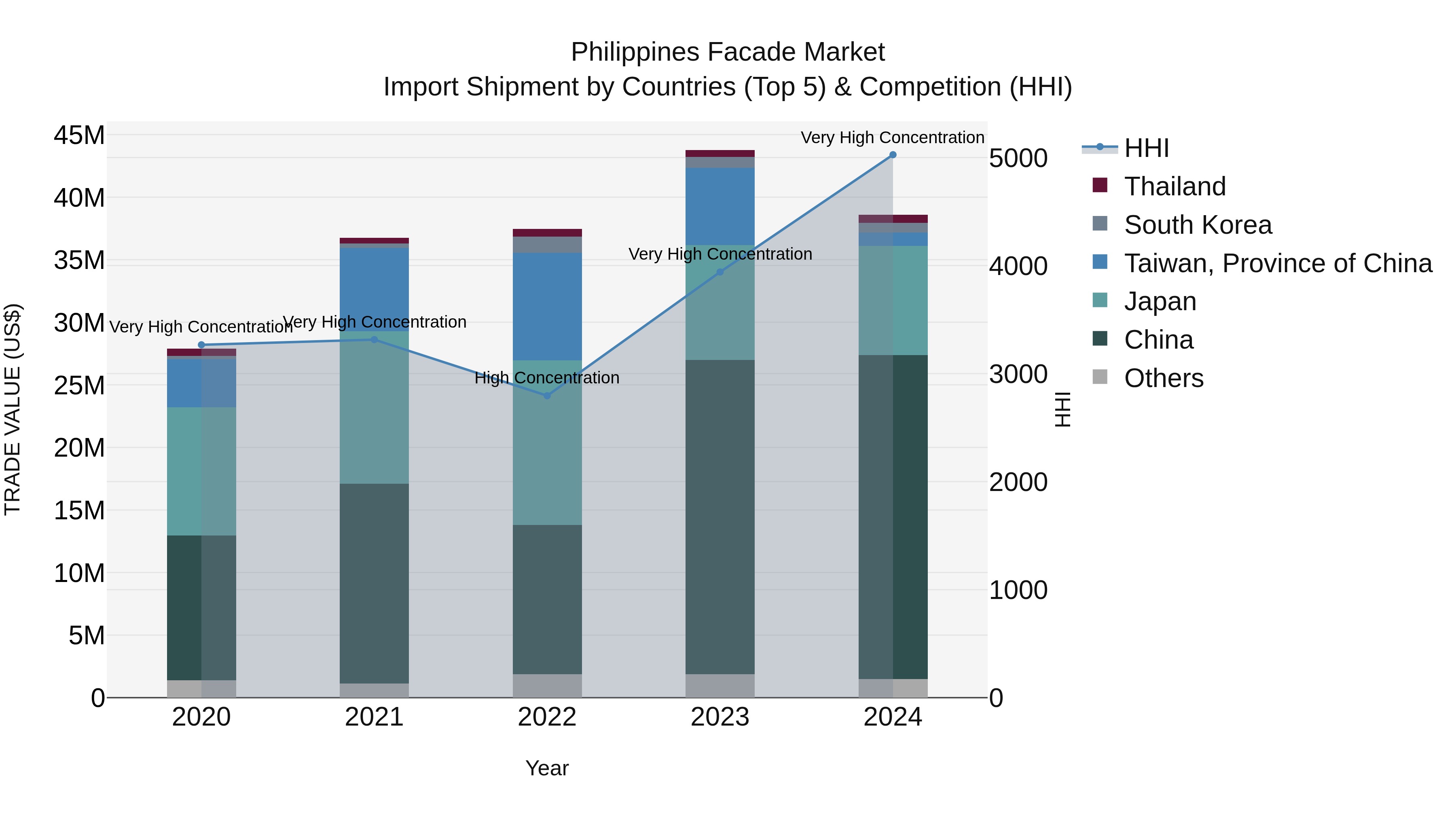
In 2024, Philippines continued to see significant import shipments of facades, with top exporters being China, Japan, Taiwan, South Korea, and Thailand. The market remained highly concentrated, as indicated by the high Herfindahl-Hirschman Index (HHI). Despite a strong compound annual growth rate (CAGR) of 8.47% from 2020 to 2024, there was a slight decline in the growth rate from 2023 to 2024 at -11.8%. This data suggests a dynamic market landscape for facade imports in the Philippines, influenced by key players in the region.
Philippines Facade Market Synopsis
The Philippines facade market has been experiencing steady growth over the past few years. With the booming construction industry, demand for aesthetically pleasing and energy-efficient facades has risen. The CAGR for this market is estimated to be around 8%, driven by urbanization and commercial development.
Drivers of the Market
The Philippines Facade Market growth is driven by the construction industry`s emphasis on architectural aesthetics and energy efficiency. Facades play a crucial role in a building`s appearance, energy performance, and sustainability. With urban development and the demand for visually striking structures, the market for facade materials and solutions is expanding. Additionally, government initiatives and regulations promoting energy-efficient buildings contribute to the market`s growth.
Challenges of the Market
The facade market`s challenges include adapting to changing architectural trends and offering energy-efficient solutions. Providing innovative designs that also contribute to building performance poses challenges.
COVID-19 Impact on the Market
The Philippines Facade market has been impacted by the pandemic as construction projects were put on hold and demand for architectural solutions decreased. As construction activities resume, the market is expected to witness a gradual recovery.
Key Players in the Market
Some of the prominent players in the Philippines facade market include Saint-Gobain Philippines Co. Ltd., Asahi Glass Philippines Inc., and Alcopanel Philippines.
Key Highlights of the Report:
- Philippines Facade Market Outlook
- Market Size of Philippines Facade Market, 2024
- Forecast of Philippines Facade Market, 2031
- Historical Data and Forecast of Philippines Facade Revenues & Volume for the Period 2021-2031
- Philippines Facade Market Trend Evolution
- Philippines Facade Market Drivers and Challenges
- Philippines Facade Price Trends
- Philippines Facade Porter's Five Forces
- Philippines Facade Industry Life Cycle
- Historical Data and Forecast of Philippines Facade Market Revenues & Volume By Product for the Period 2021-2031
- Historical Data and Forecast of Philippines Facade Market Revenues & Volume By Ventilated Facades for the Period 2021-2031
- Historical Data and Forecast of Philippines Facade Market Revenues & Volume By Non-ventilated Facades for the Period 2021-2031
- Historical Data and Forecast of Philippines Facade Market Revenues & Volume By Others for the Period 2021-2031
- Historical Data and Forecast of Philippines Facade Market Revenues & Volume By End-use for the Period 2021-2031
- Historical Data and Forecast of Philippines Facade Market Revenues & Volume By Commercial for the Period 2021-2031
- Historical Data and Forecast of Philippines Facade Market Revenues & Volume By Residential for the Period 2021-2031
- Historical Data and Forecast of Philippines Facade Market Revenues & Volume By Industrial for the Period 2021-2031
- Philippines Facade Import Export Trade Statistics
- Market Opportunity Assessment By Product
- Market Opportunity Assessment By End-use
- Philippines Facade Top Companies Market Share
- Philippines Facade Competitive Benchmarking By Technical and Operational Parameters
- Philippines Facade Company Profiles
- Philippines Facade Key Strategic Recommendations






































