United Kingdom (UK) Facade Market Size, Share & Growth Rate
The United Kingdom (UK) Facade Market was estimated at USD 212 Million in 2025 and is projected to reach USD 262 Million by 2032, growing at a CAGR of 3.1% from 2026 to 2032. This growth trajectory is fueled by a robust construction sector, particularly in commercial and residential projects, where innovative and energy-efficient facade solutions are becoming paramount. As the UK embraces sustainability and aesthetic design in architecture, the demand for advanced facade technologies continues to accelerate.
United Kingdom (UK) Facade Market Year-wise Growth Rate and Key Drivers
This graph highlights how the United Kingdom (UK) Facade Market has steadily grown over the years, supported by major growth factors.
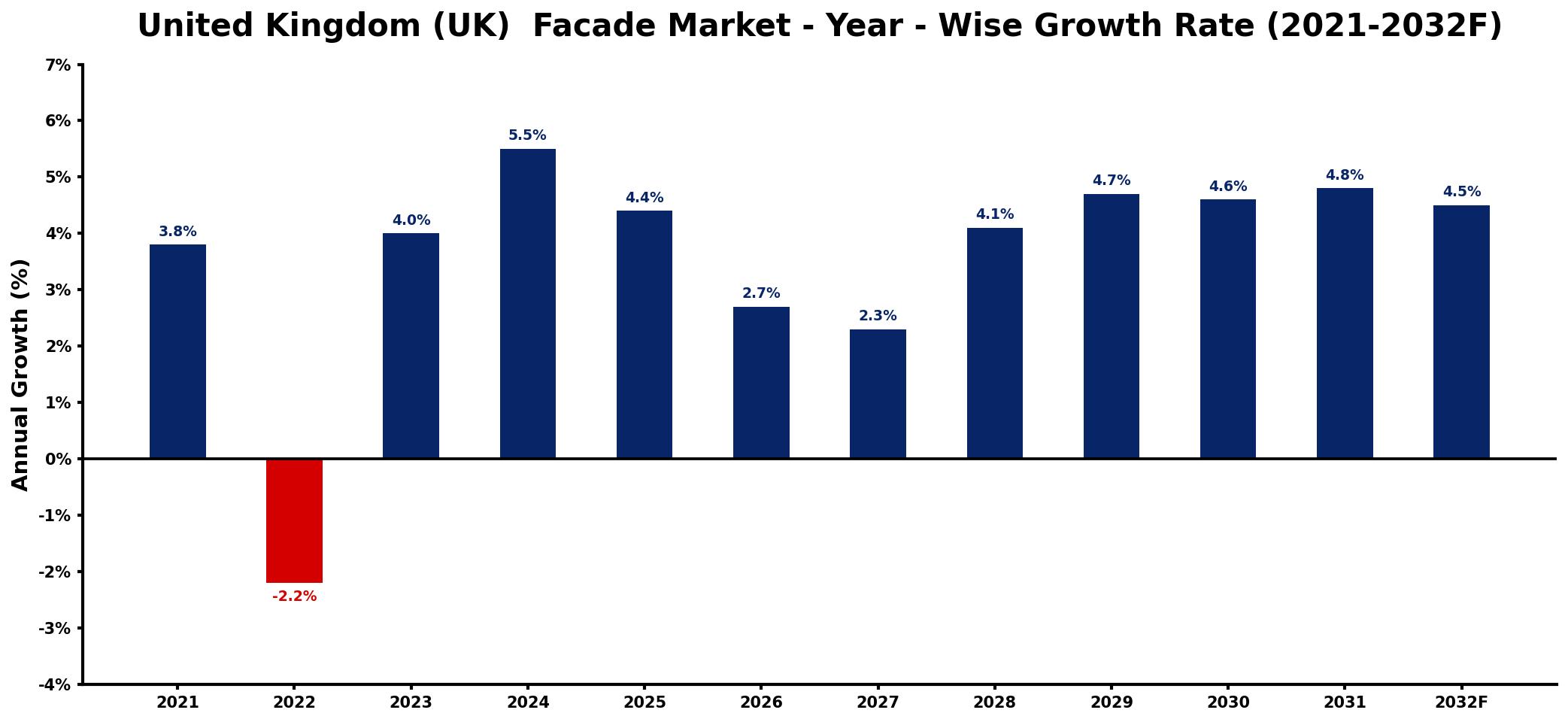
The table below presents the year‑wise growth rates along with the key drivers influencing the market
| Year | Growth Rate | Major Drivers |
| 2021 | 3.8% | Renewable energy projects increase demand |
| 2022 | -2.2% | Construction activity experiences downturn |
| 2023 | 4.0% | Government incentives drive investments |
| 2024 | 5.5% | Sustainable building practices gain traction |
| 2025 | 4.4% | Urban regeneration projects expand rapidly |
| 2026 | 2.7% | Technological advancements enhance efficiency |
| 2027 | 2.3% | Rising urban population boosts demand |
| 2028 | 4.1% | Infrastructure investments support growth |
| 2029 | 4.7% | Green certifications attract new projects |
| 2030 | 4.6% | Innovative materials capture market interest |
| 2031 | 4.8% | Public-private partnerships foster expansion |
| 2032 | 4.5% | Increased focus on energy efficiency |
Note: Market size estimations and growth projections presented in this report are based on 6Wresearch's proprietary forecasting methodology, utilizing the latest available industry data, government publications, and primary research inputs.
United Kingdom (UK) Facade Market Synopsis
The UK facade market is increasingly characterized by the rising demand for energy-efficient building envelopes. This trend is catalyzed by stringent regulatory frameworks and a societal shift toward sustainability, compelling stakeholders to explore innovative materials and designs. An emphasis on performance and aesthetics is driving the adoption of advanced facade solutions, including smart technologies.
Sustainable materials such as glass and metal composites are gaining popularity, aligning with the UK's commitment to reduce carbon emissions. This growing acceptance of eco-friendly solutions not only enhances building performance but also meets the expectations of environmentally conscious consumers and businesses.
United Kingdom (UK) Facade Market Key Takeaways
- The market is driven by the demand for sustainable and aesthetically appealing facade solutions.
- Energy-efficient building regulations are shaping the development of advanced facade technologies.
- Innovations like modular and prefabricated facade systems are gaining traction in the construction process.
- The skilled labor shortage poses challenges, impacting project timelines and quality.
- Government initiatives are providing a supportive framework for green building practices.
Evaluation of Restraints in United Kingdom (UK) Facade Market
The UK facade market faces several restraints that could hinder its growth. Strict regulatory requirements regarding energy efficiency and building codes necessitate that developers keep pace with evolving compliance standards. Additionally, the challenge of sourcing innovative designs that meet both aesthetic and functional needs can limit project feasibility. Material cost volatility further complicates planning and budgeting. Moreover, the ongoing skilled labor shortage in construction poses a risk for timely project delivery and overall quality, making it imperative for stakeholders to collaborate closely and adapt to these constraints.
United Kingdom (UK) Facade Market Trends
Current trends in the UK facade market emphasize sustainability, with a focus on energy-efficient systems that not only comply with regulations but also enhance building performance. The integration of smart technologies, including automation and sensors in facades, is on the rise. Additionally, theres a marked preference for modular and prefabricated facade solutions that streamline construction processes. These innovations not only reduce labor costs but also enhance overall project efficiency, which is becoming increasingly important in a competitive market.
United Kingdom (UK) Facade Market Opportunities
Investment opportunities in the UK facade market are thriving, fueled by the demand for innovative and sustainable solutions. Companies focusing on advanced materials—such as insulated glass and high-performance cladding—stand to gain significantly. The governments initiatives to retrofit existing buildings for enhanced energy efficiency create a lucrative market for renovation projects. Furthermore, advancing facade technologies provide avenues for research and development investments, positioning investors to capitalize on a burgeoning sector with a focus on sustainability and aesthetic appeal.
Government Initiatives in the United Kingdom (UK) Facade Market
Government policies in the UK are pivotal in steering the facade market towards sustainability and energy efficiency. Initiatives such as the Green Deal and the Energy Company Obligation (ECO) encourage the installation of energy-efficient facades. Building regulations, particularly Part L of the Building Regulations, mandate energy performance standards that guide new constructions and renovations. Additionally, the commitment to reducing carbon emissions under the Climate Change Act bolsters the demand for environmentally-friendly facade solutions, with future regulations set to intensify this trend.
Future Insights of the United Kingdom (UK) Facade Market
Looking ahead to 2026-2032, the UK facade market is poised for substantial growth. As construction activity accelerates, the demand for energy-efficient designs and sustainable materials will expand. Advancements in technology, particularly smart building solutions, are likely to become integral in the design and functionality of facades. With ongoing government support for green initiatives, the market is expected to innovate continuously, making strides toward enhanced efficiency, aesthetics, and sustainability in building design.
United Kingdom (UK) Facade Market Latest Developments (2025 - 2026)
Recent developments in the UK facade market indicate a heightened focus on sustainability and efficiency. A surge in public and private sector collaborations is enabling rapid advancements in facade technology. Additionally, an increasing number of projects are integrating smart facade systems that enhance energy performance while providing real-time data to building managers. The landscape is evolving as both new constructions and renovations increasingly prioritize innovative facade solutions that cater to modern aesthetic and functional demands.
United Kingdom (UK) Facade Market - Key Attractiveness of the Report
- 10 Years of Market Numbers
- Historical Data Starting from 2022 to 2025
- Base Year: 2025
- Forecast Data until 2032
- Key Performance Indicators Impacting the Market
- Major Upcoming Developments and Projects
Key Highlights of the Report:
- United Kingdom (UK) Facade Market Outlook
- Market Size of United Kingdom (UK) Facade Market, 2025
- Forecast of United Kingdom (UK) Facade Market, 2032
- Historical Data and Forecast of United Kingdom (UK) Facade Revenues & Volume for the Period 2022-2032F
- United Kingdom (UK) Facade Market Trend Evolution
- United Kingdom (UK) Facade Market Drivers and Challenges
- United Kingdom (UK) Facade Price Trends
- United Kingdom (UK) Facade Porter's Five Forces
- United Kingdom (UK) Facade Industry Life Cycle
- Historical Data and Forecast of United Kingdom (UK) Facade Market Revenues & Volume By Product for the Period 2022-2032F
- Historical Data and Forecast of United Kingdom (UK) Facade Market Revenues & Volume By Ventilated Facades for the Period 2022-2032F
- Historical Data and Forecast of United Kingdom (UK) Facade Market Revenues & Volume By Non-ventilated Facades for the Period 2022-2032F
- Historical Data and Forecast of United Kingdom (UK) Facade Market Revenues & Volume By Others for the Period 2022-2032F
- Historical Data and Forecast of United Kingdom (UK) Facade Market Revenues & Volume By End-use for the Period 2022-2032F
- Historical Data and Forecast of United Kingdom (UK) Facade Market Revenues & Volume By Commercial for the Period 2022-2032F
- Historical Data and Forecast of United Kingdom (UK) Facade Market Revenues & Volume By Residential for the Period 2022-2032F
- Historical Data and Forecast of United Kingdom (UK) Facade Market Revenues & Volume By Industrial for the Period 2022-2032F
- United Kingdom (UK) Facade Import Export Trade Statistics
- Market Opportunity Assessment By Product
- Market Opportunity Assessment By End-use
- United Kingdom (UK) Facade Top Companies Market Share
- United Kingdom (UK) Facade Competitive Benchmarking By Technical and Operational Parameters
- United Kingdom (UK) Facade Company Profiles
- United Kingdom (UK) Facade Key Strategic Recommendations






































