Turkey Facade Market Size, Share & Growth Rate
The Turkey Facade Market was estimated at USD 241 Million in 2025 and is projected to reach USD 332 Million by 2032, growing at a CAGR of 4.7% from 2026 to 2032. This growth trajectory is primarily driven by a surge in urbanization and construction activities across the residential and commercial sectors. Additionally, the increasing focus on energy efficiency and aesthetic appeal in building designs is further propelling the demand for innovative facade solutions.
Turkey Facade Market Year-wise Growth Rate and Key Drivers
This graph highlights how the Turkey Facade Market has steadily grown over the years, supported by major growth factors.
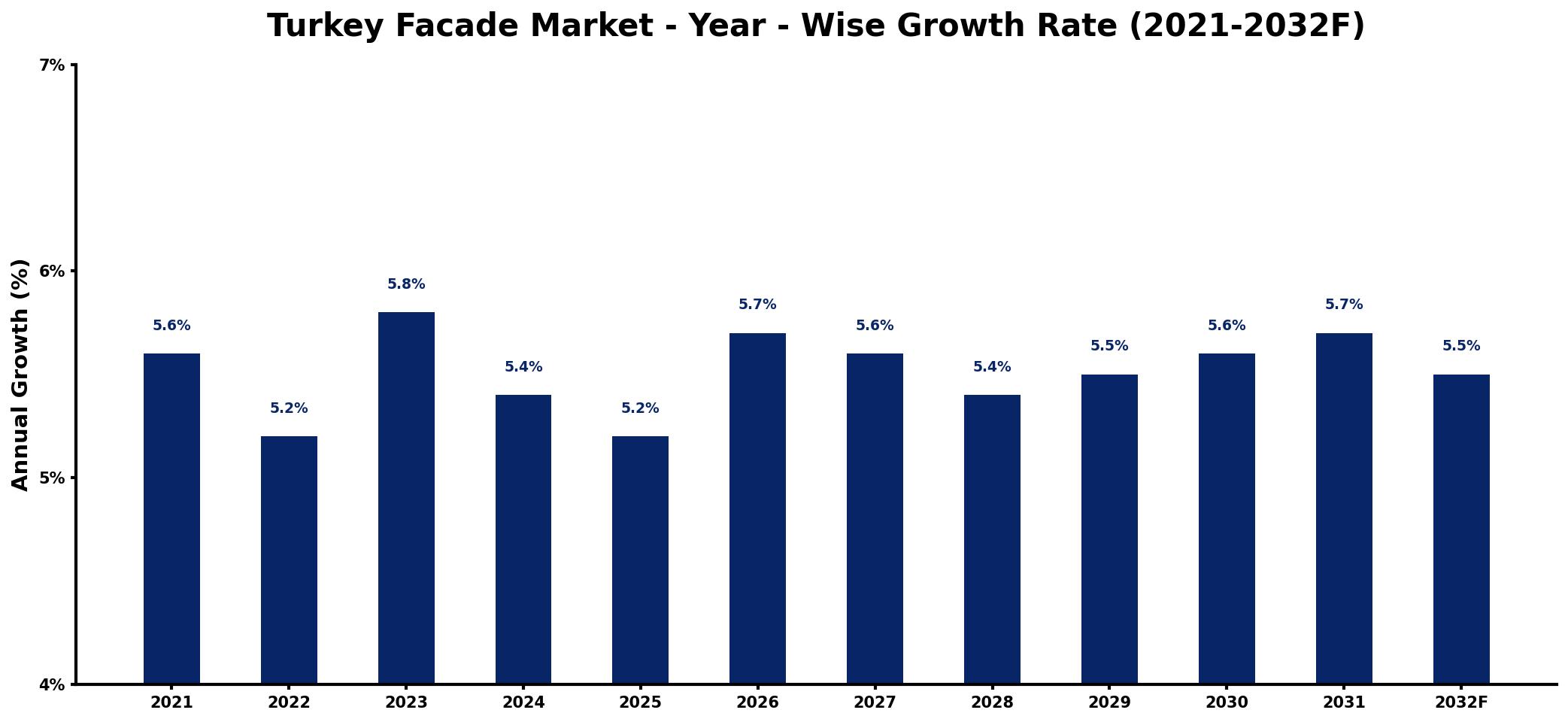
The table below presents the year‑wise growth rates along with the key drivers influencing the market
| Year | Growth Rate | Major Drivers |
| 2021 | 5.6% | Rising urban construction projects |
| 2022 | 5.2% | Increased investment in infrastructure |
| 2023 | 5.8% | Demand for energy efficient systems |
| 2024 | 5.4% | Growth in renewable energy sector |
| 2025 | 5.2% | Expansion of commercial real estate |
| 2026 | 5.7% | Innovations in building materials |
| 2027 | 5.6% | Strengthened regulations promoting sustainability |
| 2028 | 5.4% | Surge in residential renovations |
| 2029 | 5.5% | Boost in public-private partnerships |
| 2030 | 5.6% | Technological advancements in design |
| 2031 | 5.7% | Growing focus on aesthetic appeal |
| 2032 | 5.5% | Enhanced government funding initiatives |
Note: Market size estimations and growth projections presented in this report are based on 6Wresearch's proprietary forecasting methodology, utilizing the latest available industry data, government publications, and primary research inputs.
Turkey Facade Market Synopsis
Currently, the Turkey facade market is witnessing a dynamic transformation, characterized by a growing preference for sustainable and energy-efficient materials. Enhanced urban development initiatives and a burgeoning middle class are significantly influencing building aesthetics and energy performance, leading to a shift in facade requirements. This evolving landscape underscores the necessity for modern, efficient building solutions.
The integration of smart technologies in facade designs is gaining traction, with advancements that facilitate automated systems for monitoring and controlling energy use. Furthermore, government regulations promoting sustainable practices are shaping the market, pushing developers to adopt eco-friendly materials and construction techniques.
Turkey Facade Market Key Takeaways
- The Turkey facade market is poised for steady growth, driven by urbanization and sustainable construction trends.
- Government regulations are increasingly favoring energy-efficient and environmentally friendly building practices.
- Adoption of smart facade technologies is transforming traditional building designs, enhancing efficiency and management.
- Investment in innovative materials, such as insulated glass and photovoltaic panels, presents lucrative opportunities.
- Aesthetic diversity in facade designs is becoming vital for attracting attention in the competitive construction landscape.
Evaluation of Restraints in Turkey Facade Market
While the Turkey facade market holds significant potential, it faces several constraints that can impede growth. Economic instability and fluctuating construction activity often lead to uncertainty in investment and project timelines, hindering the demand for facade solutions. Regulatory compliance is another challenge, as companies must navigate complex standards and ensure that their materials meet safety and quality benchmarks. This continual adjustment to regulations adds an additional layer of complexity for market participants, impacting their operational efficiency and market competitiveness.
Turkey Facade Market Trends
Several key trends are shaping the Turkey facade market. There is a notable shift towards sustainable and energy-efficient materials, such as insulated glass and green walls, driven by heightened environmental awareness. Alongside this, the demand for smart facades, equipped with sensors and automation, is rising, enhancing building performance and management capabilities. Furthermore, aesthetic considerations are becoming increasingly important, leading to innovative and customized facade designs that reflect modern architectural trends.
Turkey Facade Market Opportunities
The Turkey facade market offers a plethora of investment opportunities, particularly for stakeholders interested in sustainable and technologically advanced solutions. The increasing adoption of energy-efficient materials presents a significant opening for manufacturers specializing in eco-friendly products. Additionally, the growing urban landscape creates ample chances for partnerships with local developers for turnkey facade projects. Investors focusing on smart building technologies, such as automated facade management systems, will likely find a receptive market as demand escalates for intelligent infrastructure solutions.
Government Initiatives in the Turkey Facade Market
Government policies in Turkey are fundamentally influencing the facade market by promoting sustainability and energy efficiency. Initiatives like the Building Energy Performance Regulation mandate specific energy standards for buildings, while the Green Building Certification System incentivizes the use of environmentally sound materials in facades. Moreover, renovation incentives under the Urban Transformation Law are driving demand for modern facade solutions in older structures. These government-backed initiatives are vital in steering the market towards innovative and sustainable practices.
Future Insights of the Turkey Facade Market
Looking ahead to 2026-2032, the Turkey facade market is expected to flourish, propelled by ongoing urban development and a commitment to sustainable building practices. As cities expand and infrastructure modernization continues, the demand for innovative and energy-efficient facade solutions will likely intensify. Furthermore, advancements in materials and technologies, including the increasing integration of smart systems, will open new avenues for market growth. However, stakeholders must remain vigilant regarding fluctuating raw material prices and regulatory shifts that could impact overall market dynamics.
Turkey Facade Market Latest Developments (2025 - 2026)
Recent developments within the Turkey facade market indicate a strong shift towards innovative materials and designs. There is a marked increase in projects utilizing smart technologies to enhance building energy efficiency and performance. Additionally, various initiatives are underway focusing on sustainable construction, aligning with global environmental goals. As cities continue to modernize, the emphasis on unique and aesthetically appealing facades is becoming a significant trend, pushing the boundaries of traditional design.
Turkey Facade Market - Key Attractiveness of the Report
- 10 Years of Market Numbers
- Historical Data Starting from 2022 to 2025
- Base Year: 2025
- Forecast Data until 2032
- Key Performance Indicators Impacting the Market
- Major Upcoming Developments and Projects
Key Highlights of the Report:
- Turkey Facade Market Outlook
- Market Size of Turkey Facade Market, 2025
- Forecast of Turkey Facade Market, 2032
- Historical Data and Forecast of Turkey Facade Revenues & Volume for the Period 2022-2032F
- Turkey Facade Market Trend Evolution
- Turkey Facade Market Drivers and Challenges
- Turkey Facade Price Trends
- Turkey Facade Porter's Five Forces
- Turkey Facade Industry Life Cycle
- Historical Data and Forecast of Turkey Facade Market Revenues & Volume By Product for the Period 2022-2032F
- Historical Data and Forecast of Turkey Facade Market Revenues & Volume By Ventilated Facades for the Period 2022-2032F
- Historical Data and Forecast of Turkey Facade Market Revenues & Volume By Non-ventilated Facades for the Period 2022-2032F
- Historical Data and Forecast of Turkey Facade Market Revenues & Volume By Others for the Period 2022-2032F
- Historical Data and Forecast of Turkey Facade Market Revenues & Volume By End-use for the Period 2022-2032F
- Historical Data and Forecast of Turkey Facade Market Revenues & Volume By Commercial for the Period 2022-2032F
- Historical Data and Forecast of Turkey Facade Market Revenues & Volume By Residential for the Period 2022-2032F
- Historical Data and Forecast of Turkey Facade Market Revenues & Volume By Industrial for the Period 2022-2032F
- Turkey Facade Import Export Trade Statistics
- Market Opportunity Assessment By Product
- Market Opportunity Assessment By End-use
- Turkey Facade Top Companies Market Share
- Turkey Facade Competitive Benchmarking By Technical and Operational Parameters
- Turkey Facade Company Profiles
- Turkey Facade Key Strategic Recommendations






































