Kazakhstan Facade Market Size, Share & Growth Rate
The Kazakhstan Facade Market was estimated at USD 499 Million in 2025 and is projected to reach USD 693 Million by 2032, growing at a CAGR of 4.8% from 2026 to 2032. This robust growth trajectory can be attributed to a surge in urbanization and substantial investments in infrastructure, fostering demand for modern and energy-efficient facade solutions. As the construction sector expands, the push for innovative designs and sustainable materials is further propelling the market.
Kazakhstan Facade Market Year-wise Growth Rate and Key Drivers
This graph highlights how the Kazakhstan Facade Market has steadily grown over the years, supported by major growth factors.
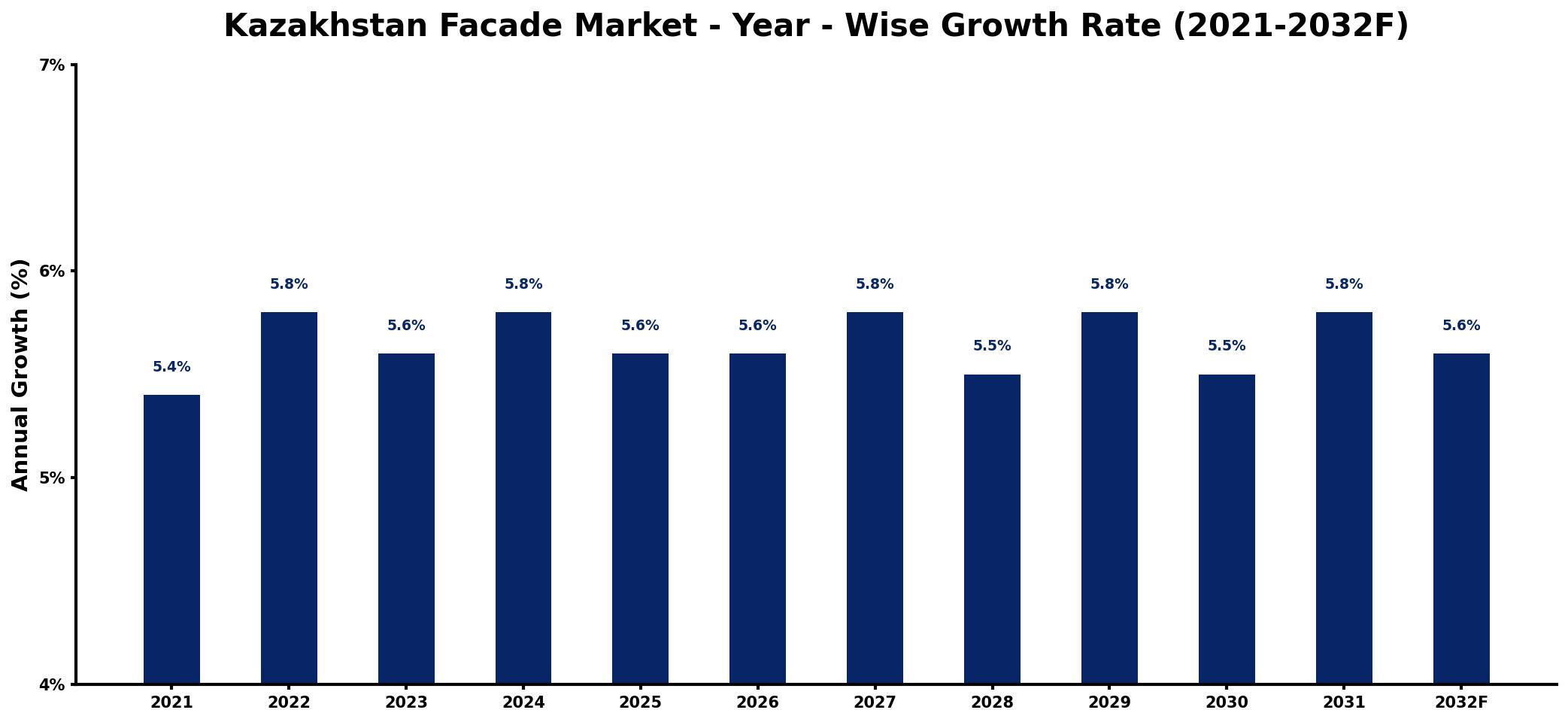
The table below presents the year‑wise growth rates along with the key drivers influencing the market
| Year | Growth Rate | Major Drivers |
| 2021 | 5.4% | Rising construction sector investments |
| 2022 | 5.8% | Increased urbanization and development |
| 2023 | 5.6% | Growing demand for energy efficiency |
| 2024 | 5.8% | Expansion of green building initiatives |
| 2025 | 5.6% | strengthening international trade flows |
| 2026 | 5.6% | Surge in residential construction activities |
| 2027 | 5.8% | Enhancements in architectural design practices |
| 2028 | 5.5% | Strengthening regulatory standards compliance |
| 2029 | 5.8% | Increased focus on aesthetic value |
| 2030 | 5.5% | Growing popularity of sustainable materials |
| 2031 | 5.8% | Advancements in building technologies adoption |
| 2032 | 5.6% | expanding healthcare application demand |
Note: Market size estimations and growth projections presented in this report are based on 6Wresearch's proprietary forecasting methodology, utilizing the latest available industry data, government publications, and primary research inputs.
Kazakhstan Facade Market Synopsis
In Kazakhstan, the increasing focus on energy efficiency is shaping the facade market, leading to a notable shift towards sustainable building materials. Particularly, the adoption of glass, aluminum, and composite panels is gaining traction as construction projects prioritize environmental impact and operational cost savings.
The governmental policies supporting green building practices are also vital in this sector. As regulations become more stringent regarding energy efficiency, the market is adapting to fulfill these emerging demands, creating a ripe environment for innovative facade technologies.
Kazakhstan Facade Market Key Takeaways
- Significant growth opportunities driven by urbanization and infrastructure investment.
- Shift towards sustainable materials and energy-efficient facade solutions.
- Strong governmental support for green building initiatives and local material sourcing.
- Increasing demand for high-quality, durable, and low-maintenance facade products.
- Emerging trends in smart technology and innovative design in facades.
Evaluation of Restraints in Kazakhstan Facade Market
Despite the positive outlook, the Kazakhstan facade market faces several restraints that could hinder growth. Fluctuating prices of raw materials pose a significant challenge, complicating budgeting and project planning for construction firms. Additionally, there exists a limited pool of skilled labor and specialized contractors, which can lead to project delays and increased costs. Furthermore, the presence of competitive imported materials may impact local manufacturers market share. Navigating these complexities requires strategic collaboration across stakeholders in the sector.
Kazakhstan Facade Market Trends
The Kazakhstan facade market is currently embracing a variety of trends aimed at enhancing sustainability and aesthetic appeal. There is a marked interest in innovative facade designs that integrate smart technologies, such as dynamic facades that adapt to environmental conditions. Moreover, modular construction methods are gaining popularity, offering efficiency in both time and resource utilization. As consumers become more environmentally conscious, the demand for high-quality, low-maintenance materials that can withstand the harsh weather conditions prevalent in the region is also on the rise.
Kazakhstan Facade Market Opportunities
Investment opportunities abound in the Kazakhstan facade market, particularly for players offering innovative and sustainable facade solutions. The growing urban population necessitates the construction of energy-efficient buildings, where high-quality materials such as glass and composite panels are in demand. Additionally, theres potential for growth in facade engineering services, covering design, consulting, and project management that aligns with modern construction practices. Entering this market can yield lucrative returns as the construction landscape evolves.
Government Initiatives in the Kazakhstan Facade Market
The Kazakhstan government has introduced several initiatives to enhance the facade market's growth and sustainability. The State Construction Control Committee oversees the enforcement of building codes, ensuring compliance with regulations that promote energy-efficient construction. Policies aimed at supporting green building practices are encouraging the adoption of locally sourced materials, thereby boosting the domestic economy. These initiatives not only aim to improve the quality of building facades but also emphasize the importance of sustainability within the construction sector.
Future Insights of the Kazakhstan Facade Market
Looking ahead, the Kazakhstan Facade Market is expected to flourish, driven by ongoing urbanization, escalating infrastructure projects, and an unwavering demand for innovative building solutions. With advancements in facade technology and materials, the industry is likely to witness further integration of sustainability and aesthetic appeal in construction practices. As regulations tighten around energy efficiency, the market will increasingly pivot towards solutions that fulfill these requirements, creating a promising landscape for future investment.
Kazakhstan Facade Market Latest Developments (2025 - 2026)
Recent developments in the Kazakhstan facade market reflect a strong alignment with global trends towards sustainability and technological innovation. As construction projects increasingly incorporate smart materials, companies are exploring advanced design techniques that improve energy efficiency and aesthetic value. The industry is also witnessing collaborations between construction firms and technology providers to enhance facade performance and compliance with emerging building standards.
Kazakhstan Facade Market - Key Attractiveness of the Report
- 10 Years of Market Numbers
- Historical Data Starting from 2022 to 2025
- Base Year: 2025
- Forecast Data until 2032
- Key Performance Indicators Impacting the Market
- Major Upcoming Developments and Projects
Key Highlights of the Report:
- Kazakhstan Facade Market Outlook
- Market Size of Kazakhstan Facade Market, 2025
- Forecast of Kazakhstan Facade Market, 2032
- Historical Data and Forecast of Kazakhstan Facade Revenues & Volume for the Period 2022-2032F
- Kazakhstan Facade Market Trend Evolution
- Kazakhstan Facade Market Drivers and Challenges
- Kazakhstan Facade Price Trends
- Kazakhstan Facade Porter's Five Forces
- Kazakhstan Facade Industry Life Cycle
- Historical Data and Forecast of Kazakhstan Facade Market Revenues & Volume By Product for the Period 2022-2032F
- Historical Data and Forecast of Kazakhstan Facade Market Revenues & Volume By Ventilated Facades for the Period 2022-2032F
- Historical Data and Forecast of Kazakhstan Facade Market Revenues & Volume By Non-ventilated Facades for the Period 2022-2032F
- Historical Data and Forecast of Kazakhstan Facade Market Revenues & Volume By Others for the Period 2022-2032F
- Historical Data and Forecast of Kazakhstan Facade Market Revenues & Volume By End-use for the Period 2022-2032F
- Historical Data and Forecast of Kazakhstan Facade Market Revenues & Volume By Commercial for the Period 2022-2032F
- Historical Data and Forecast of Kazakhstan Facade Market Revenues & Volume By Residential for the Period 2022-2032F
- Historical Data and Forecast of Kazakhstan Facade Market Revenues & Volume By Industrial for the Period 2022-2032F
- Kazakhstan Facade Import Export Trade Statistics
- Market Opportunity Assessment By Product
- Market Opportunity Assessment By End-use
- Kazakhstan Facade Top Companies Market Share
- Kazakhstan Facade Competitive Benchmarking By Technical and Operational Parameters
- Kazakhstan Facade Company Profiles
- Kazakhstan Facade Key Strategic Recommendations






































