South Korea Facade Market Size, Share & Growth Rate
The South Korea Facade Market was estimated at USD 399 Million in 2025 and is projected to reach USD 525 Million by 2032, growing at a CAGR of 4.0% from 2026 to 2032. This growth trajectory is underpinned by a surge in construction activities across both commercial and residential sectors, fueled by urbanization and a heightened demand for aesthetically appealing and energy-efficient building designs.
South Korea Facade Market Year-wise Growth Rate and Key Drivers
This graph highlights how the South Korea Facade Market has steadily grown over the years, supported by major growth factors.
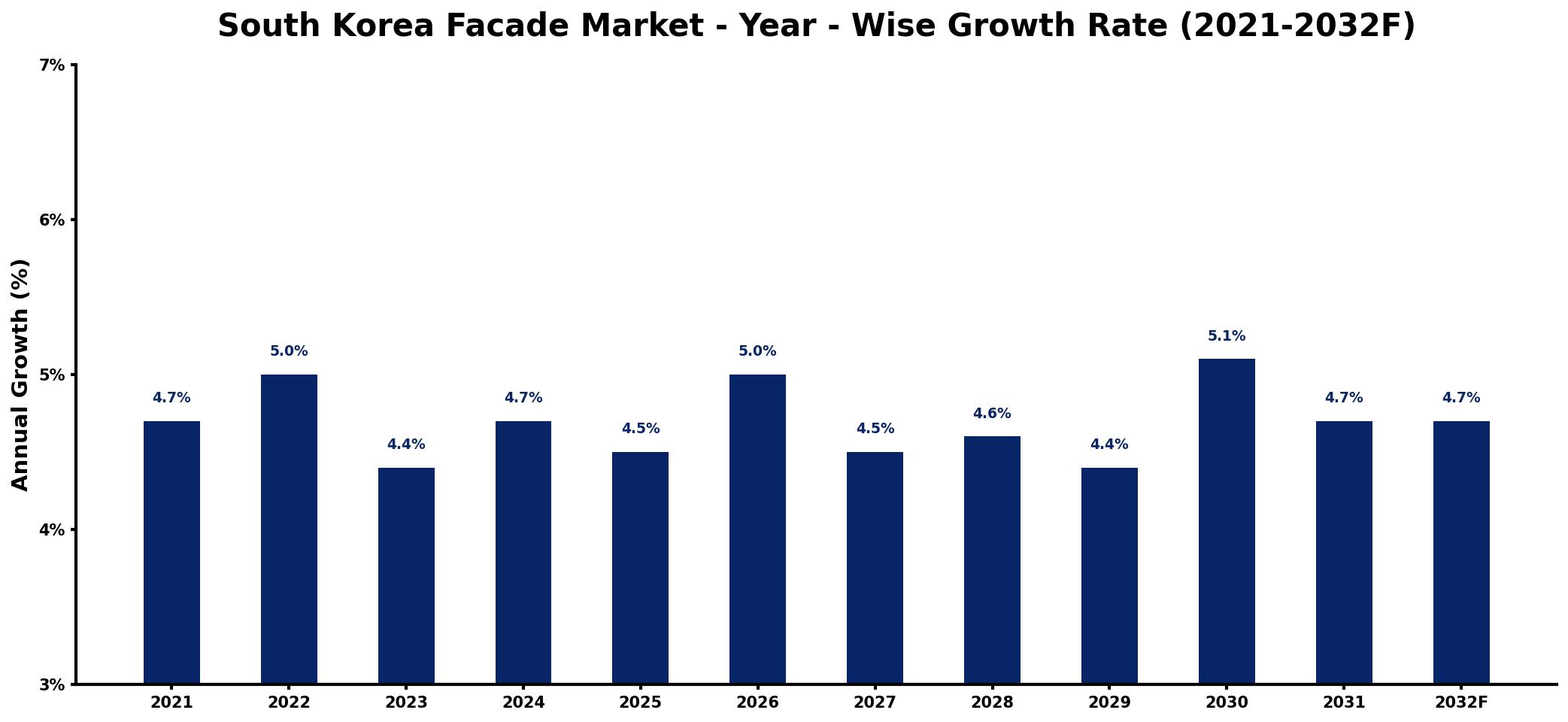
The table below presents the year‑wise growth rates along with the key drivers influencing the market
| Year | Growth Rate | Major Drivers |
| 2021 | 4.7% | Rising construction project investments |
| 2022 | 5.0% | Increased urban development activities |
| 2023 | 4.4% | Growing demand for sustainable buildings |
| 2024 | 4.7% | Expansion of green building initiatives |
| 2025 | 4.5% | Higher focus on architectural aesthetics |
| 2026 | 5.0% | Technological advancements in materials |
| 2027 | 4.5% | Boost in renovation and retrofitting |
| 2028 | 4.6% | Increased government infrastructure spending |
| 2029 | 4.4% | Surge in commercial real estate |
| 2030 | 5.1% | Growing emphasis on energy efficiency |
| 2031 | 4.7% | Rise in public-private partnerships |
| 2032 | 4.7% | Enhanced focus on urban revitalization |
Note: Market size estimations and growth projections presented in this report are based on 6Wresearch's proprietary forecasting methodology, utilizing the latest available industry data, government publications, and primary research inputs.
South Korea Facade Market Synopsis
The most significant force shaping the South Korea facade market is the increasing emphasis on sustainability and energy efficiency in building design. Developers are keen to adopt advanced facade solutions that not only enhance visual appeal but also contribute to energy conservation, aligning with global environmental goals.
This trend is reinforced by the integration of smart technologies and the use of eco-friendly materials. Glass and aluminum have become prominent in contemporary projects, providing innovative solutions that meet rigorous performance and aesthetic standards while also addressing the growing need for environmentally responsible construction practices.
South Korea Facade Market Key Takeaways
- The market is experiencing robust growth driven by urban development and infrastructure modernization.
- Sustainable materials and smart building solutions are transforming facade designs.
- Investment in research and development is critical for companies to innovate and remain competitive.
- Government regulations promote energy efficiency, enhancing facade performance standards.
- The shift towards green architecture is likely to drive demand for advanced facade systems.
Evaluation of Restraints in South Korea Facade Market
Despite the favorable conditions for growth, the South Korea facade market faces several notable restraints. Increasing competition from global players is compelling domestic firms to elevate their offerings, leading to heightened R&D investments. Moreover, volatile raw material prices present a challenge, as they can significantly impact project budgets and timelines. Compliance with stringent building codes necessitates constant adaptation, adding complexity to market operations. Additionally, the industry is grappling with a shortage of skilled labor, which can cause delays and inflate labor costs, ultimately hindering growth potential.
South Korea Facade Market Trends
The South Korea facade market is witnessing a pivotal shift towards sustainable and energy-efficient designs. Green facades, characterized by the integration of vegetation, are gaining traction as a means to improve insulation and air quality. Furthermore, the adoption of smart facades utilizing advanced technologies for energy optimization is rapidly rising. Architectural trends reveal a harmonious blend of traditional elements with modern aesthetics, where innovative materials such as composite panels, glass, and metals are increasingly employed to achieve a balance between functionality and artistic expression.
South Korea Facade Market Opportunities
As South Korea focuses on modernizing its infrastructure, substantial investment opportunities are emerging within the facade market. The demand for high-quality, innovative facade solutions presents avenues for investors to engage with companies specializing in advanced materials and cutting-edge design services. Additionally, government initiatives promoting sustainable building practices further amplify growth potential, positioning the facade sector as a key player in the evolving construction landscape.
Government Initiatives in the South Korea Facade Market
Government policies in South Korea are increasingly geared towards enhancing energy efficiency within the facade market. Regulations set forth ensure that new constructions adhere to specific energy performance standards, thereby fostering eco-friendly practices. Financial incentives and subsidies are also provided to encourage the use of sustainable materials and technologies in building facades. By prioritizing aesthetic enhancements alongside safety and quality compliance, these initiatives align with the countrys broader commitment to sustainable urban development.
Future Insights of the South Korea Facade Market
Looking ahead, the South Korea facade market is poised for steady growth through 2026-2032. Key drivers include rising urbanization rates, escalating construction activities, and an increased emphasis on energy-efficient solutions. Developers will continue to seek innovative and visually striking building facades to differentiate their projects in a competitive landscape. Stringent building regulations, along with a growing commitment to sustainability, will likely fuel the adoption of advanced facade systems, paving the way for technological advancements and design innovations in the sector.
South Korea Facade Market Latest Developments (2025 - 2026)
Recent developments in the South Korea facade market reflect a concentrated effort towards innovation and sustainability. Numerous firms are enhancing their product lines to include energy-efficient materials and smart technology solutions. The integration of renewable energy features within facade designs is also becoming more common, showcasing a commitment to reducing carbon footprints. As the market evolves, collaborative efforts between architects, builders, and material suppliers are increasing, leading to exciting new projects that prioritize both aesthetics and environmental responsibility.
South Korea Facade Market - Key Attractiveness of the Report
- 10 Years of Market Numbers
- Historical Data Starting from 2022 to 2025
- Base Year: 2025
- Forecast Data until 2032
- Key Performance Indicators Impacting the Market
- Major Upcoming Developments and Projects
Key Highlights of the Report:
- South Korea Facade Market Outlook
- Market Size of South Korea Facade Market, 2025
- Forecast of South Korea Facade Market, 2032
- Historical Data and Forecast of South Korea Facade Revenues & Volume for the Period 2022-2032F
- South Korea Facade Market Trend Evolution
- South Korea Facade Market Drivers and Challenges
- South Korea Facade Price Trends
- South Korea Facade Porter's Five Forces
- South Korea Facade Industry Life Cycle
- Historical Data and Forecast of South Korea Facade Market Revenues & Volume By Product for the Period 2022-2032F
- Historical Data and Forecast of South Korea Facade Market Revenues & Volume By Ventilated Facades for the Period 2022-2032F
- Historical Data and Forecast of South Korea Facade Market Revenues & Volume By Non-ventilated Facades for the Period 2022-2032F
- Historical Data and Forecast of South Korea Facade Market Revenues & Volume By Others for the Period 2022-2032F
- Historical Data and Forecast of South Korea Facade Market Revenues & Volume By End-use for the Period 2022-2032F
- Historical Data and Forecast of South Korea Facade Market Revenues & Volume By Commercial for the Period 2022-2032F
- Historical Data and Forecast of South Korea Facade Market Revenues & Volume By Residential for the Period 2022-2032F
- Historical Data and Forecast of South Korea Facade Market Revenues & Volume By Industrial for the Period 2022-2032F
- South Korea Facade Import Export Trade Statistics
- Market Opportunity Assessment By Product
- Market Opportunity Assessment By End-use
- South Korea Facade Top Companies Market Share
- South Korea Facade Competitive Benchmarking By Technical and Operational Parameters
- South Korea Facade Company Profiles
- South Korea Facade Key Strategic Recommendations






































