Iraq Facade Market Size, Share & Growth Rate
The Iraq Facade Market was estimated at USD 208 Million in 2025 and is projected to reach USD 290 Million by 2032, growing at a CAGR of 4.9% from 2026 to 2032. This growth trajectory is largely attributed to a burgeoning construction sector fueled by urbanization and a growing emphasis on sustainable building practices. Increasing investments in infrastructure, coupled with a demand for visually appealing and energy-efficient facade solutions, are significant contributors to this upward trend.
Iraq Facade Market Year-wise Growth Rate and Key Drivers
This graph highlights how the Iraq Facade Market has steadily grown over the years, supported by major growth factors.
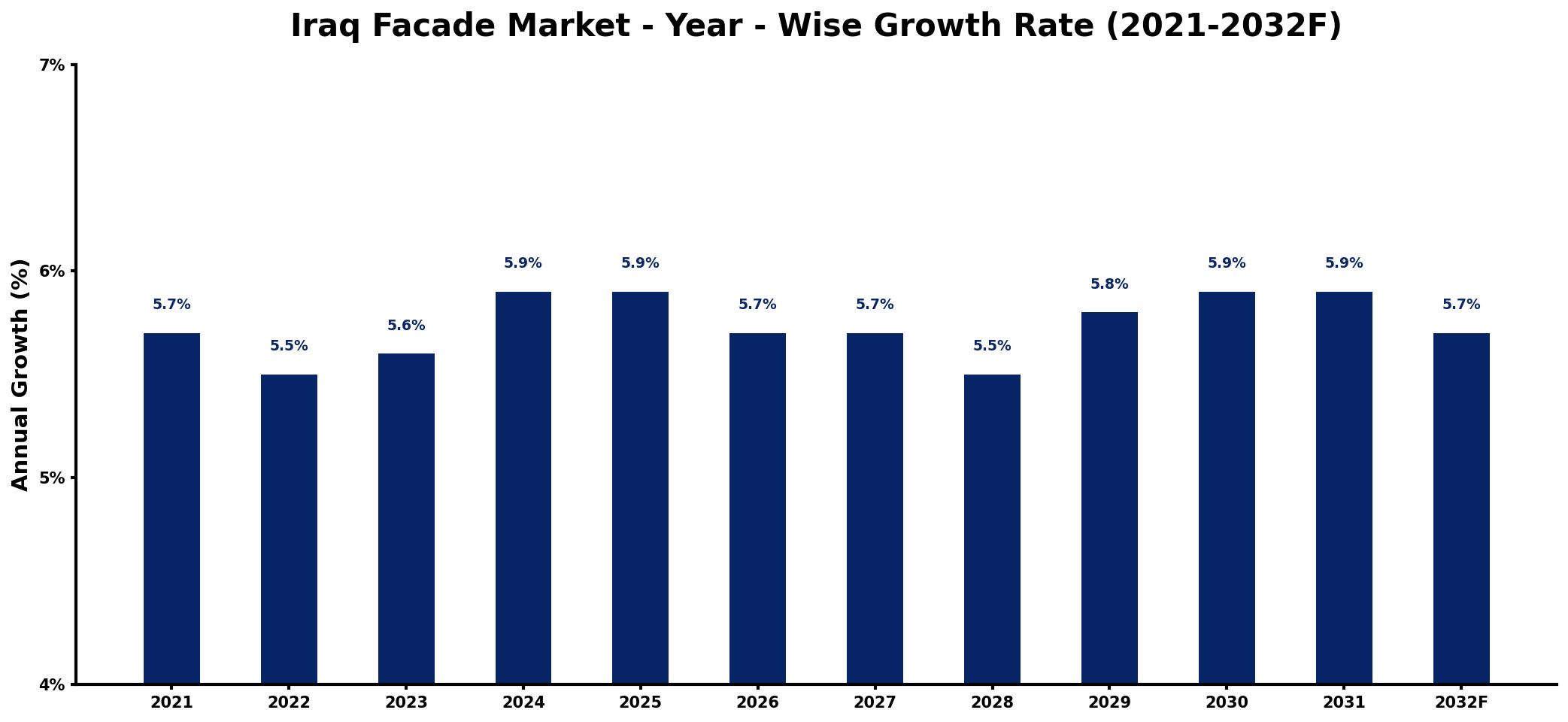
The table below presents the year‑wise growth rates along with the key drivers influencing the market
| Year | Growth Rate | Major Drivers |
| 2021 | 5.7% | Increased construction sector investments |
| 2022 | 5.5% | Rising urbanization and infrastructure projects |
| 2023 | 5.6% | Growing demand for sustainable buildings |
| 2024 | 5.9% | Expansion of commercial real estate |
| 2025 | 5.9% | Surge in residential housing projects |
| 2026 | 5.7% | Investment in green building technologies |
| 2027 | 5.7% | Increased public sector construction projects |
| 2028 | 5.5% | Rising demand for aesthetic design |
| 2029 | 5.8% | enhanced product quality standards |
| 2030 | 5.9% | Boost in energy efficiency initiatives |
| 2031 | 5.9% | Increased focus on urban renewal |
| 2032 | 5.7% | growing downstream application demand |
Note: Market size estimations and growth projections presented in this report are based on 6Wresearch's proprietary forecasting methodology, utilizing the latest available industry data, government publications, and primary research inputs.
Iraq Facade Market Synopsis
The Iraq facade market is characterized by a diverse array of facade systems, including glass, metal, stone, and composite materials. This variety caters to the distinct architectural requirements of residential, commercial, and industrial projects, reflecting a shift towards modernity and aesthetic appeal in building designs.
As sustainability becomes increasingly crucial, there is a notable trend toward green facades that incorporate energy-efficient technologies. This shift not only enhances the visual appeal of buildings but also supports Iraq's broader environmental goals, making the facade market a pivotal player in the construction landscape.
Iraq Facade Market Key Takeaways
- The market is projected to grow from USD 208 Million in 2025 to USD 290 Million by 2032.
- Increasing urbanization and infrastructure development are driving facade demand.
- There is a notable shift toward sustainable and energy-efficient facade solutions.
- Innovative designs featuring smart technologies are becoming popular.
- Local partnerships are crucial for navigating the complex market landscape.
Evaluation of Restraints in Iraq Facade Market
The growth of the Iraq facade market is significantly influenced by several restraints, primarily stemming from the countrys ongoing political instability and security challenges. This volatility can lead to unpredictable disruptions in construction projects, often resulting in delays and escalated costs for facade installations. The lack of reliable infrastructure and skilled labor further complicates the situation, potentially undermining both quality and efficiency in facade construction.
In addition, bureaucratic hurdles and import restrictions can complicate the procurement of necessary materials and components. Participants in this market must carefully assess these risks while strategically aligning with local stakeholders to mitigate these challenges effectively.
Iraq Facade Market Trends
A notable trend within the Iraq facade market is the increasing demand for energy-efficient building solutions, driven by heightened environmental awareness. This has led to a surge in the popularity of facade materials with superior insulation properties, such as insulated glass units and high-performance coatings. Moreover, innovative facade designs incorporating smart glass technology and dynamic shading systems are emerging as essential features in modern construction.
The movement toward mixed-use developments and large-scale urban infrastructure projects is further propelling demand for high-quality facade solutions that balance aesthetics with functionality, marking a significant evolution in how buildings are designed and constructed in Iraq.
Iraq Facade Market Opportunities
Investors seeking opportunities within the Iraq facade market can explore avenues in supplying advanced facade materials such as glass, aluminum, and composite panels, while also considering the growing need for installation and maintenance services. As the construction sector expands, there is a significant market for innovative facade solutions that prioritize energy efficiency and sustainable designs. Establishing partnerships with local construction firms can enhance market entry strategies, enabling stakeholders to tap into the surging demand for modern, visually appealing facades.
Government Initiatives in the Iraq Facade Market
Government policies in Iraq are focused on enhancing quality standards, safety measures, and environmental sustainability within the facade market. Oversight from the Ministry of Construction and Housing ensures that facade designs comply with established building codes and regulations. Additionally, there are initiatives aimed at promoting the use of energy-efficient materials, aligning with the countrys broader objectives for sustainable construction and development. Stakeholders must remain vigilant in understanding the regulatory landscape to maintain compliance and capitalize on available incentives.
Future Insights of the Iraq Facade Market
Looking ahead to 2026-2032, the Iraq facade market is anticipated to experience consistent growth fueled by the ongoing urbanization and infrastructure development efforts. As demand for aesthetically appealing and energy-efficient facades escalates, developers and architects are expected to continue pushing the envelope in design innovation. Government support for sustainable practices will likely foster an environment conducive to the adoption of advanced facade technologies, positioning the market for significant expansion in the coming years.
Iraq Facade Market Latest Developments (2025 - 2026)
In recent months, the Iraq facade market has seen a pronounced shift towards sustainable building practices, with several initiatives being rolled out to promote energy-efficient materials and designs. Various industry stakeholders are investing in research to develop advanced facade technologies, enhancing thermal performance and safety features. This proactive approach is aimed at meeting the growing demand for modern, visually compelling building exteriors amid the backdrop of the countrys revitalizing construction sector.
Iraq Facade Market - Key Attractiveness of the Report
- 10 Years of Market Numbers
- Historical Data Starting from 2022 to 2025
- Base Year: 2025
- Forecast Data until 2032
- Key Performance Indicators Impacting the Market
- Major Upcoming Developments and Projects
Key Highlights of the Report:
- Iraq Facade Market Outlook
- Market Size of Iraq Facade Market, 2025
- Forecast of Iraq Facade Market, 2032
- Historical Data and Forecast of Iraq Facade Revenues & Volume for the Period 2022-2032F
- Iraq Facade Market Trend Evolution
- Iraq Facade Market Drivers and Challenges
- Iraq Facade Price Trends
- Iraq Facade Porter's Five Forces
- Iraq Facade Industry Life Cycle
- Historical Data and Forecast of Iraq Facade Market Revenues & Volume By Product for the Period 2022-2032F
- Historical Data and Forecast of Iraq Facade Market Revenues & Volume By Ventilated Facades for the Period 2022-2032F
- Historical Data and Forecast of Iraq Facade Market Revenues & Volume By Non-ventilated Facades for the Period 2022-2032F
- Historical Data and Forecast of Iraq Facade Market Revenues & Volume By Others for the Period 2022-2032F
- Historical Data and Forecast of Iraq Facade Market Revenues & Volume By End-use for the Period 2022-2032F
- Historical Data and Forecast of Iraq Facade Market Revenues & Volume By Commercial for the Period 2022-2032F
- Historical Data and Forecast of Iraq Facade Market Revenues & Volume By Residential for the Period 2022-2032F
- Historical Data and Forecast of Iraq Facade Market Revenues & Volume By Industrial for the Period 2022-2032F
- Iraq Facade Import Export Trade Statistics
- Market Opportunity Assessment By Product
- Market Opportunity Assessment By End-use
- Iraq Facade Top Companies Market Share
- Iraq Facade Competitive Benchmarking By Technical and Operational Parameters
- Iraq Facade Company Profiles
- Iraq Facade Key Strategic Recommendations






































