Thailand Facade Market Size, Share & Growth Rate
The Thailand Facade Market was estimated at USD 80 Million in 2025 and is projected to reach USD 92 Million by 2032, growing at a CAGR of 2.0% from 2026 to 2032. This growth trajectory is fueled by an increasing demand for modern architectural designs that emphasize both aesthetics and energy efficiency. Additionally, government regulations promoting sustainable construction practices are further bolstering market expansion, as stakeholders seek innovative facade solutions that align with environmental goals.
Thailand Facade Market Year-wise Growth Rate and Key Drivers
This graph highlights how the Thailand Facade Market has steadily grown over the years, supported by major growth factors.
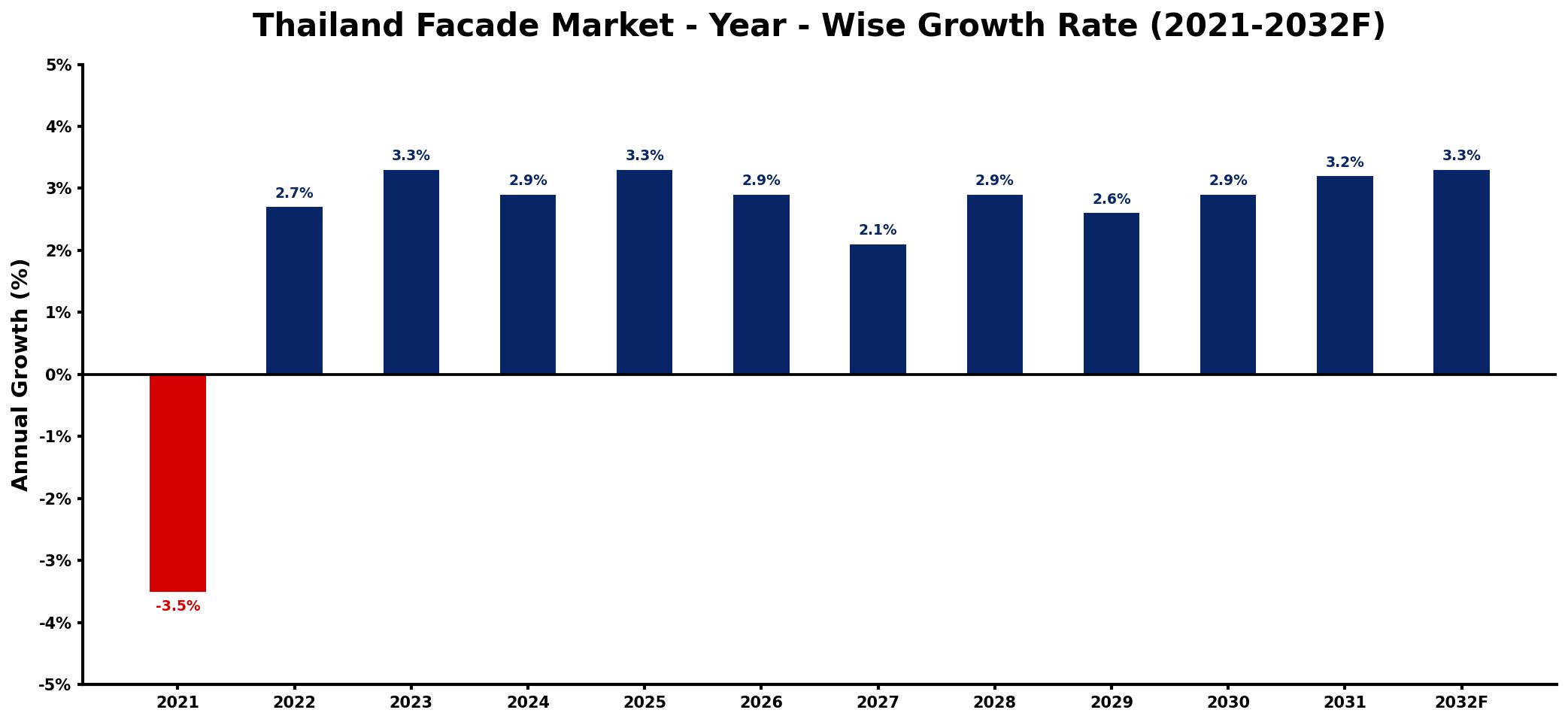
The table below presents the year‑wise growth rates along with the key drivers influencing the market
| Year | Growth Rate | Major Drivers |
| 2021 | -3.5% | Construction investments faced significant reductions |
| 2022 | 2.7% | Residential building projects increased significantly |
| 2023 | 3.3% | Commercial developments saw substantial growth |
| 2024 | 2.9% | Sustainable architecture gained wider acceptance |
| 2025 | 3.3% | Urbanization trends fueled infrastructure expansion |
| 2026 | 2.9% | Technological advancements drove innovation adoption |
| 2027 | 2.1% | Government initiatives promoted green building |
| 2028 | 2.9% | Renovation projects experienced higher demand |
| 2029 | 2.6% | Investment in smart technologies surged |
| 2030 | 2.9% | Public-private partnerships enhanced project funding |
| 2031 | 3.2% | Luxury developments attracted foreign investments |
| 2032 | 3.3% | Energy efficiency regulations encouraged upgrades |
Note: Market size estimations and growth projections presented in this report are based on 6Wresearch's proprietary forecasting methodology, utilizing the latest available industry data, government publications, and primary research inputs.
Thailand Facade Market Synopsis
Currently, the Thailand Facade Market stands at the intersection of architectural innovation and sustainability. A significant shift towards visually striking and energy-efficient building exteriors is shaping the landscape, reflecting contemporary trends in urban development. As cities expand, the integration of advanced facade systems has become crucial to meet both aesthetic and regulatory demands.
The growing emphasis on energy-efficient structures is driving architects and developers to adopt innovative materials and designs. As awareness around sustainability rises, facade systems are not only seen as architectural features but also as essential components that enhance a buildings overall performance and environmental footprint.
Thailand Facade Market Key Takeaways
- The Thailand Facade Market is experiencing growth driven by modern design trends and sustainability considerations.
- Government initiatives are fostering energy-efficient construction, promoting the adoption of advanced facade technologies.
- Innovations in materials and design are crucial to meeting the diverse needs of the construction sector.
- Companies are increasingly focusing on R&D to develop facades that can withstand Thailand's extreme weather conditions.
- The market is rebounding post-COVID-19 as construction activity picks up, signaling a return to growth.
Evaluation of Restraints in Thailand Facade Market
Despite its promising growth, the Thailand Facade Market faces several constraints that could impede progress. A notable barrier is the slow adoption of modern building technologies among some construction stakeholders. This can hinder the integration of innovative facade designs that are essential in todays competitive landscape. Moreover, Thailand's extreme weather can compromise the durability of facade materials, necessitating ongoing advancements in research and development to ensure product longevity. Additionally, firms must continually adapt to market shifts and invest in technologies to stay ahead.
Thailand Facade Market Trends
The landscape of the Thailand Facade Market is marked by several current trends. One of the most significant is the move towards sustainable materials, which not only meet aesthetic needs but also contribute to energy efficiency. The use of smart technologies in facades is also gaining traction, as digital tools and IoT integration become increasingly common in building designs. Furthermore, biophilic design principles are emerging, with facades incorporating natural elements to enhance both visual appeal and occupant well-being.
Thailand Facade Market Opportunities
A multitude of growth opportunities exists within the Thailand Facade Market. The increasing focus on green buildings opens avenues for investment in innovative facade technologies that promote energy efficiency and sustainability. Collaborations between technology providers and architectural firms are likely to yield novel solutions tailored to the region's specific needs. Additionally, as urbanization intensifies, there is a compelling need for facades that enhance building performance while contributing to the aesthetic value of Thailand's evolving skyline.
Government Initiatives in the Thailand Facade Market
The Thai government is actively promoting sustainable construction practices through various initiatives and regulations. Programs aimed at enhancing energy efficiency in buildings encourage the adoption of advanced facade systems. Furthermore, public spending on infrastructure projects is rising, which can lead to greater demand for innovative facade solutions. These initiatives highlight the governments commitment to fostering a sustainable construction environment, thereby benefiting the facade market.
Future Insights of the Thailand Facade Market
Looking ahead to 2026-2032, the Thailand Facade Market is poised for steady growth, propelled by a commitment to sustainability and technological innovation. As architects and developers increasingly prioritize energy efficiency, the demand for advanced facade solutions will continue to rise. Moreover, the ongoing urbanization and infrastructural development will likely create further opportunities for innovative facade designs that blend functionality with aesthetics. By aligning with environmental standards, stakeholders can ensure a resilient and competitive market landscape.
Thailand Facade Market Latest Developments (2025 - 2026)
Recent developments in the Thailand facade market indicate a strong pivot towards sustainability and advanced technology. Companies are increasingly adopting digital tools for facade design and visualization, allowing for greater customization in response to client needs. Additionally, significant public projects are underway, emphasizing energy-efficient facades as a vital aspect of modern construction. This focus on sustainable practices reflects a broader trend in the industry, where environmental considerations are becoming a central theme.
Thailand Facade Market - Key Attractiveness of the Report
- 10 Years of Market Numbers
- Historical Data Starting from 2022 to 2025
- Base Year: 2025
- Forecast Data until 2032
- Key Performance Indicators Impacting the Market
- Major Upcoming Developments and Projects
Key Highlights of the Report:
- Thailand Facade Market Outlook
- Market Size of Thailand Facade Market, 2025
- Forecast of Thailand Facade Market, 2032
- Historical Data and Forecast of Thailand Facade Revenues & Volume for the Period 2022-2032F
- Thailand Facade Market Trend Evolution
- Thailand Facade Market Drivers and Challenges
- Thailand Facade Price Trends
- Thailand Facade Porter's Five Forces
- Thailand Facade Industry Life Cycle
- Historical Data and Forecast of Thailand Facade Market Revenues & Volume By Product for the Period 2022-2032F
- Historical Data and Forecast of Thailand Facade Market Revenues & Volume By Ventilated Facades for the Period 2022-2032F
- Historical Data and Forecast of Thailand Facade Market Revenues & Volume By Non-ventilated Facades for the Period 2022-2032F
- Historical Data and Forecast of Thailand Facade Market Revenues & Volume By Others for the Period 2022-2032F
- Historical Data and Forecast of Thailand Facade Market Revenues & Volume By End-use for the Period 2022-2032F
- Historical Data and Forecast of Thailand Facade Market Revenues & Volume By Commercial for the Period 2022-2032F
- Historical Data and Forecast of Thailand Facade Market Revenues & Volume By Residential for the Period 2022-2032F
- Historical Data and Forecast of Thailand Facade Market Revenues & Volume By Industrial for the Period 2022-2032F
- Thailand Facade Import Export Trade Statistics
- Market Opportunity Assessment By Product
- Market Opportunity Assessment By End-use
- Thailand Facade Top Companies Market Share
- Thailand Facade Competitive Benchmarking By Technical and Operational Parameters
- Thailand Facade Company Profiles
- Thailand Facade Key Strategic Recommendations






































