Ghana Facade Market Size, Share & Growth Rate
The Ghana Facade Market was estimated at USD 472 Million in 2025 and is projected to reach USD 644 Million by 2032, growing at a CAGR of 4.5% from 2026 to 2032. This upward trajectory is largely driven by a surge in construction activities, supported by government initiatives focused on infrastructural development and urbanization. As developers increasingly seek innovative designs, the demand for advanced facade solutions continues to rise, creating a fertile ground for market expansion.
Ghana Facade Market Year-wise Growth Rate and Key Drivers
This graph highlights how the Ghana Facade Market has steadily grown over the years, supported by major growth factors.
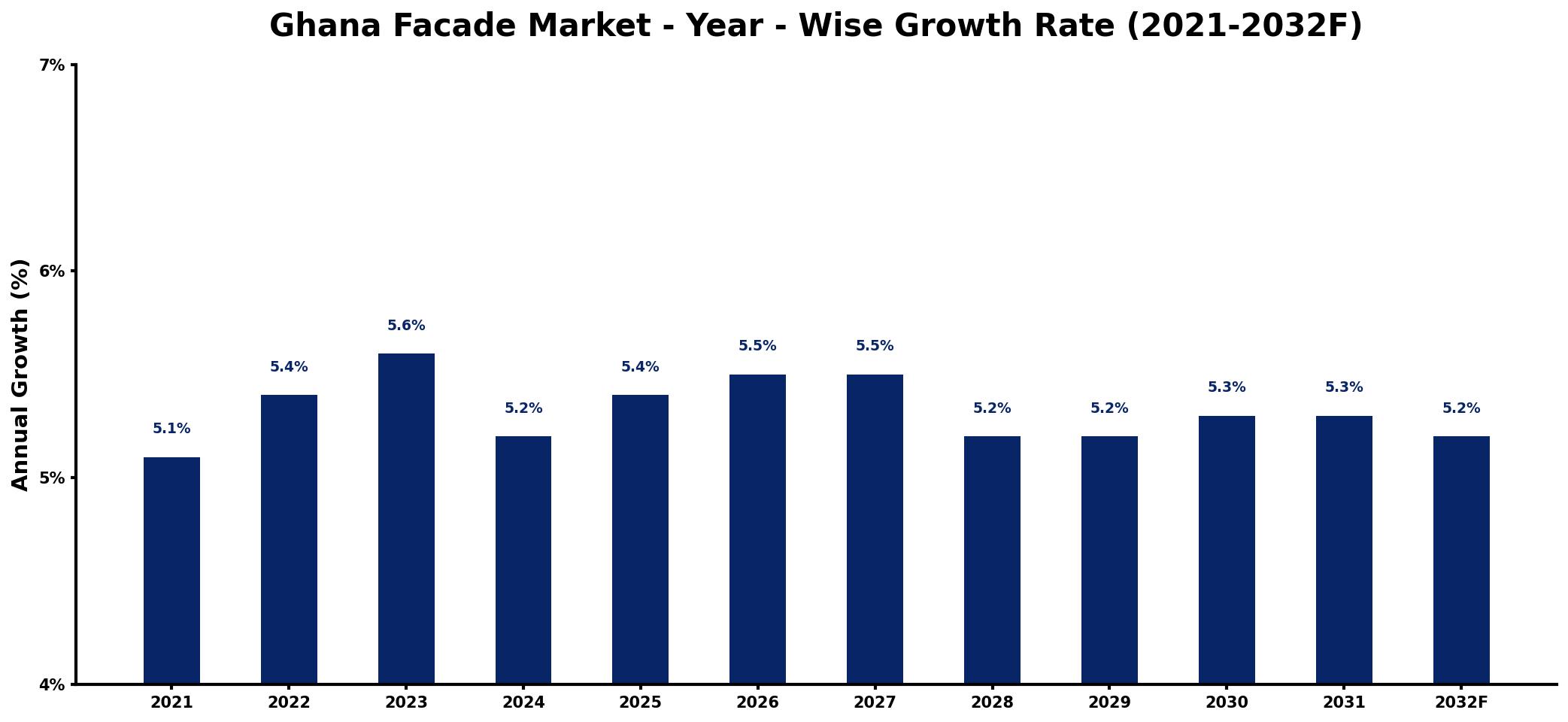
The table below presents the year‑wise growth rates along with the key drivers influencing the market
| Year | Growth Rate | Major Drivers |
| 2021 | 5.1% | Rising urban population demands construction |
| 2022 | 5.4% | Increased investment in infrastructure projects |
| 2023 | 5.6% | Growing interest in sustainable architecture |
| 2024 | 5.2% | strengthening underlying market demand |
| 2025 | 5.4% | Boost in residential housing development |
| 2026 | 5.5% | Emergence of innovative design trends |
| 2027 | 5.5% | Strengthened regulatory support for construction |
| 2028 | 5.2% | rising demand from electronics |
| 2029 | 5.2% | Surge in foreign direct investments |
| 2030 | 5.3% | Increased availability of financing options |
| 2031 | 5.3% | rising end-use demand growth |
| 2032 | 5.2% | Enhanced collaboration among industry stakeholders |
Note: Market size estimations and growth projections presented in this report are based on 6Wresearch's proprietary forecasting methodology, utilizing the latest available industry data, government publications, and primary research inputs.
Ghana Facade Market Synopsis
The Ghana facade market is characterized by a strong inclination towards innovative materials like glass and aluminum, reflecting a growing consumer demand for modern architectural aesthetics. This is not merely an aesthetic shift; it aligns with the broader trend of energy-efficient building practices, as stakeholders increasingly incorporate green technologies into their facade designs.
Government policies aimed at urbanization and infrastructural enhancement further amplify this trend, creating a conducive environment for manufacturers and suppliers. The focus on sustainability is pushing market players to adapt, innovate, and offer solutions that comply with modern building standards while also promoting environmental stewardship.
Ghana Facade Market Key Takeaways
- Rapid urbanization and construction growth are prime drivers of market expansion.
- There is an increasing demand for energy-efficient and sustainable facade solutions.
- Architectural innovation is leading to a rise in the use of advanced materials and design strategies.
- Government policies are fostering an environment conducive to sustainable building practices.
- The market is becoming increasingly competitive with both local and international players involved.
Evaluation of Restraints in Ghana Facade Market
Despite the promising outlook, the Ghana facade market faces notable restraints that may hinder its growth. A primary concern is the shortage of skilled labor proficient in facade design and installation, often leading to delays and compromised quality during project execution. Moreover, fluctuating material costs and reliance on imports can disrupt supply chains and inflate project budgets. The absence of stringent regulations surrounding facade construction also raises concerns about safety and quality, making it essential for stakeholders to address these limitations to ensure sustainable market growth.
Ghana Facade Market Trends
The Ghana facade market is witnessing a shift towards sustainable and technologically advanced solutions. Growing environmental consciousness among consumers and developers alike is steering preferences towards facades integrated with solar panels and energy-efficient glazing. Furthermore, innovative design trends emphasize unique aesthetic appeals, prompting architects to explore unconventional materials and construction techniques that enhance durability while resonating with modern design sensibilities. These trends collectively are setting the stage for a more robust and diverse facade market.
Ghana Facade Market Opportunities
Investors looking to enter the Ghana facade market will find numerous opportunities, particularly in developing sustainable facade solutions that meet the rising demand for eco-friendly materials. The increasing focus on energy efficiency opens pathways for manufacturers to innovate and supply high-quality, aesthetically pleasing products that adhere to government standards. Partnering with local contractors and developers can further enhance market penetration, making it a lucrative area for investment and growth in the coming years.
Government Initiatives in the Ghana Facade Market
The Ghanaian government is actively promoting policies that enhance safety, sustainability, and aesthetic quality in construction. Building codes enforce the use of high-grade materials while providing incentives to developers integrating energy-efficient facade systems into their projects. Regulatory measures are also in place to ensure the maintenance and inspection of facades, thereby prioritizing public safety and encouraging responsible construction practices. These government initiatives are critical in shaping a resilient and forward-looking facade market.
Future Insights of the Ghana Facade Market
As we look towards 2026-2032, the Ghana facade market is expected to thrive, buoyed by ongoing urban development and infrastructure projects. The increasing emphasis on sustainable building practices will likely drive the adoption of advanced facade solutions, ensuring that the market evolves in line with global trends. With economic growth and a burgeoning middle class, the construction sector will continue to expand, offering a wealth of opportunities for manufacturers and suppliers focused on meeting the emerging needs of this dynamic market.
Ghana Facade Market Latest Developments (2025 - 2026)
Recent developments in the Ghana facade market indicate a growing focus on integrating innovative technologies and sustainable practices. Companies are exploring advanced materials that enhance both aesthetic appeal and energy efficiency. Additionally, collaborations between local suppliers and international firms are becoming more prevalent, aimed at optimizing supply chains and improving product offerings. These directional shifts underscore the market's evolution towards a more competitive and sustainable future.
Ghana Facade Market - Key Attractiveness of the Report
- 10 Years of Market Numbers
- Historical Data Starting from 2022 to 2025
- Base Year: 2025
- Forecast Data until 2032
- Key Performance Indicators Impacting the Market
- Major Upcoming Developments and Projects
Key Highlights of the Report:
- Ghana Facade Market Outlook
- Market Size of Ghana Facade Market, 2025
- Forecast of Ghana Facade Market, 2032
- Historical Data and Forecast of Ghana Facade Revenues & Volume for the Period 2022-2032F
- Ghana Facade Market Trend Evolution
- Ghana Facade Market Drivers and Challenges
- Ghana Facade Price Trends
- Ghana Facade Porter's Five Forces
- Ghana Facade Industry Life Cycle
- Historical Data and Forecast of Ghana Facade Market Revenues & Volume By Product for the Period 2022-2032F
- Historical Data and Forecast of Ghana Facade Market Revenues & Volume By Ventilated Facades for the Period 2022-2032F
- Historical Data and Forecast of Ghana Facade Market Revenues & Volume By Non-ventilated Facades for the Period 2022-2032F
- Historical Data and Forecast of Ghana Facade Market Revenues & Volume By Others for the Period 2022-2032F
- Historical Data and Forecast of Ghana Facade Market Revenues & Volume By End-use for the Period 2022-2032F
- Historical Data and Forecast of Ghana Facade Market Revenues & Volume By Commercial for the Period 2022-2032F
- Historical Data and Forecast of Ghana Facade Market Revenues & Volume By Residential for the Period 2022-2032F
- Historical Data and Forecast of Ghana Facade Market Revenues & Volume By Industrial for the Period 2022-2032F
- Ghana Facade Import Export Trade Statistics
- Market Opportunity Assessment By Product
- Market Opportunity Assessment By End-use
- Ghana Facade Top Companies Market Share
- Ghana Facade Competitive Benchmarking By Technical and Operational Parameters
- Ghana Facade Company Profiles
- Ghana Facade Key Strategic Recommendations






































