Qatar Facade Market Size, Share & Growth Rate
The Qatar Facade Market was estimated at USD 632 Million in 2025 and is projected to reach USD 904 Million by 2032, growing at a CAGR of 5.2% from 2026 to 2032. This growth trajectory is fueled by Qatar's commitment to enhancing its architectural landscape through innovative designs and sustainable practices. The influx of major events and the pursuit of becoming a global hub are further propelling the demand for modern facade solutions.
Qatar Facade Market Year-wise Growth Rate and Key Drivers
This graph highlights how the Qatar Facade Market has steadily grown over the years, supported by major growth factors.
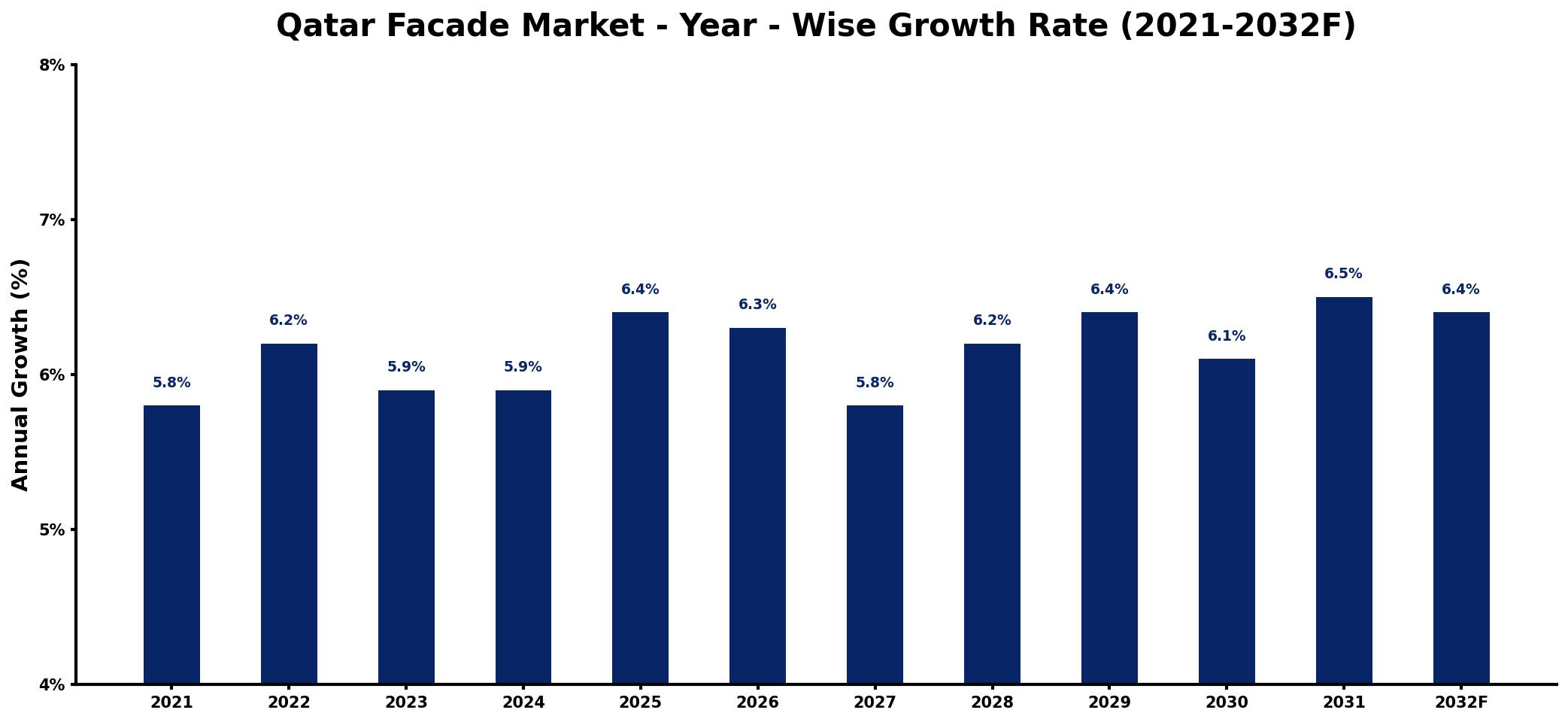
The table below presents the year‑wise growth rates along with the key drivers influencing the market
| Year | Growth Rate | Major Drivers |
| 2021 | 5.8% | Rising construction sector investments |
| 2022 | 6.2% | Increased urbanization and infrastructure |
| 2023 | 5.9% | Growing demand for sustainable buildings |
| 2024 | 5.9% | Expansion of commercial real estate |
| 2025 | 6.4% | Boosted government infrastructure projects |
| 2026 | 6.3% | Technological advancements in construction |
| 2027 | 5.8% | Higher focus on energy efficiency |
| 2028 | 6.2% | Increased tourism and hospitality projects |
| 2029 | 6.4% | Surge in residential developments |
| 2030 | 6.1% | Strengthened regulatory building codes |
| 2031 | 6.5% | Enhanced design innovation trends |
| 2032 | 6.4% | Growing preference for aesthetic solutions |
Note: Market size estimations and growth projections presented in this report are based on 6Wresearch's proprietary forecasting methodology, utilizing the latest available industry data, government publications, and primary research inputs.
Qatar Facade Market Synopsis
The most significant force shaping the Qatar Facade Market today is the country's architectural evolution, marked by a pronounced shift toward modernity and visual appeal. As urban development initiatives accelerate, architects and builders are increasingly prioritizing innovative designs that elevate building aesthetics and functionality.
Moreover, the market is poised for sustained growth, largely driven by the quest for energy-efficient and sustainable building solutions. This shift is reflective of a broader commitment to sustainable construction practices, ensuring that facades not only enhance the skyline but also contribute to energy conservation efforts.
Qatar Facade Market Key Takeaways
- Steady growth in the Qatar Facade Market is underscored by ambitious architectural projects and urban developments.
- Innovative and visually striking facades are increasingly integral to the architectural identity of Qatar.
- Energy efficiency and sustainability are key trends influencing facade design and materials.
- Major commercial and hospitality projects are driving demand for advanced facade solutions.
- The market is recovering from pandemic-related delays, with a strong focus on modern designs and sustainable solutions.
Evaluation of Restraints in Qatar Facade Market
Despite its positive outlook, the Qatar Facade Market faces challenges that could hinder its growth. Harsh weather conditions pose a significant threat to maintaining facade aesthetics and durability. Additionally, the pressure to comply with evolving building regulations regarding safety and energy efficiency can complicate design processes. These factors necessitate innovation in materials and designs, making it crucial for players in the market to adopt resilient and adaptive strategies.
Qatar Facade Market Trends
Current trends in the Qatar Facade Market reflect a growing inclination towards sustainable materials and energy-efficient designs. Architects are increasingly turning to cutting-edge technologies, such as smart facades that respond to environmental changes. Theres also a rising interest in biophilic design, integrating natural elements into facades to promote wellbeing. As Qatars architectural landscape continues to evolve, these trends will play a pivotal role in shaping the market's future.
Qatar Facade Market Opportunities
The Qatar Facade Market presents significant growth opportunities driven by the burgeoning construction sector. With the impending development of iconic structures and commercial projects, there is a demand for innovative facade solutions that meet both aesthetic and functional criteria. Furthermore, the push for sustainability opens avenues for companies specializing in green technologies and eco-friendly materials, making it a prime area for investment and development.
Government Initiatives in the Qatar Facade Market
The Qatari government is actively promoting initiatives aimed at enhancing the construction industry, including regulations that favor sustainable practices and energy efficiency. Public spending on infrastructure is on the rise, with significant investments being funneled into major projects that include advanced facade systems. These initiatives not only encourage compliance with modern standards but also support the growth of the facade market through structured guidelines and incentives.
Future Insights of the Qatar Facade Market
Looking ahead to 2026-2032, the Qatar Facade Market is set to experience robust growth. The continued emphasis on sustainability and energy efficiency will drive innovation in facade technology, making it a crucial element in future construction projects. As Qatar positions itself as a global hub for business and tourism, the demand for visually captivating and functional facades will remain a priority, influencing market dynamics and investment strategies moving forward.
Qatar Facade Market Latest Developments (2025 - 2026)
Recent developments within the Qatar Facade Market indicate a resurgence in activity as construction projects that were delayed during the pandemic are being revived. There is a notable increase in collaborations between architects and facade specialists, focusing on the integration of smart technologies and sustainable materials. The market is witnessing a wave of innovative designs that align with Qatars vision for a modern skyline.
Qatar Facade Market - Key Attractiveness of the Report
- 10 Years of Market Numbers
- Historical Data Starting from 2022 to 2025
- Base Year: 2025
- Forecast Data until 2032
- Key Performance Indicators Impacting the Market
- Major Upcoming Developments and Projects
Key Highlights of the Report:
- Qatar Facade Market Outlook
- Market Size of Qatar Facade Market, 2025
- Forecast of Qatar Facade Market, 2032
- Historical Data and Forecast of Qatar Facade Revenues & Volume for the Period 2022-2032F
- Qatar Facade Market Trend Evolution
- Qatar Facade Market Drivers and Challenges
- Qatar Facade Price Trends
- Qatar Facade Porter's Five Forces
- Qatar Facade Industry Life Cycle
- Historical Data and Forecast of Qatar Facade Market Revenues & Volume By Product for the Period 2022-2032F
- Historical Data and Forecast of Qatar Facade Market Revenues & Volume By Ventilated Facades for the Period 2022-2032F
- Historical Data and Forecast of Qatar Facade Market Revenues & Volume By Non-ventilated Facades for the Period 2022-2032F
- Historical Data and Forecast of Qatar Facade Market Revenues & Volume By Others for the Period 2022-2032F
- Historical Data and Forecast of Qatar Facade Market Revenues & Volume By End-use for the Period 2022-2032F
- Historical Data and Forecast of Qatar Facade Market Revenues & Volume By Commercial for the Period 2022-2032F
- Historical Data and Forecast of Qatar Facade Market Revenues & Volume By Residential for the Period 2022-2032F
- Historical Data and Forecast of Qatar Facade Market Revenues & Volume By Industrial for the Period 2022-2032F
- Qatar Facade Import Export Trade Statistics
- Market Opportunity Assessment By Product
- Market Opportunity Assessment By End-use
- Qatar Facade Top Companies Market Share
- Qatar Facade Competitive Benchmarking By Technical and Operational Parameters
- Qatar Facade Company Profiles
- Qatar Facade Key Strategic Recommendations






































