United Arab Emirates (UAE) Facade Market Size, Share & Growth Rate
The United Arab Emirates (UAE) Facade Market was estimated at USD 312 Million in 2025 and is projected to reach USD 418 Million by 2032, growing at a CAGR of 4.3% from 2026 to 2032. This growth trajectory is fueled by a vibrant real estate sector, coupled with a heightened emphasis on innovative architectural designs that enhance energy efficiency and aesthetic appeal. The increasing number of commercial and residential projects, along with rigorous demands for sustainable solutions, significantly propels this market forward.
United Arab Emirates (UAE) Facade Market Year-wise Growth Rate and Key Drivers
This graph highlights how the United Arab Emirates (UAE) Facade Market has steadily grown over the years, supported by major growth factors.
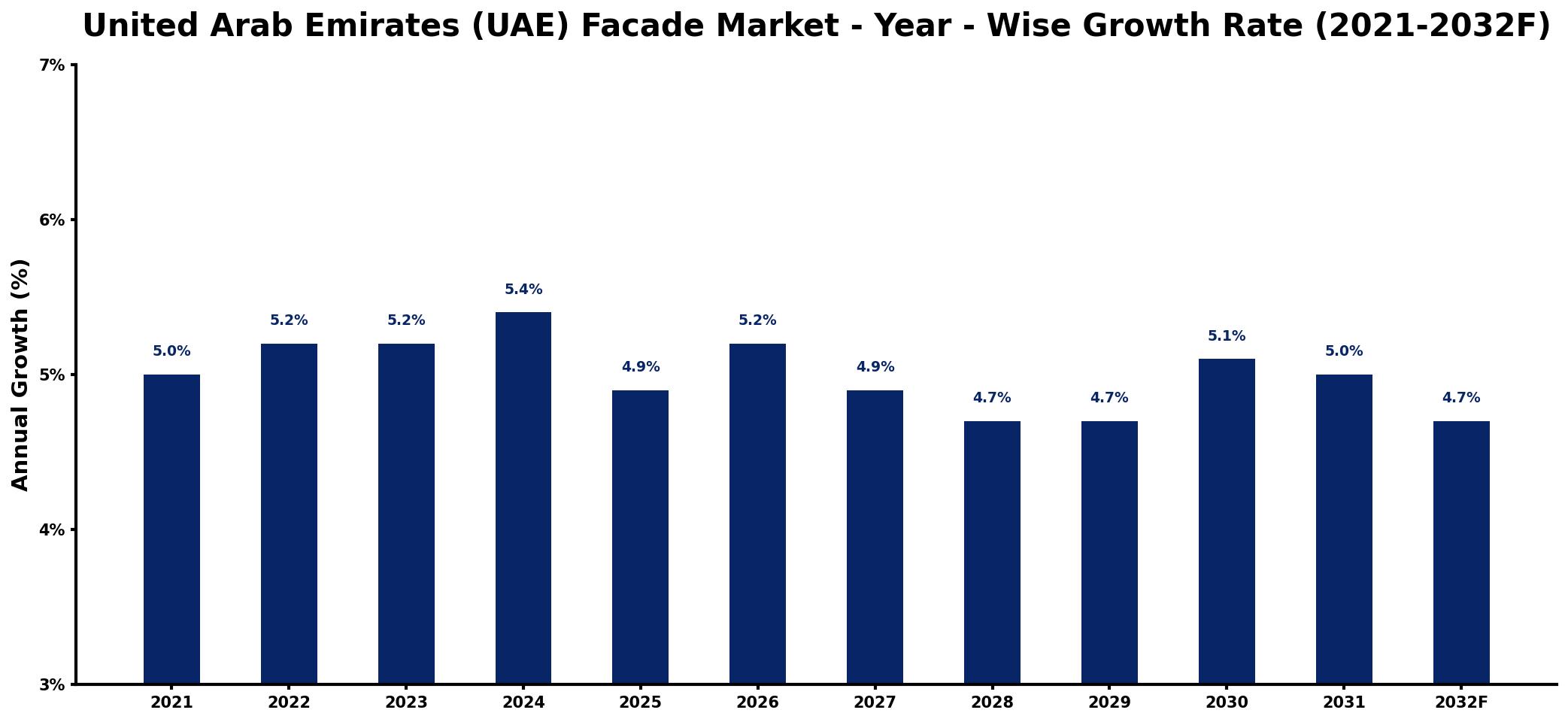
The table below presents the year‑wise growth rates along with the key drivers influencing the market
| Year | Growth Rate | Major Drivers |
| 2021 | 5.0% | Infrastructure investments in construction projects |
| 2022 | 5.2% | Growing urbanization and population density |
| 2023 | 5.2% | Increased focus on sustainable design |
| 2024 | 5.4% | Rising demand for energy efficiency |
| 2025 | 4.9% | Emerging technologies in building materials |
| 2026 | 5.2% | Expansion of commercial real estate |
| 2027 | 4.9% | Government incentives for green buildings |
| 2028 | 4.7% | Innovations in architectural aesthetics |
| 2029 | 4.7% | Strengthening of construction regulations |
| 2030 | 5.1% | Rising interest in smart buildings |
| 2031 | 5.0% | Increased investment in infrastructure upgrades |
| 2032 | 4.7% | Growing trends in modular construction |
Note: Market size estimations and growth projections presented in this report are based on 6Wresearch's proprietary forecasting methodology, utilizing the latest available industry data, government publications, and primary research inputs.
United Arab Emirates (UAE) Facade Market Synopsis
In the UAE, facades are not merely decorative; they serve as critical components that contribute to energy efficiency and building sustainability. The local architecture showcases a blend of modern design and traditional aesthetics, compelling facade manufacturers to innovate constantly with new materials and technologies.
With the UAEs ambitious vision to enhance its skyline through iconic structures, there is an increasing demand for high-performance facades that offer insulation, durability, and visual appeal. This demand is particularly significant in a market that prioritizes sustainability alongside striking architectural achievements.
United Arab Emirates (UAE) Facade Market Key Takeaways
- Robust growth driven by the booming real estate sector and architectural innovation.
- Heightened focus on energy-efficient facade solutions to meet sustainability standards.
- Demand for aesthetically pleasing facades that enhance building functionality.
- Challenges in sourcing eco-friendly materials while managing costs remain prevalent.
- Industry transformation post-COVID-19, with a renewed focus on sustainable practices.
Evaluation of Restraints in United Arab Emirates (UAE) Facade Market
While the UAE Facade market is expanding rapidly, it faces notable constraints that could limit its growth potential. One primary issue is the difficulty in adhering to stringent energy efficiency and sustainability benchmarks. Manufacturers are often challenged to balance aesthetic considerations with functional requirements, leading to complex design and material decisions. Additionally, the high costs associated with sourcing environmentally friendly materials pose a significant challenge, creating a landscape where cost management becomes critical for market players.
United Arab Emirates (UAE) Facade Market Trends
Emerging trends in the UAE Facade market include a growing inclination towards smart building technologies that integrate advanced facade systems, enhancing energy management. Moreover, there is an increased interest in using local materials to reduce the carbon footprint associated with transportation and to promote regional economies. The incorporation of biophilic design elements that connect building occupants with nature is also gaining traction, thereby influencing facade aesthetics and functionality.
United Arab Emirates (UAE) Facade Market Opportunities
The UAE Facade market presents substantial growth and investment opportunities, particularly in the development of green building technologies. Companies focusing on innovative, sustainable facade solutions can capitalize on government initiatives that promote environmentally friendly construction practices. Furthermore, as demand for mixed-use developments increases, there is significant potential for tailored facade solutions that meet diverse architectural needs.
Government Initiatives in the United Arab Emirates (UAE) Facade Market
The UAE government is committed to promoting sustainable development through various initiatives and policies. These include stringent building regulations aimed at enhancing energy efficiency and reducing environmental impact. Public spending on infrastructure and urban development projects reflects the governments intent to foster innovative facade designs that meet international standards. Incentives for utilizing sustainable materials further encourage market participants to align with national sustainability goals.
Future Insights of the United Arab Emirates (UAE) Facade Market
From 2026 to 2032, the UAE Facade market is poised for significant evolution, driven by advancements in construction technologies and materials. The increasing adoption of prefabricated facade systems is expected to streamline construction processes while maintaining high standards of quality and performance. Moreover, the trend towards sustainable practices will likely deepen, compelling manufacturers to innovate continuously. As the market matures, there will be a greater emphasis on creating facades that not only appeal visually but also contribute positively to environmental sustainability.
United Arab Emirates (UAE) Facade Market Latest Developments (2025 - 2026)
Recent developments in the UAE Facade market have been marked by a shift towards smart facade technologies that enhance energy efficiency and sustainability. Industry players are increasingly exploring partnerships for research and development to foster innovative solutions that meet evolving consumer demands. Additionally, there is an observable increase in public and private sector collaborations aimed at enhancing the aesthetic and functional qualities of building facades across the region.
United Arab Emirates (UAE) Facade Market - Key Attractiveness of the Report
- 10 Years of Market Numbers
- Historical Data Starting from 2022 to 2025
- Base Year: 2025
- Forecast Data until 2032
- Key Performance Indicators Impacting the Market
- Major Upcoming Developments and Projects
Key Highlights of the Report:
- United Arab Emirates (UAE) Facade Market Outlook
- Market Size of United Arab Emirates (UAE) Facade Market, 2025
- Forecast of United Arab Emirates (UAE) Facade Market, 2032
- Historical Data and Forecast of United Arab Emirates (UAE) Facade Revenues & Volume for the Period 2022-2032F
- United Arab Emirates (UAE) Facade Market Trend Evolution
- United Arab Emirates (UAE) Facade Market Drivers and Challenges
- United Arab Emirates (UAE) Facade Price Trends
- United Arab Emirates (UAE) Facade Porter's Five Forces
- United Arab Emirates (UAE) Facade Industry Life Cycle
- Historical Data and Forecast of United Arab Emirates (UAE) Facade Market Revenues & Volume By Product for the Period 2022-2032F
- Historical Data and Forecast of United Arab Emirates (UAE) Facade Market Revenues & Volume By Ventilated Facades for the Period 2022-2032F
- Historical Data and Forecast of United Arab Emirates (UAE) Facade Market Revenues & Volume By Non-ventilated Facades for the Period 2022-2032F
- Historical Data and Forecast of United Arab Emirates (UAE) Facade Market Revenues & Volume By Others for the Period 2022-2032F
- Historical Data and Forecast of United Arab Emirates (UAE) Facade Market Revenues & Volume By End-use for the Period 2022-2032F
- Historical Data and Forecast of United Arab Emirates (UAE) Facade Market Revenues & Volume By Commercial for the Period 2022-2032F
- Historical Data and Forecast of United Arab Emirates (UAE) Facade Market Revenues & Volume By Residential for the Period 2022-2032F
- Historical Data and Forecast of United Arab Emirates (UAE) Facade Market Revenues & Volume By Industrial for the Period 2022-2032F
- United Arab Emirates (UAE) Facade Import Export Trade Statistics
- Market Opportunity Assessment By Product
- Market Opportunity Assessment By End-use
- United Arab Emirates (UAE) Facade Top Companies Market Share
- United Arab Emirates (UAE) Facade Competitive Benchmarking By Technical and Operational Parameters
- United Arab Emirates (UAE) Facade Company Profiles
- United Arab Emirates (UAE) Facade Key Strategic Recommendations






































