Brazil Facade Market Size, Share & Growth Rate
The Brazil Facade Market was estimated at USD 234 Million in 2025 and is projected to reach USD 277 Million by 2032, growing at a CAGR of 2.4% from 2026 to 2032. This growth is primarily driven by urbanization and modernization trends, as cities expand and demand for innovative, aesthetically pleasing facades intensifies. Additionally, government regulations encouraging sustainable practices further fuel the adoption of advanced facade materials that promote energy efficiency and resilience.
Brazil Facade Market Year-wise Growth Rate and Key Drivers
This graph highlights how the Brazil Facade Market has steadily grown over the years, supported by major growth factors.
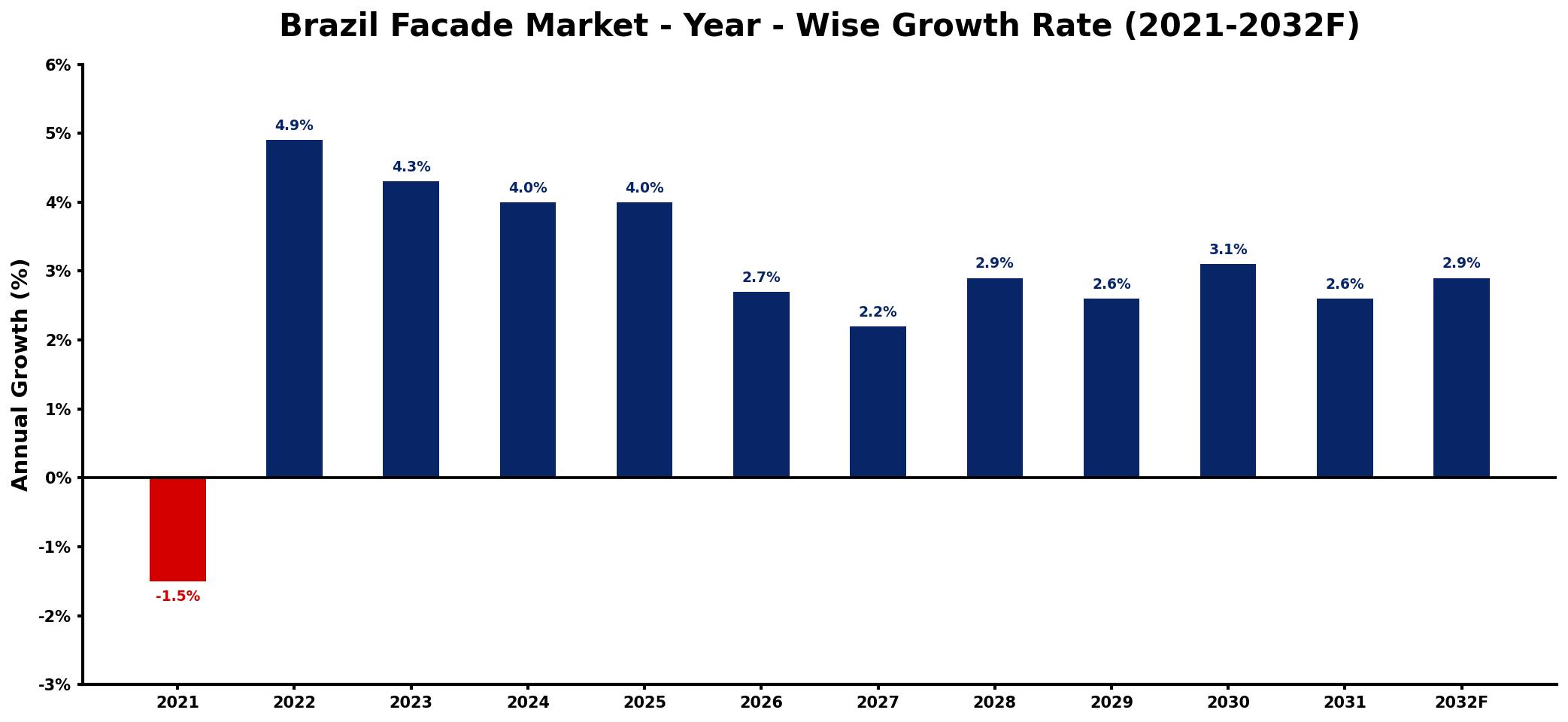
The table below presents the year‑wise growth rates along with the key drivers influencing the market
| Year | Growth Rate | Major Drivers |
| 2021 | -1.5% | Construction projects decreased significantly |
| 2022 | 4.9% | Increased investment in infrastructure |
| 2023 | 4.3% | Rising demand for sustainable materials |
| 2024 | 4.0% | Urbanization driving market expansion |
| 2025 | 4.0% | Technological advancements enhancing efficiency |
| 2026 | 2.7% | Growing focus on energy efficiency |
| 2027 | 2.2% | Increased residential construction activities |
| 2028 | 2.9% | Government incentives for renovations |
| 2029 | 2.6% | Emerging trends in design innovation |
| 2030 | 3.1% | Strengthened supply chain capabilities |
| 2031 | 2.6% | Rising awareness of aesthetic appeal |
| 2032 | 2.9% | Expanding commercial real estate sector |
Note: Market size estimations and growth projections presented in this report are based on 6Wresearch's proprietary forecasting methodology, utilizing the latest available industry data, government publications, and primary research inputs.
Brazil Facade Market Synopsis
The Brazil Facade Market has witnessed a significant shift as urban areas prioritize aesthetic appeal and energy efficiency in building designs. In response, architects and developers are adopting a variety of materials, including glass, aluminum, and composite panels, to create functional yet visually striking facades.
As construction projects proliferate, both new builds and renovations require high-performance facades that not only enhance the exterior appearance but also comply with stringent safety and energy standards. This dynamic presents unique challenges and opportunities, reflecting the evolving landscape of the Brazilian facade sector.
Brazil Facade Market Key Takeaways
- Rapid urbanization is driving demand for innovative and sustainable facade solutions across commercial and residential sectors.
- Government policies are encouraging the use of eco-friendly materials in construction, aligning with global sustainability trends.
- Technological advancements in facade materials are leading to better insulation, energy efficiency, and durability.
- The market is experiencing increased competition, influencing pricing and material selection in building projects.
- Architectural trends are shifting towards customization, enhancing the aesthetic value of buildings while meeting performance requirements.
Evaluation of Restraints in Brazil Facade Market
Despite the positive outlook for the Brazil Facade Market, several restraints challenge its growth trajectory. Compliance with stringent building codes and regulations can often complicate project timelines and increase costs. Furthermore, environmental concerns related to energy efficiency demand constant innovation, compelling companies to invest heavily in research and development. The high costs associated with premium facade materials may deter some developers, while competition from alternative construction methods poses a significant threat to traditional facade applications. Together, these factors create a complex landscape that market players must navigate to seize opportunities effectively.
Brazil Facade Market Trends
Emerging trends in the Brazil Facade Market include a growing preference for sustainable materials that contribute to energy efficiency and minimal environmental impact. The integration of smart technologies within facade systems is gaining traction, with features such as automated shading and responsive glazing becoming more prevalent. Additionally, a shift towards biophilic design is influencing architects to incorporate natural elements into building exteriors, enhancing both aesthetics and occupant well-being.
Brazil Facade Market Opportunities
As Brazil continues to develop urban infrastructure, significant growth opportunities exist in the renovation of existing buildings to meet modern energy standards. The increasing focus on sustainability also opens avenues for innovations in facade materials and designs. Additionally, as cities expand, there is a burgeoning demand for high-performance facades in new commercial and residential projects, making this an opportune time for investments in advanced facade solutions.
Government Initiatives in the Brazil Facade Market
The Brazilian government has instituted various policies aimed at promoting sustainable construction practices, including incentives for using energy-efficient materials in facades. Regulatory frameworks encourage adherence to building codes and safety standards while supporting architectural innovation. These initiatives play a crucial role in enhancing urban development, ensuring public safety, and fostering a competitive market environment.
Future Insights of the Brazil Facade Market
Looking ahead to 2026-2032, the Brazil Facade Market is poised for steady growth driven by continued urbanization and an emphasis on sustainable construction. As consumers and developers alike demand greater energy efficiency and aesthetic quality, the market will likely see an influx of innovative facade technologies. Moreover, ongoing government support for environmentally responsible practices is expected to create a robust framework for expansion, ensuring the Brazilian facade market remains a vibrant segment of the construction industry.
Brazil Facade Market Latest Developments (2025 - 2026)
Recent developments in the Brazil Facade Market indicate a shift towards integrating smart technologies into facade designs, allowing for greater energy efficiency and automation. Additionally, more companies are exploring partnerships to enhance material offerings and expand into new segments, reflecting a collaborative approach to innovation. These trends highlight the industry's responsiveness to evolving consumer preferences and regulatory demands.
Brazil Facade Market - Key Attractiveness of the Report
- 10 Years of Market Numbers
- Historical Data Starting from 2022 to 2025
- Base Year: 2025
- Forecast Data until 2032
- Key Performance Indicators Impacting the Market
- Major Upcoming Developments and Projects
Key Highlights of the Report:
- Brazil Facade Market Outlook
- Market Size of Brazil Facade Market, 2025
- Forecast of Brazil Facade Market, 2032
- Historical Data and Forecast of Brazil Facade Revenues & Volume for the Period 2022-2032F
- Brazil Facade Market Trend Evolution
- Brazil Facade Market Drivers and Challenges
- Brazil Facade Price Trends
- Brazil Facade Porter's Five Forces
- Brazil Facade Industry Life Cycle
- Historical Data and Forecast of Brazil Facade Market Revenues & Volume By Product for the Period 2022-2032F
- Historical Data and Forecast of Brazil Facade Market Revenues & Volume By Ventilated Facades for the Period 2022-2032F
- Historical Data and Forecast of Brazil Facade Market Revenues & Volume By Non-ventilated Facades for the Period 2022-2032F
- Historical Data and Forecast of Brazil Facade Market Revenues & Volume By Others for the Period 2022-2032F
- Historical Data and Forecast of Brazil Facade Market Revenues & Volume By End-use for the Period 2022-2032F
- Historical Data and Forecast of Brazil Facade Market Revenues & Volume By Commercial for the Period 2022-2032F
- Historical Data and Forecast of Brazil Facade Market Revenues & Volume By Residential for the Period 2022-2032F
- Historical Data and Forecast of Brazil Facade Market Revenues & Volume By Industrial for the Period 2022-2032F
- Brazil Facade Import Export Trade Statistics
- Market Opportunity Assessment By Product
- Market Opportunity Assessment By End-use
- Brazil Facade Top Companies Market Share
- Brazil Facade Competitive Benchmarking By Technical and Operational Parameters
- Brazil Facade Company Profiles
- Brazil Facade Key Strategic Recommendations






































