Philippines Fashion Belt Market Top 5 Importing Countries and Market Competition (HHI) Analysis
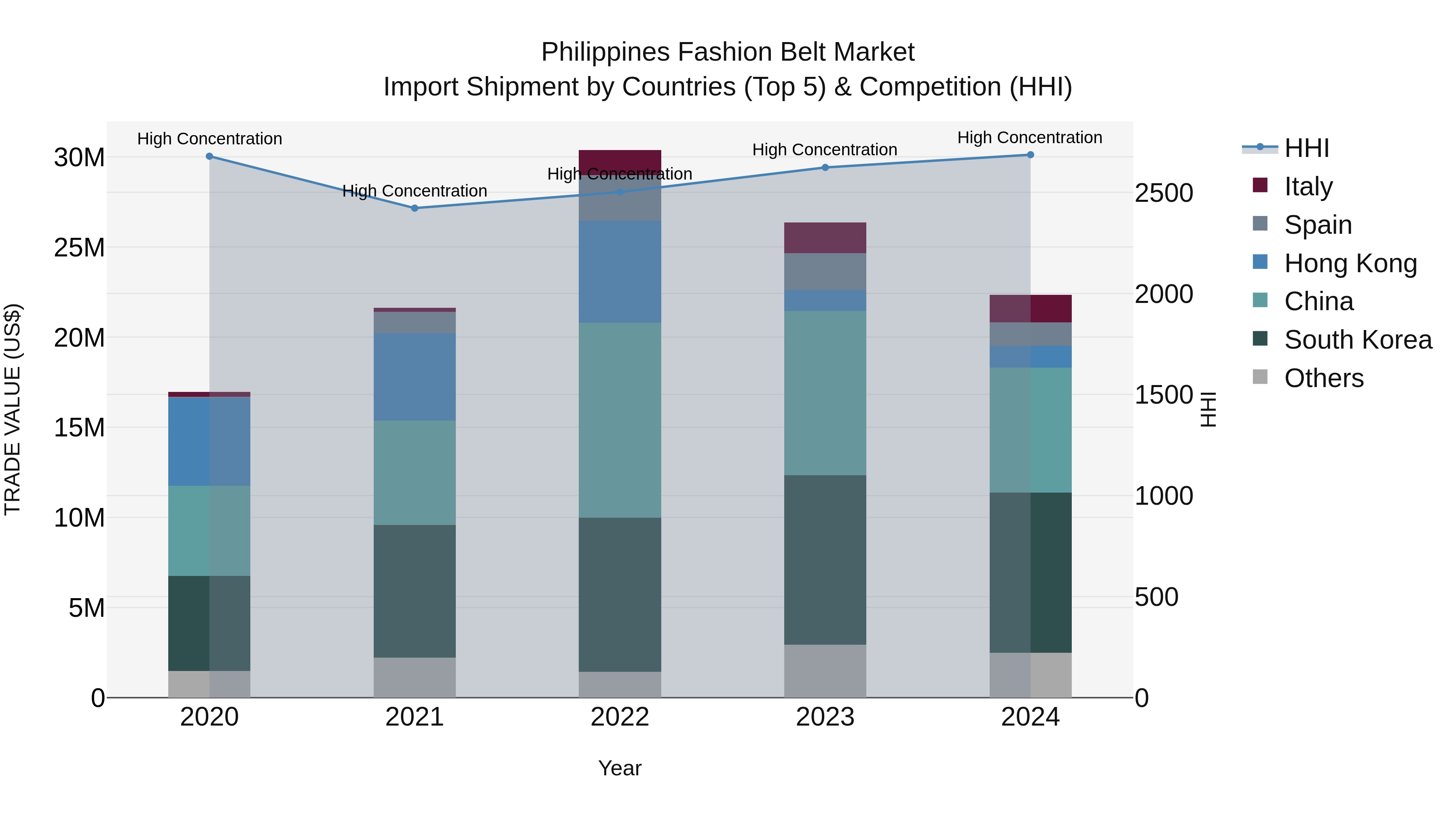
In 2024, the Philippines continued to see a significant influx of fashion belt imports, with key exporting countries including South Korea, China, Italy, Spain, and Hong Kong. Despite the high concentration of market share indicated by the Herfindahl-Hirschman Index (HHI), the industry maintained a healthy CAGR of 7.12% from 2020 to 2024. However, there was a slight decline in growth rate from 2023 to 2024 at -15.26%, suggesting a potential shift in market dynamics. Monitoring these trends closely will be crucial for both importers and domestic retailers in the fashion belt sector.
Philippines Fashion Belt Market Synopsis
The Philippines fashion belt market was estimated to be worth USD 8.56 million in 2025 and is expected to grow at a CAGR of around 11% during the forecast period. Leather belts accounted for the largest share in terms of revenue, with an estimated value of around USD 5.31 million. The increasing demand for formal clothing among men has been driving the growth of leather belts segment. Furthermore, synthetic belts are also gaining popularity due to their low price and variety designs available as compared to leather belts.
Drivers of the market
The Philippines fashion belt market is a dynamic segment of the fashion industry, offering a wide range of belts that cater to different styles and trends. The market is driven by factors such as changing fashion preferences, rising disposable income, and a growing emphasis on accessorizing outfits. Key drivers include the influence of social media and celebrity fashion, as well as the desire among consumers to express their individuality through accessories like fashion belts. Market players include designers, manufacturers, and retailers who continually innovate to meet evolving consumer demands.
Challenges of the market
The Philippines fashion belt market contributes to the country`s fashion and accessory industry, offering a variety of belts to complement different styles. However, challenges in this market could include competition from imported belts, fluctuating consumer preferences, and the need for consistent quality control to meet fashion trends. Striking a balance between affordability and quality is crucial to remain competitive and capture the interest of fashion-conscious consumers.
Covid-19 Impact of the market
The Philippines fashion belt market is a dynamic sector within the country`s fashion industry, catering to both functional and aesthetic needs. Key players include fashion accessory manufacturers, designers, and retailers that offer a variety of belt styles to complement outfits and enhance personal style. While the market may have faced some temporary challenges due to the COVID-19 pandemic, it`s expected to recover as consumer spending on fashion accessories gradually resumes.
Key Players of the market
The Philippines Fashion Belt market is driven by key players specializing in fashion accessories. Companies such as BeltStyle Trends, AccessoryMasters, and ChicBelt Innovations are prominent players in producing and supplying a wide range of fashionable belts. These companies play an essential role in meeting consumer preferences and trends, contributing to the country`s fashion industry with innovative and stylish belt designs.
Key Highlights of the Report:
- Philippines Fashion Belt Market Outlook
- Market Size of Philippines Fashion Belt Market, 2024
- Forecast of Philippines Fashion Belt Market, 2031
- Historical Data and Forecast of Philippines Fashion Belt Revenues & Volume for the Period 2021-2031
- Philippines Fashion Belt Market Trend Evolution
- Philippines Fashion Belt Market Drivers and Challenges
- Philippines Fashion Belt Price Trends
- Philippines Fashion Belt Porter's Five Forces
- Philippines Fashion Belt Industry Life Cycle
- Historical Data and Forecast of Philippines Fashion Belt Market Revenues & Volume By Types for the Period 2021-2031
- Historical Data and Forecast of Philippines Fashion Belt Market Revenues & Volume By Grommet Belt for the Period 2021-2031
- Historical Data and Forecast of Philippines Fashion Belt Market Revenues & Volume By Chain Belt for the Period 2021-2031
- Historical Data and Forecast of Philippines Fashion Belt Market Revenues & Volume By Leather Belt for the Period 2021-2031
- Historical Data and Forecast of Philippines Fashion Belt Market Revenues & Volume By Others for the Period 2021-2031
- Historical Data and Forecast of Philippines Fashion Belt Market Revenues & Volume By Industry for the Period 2021-2031
- Historical Data and Forecast of Philippines Fashion Belt Market Revenues & Volume By Online Sales for the Period 2021-2031
- Historical Data and Forecast of Philippines Fashion Belt Market Revenues & Volume By Offline Sales for the Period 2021-2031
- Philippines Fashion Belt Import Export Trade Statistics
- Market Opportunity Assessment By Types
- Market Opportunity Assessment By Industry
- Philippines Fashion Belt Top Companies Market Share
- Philippines Fashion Belt Competitive Benchmarking By Technical and Operational Parameters
- Philippines Fashion Belt Company Profiles
- Philippines Fashion Belt Key Strategic Recommendations






































