Philippines Flavoured Tea Market Top 5 Importing Countries and Market Competition (HHI) Analysis
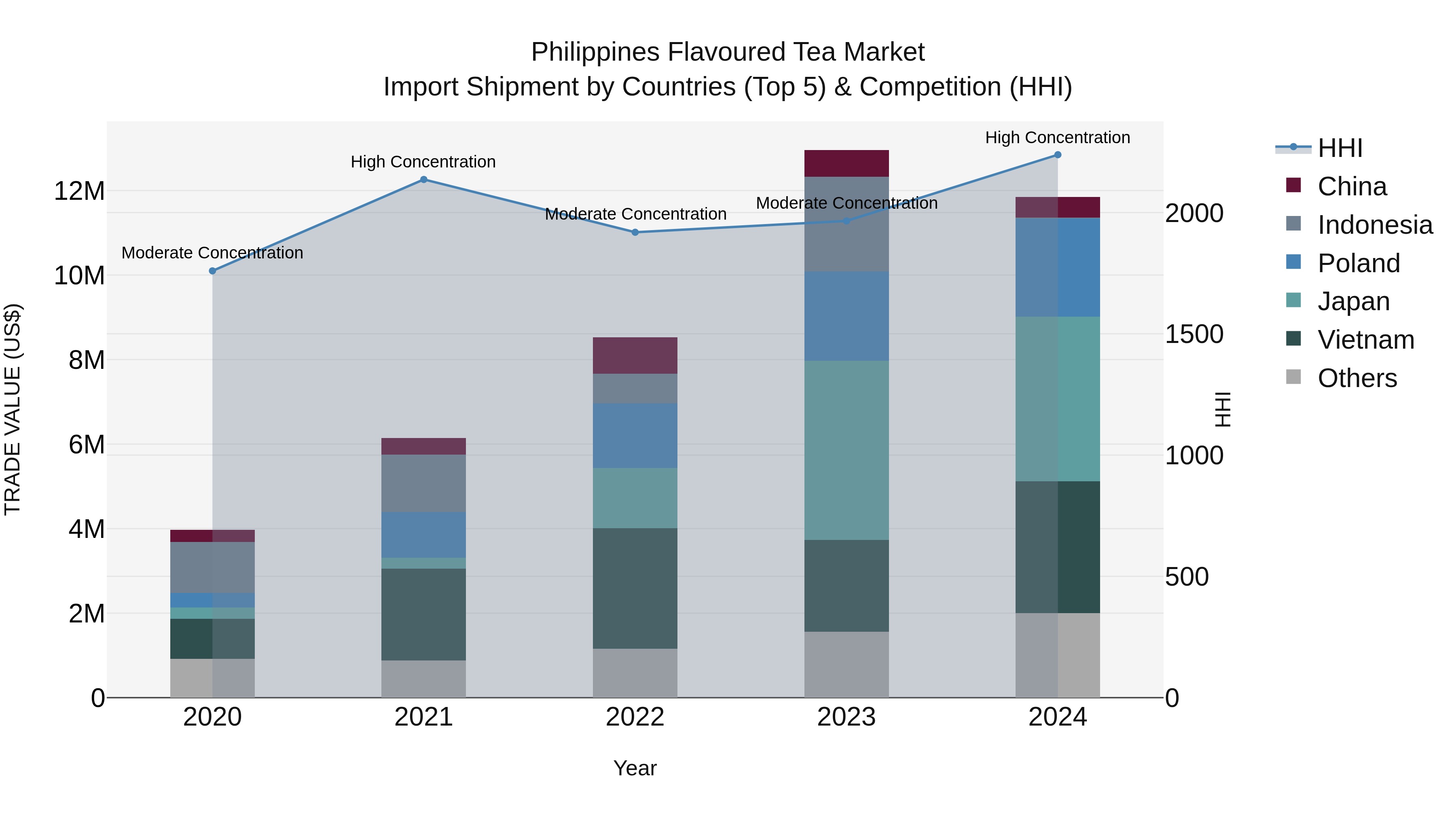
The Philippines saw a significant increase in flavoured tea import shipments in 2024, with top exporting countries being Japan, Vietnam, Poland, USA, and China. The market exhibited a shift towards higher concentration levels, indicating increased dominance from key players. Despite a slight decline in growth rate from 2023 to 2024, the impressive compound annual growth rate (CAGR) of 31.43% over the period 2020-2024 underscores the strong demand for flavoured tea in the Philippines. This trend suggests a promising market outlook with continued interest from both domestic consumers and international suppliers.
Philippines Flavoured Tea Market Synopsis
Flavored teas have become a staple in urban Filipino households, with demand increasing for green, black, and herbal teas infused with fruit, floral, and spice flavors. This market benefits from rising health awareness, a shift from sugary drinks, and the popularity of milk tea shops incorporating flavored tea bases.
Trends of the market
Flavored tea is a growing category in the Philippines, aligning with the wellness boom and preference for natural beverages. Herbal infusions, fruit blends, and spiced teas are popular among both traditional tea drinkers and millennials. Cafés and specialty stores play a critical role in market development and flavor experimentation.
Challenges of the market
Although the tea market is growing, flavored tea still faces competition from coffee and sugary drinks, which remain dominant in Filipino beverage habits. The segment also struggles with inconsistent consumer education about the health benefits of flavored herbal teas. Price sensitivity and competition from low-cost imported products further add to the pressure on local producers to maintain quality while keeping costs low.
Investment opportunities in the Market
The Philippines flavored tea market is growing due to the increasing popularity of tea-based beverages among health-conscious consumers who appreciate its variety and health benefits. Flavored teas, including fruit-infused, herbal, and green tea varieties, are particularly appealing to those seeking refreshing and healthy alternatives to sugary drinks. Investment opportunities in this market include the development of premium flavored teas using local ingredients such as calamansi, pandan, and ginger. Additionally, offering organic and fair-trade certified teas can cater to the rising demand for ethical and sustainable products. Expanding the availability of flavored teas through both traditional and online retail channels presents significant growth potential.
Government Policy of the market
Policies favor the development of herbal and flavored tea industries through support for local farmers and exporters. The Department of Agriculture promotes native herbal plants and tea variants, while the FDA ensures safety in flavored infusions. Export incentives are provided under trade agreements to position flavored teas in global niche markets.
Key Highlights of the Report:
- Philippines Flavoured Tea Market Outlook
- Market Size of Philippines Flavoured Tea Market, 2024
- Forecast of Philippines Flavoured Tea Market, 2031
- Historical Data and Forecast of Philippines Flavoured Tea Revenues & Volume for the Period 2021- 2031
- Philippines Flavoured Tea Market Trend Evolution
- Philippines Flavoured Tea Market Drivers and Challenges
- Philippines Flavoured Tea Price Trends
- Philippines Flavoured Tea Porter's Five Forces
- Philippines Flavoured Tea Industry Life Cycle
- Historical Data and Forecast of Philippines Flavoured Tea Market Revenues & Volume By Type for the Period 2021- 2031
- Historical Data and Forecast of Philippines Flavoured Tea Market Revenues & Volume By Loose Leaf Tea for the Period 2021- 2031
- Historical Data and Forecast of Philippines Flavoured Tea Market Revenues & Volume By CTC Tea for the Period 2021- 2031
- Historical Data and Forecast of Philippines Flavoured Tea Market Revenues & Volume By Flavour for the Period 2021- 2031
- Historical Data and Forecast of Philippines Flavoured Tea Market Revenues & Volume By Fruits for the Period 2021- 2031
- Historical Data and Forecast of Philippines Flavoured Tea Market Revenues & Volume By Flower for the Period 2021- 2031
- Historical Data and Forecast of Philippines Flavoured Tea Market Revenues & Volume By Herbs and Spices for the Period 2021- 2031
- Historical Data and Forecast of Philippines Flavoured Tea Market Revenues & Volume By Packaging format for the Period 2021- 2031
- Historical Data and Forecast of Philippines Flavoured Tea Market Revenues & Volume By Packed for the Period 2021- 2031
- Historical Data and Forecast of Philippines Flavoured Tea Market Revenues & Volume By Loose for the Period 2021- 2031
- Historical Data and Forecast of Philippines Flavoured Tea Market Revenues & Volume By Product Type for the Period 2021- 2031
- Historical Data and Forecast of Philippines Flavoured Tea Market Revenues & Volume By Black Tea for the Period 2021- 2031
- Historical Data and Forecast of Philippines Flavoured Tea Market Revenues & Volume By Green Tea for the Period 2021- 2031
- Historical Data and Forecast of Philippines Flavoured Tea Market Revenues & Volume By Herbal Tea for the Period 2021- 2031
- Historical Data and Forecast of Philippines Flavoured Tea Market Revenues & Volume By Oolong Tea for the Period 2021- 2031
- Historical Data and Forecast of Philippines Flavoured Tea Market Revenues & Volume By Distribution Channel for the Period 2021- 2031
- Historical Data and Forecast of Philippines Flavoured Tea Market Revenues & Volume By Online and Offline for the Period 2021- 2031
- Historical Data and Forecast of Philippines Flavoured Tea Market Revenues & Volume By Supermarkets/Hypermarkets for the Period 2021- 2031
- Philippines Flavoured Tea Import Export Trade Statistics
- Market Opportunity Assessment By Type
- Market Opportunity Assessment By Flavour
- Market Opportunity Assessment By Packaging format
- Market Opportunity Assessment By Product Type
- Market Opportunity Assessment By Distribution Channel
- Philippines Flavoured Tea Top Companies Market Share
- Philippines Flavoured Tea Competitive Benchmarking By Technical and Operational Parameters
- Philippines Flavoured Tea Company Profiles
- Philippines Flavoured Tea Key Strategic Recommendations






































