Philippines Groceries Market Summary
The philippines groceries market was estimated at USD 427 Million in 2025 and is projected to reach USD 602 Million by 2032, growing at a CAGR of 6.1% from 2026 to 2032.
Philippines Groceries Market Year-wise Growth Rate and Key Drivers
This graph highlights how the Philippines Groceries Market has steadily grown over the past five years, supported by major growth factors.
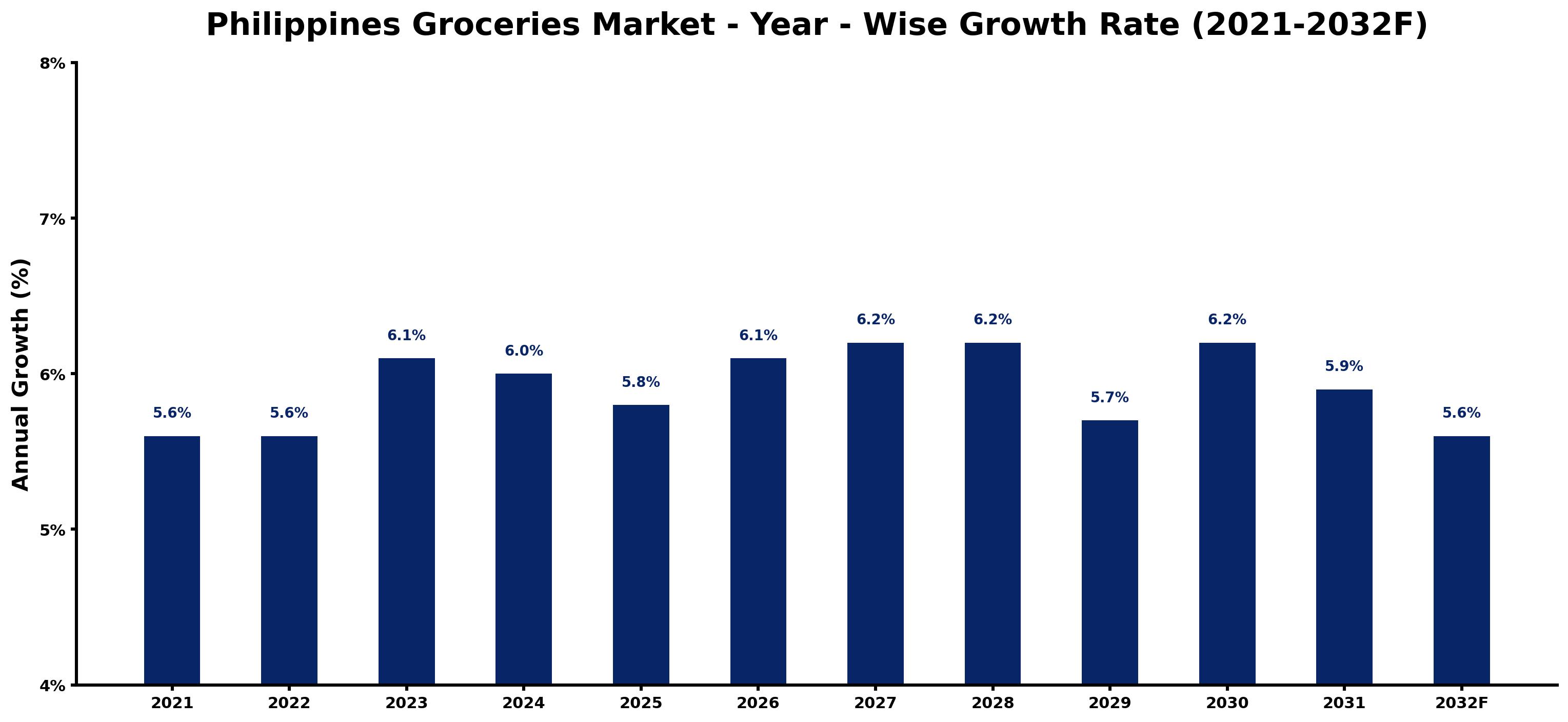
The table below presents the year wise growth rates along with the key drivers influencing the market
| Year | Growth Rate | Major Drivers |
| 2021 | 5.6% | Post-lockdown retail projects emphasized digital strategies for grocery shopping efficiency. |
| 2022 | 5.6% | Shifting consumer preferences leaned towards sustainable and locally-sourced grocery options. |
| 2023 | 6.1% | Supply chain improvements have streamlined local produce availability across urban areas. |
| 2024 | 6.0% | Increased smartphone penetration boosted e-commerce grocery platforms significantly this year. |
| 2025 | 5.8% | Corporate partnerships with logistics firms enhanced delivery speed and customer satisfaction. |
| 2026 | 6.1% | Rising middle-class income levels expanded access to premium grocery brands across regions. |
| 2027 | 6.2% | Urbanization trends fueled demand for convenience stores in densely populated areas. |
| 2028 | 6.2% | Health-conscious consumers prioritized organic products, reshaping grocery retail landscapes extensively. |
| 2029 | 5.7% | Competitive pricing strategies emerged as major retailers battled for market share dominance. |
| 2030 | 6.2% | Digital payment solutions simplified transactions, encouraging online grocery shopping growth. |
| 2031 | 5.9% | Innovative marketing campaigns targeted younger demographics, engaging them with personalized offers. |
| 2032 | 5.6% | Sustainability initiatives prompted grocery retailers to adopt eco-friendly practices and products. |
Note - Market size estimations and growth projections presented in this report are based on 6Wresearch's advanced forecasting approach, validated with industry datasets as of June 2026.
Philippines Groceries Market Synopsis
The Philippines Groceries Market is projected to reach 6.1% and witness significant growth during the forecast period (2026-2032). This expansion is largely driven by multifaceted factors such as a burgeoning population, increasing income levels, and rapid urbanization. The rise of convenience stores and grocery outlets has significantly contributed to market development, supported by the availability of essential items including fresh produce, dairy products, packaged foods, beverages, and frozen goods. Furthermore, the advent of online retailing for groceries is fostering substantial growth within the sector, catering to the evolving preferences of Filipino consumers.
Philippines Groceries Market Growth Drivers
In recent years, the Philippines Groceries Market has been noticeably influenced by several growth drivers:
- The population of the Philippines is steadily increasing, resulting in heightened demand for grocery items as households expand.
- Rising income levels are enhancing purchasing power, enabling consumers to opt for a wider array of grocery products.
- Urbanization is transforming traditional shopping habits, steering consumers towards modern retail formats that offer convenience and variety.
- The proliferation of convenience stores is reshaping shopping experiences, providing quick access to fresh food and essential items.
- In parallel, the growth of online grocery shopping platforms caters to consumer demand for efficiency and competitive pricing, further driving market growth.
Philippines Groceries Market Trends and Opportunities
The Philippines Groceries Market is witnessing several pivotal trends that present rich opportunities:
- The increasing preference for organic and health-oriented food products is prompting retailers to diversify their offerings.
- Technological advancements in e-commerce are enabling more grocery providers to adopt digital payment solutions, facilitating smoother transactions.
- Consumer interest in sustainable and eco-friendly packaging is driving innovation in product presentation and supply chain logistics.
- The penetration of mobile shopping applications is enhancing the shopping experience, providing users with greater convenience and product accessibility.
- Collaborations between local producers and grocery chains are becoming more common, enhancing the appeal of locally sourced products and driving foot traffic.
Philippines Groceries Market Challenges and Restraints
Despite the robust growth projections, the Philippines Groceries Market faces several challenges:
- Supply chain disruptions, often caused by natural disasters or logistics issues, can significantly impact availability and prices of grocery items.
- Intense competition among retailers can compress profit margins, making it difficult for businesses to sustain profitability.
- Adoption of technology in grocery retailing may be hindered by limited internet access in certain areas, restricting market reach.
- Shifting consumer preferences necessitate constant adaptation and innovation by retailers, which may require substantial investment.
- Regulatory hurdles and compliance with health and safety guidelines can complicate operational processes for grocery businesses.
Philippines Groceries Market Government Investment and Initiatives
The Philippines government plays a vital role in the development of the groceries market through various investments and initiatives:
- Government policies aimed at boosting the agricultural sector are directly beneficial to grocery retailers, facilitating a stable supply of fresh produce.
- Support for e-commerce and digital payment systems has been enhanced, promoting a cashless shopping environment that aligns with market trends.
- Public spending aimed at improving infrastructure, such as transportation networks, is crucial for streamlining supply chains and enhancing product distribution.
- Incentives for local businesses, particularly those focusing on sustainability and local sourcing, foster competitive advantages in the grocery sector.
- Programs aimed at consumer education regarding health and nutrition further bolster demand for quality grocery products.
Philippines Groceries Market Latest Developments (May 2025 - June 2026)
Recent developments in the Philippines Groceries Market from May 2025 to June 2026 have indicated a dynamic shift within the sector:
- Retailers have increasingly adopted omnichannel strategies, blending physical and online experiences to cater to diverse consumer preferences.
- There has been a notable rise in partnerships between grocery outlets and delivery service providers to ensure timely and efficient product delivery.
- Emerging technologies such as artificial intelligence are being integrated into inventory management systems to optimize stock levels and reduce waste.
- Response to environmental concerns has led to a shift towards biodegradable packaging, reflecting growing consumer demand for sustainability.
- Increased emphasis on consumer health has prompted grocery stores to stock a greater variety of health foods and organic products, aligning with market trends.
Philippines Groceries Market - Key Attractiveness of the Report
- 10 Years of Market Numbers
- Historical Data Starting from 2022 to 2025
- Base Year: 2025
- Forecast Data until 2032
- Key Performance Indicators Impacting the Market
- Major Upcoming Developments and Projects
Key Highlights of the Report:
- Philippines Groceries Market Outlook
- Market Size of Philippines Groceries Market, 2025
- Forecast of Philippines Groceries Market, 2032F
- Historical Data and Forecast of Philippines Groceries Revenues & Volume for the Period 2022-2032F
- Philippines Groceries Market Trend Evolution
- Philippines Groceries Market Drivers and Challenges
- Philippines Groceries Price Trends
- Philippines Groceries Porter's Five Forces
- Philippines Groceries Industry Life Cycle
- Historical Data and Forecast of Philippines Groceries Market Revenues & Volume By Product Types for the Period 2022-2032F
- Historical Data and Forecast of Philippines Groceries Market Revenues & Volume By Packaged Food for the Period 2022-2032F
- Historical Data and Forecast of Philippines Groceries Market Revenues & Volume By Unpackaged Food for the Period 2022-2032F
- Historical Data and Forecast of Philippines Groceries Market Revenues & Volume By Drinks for the Period 2022-2032F
- Historical Data and Forecast of Philippines Groceries Market Revenues & Volume By Tobacco for the Period 2022-2032F
- Historical Data and Forecast of Philippines Groceries Market Revenues & Volume By Household Products for the Period 2022-2032F
- Historical Data and Forecast of Philippines Groceries Market Revenues & Volume By Others for the Period 2022-2032F
- Historical Data and Forecast of Philippines Groceries Market Revenues & Volume By Distribution Channel for the Period 2022-2032F
- Historical Data and Forecast of Philippines Groceries Market Revenues & Volume By Supermarkets & Hypermarkets for the Period 2022-2032F
- Historical Data and Forecast of Philippines Groceries Market Revenues & Volume By Convenience Store for the Period 2022-2032F
- Historical Data and Forecast of Philippines Groceries Market Revenues & Volume By Online for the Period 2022-2032F
- Philippines Groceries Import Export Trade Statistics
- Market Opportunity Assessment By Product Types
- Market Opportunity Assessment By Distribution Channel
- Philippines Groceries Top Companies Market Share
- Philippines Groceries Competitive Benchmarking By Technical and Operational Parameters
- Philippines Groceries Company Profiles
- Philippines Groceries Key Strategic Recommendations






































