Philippines Hair Shampoos Market (2026-2032) | Growth, Analysis, Revenue, Industry, Trends, Value, Companies, Outlook, Size, Share & Forecast
Market Forecast By Types (Anti-dandruff Shampoo, Cosmetic Shampoo, Dry Shampoo, Herbal Shampoo, Baby Care Shampoo, Animal Shampoo, Antibacterial Shampoo), By Gender (Male, Female, Unisex), By Distribution Channel (Online , Offline) And Competitive Landscape
| Product Code: ETC025909 | Publication Date: Jul 2023 | Updated Date: Mar 2026 | Product Type: Report | |
| Publisher: 6Wresearch | Author: Ravi Bhandari | No. of Pages: 70 | No. of Figures: 35 | No. of Tables: 5 |
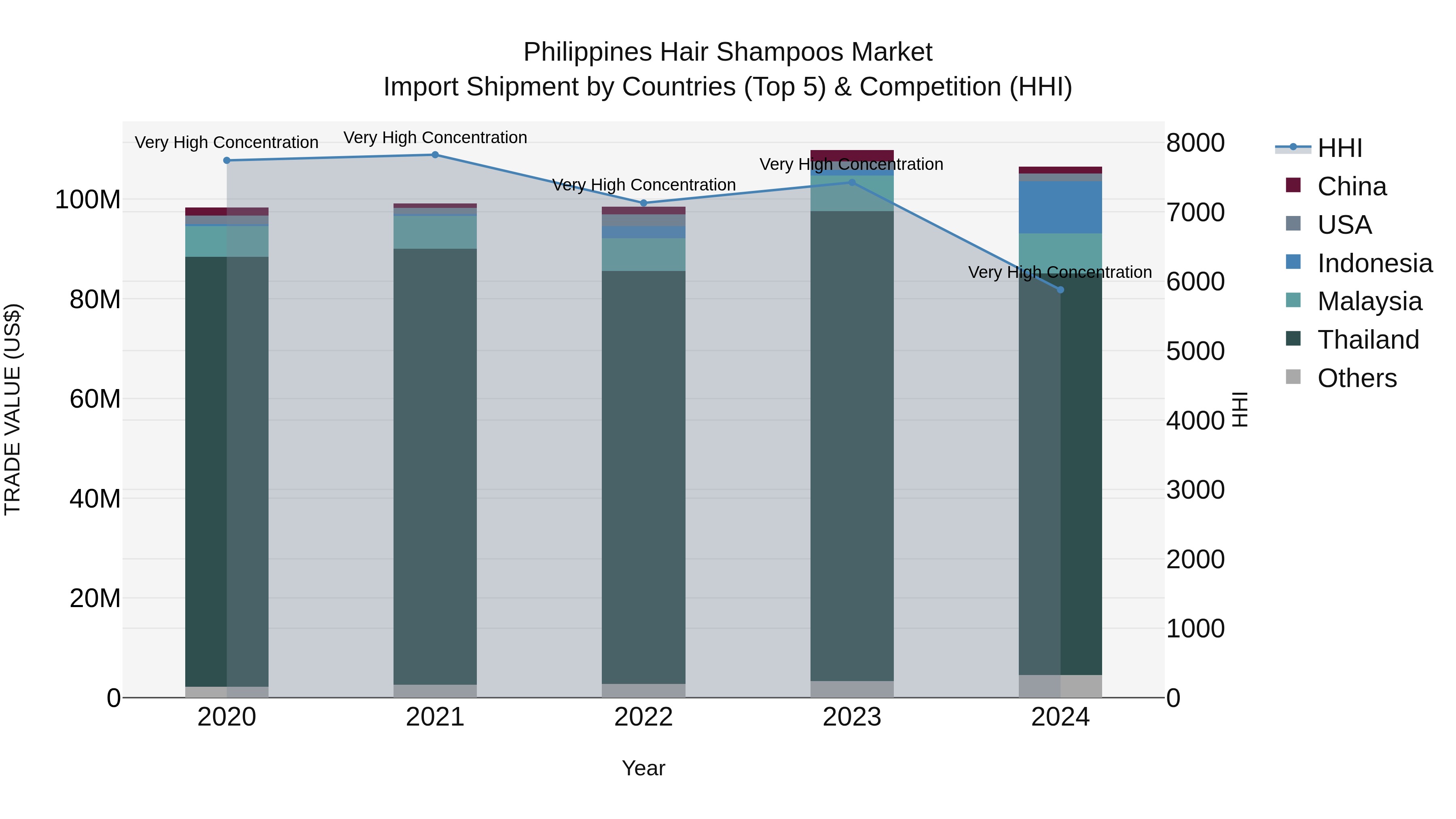
Philippines Hair Shampoos Market Top 5 Importing Countries and Market Competition (HHI) Analysis
The Philippines hair shampoo import market continued to exhibit high concentration in 2024, with top exporting countries being Thailand, Indonesia, Malaysia, USA, and China. Despite a slight decline in growth rate from 2023 to 2024, the market maintained a steady compound annual growth rate of 2.02% from 2020 to 2024. This suggests a stable demand for imported hair shampoos in the Philippines, with opportunities for market players to explore strategies for sustained growth and market penetration.
Philippines Hair Shampoos Market Growth Rate
According to 6Wresearch internal database and industry insights, the Philippines Hair Shampoos Market is growing at a compound annual growth rate (CAGR) of 8% during the forecast period (2026-2032).
Topics Covered in the Philippines Hair Shampoos Market Report
The Philippines Hair Shampoos Market report thoroughly covers the market by gender, distribution channels, and product type. The market report provides an unbiased and detailed analysis of ongoing market trends, opportunities/high growth areas, and market drivers, which would help stakeholders devise and align their market strategies according to the current and future market dynamics.
Philippines Hair Shampoos Market Highlights
| Report Name | Philippines Hair Shampoos Market |
| Forecast Period | 2026–2032 |
| CAGR | 8% |
| Growing Sector | E-commerce |
Philippines Hair Shampoos Market Synopsis
The Philippines Hair Shampoos Market is expected to grow robustly. The market growth is driven by growing demand among consumers for specialized products such as sulfate-free shampoos and anti-dandruff shampoos. Other than that, there is a growing demand among consumers for natural and organic shampoos due to increased awareness about their benefits on health. Moreover, the increasing hair loss concerns due to the polluted environment are expected to increase the market expansion.
Evaluation of Growth Drivers in the Philippines Hair Shampoos Market
Below mentioned are some growth drivers and their impact on market dynamics:
| Drivers | Primary Segments Affected | Why It Matters |
| Rising Demand for Premium Shampoos | Types (Anti-dandruff, Cosmetic, Herbal) | Consumers are opting for higher quality products. |
| Growth of E-commerce Platforms | Distribution Channels (Online) | Online shopping platforms are increasing access. |
| Preference for Organic Products | Types (Herbal, Cosmetic) | Aligns with the rising health-conscious trend. |
| Government Initiatives for Cosmetic Industry | Types, Distribution Channels | Regulatory support promotes market growth. |
| Urbanization and Disposable Income Growth | All Segments | Consumers are becoming more willing to spend on quality. |
The Philippines Hair Shampoos Market is expected to grow robustly at a CAGR of 8% during the forecast period of 2026-2032. Several factors are boosting the growth of the Philippines hair shampoos market. These factors are the growing urbanization and influence of beauty trends globally. Several awareness campaigns have been introduced by leading players regarding chemical-free formulations and scalp health are pushing consumers to invest in high quality shampoos to get rid of these concerns. The expanding e-commerce platforms, providing easy access to various brands, have surged the market reach. Furthermore, a rise in the demand for specialized shampoos addressing concerns, such as thinning hair, dandruff, and fizziness, propelling the Philippines Hair Shampoos Market growth. The personal care sector's overall expansion in the country supports the continued upward movement of this industry.
Evaluation of Restraints in the Philippines Hair Shampoos Market
Below mentioned are some major restraints and their influence on market dynamics:
| Restraints | Primary Segments Affected | What This Means |
| Intense Competition | Types, Distribution Channels | Reduces pricing flexibility and brand differentiation. |
| Price Sensitivity of Consumers | All Segments | Limits the demand for high-end products in certain segments. |
| Dependency on Imported Raw Materials | All Segments | Impacted by fluctuations in raw material prices. |
| Regulatory Compliance Challenges | Types, Distribution Channels | Makes more operational costs and hampers accessibility. |
| Cultural Preferences & Sensitivities | Gender, Types | Hamper growth in certain consumer segments. |
Philippines Hair Shampoos Market Challenges
The Philippines Hair Shampoos Market encounters several challenges in its path of growth. These challenges mainly include intense competition between local and international brands. Other than that, the increased pricing of premium hair care products discourages the product adoption by the middle-class consumer base. Also, the market is dependent on the imported raw materials, which creates instability and hampers the supply efficiency. In many regions there are cultural barriers around usage of certain shampoo categories, especially in rural areas.
Philippines Hair Shampoos Market Trends
Some major trends contributing to the Philippines Hair Shampoos Market are:
- Preference for Specialized Shampoos: There is growing demand among consumers for professional shampoos like anti-dandruff, herbal, and baby care products.
- Customization of Products: The consumers are increasing opting for personalized care shampoos due to increased awareness about the skin type and health consciousness.
- Influence of Celebrity and Social Media Endorsements: The increased endorsement of various shampoos by social media influencers and celebrities encourage the demand among consumers.
Investment Opportunities in the Philippines Hair Shampoos Market
Here are some investment opportunities in the Philippines Hair Shampoos Industry:
- Sustainable Product Development: Investing in eco-friendly and organic hair care formulations to cater to health-conscious and environmentally-aware consumers.
- Expansion of E-commerce Channels: Developing online platforms or partnering with existing e-commerce giants to reach a broader consumer base.
- Innovative Packaging Solutions: The investors can invest more on the making of sustainable packaging solution due to increased consumer demand for sustainable items.
Top 5 Leading Players in the Philippines Hair Shampoos Market
Here are some top companies contributing to the Philippines Hair Shampoos Market Share:
1. Procter & Gamble
| Company Name | Procter & Gamble (P&G) |
|---|---|
| Established Year | 1837 |
| Headquarters | Manila, Philippines |
| Official Website | Click Here |
Procter & Gamble is a key player in the Philippines hair care market with widely recognized brands such as Pantene, Head & Shoulders, and Herbal Essences. The company is known for its advanced hair care formulations, strong research capabilities, and extensive distribution networks that make its products accessible across supermarkets, pharmacies, and retail outlets throughout the country.
2. Unilever Philippines
| Company Name | Unilever Philippines |
|---|---|
| Established Year | 1929 |
| Headquarters | Manila, Philippines |
| Official Website | Click Here |
Unilever Philippines is a major player in the country’s hair care industry with well-known brands such as Sunsilk, Dove, and Clear. The company focuses on developing products designed for different hair types and climate conditions while promoting sustainability initiatives and continuous innovation in personal care products.
3. L'Oréal Philippines
| Company Name | L'Oréal Philippines |
|---|---|
| Established Year | 1995 |
| Headquarters | Manila, Philippines |
| Official Website | Click Here |
L'Oréal Philippines plays a strong role in the premium hair care segment by offering high-quality products through brands such as L'Oréal Paris, Garnier, and Pureology. The company emphasizes scientific research, product innovation, and advanced beauty technology to deliver specialized hair care solutions to Filipino consumers.
4. Johnson & Johnson
| Company Name | Johnson & Johnson Inc. |
|---|---|
| Established Year | 1886 |
| Headquarters | New Brunswick, New Jersey, USA |
| Official Website | Click Here |
Johnson & Johnson is a major global company in the beauty and personal care sector, offering a diverse portfolio of consumer products including hair care brands such as OGX. The company is recognized for its commitment to product innovation, safety standards, and consumer trust across global markets.
5. Colgate-Palmolive Philippines Incorporation
| Company Name | Colgate-Palmolive Philippines Incorporation |
|---|---|
| Established Year | 1926 |
| Headquarters | Parañaque City, Philippines |
| Official Website | Click Here |
Colgate-Palmolive Philippines is a leading competitor in the personal care market, particularly known for its Palmolive shampoo range. The company maintains a strong market presence through extensive distribution channels and a diverse portfolio of personal care products tailored to Filipino consumer needs.
Government Regulations Introduced in the Philippines Hair Shampoos Market
According to Filipino government data, the Philippines Hair Shampoos Market is well- regulated by various government policies ensuring the smooth expansion of the market. The Food and Drug Administration (FDA) policy ensures product safety and quality standards for hair care items. Moreover, the government also encourages local manufacturing and sustainable production practices, providing incentives for companies that meet eco-friendly standards. On top of that, regulations makes sure that hair care products comply with hygiene, labeling, and ingredient disclosure requirements. Overall, these initiatives foster consumer safety, enhance market growth, and improve the competitiveness of Philippine-made products in the global market.
Future Insights of the Philippines Hair Shampoos Market
The Philippines Hair Shampoos Market is expected to grow robustly. The market growth is driven by growing consumer demand for premium shampoos. Also, the online retail expansion is expected to encourage market growth by providing ease of accessibility and a wide range of product offerings. Moreover, the government provides tax subsidies and organic certifications, which encourage the production of organic farming and also build trust among consumers. It can be seen that the consumers are increasingly preferring more organic and herbal shampoos due to increased awareness about their benefits on health.
Market Segmentation Analysis
The report offers a comprehensive study of the subsequent market segments and their leading categories.
Herbal Shampoo to Dominate the Market - By Product Type
According to Guneet Kaur, Senior Research Analyst at 6Wresearch, herbal shampoos dominate the market due to their rising preference for natural ingredients, which cater to the growing health-conscious consumer base looking for chemical-free and environmentally friendly hair care solutions.
Female to Dominate the Market – By Gender
The female segment is leading the market. Mainly due to higher consumer demand for diverse hair care solutions, mainly for anti-dandruff and colour-treated products, as women continue to prioritize hair health and aesthetics, driving strong demand for specialized shampoo options.
Online to Dominate the Market – By Distribution Channel
The online distribution channel is leading the market efficiently. This is due to the convenience of e-commerce platforms and the increasing trend of online shopping, especially in urban areas, providing consumers with easy access to a wide variety of hair care products.
Key attractiveness of the report
- 10 Years Market Numbers.
- Historical Data Starting from 2022 to 2025.
- Base Year: 2025
- Forecast Data until 2032.
- Key Performance Indicators Impacting the Market.
- Major Upcoming Developments and Projects.
Key Highlights of the Report:
- Philippines Hair Shampoos Market Outlook
- Market Size of Philippines Hair Shampoos Market, 2025
- Forecast of Philippines Hair Shampoos Market, 2032
- Historical Data and Forecast of Philippines Hair Shampoos Revenues & Volume for the Period 2022-2032
- Philippines Hair Shampoos Market Trend Evolution
- Philippines Hair Shampoos Market Drivers and Challenges
- Philippines Hair Shampoos Price Trends
- Philippines Hair Shampoos Porter's Five Forces
- Philippines Hair Shampoos Industry Life Cycle
- Historical Data and Forecast of Philippines Hair Shampoos Market Revenues & Volume By Types for the Period 2022-2032
- Historical Data and Forecast of Philippines Hair Shampoos Market Revenues & Volume By Anti-dandruff Shampoo for the Period 2022-2032
- Historical Data and Forecast of Philippines Hair Shampoos Market Revenues & Volume By Cosmetic Shampoo for the Period 2022-2032
- Historical Data and Forecast of Philippines Hair Shampoos Market Revenues & Volume By Dry Shampoo for the Period 2022-2032
- Historical Data and Forecast of Philippines Hair Shampoos Market Revenues & Volume By Herbal Shampoo for the Period 2022-2032
- Historical Data and Forecast of Philippines Hair Shampoos Market Revenues & Volume By Baby Care Shampoo for the Period 2022-2032
- Historical Data and Forecast of Philippines Hair Shampoos Market Revenues & Volume By Animal Shampoo for the Period 2022-2032
- Historical Data and Forecast of Philippines Hair Shampoos Market Revenues & Volume By Antibacterial Shampoo for the Period 2022-2032
- Historical Data and Forecast of Philippines Hair Shampoos Market Revenues & Volume By Gender for the Period 2022-2032
- Historical Data and Forecast of Philippines Hair Shampoos Market Revenues & Volume By Male for the Period 2022-2032
- Historical Data and Forecast of Philippines Hair Shampoos Market Revenues & Volume By Female for the Period 2022-2032
- Historical Data and Forecast of Philippines Hair Shampoos Market Revenues & Volume By Unisex for the Period 2022-2032
- Historical Data and Forecast of Philippines Hair Shampoos Market Revenues & Volume By Distribution Channel for the Period 2022-2032
- Historical Data and Forecast of Philippines Hair Shampoos Market Revenues & Volume By Online for the Period 2022-2032
- Historical Data and Forecast of Philippines Hair Shampoos Market Revenues & Volume By Offline for the Period 2022-2032
- Philippines Hair Shampoos Import Export Trade Statistics
- Market Opportunity Assessment By Types
- Market Opportunity Assessment By Gender
- Market Opportunity Assessment By Distribution Channel
- Philippines Hair Shampoos Top Companies Market Share
- Philippines Hair Shampoos Competitive Benchmarking By Technical and Operational Parameters
- Philippines Hair Shampoos Company Profiles
- Philippines Hair Shampoos Key Strategic Recommendations
Market Segmentations
The Market report covers a detailed analysis of the following market segments:
By Types
- Anti-dandruff Shampoo
- Cosmetic Shampoo
- Dry Shampoo
- Herbal Shampoo
- Baby Care Shampoo
- Animal Shampoo
- Antibacterial Shampoo
By Gender
- Male
- Female
- Unisex
By Distribution Channel
- Online
- Offline
Philippines Hair Shampoos Market (2026-2032) : FAQs
The market growth drivers include increasing consumer demand for specialized products, premium offerings, and the growth of e-commerce.
The market new opportunities include growth of e-commerce platforms and more and more demand for organic products and specialized shampoos.
Challenges include intense competition, cultural preferences, and fluctuations in raw material prices.
The Philippines Hair Shampoos Market is projected to grow at a CAGR of 8% during the forecast period.
6Wresearch actively monitors the Philippines Hair Shampoos Market and publishes its comprehensive annual report, highlighting emerging trends, growth drivers, revenue analysis, and forecast outlook. Our insights help businesses to make data-backed strategic decisions with ongoing market dynamics. Our analysts track relevent industries related to the Philippines Hair Shampoos Market, allowing our clients with actionable intelligence and reliable forecasts tailored to emerging regional needs.
Yes, we provide customisation as per your requirements. To learn more, feel free to contact us on sales@6wresearch.com
| 1 Executive Summary |
| 2 Introduction |
| 2.1 Key Highlights of the Report |
| 2.2 Report Description |
| 2.3 Market Scope & Segmentation |
| 2.4 Research Methodology |
| 2.5 Assumptions |
| 3 Philippines Hair Shampoos Market Overview |
| 3.1 Philippines Country Macro Economic Indicators |
| 3.2 Philippines Hair Shampoos Market Revenues & Volume, 2022 & 2032F |
| 3.3 Philippines Hair Shampoos Market - Industry Life Cycle |
| 3.4 Philippines Hair Shampoos Market - Porter's Five Forces |
| 3.5 Philippines Hair Shampoos Market Revenues & Volume Share, By Types, 2022 & 2032F |
| 3.6 Philippines Hair Shampoos Market Revenues & Volume Share, By Gender, 2022 & 2032F |
| 3.7 Philippines Hair Shampoos Market Revenues & Volume Share, By Distribution Channel, 2022 & 2032F |
| 4 Philippines Hair Shampoos Market Dynamics |
| 4.1 Impact Analysis |
| 4.2 Market Drivers |
| 4.3 Market Restraints |
| 5 Philippines Hair Shampoos Market Trends |
| 6 Philippines Hair Shampoos Market, By Types |
| 6.1 Philippines Hair Shampoos Market, By Types |
| 6.1.1 Overview and Analysis |
| 6.1.2 Philippines Hair Shampoos Market Revenues & Volume, By Types, 2022-2032F |
| 6.1.3 Philippines Hair Shampoos Market Revenues & Volume, By Anti-dandruff Shampoo, 2022-2032F |
| 6.1.4 Philippines Hair Shampoos Market Revenues & Volume, By Cosmetic Shampoo, 2022-2032F |
| 6.1.5 Philippines Hair Shampoos Market Revenues & Volume, By Dry Shampoo, 2022-2032F |
| 6.1.6 Philippines Hair Shampoos Market Revenues & Volume, By Herbal Shampoo, 2022-2032F |
| 6.1.7 Philippines Hair Shampoos Market Revenues & Volume, By Baby Care Shampoo, 2022-2032F |
| 6.1.8 Philippines Hair Shampoos Market Revenues & Volume, By Animal Shampoo, 2022-2032F |
| 6.2 Philippines Hair Shampoos Market, By Gender |
| 6.2.1 Overview and Analysis |
| 6.2.2 Philippines Hair Shampoos Market Revenues & Volume, By Male, 2022-2032F |
| 6.2.3 Philippines Hair Shampoos Market Revenues & Volume, By Female, 2022-2032F |
| 6.2.4 Philippines Hair Shampoos Market Revenues & Volume, By Unisex, 2022-2032F |
| 6.3 Philippines Hair Shampoos Market, By Distribution Channel |
| 6.3.1 Overview and Analysis |
| 6.3.2 Philippines Hair Shampoos Market Revenues & Volume, By Online , 2022-2032F |
| 6.3.3 Philippines Hair Shampoos Market Revenues & Volume, By Offline, 2022-2032F |
| 7 Philippines Hair Shampoos Market Import-Export Trade Statistics |
| 7.1 Philippines Hair Shampoos Market Export to Major Countries |
| 7.2 Philippines Hair Shampoos Market Imports from Major Countries |
| 8 Philippines Hair Shampoos Market Key Performance Indicators |
| 9 Philippines Hair Shampoos Market - Opportunity Assessment |
| 9.1 Philippines Hair Shampoos Market Opportunity Assessment, By Types, 2022 & 2032F |
| 9.2 Philippines Hair Shampoos Market Opportunity Assessment, By Gender, 2022 & 2032F |
| 9.3 Philippines Hair Shampoos Market Opportunity Assessment, By Distribution Channel, 2022 & 2032F |
| 10 Philippines Hair Shampoos Market - Competitive Landscape |
| 10.1 Philippines Hair Shampoos Market Revenue Share, By Companies, 2025 |
| 10.2 Philippines Hair Shampoos Market Competitive Benchmarking, By Operating and Technical Parameters |
| 11 Company Profiles |
| 12 Recommendations |
| 13 Disclaimer |
Global Go To Market Strategy - 2030
Export potential enables firms to identify high-growth global markets with greater confidence by combining advanced trade intelligence with a structured quantitative methodology. The framework analyzes emerging demand trends and country-level import patterns while integrating macroeconomic and trade datasets such as GDP and population forecasts, bilateral import–export flows, tariff structures, elasticity differentials between developed and developing economies, geographic distance, and import demand projections. Using weighted trade values from 2020–2024 as the base period to project country-to-country export potential for 2030, these inputs are operationalized through calculated drivers such as gravity model parameters, tariff impact factors, and projected GDP per-capita growth. Through an analysis of hidden potentials, demand hotspots, and market conditions that are most favorable to success, this method enables firms to focus on target countries, maximize returns, and global expansion with data, backed by accuracy.
By factoring in the projected importer demand gap that is currently unmet and could be potential opportunity, it identifies the potential for the Exporter (Country) among 190 countries, against the general trade analysis, which identifies the biggest importer or exporter.
To discover high-growth global markets and optimize your business strategy:
Click Here
Pricing
- Single User License$ 1,995
- Department License$ 2,400
- Site License$ 3,120
- Global License$ 3,795

Leadership Perspectives from Industry Events
Search
Thought Leadership and Analyst Meet





Our Clients








6WResearch In News
- India Air Conditioner Market Set for Strong Rebound in 2026 After Weather-Led Correction and GST-Driven Recovery: 6Wresearch
- ADAS in India: How Automatic Emergency Braking, Blind Spot Detection & Driver Monitoring are Transforming Road Safety
- Doha a strategic location for EV manufacturing hub: IPA Qatar
- Demand for luxury TVs surging in the GCC, says Samsung
- Empowering Growth: The Thriving Journey of Bangladesh’s Cable Industry
- Demand for luxury TVs surging in the GCC, says Samsung
Latest Reports
- Nicaragua RPG Gaming Market (2026-2032)
- New Zealand RPG Gaming Market (2026-2032)
- Netherlands RPG Gaming Market (2026-2032)
- Nauru RPG Gaming Market (2026-2032)
- Namibia RPG Gaming Market (2026-2032)
- Mozambique RPG Gaming Market (2026-2032)
- Montenegro RPG Gaming Market (2026-2032)
- Mongolia RPG Gaming Market (2026-2032)
- Monaco RPG Gaming Market (2026-2032)
- Micronesia RPG Gaming Market (2026-2032)
Industry Events and Analyst Meet

HIMTEX 2026

India Refining Summit 2026

India EV Show 2026

EV tech India Expo 2026

Auto Tech Asia 2026
Whitepaper
- Middle East & Africa Commercial Security Market Click here to view more.
- Middle East & Africa Fire Safety Systems & Equipment Market Click here to view more.
- GCC Drone Market Click here to view more.
- Middle East Lighting Fixture Market Click here to view more.
- GCC Physical & Perimeter Security Market Click here to view more.


