Philippines Human Hair Extension Market Top 5 Importing Countries and Market Competition (HHI) Analysis
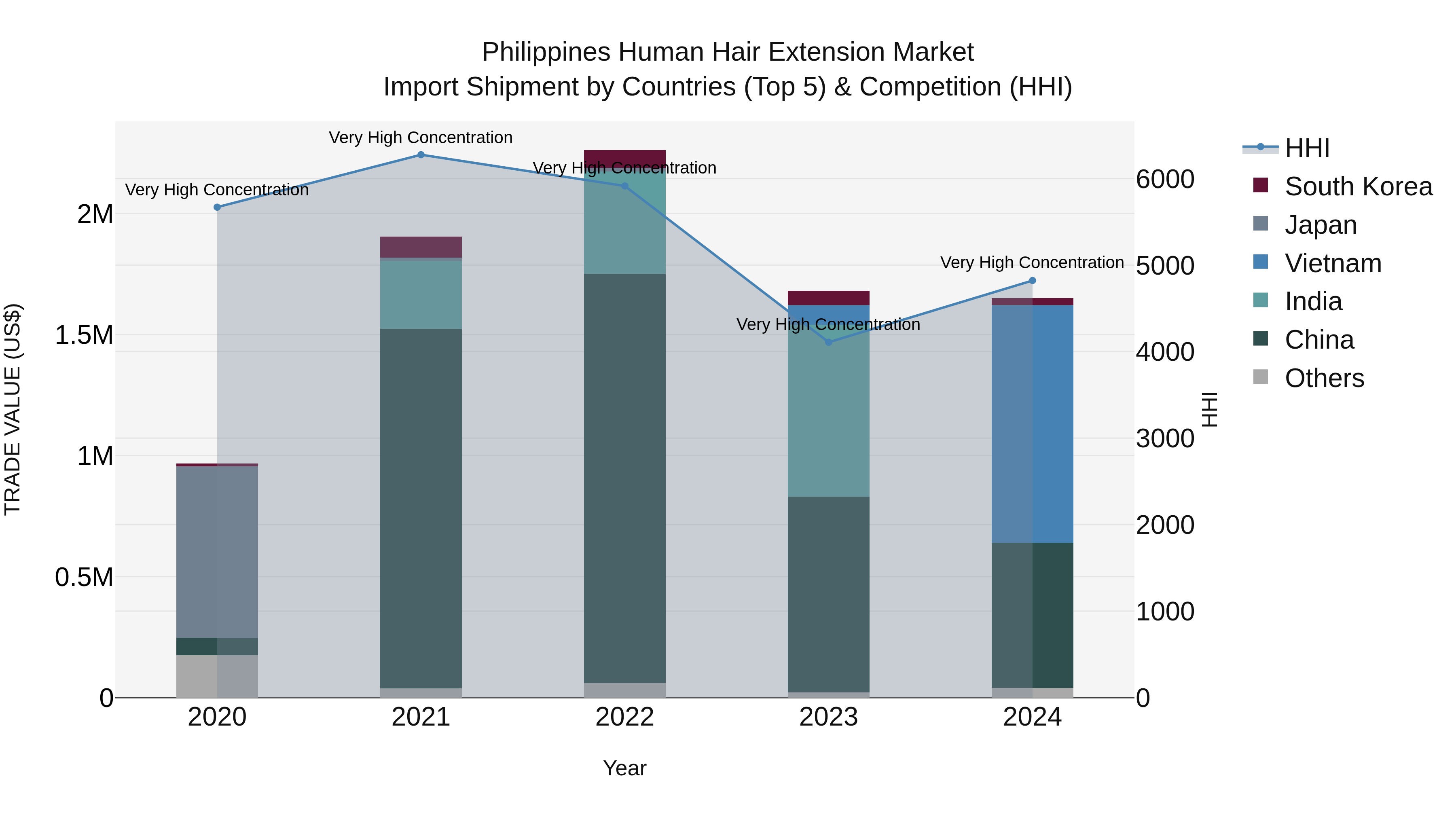
The Philippines continues to be a key market for human hair extension imports, with top suppliers including Vietnam, China, South Korea, Hong Kong, and Belgium in 2024. Despite a slight decrease in growth rate from 2023 to 2024, the industry maintained a high Herfindahl-Hirschman Index (HHI) concentration. With a strong compound annual growth rate (CAGR) of 14.29% from 2020 to 2024, the market remains dynamic and competitive, offering opportunities for both local businesses and international suppliers to capitalize on the growing demand for quality hair extensions in the country.
Human Hair Extension Market: Philippines vs Top 5 Major Economies in 2027 (Asia)
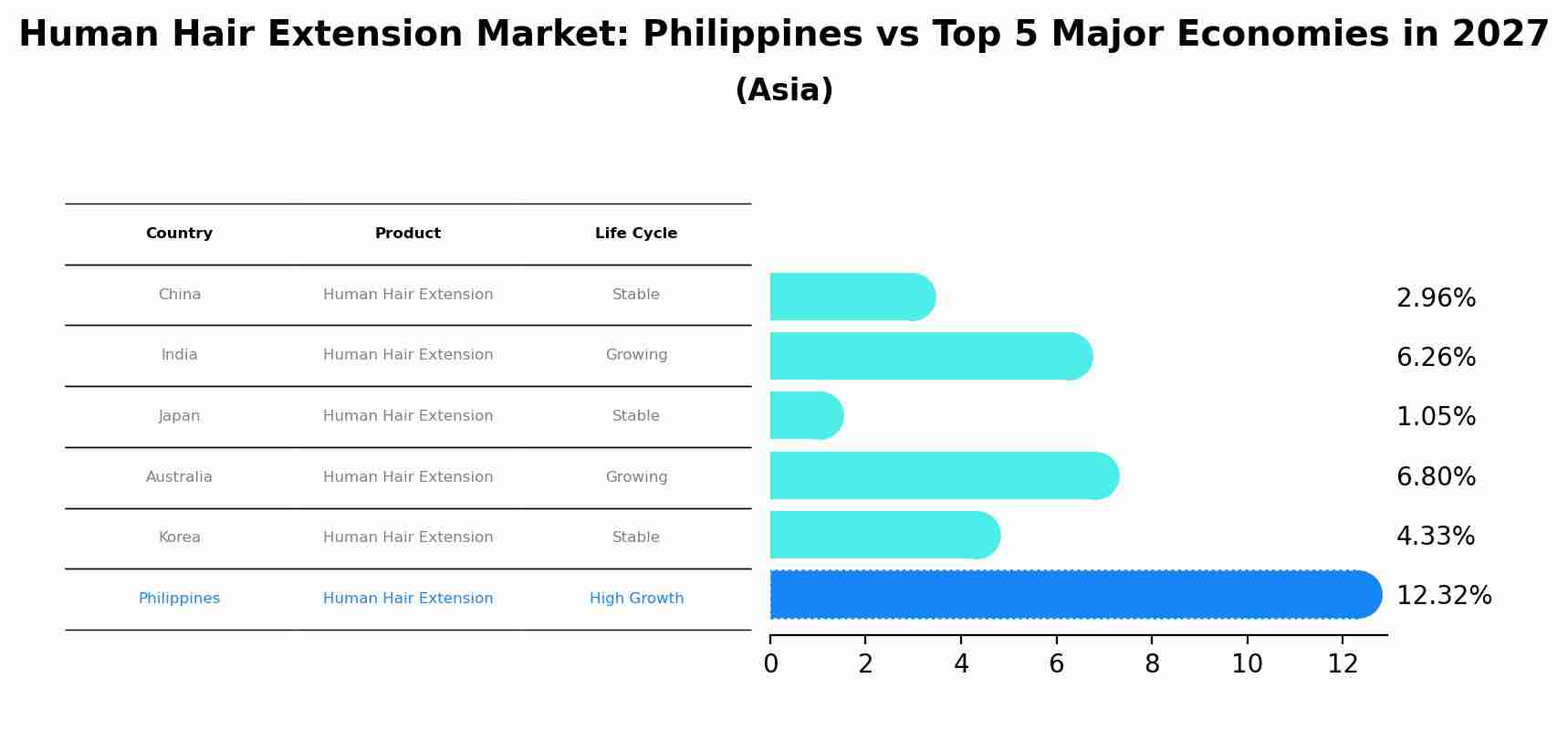
Philippines's Human Hair Extension market is anticipated to experience a high growth rate of 12.32% by 2027, reflecting trends observed in the largest economy China, followed by India, Japan, Australia and South Korea.
philippines human hair extension market Synopsis
The human hair extension market has seen significant growth over the past few years due to increasing interest among Filipinos wanting to try out different hairstyles or color without damaging their own natural locks. According to data released by 6wresearch, sales of human hair extensions hit 10 million US dollars in 2025 ? representing a 4. 1% increase compared with 2018?s figures - while volume sales increased 11%. Synthetic wigs are still more popular than real ones however; they account for 78% of total category value while real hair only makes up 22%.
Drivers of the Market
The Philippines human hair extension market is driven by fashion trends, beauty ideals, and the desire for aesthetic versatility. Human hair extensions offer the opportunity to change hairstyles quickly and achieve desired looks, attracting consumers who seek to experiment with their appearance. Social media platforms and celebrity influences also play a role in promoting these products. As the market offers various hair types, lengths, and colors, consumers can find extensions that suit their preferences, contributing to market expansion.
Challenges of the Market
Challenges in the Philippines human hair extension market involve issues of authenticity, quality control, and ethical sourcing of human hair. Establishing transparent supply chains and consumer education are essential.
COVID-19 Impact on the Market
The Philippines Human Hair Extension Market faced challenges during the COVID-19 pandemic, particularly due to the closure of beauty salons and reduced social gatherings. The decreased demand for personal appearance-related services led to a temporary slump in the market. However, as restrictions eased, there was a gradual recovery driven by pent-up demand for hair-related services. The market`s performance remains linked to consumer preferences for beauty treatments and personal grooming.
Key Players in the Market
The Philippines Human Hair Extension market is dominated by several key players, including the likes of Indique Hair, Unihairvn, Hot Beauty Hair, and Xuchang Global Trading Co. These companies are responsible for supplying premium quality extensions to customers all over the country. Additionally, a number of smaller online retailers have also emerged in recent years offering products at competitive prices. Each company contributes to the overall growth of the industry and provides customers with diverse options when it comes to hair extension styles and textures.
Key Highlights of the Report:
- Philippines Human Hair Extension Market Outlook
- Market Size of Philippines Human Hair Extension Market, 2024
- Forecast of Philippines Human Hair Extension Market, 2031
- Historical Data and Forecast of Philippines Human Hair Extension Revenues & Volume for the Period 2021-2031
- Philippines Human Hair Extension Market Trend Evolution
- Philippines Human Hair Extension Market Drivers and Challenges
- Philippines Human Hair Extension Price Trends
- Philippines Human Hair Extension Porter's Five Forces
- Philippines Human Hair Extension Industry Life Cycle
- Historical Data and Forecast of Philippines Human Hair Extension Market Revenues & Volume By Hair Type for the Period 2021-2031
- Historical Data and Forecast of Philippines Human Hair Extension Market Revenues & Volume By Human Hair for the Period 2021-2031
- Historical Data and Forecast of Philippines Human Hair Extension Market Revenues & Volume By Animal Hair for the Period 2021-2031
- Historical Data and Forecast of Philippines Human Hair Extension Market Revenues & Volume By Synthetic Hair for the Period 2021-2031
- Historical Data and Forecast of Philippines Human Hair Extension Market Revenues & Volume By Application for the Period 2021-2031
- Historical Data and Forecast of Philippines Human Hair Extension Market Revenues & Volume By Fusion & Pre-bonded for the Period 2021-2031
- Historical Data and Forecast of Philippines Human Hair Extension Market Revenues & Volume By Tap-in for the Period 2021-2031
- Historical Data and Forecast of Philippines Human Hair Extension Market Revenues & Volume By Clip-in for the Period 2021-2031
- Historical Data and Forecast of Philippines Human Hair Extension Market Revenues & Volume By Distribution Channel for the Period 2021-2031
- Historical Data and Forecast of Philippines Human Hair Extension Market Revenues & Volume By Non-Store Based for the Period 2021-2031
- Historical Data and Forecast of Philippines Human Hair Extension Market Revenues & Volume By Store Based for the Period 2021-2031
- Philippines Human Hair Extension Import Export Trade Statistics
- Market Opportunity Assessment By Hair Type
- Market Opportunity Assessment By Application
- Market Opportunity Assessment By Distribution Channel
- Philippines Human Hair Extension Top Companies Market Share
- Philippines Human Hair Extension Competitive Benchmarking By Technical and Operational Parameters
- Philippines Human Hair Extension Company Profiles
- Philippines Human Hair Extension Key Strategic Recommendations






































