Philippines Insect Pest Control Market Top 5 Importing Countries and Market Competition (HHI) Analysis
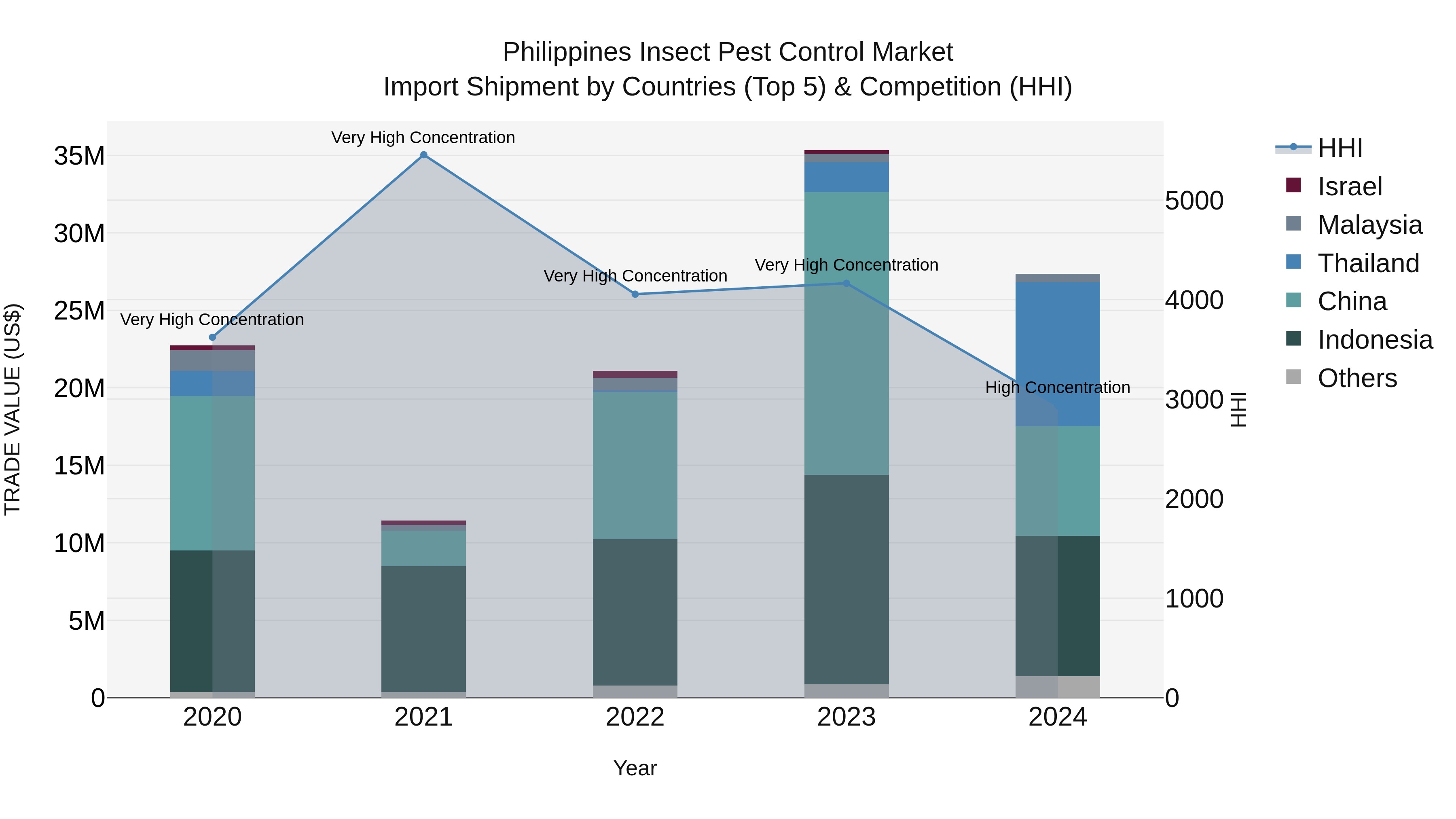
The Philippines insect pest control import market saw a shift in concentration levels from very high in 2023 to high in 2024, with top exporters being Thailand, Indonesia, China, USA, and Malaysia. Despite a decline in growth rate from 2023 to 2024, the compound annual growth rate (CAGR) for the period 2020-2024 remained positive at 4.72%. This indicates a steady demand for insect pest control products in the Philippines, with key importing countries maintaining their presence in the market.
Philippines Insect Pest Control Market Growth Rate
According to 6Wresearch internal database and industry insights, the Philippines Insect Pest Control Market is growing at a compound annual growth rate (CAGR) of 7.85% during the forecast period (2026-2032).
Topics Covered in the Philippines Insect Pest Control Market Report
Philippines Insect Pest Control Market report thoroughly covers the market by insect type, control method, and form. The market report provides an unbiased and detailed analysis of ongoing market trends, opportunities/high growth areas, and market drivers, which would help stakeholders devise and align their market strategies according to the current and future market dynamics.
Philippines Insect Pest Control Market Highlights
| Report Name | Philippines Insect Pest Control Market |
| Forecast period | 2026-2032 |
| CAGR | 7.85% |
| Growing Sector | Commercial & Residential Services |
Philippines Insect Pest Control Market Synopsis
The Philippines Insect Pest Control Market will experience substantial growth as the country has tropical weather conditions and increasing urban development and growing public health knowledge. The demand for mosquito control services has increased due to the repeated outbreaks of dengue and chikungunya mosquito-borne diseases. The growing termite problem, which affects wooden residential buildings and commercial spaces, has led to an increase in preventive pest control contracts. The market outlook for the industry benefits from three factors government sanitation programs, new food service establishments and ongoing infrastructure development projects.
Evaluation of Growth Drivers in the Philippines Insect Pest Control Market
Below mentioned some growth drivers and their impact on market dynamics:
| Drivers | Primary Segments Affected | Why It Matters |
| Rising Vector-Borne Diseases | Mosquitoes, Chemical & Liquid | Increases demand for effective health protection solutions. |
| Urban Construction Expansion | Termites, Physical & Liquid | Drives preventive pest control in new buildings. |
| Growth in Hospitality & Food Sector | Cockroaches, Flies, Ants | It basically supports strict hygiene and safety compliance. |
| Government Cleanliness Campaigns | All Insect Types | Bolsters nationwide sanitation and pest control efforts. |
| Public Awareness on Hygiene | Bedbugs, Mosquitoes | Encourages adoption of professional pest management services. |
The Philippines Insect Pest Control Market is projected to grow significantly, with a CAGR of 7.85% during the forecast period of 2026-2032. The Philippines Insect Pest Control Market experiences its main market growth as of fast urban development, increased construction work and growing dengue vector-borne disease outbreaks. The rising demand for professional pest management services stems from increased hygiene and sanitation awareness among both households and commercial businesses. The hospitality and food processing and retail sectors continue to expand their operations which requires them to implement routine pest control measures for compliance purposes. Government-led sanitation campaigns together with stricter pesticide regulations create an environment which promotes structured pest management methods while eco-friendly and integrated pest control system innovations drive continuous market expansion.
Evaluation of Restraints in the Philippines Insect Pest Control Market
Below mentioned are some major restraints and their influence on market dynamics:
| Restraints | Primary Segments Affected | What This Means |
| High Service Charges | Residential Segment | Lower service adoption due to budget constraints. |
| Environmental Regulations | Chemical Control | Increases compliance and operational expenses. |
| Limited Rural Penetration | All Segments | Restricts the market reach in provincial areas. |
| Local Operators | Organized Players | Makes the demand lesser for high-tech insect pest control. |
| Chemical Resistance Development | Mosquitoes, Cockroaches | Necessitates continuous product innovation. |
Philippines Insect Pest Control Market Challenges
The Philippines Insect Pest Control Market faces operational difficulties as insects are developing resistance to traditional pesticide treatments. The pest control operators face increased operational expenses as of regulatory restrictions that apply to particular chemical products. Organized service providers face challenges in rural areas as traditional pest control methods dominate these regions. Established companies in the market face dual challenges from price-sensitive customers and competition from informal market players.
Philippines Insect Pest Control Market Trends
Some major trends contributing to the Philippines Insect Pest Control Market Growth are:
- Integrated Pest Management (IPM): To ensure long-term effectiveness and sustainability the adoption of IPM practices integrating biological, and physical controls will be important.
- Eco-Friendly and Herbal Formulations: There is a growing demand among consumers for plant-based and low-toxicity insecticides due to environmental and safety concerns.
- Smart Monitoring Systems: The consumers are demanding for digital pest monitoring devices that can provide real-time infestation tracking.
Investment Opportunities in the Philippines Insect Pest Control Market
Here are some investment opportunities in the Philippines Insect Pest Control Industry:
- Biological Control Solutions: Investing in more natural predators and microbial pesticides supports eco-friendly pest management which is most preferred by people.
- Advanced Chemical Formulations: Development of low-toxicity yet highly effective insecticides enhances market competitiveness as it is preferred more by eco-conscious consumer base.
- Digital Pest Monitoring Services: Smart sensor-based pest detection systems improve efficiency and attract commercial clients for opting the insect pest control systems.
Top 5 Leading Players in the Philippines Insect Pest Control Market
Here are some top companies contributing to Philippines Insect Pest Control Market Share:
Rentokil Initial Philippines
| Company Name | Rentokil Initial Philippines |
| Established Year | 1965 |
| Headquarters | Makati City, Philippines |
| Official Website | Click Here |
Rentokil Initial Philippines provides comprehensive pest control solutions across residential, commercial, and industrial sectors. The company specializes in termite management, mosquito control, and integrated pest management programs with advanced monitoring technologies.
MAPECON Philippines Inc.
| Company Name | MAPECON Philippines Inc. |
| Established Year | 1999 |
| Headquarters | Quezon City, Philippines |
| Official Website | - |
MAPECON offers environment-friendly pest control services using organic-based formulations. The company serves households, restaurants, and offices while focusing on safe and sustainable pest management practices.
Pest Science Corporation
| Company Name | Pest Science Corporation |
| Established Year | 1994 |
| Headquarters | Manila, Philippines |
| Official Website | Click Here |
Pest Science Corporation delivers professional pest control and sanitation services, specializing in termite prevention and structural protection for commercial buildings and residential properties.
EcoPest Control Services
| Company Name | EcoPest Control Services |
| Established Year | 2008 |
| Headquarters | Cebu City, Philippines |
| Official Website | - |
EcoPest Control Services provides eco-conscious pest management solutions, focusing on biological and low-chemical treatments for mosquitoes, cockroaches, and ants. The company also offers regular maintenance contracts and consultation services for sustainable long-term pest prevention.
JDC Pest Control
| Company Name | JDC Pest Control |
| Established Year | 2005 |
| Headquarters | Davao City, Philippines |
| Official Website | Click Here |
JDC Pest Control offers customized pest control programs for industrial facilities, food establishments, and residential complexes, ensuring compliance with national safety standards. The company emphasizes advanced monitoring techniques and rapid-response treatments to minimize infestation risks efficiently.
Government Regulations Introduced in the Philippines Insect Pest Control Market
According to Philippine government data, the market is well regulated by various government policies ensuring its steady growth of the industry. The Department of Health (DOH) implements the National Dengue Prevention and Control Program, promoting mosquito control initiatives across communities. The Fertilizer and Pesticide Authority (FPA) controls pesticide registration processes and establishes usage guidelines to protect environmental resources. The Sanitation Code of the Philippines (Presidential Decree No. 856) grants local government units’ authority to conduct sanitation inspections for food establishments, which creates a higher need for professional pest management services.
Future Insights of the Philippines Insect Pest Control Market
The Philippines Insect Pest Control Market shows enormous potential for future growth as people now understand hygiene standards and vector control requirements. The expansion of commercial infrastructures through the construction of malls and hotels and BPO offices will create permanent service contracts that continue for many years. The increasing demand for environmentally friendly pest control methods that use advanced technology will change the existing service offerings. The upcoming years will see increased demand for pest control services as a result of government-supported health initiatives and urban housing development projects.
Market Segmentation Analysis
The report offers a comprehensive study of the subsequent market segments and their leading categories.
Termites to Dominate the Market – By Insect Type
According to Guneet Kaur, Senior Research Analyst, 6Wresearch, termites dominate the Philippines Insect Pest Control Market due to the country’s humid tropical climate and widespread use of wooden structures in residential and commercial buildings. Termite infestations cause significant structural damage, prompting property owners to invest in preventive and long-term control solutions.
Chemical to Dominate the Market – By Control Method
The sales of the market currently show chemical control methods as the top-selling product. The product achieves immediate results which can be applied to various types of residential and commercial and industrial facilities. The product uses liquid insecticides and residual sprays to create termite barriers and execute mosquito fogging and cockroach elimination.
Liquid to Dominate the Market – By Form
Liquid formulations dominate the Philippines Insect Pest Control Market as they provide better surface coverage, deeper penetration, and long-lasting residual effects. Liquid insecticides are extensively used for termite soil treatments, mosquito fogging, and general household pest control.
Key attractiveness of the report
- 10 Years Market Numbers.
- Historical Data Starting from 2022 to 2025.
- Base Year: 2025
- Forecast Data until 2032.
- Key Performance Indicators Impacting the Market.
- Major Upcoming Developments and Projects.
Key Highlights of the Report:
- Philippines Insect Pest Control Market Outlook
- Market Size of Philippines Insect Pest Control Market, 2025
- Forecast of Philippines Insect Pest Control Market, 2032
- Historical Data and Forecast of Philippines Insect Pest Control Revenues & Volume for the Period 2022- 2032F
- Philippines Insect Pest Control Market Trend Evolution
- Philippines Insect Pest Control Market Drivers and Challenges
- Philippines Insect Pest Control Price Trends
- Philippines Insect Pest Control Porter's Five Forces
- Philippines Insect Pest Control Industry Life Cycle
- Historical Data and Forecast of Philippines Insect Pest Control Market Revenues & Volume By Insect Type for the Period 2022- 2032F
- Historical Data and Forecast of Philippines Insect Pest Control Market Revenues & Volume By Termites for the Period 2022- 2032F
- Historical Data and Forecast of Philippines Insect Pest Control Market Revenues & Volume By Cockroaches for the Period 2022- 2032F
- Historical Data and Forecast of Philippines Insect Pest Control Market Revenues & Volume By Bedbugs for the Period 2022- 2032F
- Historical Data and Forecast of Philippines Insect Pest Control Market Revenues & Volume By Mosquitoes for the Period 2022- 2032F
- Historical Data and Forecast of Philippines Insect Pest Control Market Revenues & Volume By Flies for the Period 2022- 2032F
- Historical Data and Forecast of Philippines Insect Pest Control Market Revenues & Volume By Ants for the Period 2022- 2032F
- Historical Data and Forecast of Philippines Insect Pest Control Market Revenues & Volume By Control Method for the Period 2022- 2032F
- Historical Data and Forecast of Philippines Insect Pest Control Market Revenues & Volume By Chemical for the Period 2022- 2032F
- Historical Data and Forecast of Philippines Insect Pest Control Market Revenues & Volume By Biological for the Period 2022- 2032F
- Historical Data and Forecast of Philippines Insect Pest Control Market Revenues & Volume By Physical for the Period 2022- 2032F
- Historical Data and Forecast of Philippines Insect Pest Control Market Revenues & Volume By Form for the Period 2022- 2032F
- Historical Data and Forecast of Philippines Insect Pest Control Market Revenues & Volume By Dry for the Period 2022- 2032F
- Historical Data and Forecast of Philippines Insect Pest Control Market Revenues & Volume By Liquid for the Period 2022- 2032F
- Philippines Insect Pest Control Import Export Trade Statistics
- Market Opportunity Assessment By Insect Type
- Market Opportunity Assessment By Control Method
- Market Opportunity Assessment By Form
- Philippines Insect Pest Control Top Companies Market Share
- Philippines Insect Pest Control Competitive Benchmarking By Technical and Operational Parameters
- Philippines Insect Pest Control Company Profiles
- Philippines Insect Pest Control Key Strategic Recommendations
Market covered
The report subsequently covers the market by following segments and subsegments.
By Insect Type
- Termites
- Cockroaches
- Bedbugs
- Mosquitoes
- Flies
- Ants
By Control Method
- Chemical
- Biological
- Physical
By Form
- Dry
- Liquid






































