Philippines Microtomes Market Size, Share & Growth Rate
The Philippines Microtomes Market was estimated at USD 369 Million in 2025 and is projected to reach USD 498 Million by 2032, growing at a CAGR of 4.4% from 2026 to 2032. This upward trajectory can be attributed to the increasing demand for microtomes in pathology labs and research institutions, where they play a critical role in preparing specimens for detailed examination. As the life sciences sector continues to advance, the reliance on precise cutting instruments like microtomes will only amplify, fostering sustained growth within the market.
Philippines Microtomes Market Year-wise Growth Rate and Key Drivers
This graph highlights how the Philippines Microtomes Market has steadily grown over the years, supported by major growth factors.
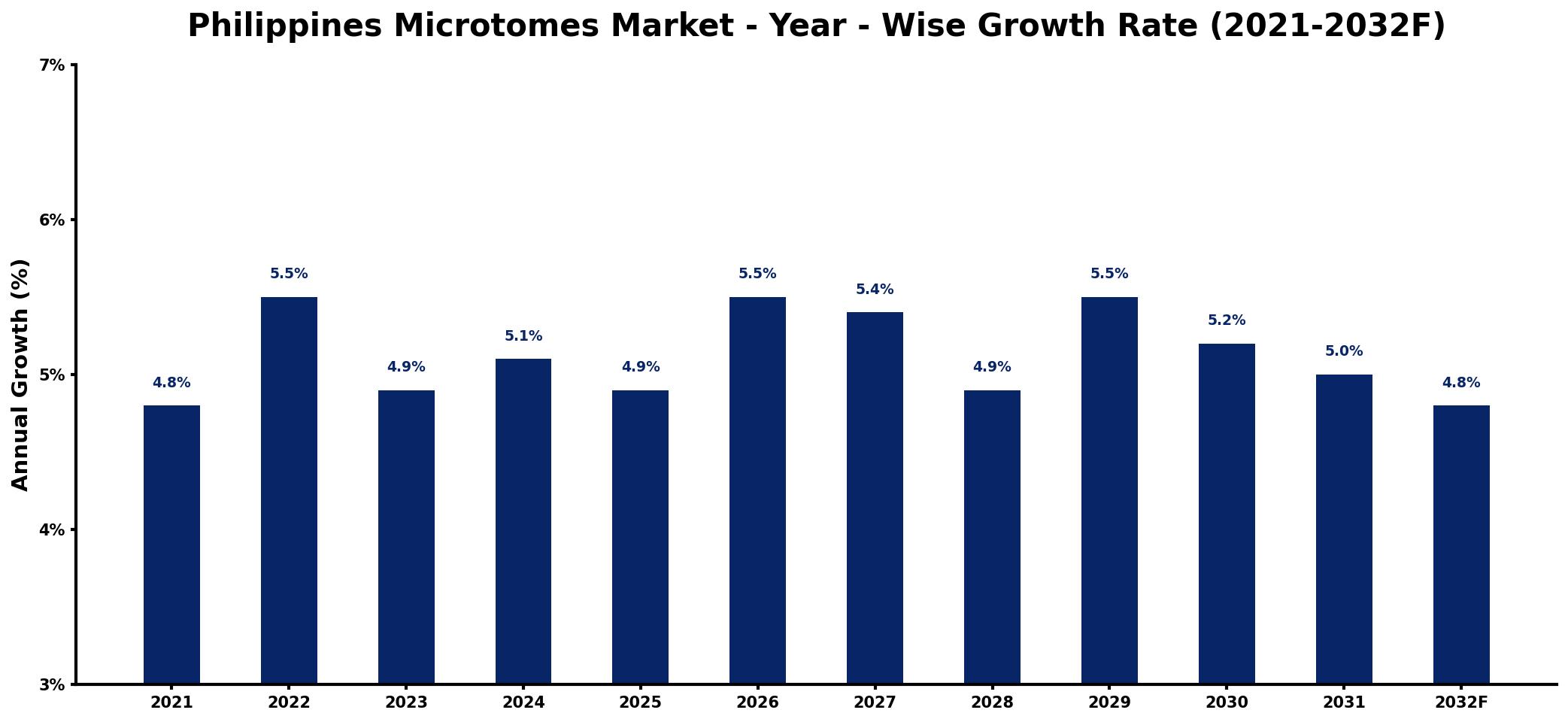
The table below presents the year‑wise growth rates along with the key drivers influencing the market
| Year | Growth Rate | Major Drivers |
| 2021 | 4.8% | Rising healthcare investments nationwide |
| 2022 | 5.5% | Increased research funding initiatives |
| 2023 | 4.9% | Growing demand for diagnostics |
| 2024 | 5.1% | Expansion of educational institutions |
| 2025 | 4.9% | Surge in biotechnology advancements |
| 2026 | 5.5% | Enhanced laboratory infrastructure development |
| 2027 | 5.4% | Growing partnerships in healthcare |
| 2028 | 4.9% | Increased awareness of pathology |
| 2029 | 5.5% | Rise in medical device innovation |
| 2030 | 5.2% | Strengthening government healthcare policies |
| 2031 | 5.0% | strengthening international trade flows |
| 2032 | 4.8% | expanding healthcare application demand |
Note: Market size estimations and growth projections presented in this report are based on 6Wresearch's proprietary forecasting methodology, utilizing the latest available industry data, government publications, and primary research inputs.
Philippines Microtomes Market Synopsis
In the Philippines, the demand for microtomes has been notably buoyed by the expanding network of pathology laboratories. These instruments are indispensable for generating thin tissue slices, crucial for accurate diagnostics and research outcomes. The convergence of educational institutions and innovative research facilities has further solidified the market's foundation, driving increased investments in advanced microtome technologies.
As educational programs evolve to include more hands-on experience in histological techniques, institutions are increasingly acquiring modern microtomes, enhancing their curricula. Furthermore, the growing emphasis on research within biomedical and life sciences is catalyzing demand, ensuring that microtomes remain vital tools in the scientific arsenal.
Philippines Microtomes Market Key Takeaways
- The market is projected to expand due to heightened research activities and diagnostics.
- Microtomes are critical in various applications, underscoring their importance in laboratories.
- Cost and maintenance challenges persist, potentially impacting adoption rates.
- The education sector plays a significant role in propelling demand for advanced microtome technologies.
- COVID-19 highlighted the need for adaptability in laboratory operations and instrument usage.
Evaluation of Restraints in Philippines Microtomes Market
Despite its growth prospects, the microtomes market in the Philippines faces several constraints that could impede its momentum. High costs associated with advanced microtome systems can deter small institutions or emerging research labs from investing in these technologies. Moreover, the complexity of maintaining and operating such precision instruments often necessitates specialized training. This requirement may limit broader adoption among institutions lacking sufficient technical expertise. As the medical field progresses toward innovative imaging methods, it will be crucial for manufacturers to address these barriers to sustain the relevance of microtomes.
Philippines Microtomes Market Trends
Emerging trends in the Philippines Microtomes Market reveal a shift toward automation and enhanced user-friendliness in microtome design. Automated microtomes are gaining traction, offering consistent results while minimizing operator error. Additionally, there is an increasing integration of digital technology within microtome systems, allowing for improved data management and analysis capabilities. The focus on sustainability is also noticeable, with manufacturers exploring eco-friendly materials and processes to align with global standards.
Philippines Microtomes Market Opportunities
Opportunities abound for growth within the Philippines Microtomes Market, particularly as the healthcare sector continues to innovate. Investments in research and development, especially in sectors such as cancer research and personalized medicine, present significant avenues for expansion. Moreover, collaborations between educational institutions and industry players can pave the way for the development of next-generation microtomes, addressing current limitations. The rising trend of telemedicine and remote diagnostics also opens up new markets for portable and cost-effective microtome solutions.
Government Initiatives in the Philippines Microtomes Market
The Philippine government has acknowledged the importance of advancing healthcare technologies, including microtomes, as part of its broader health initiatives. Public spending directed toward enhancing medical research facilities and educational institutions reflects a commitment to improving diagnostic capabilities. Furthermore, governmental programs aimed at fostering innovation in health technologies are incentivizing local and international investments, ultimately enhancing the market landscape for microtomes.
Future Insights of the Philippines Microtomes Market
Looking forward to the period between 2026 and 2032, the Philippines Microtomes Market is poised for notable advancements. As research and diagnostic requirements become increasingly sophisticated, the demand for high-quality microtomes will rise correspondingly. The integration of AI and machine learning into laboratory processes, coupled with an ongoing focus on educational advancements, is expected to enhance the operational efficiency of microtomes. Therefore, stakeholders must remain agile and responsive to technological trends to maximize their market potential.
Philippines Microtomes Market Latest Developments (2025 - 2026)
Recent developments in the Philippines Microtomes Market indicate a growing emphasis on user-friendly designs and automation. Manufacturers are increasingly focusing on enhancing precision and reducing the learning curve for operators. There is a noticeable shift towards digital connectivity, allowing for better data capture and management in laboratory settings. Additionally, partnerships between educational institutions and microtome manufacturers are emerging, fostering innovation and sharing of best practices.
Philippines Microtomes Market - Key Attractiveness of the Report
- 10 Years of Market Numbers
- Historical Data Starting from 2022 to 2025
- Base Year: 2025
- Forecast Data until 2032
- Key Performance Indicators Impacting the Market
- Major Upcoming Developments and Projects
Key Highlights of the Report:
- Philippines Microtomes Market Outlook
- Market Size of Philippines Microtomes Market, 2025
- Forecast of Philippines Microtomes Market, 2032
- Historical Data and Forecast of Philippines Microtomes Revenues & Volume for the Period 2022-2032F
- Philippines Microtomes Market Trend Evolution
- Philippines Microtomes Market Drivers and Challenges
- Philippines Microtomes Price Trends
- Philippines Microtomes Porter's Five Forces
- Philippines Microtomes Industry Life Cycle
- Historical Data and Forecast of Philippines Microtomes Market Revenues & Volume By Product for the Period 2022-2032F
- Historical Data and Forecast of Philippines Microtomes Market Revenues & Volume By Microtome Devices for the Period 2022-2032F
- Historical Data and Forecast of Philippines Microtomes Market Revenues & Volume By Accessories for the Period 2022-2032F
- Historical Data and Forecast of Philippines Microtomes Market Revenues & Volume By Technology for the Period 2022-2032F
- Historical Data and Forecast of Philippines Microtomes Market Revenues & Volume By Fully Automated for the Period 2022-2032F
- Historical Data and Forecast of Philippines Microtomes Market Revenues & Volume By Semi-Automated for the Period 2022-2032F
- Historical Data and Forecast of Philippines Microtomes Market Revenues & Volume By Manual for the Period 2022-2032F
- Philippines Microtomes Import Export Trade Statistics
- Market Opportunity Assessment By Product
- Market Opportunity Assessment By Technology
- Philippines Microtomes Top Companies Market Share
- Philippines Microtomes Competitive Benchmarking By Technical and Operational Parameters
- Philippines Microtomes Company Profiles
- Philippines Microtomes Key Strategic Recommendations






































