Philippines Military Aircraft Market Top 5 Importing Countries and Market Competition (HHI) Analysis
The Philippines saw a significant increase in military aircraft import shipments in 2024, with top exporting countries including Malaysia, USA, Metropolitan France, Australia, and India. Despite the high concentration with an elevated Herfindahl-Hirschman Index (HHI), the market experienced a robust Compound Annual Growth Rate (CAGR) of 6.68% from 2020 to 2024. Notably, the growth rate spiked by 69.86% from 2023 to 2024, indicating a surge in demand for military aircraft imports in the Philippines. This data suggests a dynamic and evolving market landscape in the defense sector.
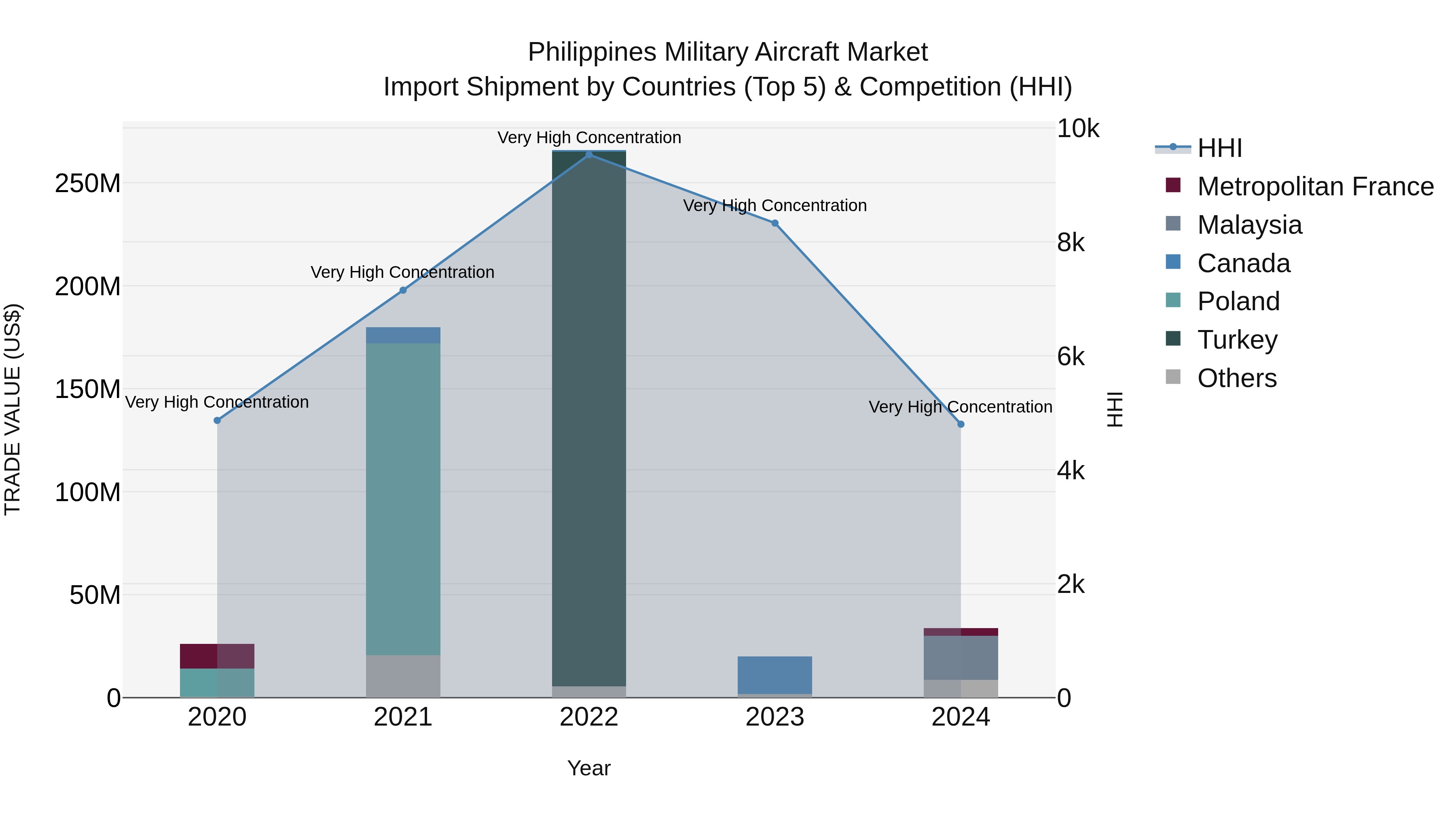
Philippines Military Aircraft Market Overview
The Philippine military aircraft market is witnessing growth as the country continues to strengthen its air defense capabilities. Procurement of fighter jets, transport aircraft, and surveillance drones is being driven by national security concerns and modernization programs. Collaborations with global defense manufacturers are contributing to market expansion. However, budget limitations and geopolitical factors may influence acquisition strategies.
Drivers of the market
The rising defense budget and efforts to strengthen air capabilities are fueling the military aircraft market in the Philippines. The procurement of advanced fighter jets, surveillance aircraft, and transport planes is enhancing national security. Additionally, partnerships with global defense manufacturers and technology transfers are supporting market expansion.
Challenges of the market
The military aircraft market in the Philippines faces procurement challenges due to high acquisition and maintenance costs. Dependence on foreign suppliers creates geopolitical risks and potential delays in deliveries. Additionally, the slow pace of modernization efforts affects the replacement of aging aircraft fleets.
Investment opportunities in the Market
The Philippine government`s focus on strengthening its air defense capabilities presents significant investment opportunities in the military aircraft sector. Investments in aircraft manufacturing, modernization of existing fleets, and supply chain development for aircraft components are promising areas. Collaborations with global defense contractors can enhance technology transfer and production efficiency.
Government Policy of the market
The procurement and modernization of military aircraft in the Philippines are governed by the AFP Modernization Act. The DND oversees acquisitions, ensuring transparency and alignment with national security objectives. Policies support the development of local aerospace manufacturing capabilities through partnerships with global defense firms. Budget allocations prioritize multi-role combat aircraft, transport planes, and surveillance systems to strengthen the country`s defense posture.
Key Highlights of the Report:
- Philippines Military Aircraft Market Outlook
- Market Size of Philippines Military Aircraft Market, 2024
- Forecast of Philippines Military Aircraft Market, 2031
- Historical Data and Forecast of Philippines Military Aircraft Revenues & Volume for the Period 2021- 2031
- Philippines Military Aircraft Market Trend Evolution
- Philippines Military Aircraft Market Drivers and Challenges
- Philippines Military Aircraft Price Trends
- Philippines Military Aircraft Porter's Five Forces
- Philippines Military Aircraft Industry Life Cycle
- Historical Data and Forecast of Philippines Military Aircraft Market Revenues & Volume By Sub Aircraft Type for the Period 2021- 2031
- Historical Data and Forecast of Philippines Military Aircraft Market Revenues & Volume By Fixed-Wing Aircraft for the Period 2021- 2031
- Historical Data and Forecast of Philippines Military Aircraft Market Revenues & Volume By Multi-Role Aircraft for the Period 2021- 2031
- Historical Data and Forecast of Philippines Military Aircraft Market Revenues & Volume By Training Aircraft for the Period 2021- 2031
- Historical Data and Forecast of Philippines Military Aircraft Market Revenues & Volume By Transport Aircraft for the Period 2021- 2031
- Historical Data and Forecast of Philippines Military Aircraft Market Revenues & Volume By Others for the Period 2021- 2031
- Philippines Military Aircraft Import Export Trade Statistics
- Market Opportunity Assessment By Sub Aircraft Type
- Philippines Military Aircraft Top Companies Market Share
- Philippines Military Aircraft Competitive Benchmarking By Technical and Operational Parameters
- Philippines Military Aircraft Company Profiles
- Philippines Military Aircraft Key Strategic Recommendations






































