Philippines Narrow Woven Fabrics Market Summary
The philippines narrow woven fabrics market was estimated at USD 395 Million in 2025 and is projected to reach USD 531 Million by 2032, growing at a CAGR of 5.4% from 2026 to 2032.
Philippines Narrow Woven Fabrics Market Year-wise Growth Rate and Key Drivers
This graph highlights how the Philippines Narrow Woven Fabrics Market has steadily grown over the past five years, supported by major growth factors.
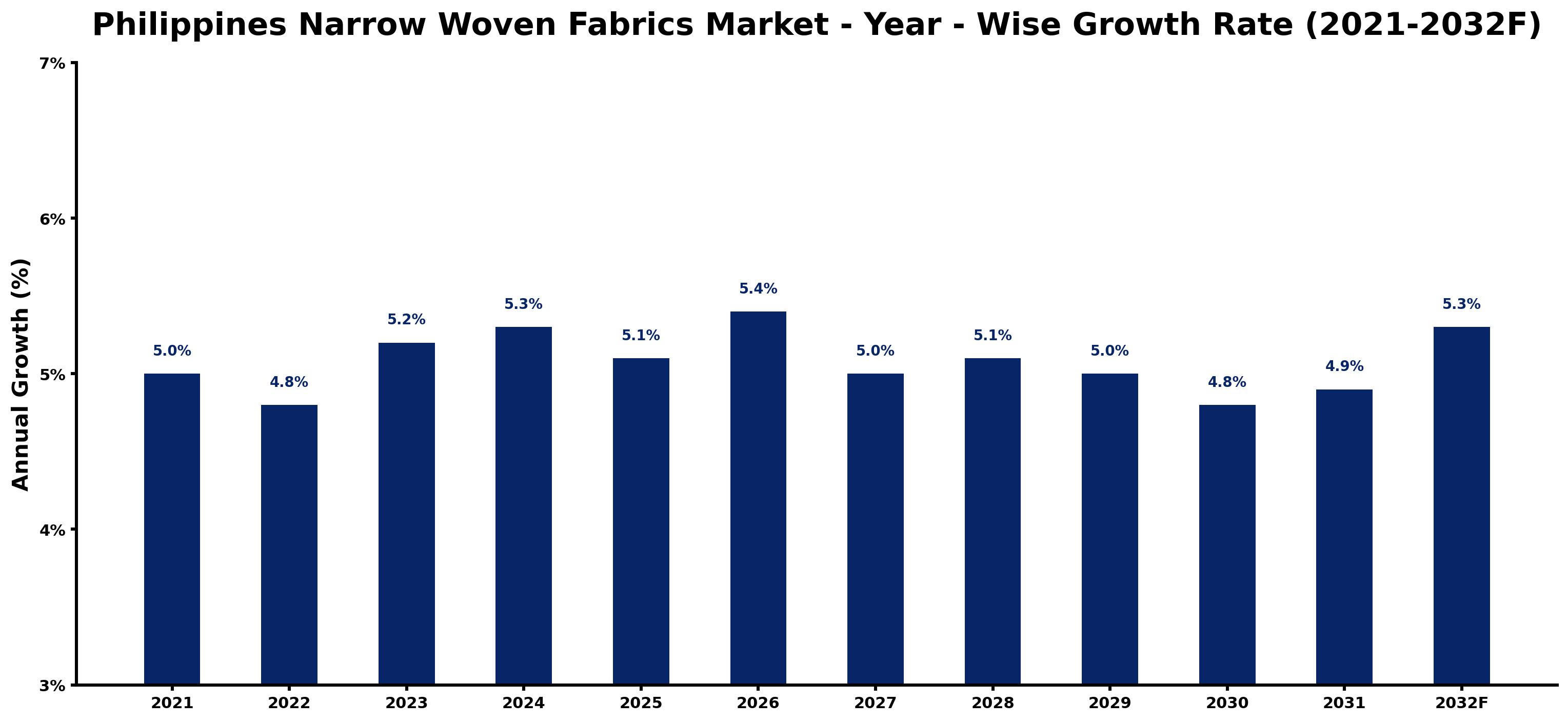
The table below presents the year wise growth rates along with the key drivers influencing the market
| Year | Growth Rate | Major Drivers |
| 2021 | 5.0% | Local artisans and manufacturers leverage traditional techniques to meet niche demands. |
| 2022 | 4.8% | E-commerce platforms expand, connecting consumers directly with local fabric producers. |
| 2023 | 5.2% | Emerging fashion brands increasingly incorporate sustainable, locally sourced materials. |
| 2024 | 5.3% | Urbanization trends drive increased interest in home textiles and decorative fabrics. |
| 2025 | 5.1% | Collaborations between designers and weavers highlight cultural heritage in fabric production. |
| 2026 | 5.4% | Technological introductions in weaving enhance efficiency and design possibilities. |
| 2027 | 5.0% | Increased consumer awareness promotes ethical sourcing and fair trade practices. |
| 2028 | 5.1% | Local government support aids small businesses in accessing larger markets. |
| 2029 | 5.0% | Trade agreements improve export opportunities for Philippine woven fabrics globally. |
| 2030 | 4.8% | Advancements in textile recycling technologies create new fabric opportunities. |
| 2031 | 4.9% | Cultural festivals celebrate traditional textiles, boosting local and tourist interest. |
| 2032 | 5.3% | Educational programs empower youth, preserving weaving skills for future generations. |
Note - Market size estimations and growth projections presented in this report are based on 6Wresearch's advanced forecasting approach, validated with industry datasets as of June 2026.
Philippines Narrow Woven Fabrics Market Synopsis
The Philippines Narrow Woven Fabrics Market is projected to reach 5.4% and witness significant growth during the forecast period (2026-2032). This growth trajectory can be attributed to several key factors within the textile and apparel sector, including the increasing demand for specialized fabrics in protective clothing and the rising popularity of eco-friendly materials in consumer preferences.
Philippines Narrow Woven Fabrics Market Growth Drivers
A key driver propelling the Philippines Narrow Woven Fabrics Market is the acute rise in demand for protective clothing. The COVID-19 pandemic has heightened awareness regarding safety measures, resulting in a marked increase in the adoption of protective garments. This shift not only diversifies the application of narrow woven fabrics but also enhances their necessity in the market.
Furthermore, the ongoing trend towards sustainable products is driving manufacturers to innovate and incorporate eco-friendly materials such as organic cotton in their offerings. This alignment with sustainability trends not only appeals to environmentally conscious consumers but also positions local manufacturers competitively in the global market.
Additionally, industrialization across the region is bolstering the demand for narrow woven fabrics. As countries like China, India, and Indonesia enhance their export capacities, they serve as key suppliers to the Philippine market, thus facilitating trade relationships that benefit local businesses.
Moreover, the increasing population in the Philippines necessitates an expansion in home furnishing applications, further stimulating the narrow woven fabrics market. This demographic trend, coupled with a growing middle class, contributes to an enhanced demand for textiles in residential sectors.
Lastly, the rising demand for customized and technical textiles in industrial applications is creating new opportunities for growth in the narrow woven fabrics segment. Industries including automotive and medical textiles are increasingly seeking specialized woven products, thus broadening the market scope.
Philippines Narrow Woven Fabrics Market Challenges and Restraints
Despite the positive outlook for the Philippines Narrow Woven Fabrics Market, several challenges could hinder progress. One significant concern is the high cost of raw materials necessary for manufacturing narrow woven fabrics. This financial burden can disproportionately affect smaller businesses, potentially compromising their profitability margins and ability to compete effectively in the marketplace.
Additionally, fluctuating prices of these raw materials can lead to uncertainty in production costs, making it difficult for manufacturers to plan and execute long-term strategies. This volatility can deter potential investors and inhibit stakeholders from making informed decisions regarding capital allocation.
Another challenge includes compliance with international quality standards and regulations. As the industry moves towards global competitiveness, local manufacturers must invest in upgrading their processes and technologies to meet these expectations, which may strain their resources.
Moreover, adapting to rapid technological advancements while maintaining product quality will pose a continuous challenge. Companies are required to stay ahead of innovations in textile manufacturing to meet evolving consumer demands, demanding both investment in new technologies and a workforce skilled in these technologies.
Finally, the ongoing impacts of global economic uncertainties can affect export volumes and local consumer spending, further complicating the operational landscape for businesses within the narrow woven fabrics sector.
Philippines Narrow Woven Fabrics Market Government Investment and Initiatives
The Philippine government has recognized the potential for the narrow woven fabrics market to contribute significantly to economic growth and is actively investing in initiatives that support the industry's development. Public spending on infrastructure improvements is aimed at enhancing supply chain efficiency, which is vital for the textile sector.
Additionally, legislation promoting sustainable practices in manufacturing processes is being implemented, encouraging local businesses to adopt eco-friendly techniques that align with global sustainability goals. This initiative helps position the Philippines as a competitive player in the international textile market while catering to the rising consumer demand for sustainable products.
The government has also launched programs aimed at providing training and development opportunities for the workforce, ensuring that local talent is equipped with the necessary skills to support technological advancements in the industry. These programs are essential for fostering innovation and maintaining high-quality standards.
Furthermore, the government is working towards establishing trade agreements that facilitate exports and enhance market accessibility for Filipino manufacturers. This effort is critical for expanding the reach of local products and increasing their competitiveness in the global marketplace.
Collaborative initiatives between the government and private sector are also being encouraged to foster research and development in textile innovations, thereby driving further growth within the narrow woven fabrics market.
Philippines Narrow Woven Fabrics Market Latest Developments (May 2025 - June 2026)
Recent developments within the Philippines Narrow Woven Fabrics Market indicate a strategic shift towards increased innovation and sustainability. Over the past year, local manufacturers have begun to embrace advanced technologies, including automation and digital textile printing, which enhance production efficiency and product customization.
There has also been a noticeable increase in partnerships between domestic companies and international firms, aimed at sharing best practices and technologies. Such collaborations are expected to bolster the quality and competitiveness of Filipino narrow woven fabrics on a global scale.
Moreover, the trend of eco-consciousness continues to shape product offerings, with numerous companies launching collections made from sustainable materials. This response to consumer demand for greener textiles will likely enhance brand loyalty and appeal to a broader market base.
In addition, the government's supportive initiatives aimed at bolstering the textile industry have resulted in increased funding opportunities for research and development projects. These initiatives focus on sustainability and advanced manufacturing processes, further contributing to the industry's evolution.
Lastly, there is a growing emphasis on the need for continuous improvement in quality control measures to meet stringent international standards, positioning Filipino manufacturers to exploit opportunities in export markets effectively.
Philippines Narrow Woven Fabrics Market - Key Attractiveness of the Report
- 10 Years of Market Numbers
- Historical Data Starting from 2022 to 2025
- Base Year: 2025
- Forecast Data until 2032
- Key Performance Indicators Impacting the Market
- Major Upcoming Developments and Projects
Q1: What are the primary drivers of growth in the Philippines Narrow Woven Fabrics Market?
Q2: What challenges does the Philippines Narrow Woven Fabrics Market face?
Q3: How is the government supporting the Philippines Narrow Woven Fabrics Market?
Q4: What recent trends should companies in the narrow woven fabrics sector focus on?
Key Highlights of the Report:
- Philippines Narrow Woven Fabrics Market Outlook
- Market Size of Philippines Narrow Woven Fabrics Market, 2025
- Forecast of Philippines Narrow Woven Fabrics Market, 2032
- Historical Data and Forecast of Philippines Narrow Woven Fabrics Revenues & Volume for the Period 2022-2032F
- Philippines Narrow Woven Fabrics Market Trend Evolution
- Philippines Narrow Woven Fabrics Market Drivers and Challenges
- Philippines Narrow Woven Fabrics Price Trends
- Philippines Narrow Woven Fabrics Porter's Five Forces
- Philippines Narrow Woven Fabrics Industry Life Cycle
- Historical Data and Forecast of Philippines Narrow Woven Fabrics Market Revenues & Volume By Type for the Period 2022-2032F
- Historical Data and Forecast of Philippines Narrow Woven Fabrics Market Revenues & Volume By Polyester for the Period 2022-2032F
- Historical Data and Forecast of Philippines Narrow Woven Fabrics Market Revenues & Volume By Nylon for the Period 2022-2032F
- Historical Data and Forecast of Philippines Narrow Woven Fabrics Market Revenues & Volume By PP for the Period 2022-2032F
- Historical Data and Forecast of Philippines Narrow Woven Fabrics Market Revenues & Volume By Applications for the Period 2022-2032F
- Historical Data and Forecast of Philippines Narrow Woven Fabrics Market Revenues & Volume By Garments for the Period 2022-2032F
- Historical Data and Forecast of Philippines Narrow Woven Fabrics Market Revenues & Volume By Home Furnishing for the Period 2022-2032F
- Historical Data and Forecast of Philippines Narrow Woven Fabrics Market Revenues & Volume By Other for the Period 2022-2032F
- Philippines Narrow Woven Fabrics Import Export Trade Statistics
- Market Opportunity Assessment By Type
- Market Opportunity Assessment By Applications
- Philippines Narrow Woven Fabrics Top Companies Market Share
- Philippines Narrow Woven Fabrics Competitive Benchmarking By Technical and Operational Parameters
- Philippines Narrow Woven Fabrics Company Profiles
- Philippines Narrow Woven Fabrics Key Strategic Recommendations






































