Philippines Non-ferrous Metal Market Summary
The philippines non-ferrous metal market was estimated at USD 125 Million in 2025 and is projected to reach USD 137 Million by 2032, growing at a CAGR of 1.4% from 2026 to 2032.
Philippines Non-ferrous Metal Market Year-wise Growth Rate and Key Drivers
This graph highlights how the Philippines Non-ferrous Metal Market has steadily grown over the past five years, supported by major growth factors.
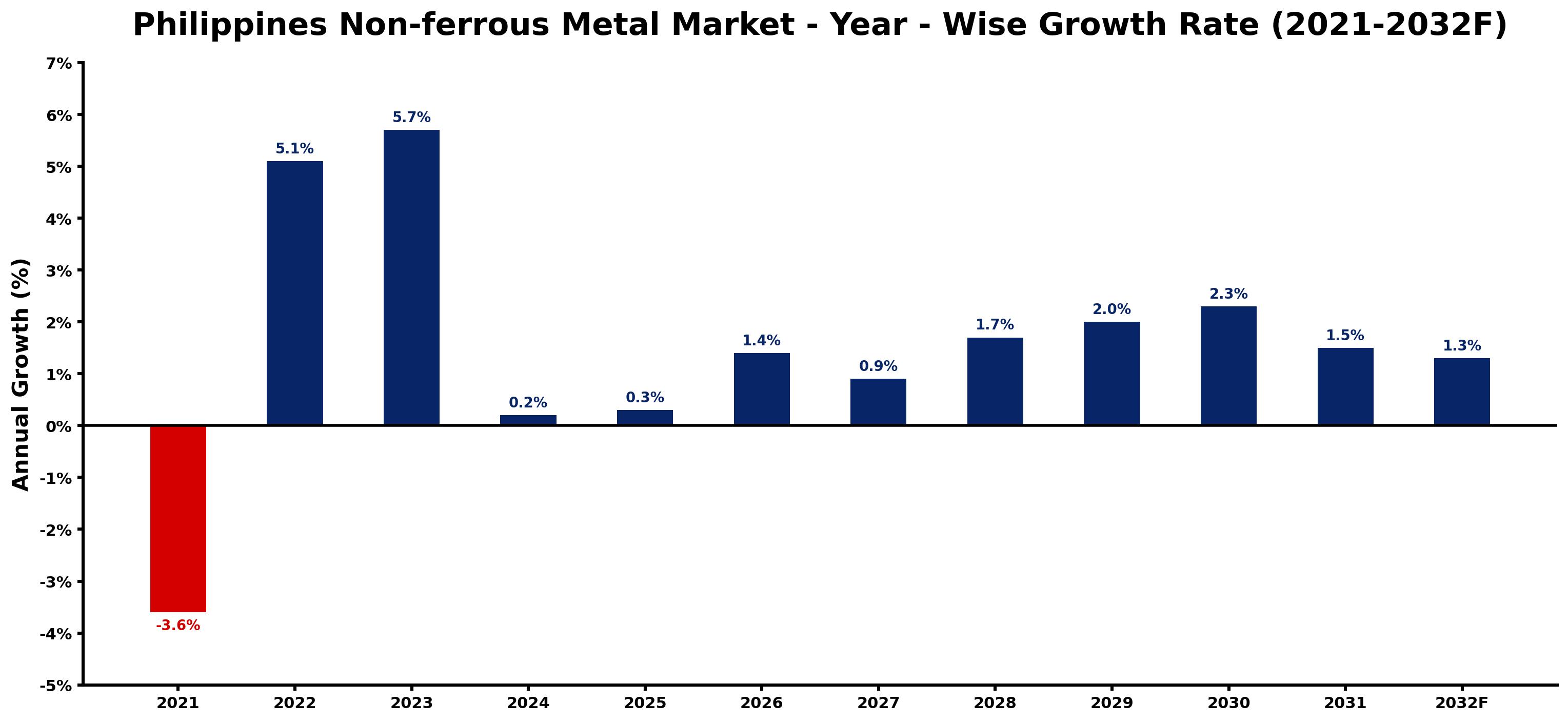
The table below presents the year wise growth rates along with the key drivers influencing the market
| Year | Growth Rate | Major Drivers |
| 2021 | -3.6% | Supply chain disruptions and elevated transportation costs significantly hindered metal distribution, impacting overall market performance. |
| 2022 | 5.1% | Construction sector expanded significantly, utilizing more aluminum and copper in urban development. |
| 2023 | 5.7% | Automotive industry's electric vehicle shift increased the need for lightweight metal components. |
| 2024 | 0.2% | Technological upgrades in manufacturing processes prompted higher consumption of refined metals. |
| 2025 | 0.3% | Global supply chain disruptions highlighted the importance of local non-ferrous metal sourcing. |
| 2026 | 1.4% | Investment in renewable energy projects created additional demand for copper and aluminum wiring. |
| 2027 | 0.9% | Rising consumer electronics production led to a surge in demand for high-quality metals. |
| 2028 | 1.7% | Urbanization trends continued, requiring stronger materials for residential and commercial buildings. |
| 2029 | 2.0% | Emerging electric mobility solutions validated the strategic importance of non-ferrous metal supply chains. |
| 2030 | 2.3% | Research innovations resulted in new alloys, broadening application scopes across various sectors. |
| 2031 | 1.5% | Increased recycling efforts improved the circular economy, enhancing metal availability for projects. |
| 2032 | 1.3% | Sustainability initiatives drove demand for responsibly sourced non-ferrous metals across industries. |
Note - Market size estimations and growth projections presented in this report are based on 6Wresearch's advanced forecasting approach, validated with industry datasets as of June 2026.
Philippines Non-ferrous Metal Market Synopsis
The Philippines Non-ferrous Metal Market is projected to reach 1.4% and witness significant growth during the forecast period (2026-2032). The increasing demand for non-ferrous materials, particularly copper and aluminum, across various industries is expected to be a major driver for market expansion. Alongside, foreign investments aimed at enhancing industrial capabilities and technological advancements are creating a robust environment for market growth. Urbanization, coupled with a rising population, has further amplified the need for electronic devices such as smartphones and laptops, consequently increasing the requirement for non-ferrous metals like zinc and nickel.
Philippines Non-ferrous Metal Market Growth Drivers
Several factors contribute to the positive outlook of the Philippines Non-ferrous Metal Market. Among these include:
- The escalation of industrial activities, particularly in construction and manufacturing sectors, is significantly elevating the demand for non-ferrous metals.
- A surge in renewable energy projects, especially solar and wind energy, is driving the need for metals that play a critical role in electric and electronic applications.
- The growth of electric vehicles (EVs) is creating a niche market for lightweight and conductive materials, thus propelling metal demand.
- Increased awareness regarding the sustainability and recyclability of non-ferrous metals is encouraging a more extensive usage in various applications.
- Technological innovations in metal extraction and processing are enhancing efficiency, thus supporting market growth.
Philippines Non-ferrous Metal Market Investment Opportunities
Investment opportunities in the Philippines Non-ferrous Metal Market are myriad, driven by both local and foreign entities. The following factors signify the potential for investment:
- Government initiatives aimed at improving mining regulations and infrastructure are likely to create an investor-friendly environment.
- The ongoing urban development projects necessitate a substantial input of non-ferrous metal, offering opportunities for suppliers and manufacturers.
- The burgeoning electronics market in the Philippines presents prospects for local manufacturing of components that require non-ferrous metals.
- Investment in recycling plants for non-ferrous metals can address the increasing demand for sustainable sources, which holds significant growth potential.
- Collaborations with technology firms to innovate applications for non-ferrous metals can lead to new market segments and revenue streams.
Philippines Non-ferrous Metal Market Challenges and Restraints
Despite its growth potential, the Philippines Non-ferrous Metal Market faces challenges that could hinder its development. These include:
- Supply chain disruptions, exacerbated by the COVID-19 pandemic, have led to increased costs and reduced availability of raw materials.
- Stringent environmental regulations aimed at promoting sustainability may pose challenges for existing mining operations.
- Market volatility, influenced by fluctuations in global metal prices, can affect profitability and investment decisions.
- Labor issues, stemming from strikes and demands for better working conditions, can disrupt production and supply chains.
- The lack of advanced technological infrastructure in certain segments of the industry limits efficiency and productivity.
Philippines Non-ferrous Metal Market Government Investment and Initiatives
The government of the Philippines has been proactive in fostering growth within the Non-ferrous Metal Market through various initiatives and policy frameworks. Key initiatives include:
- Investment in mining infrastructure aimed at enhancing extraction and transportation efficiency of non-ferrous metals.
- Support for sustainable mining practices that align with international environmental standards, encouraging responsible sourcing.
- Promotion of foreign direct investment in the mining sector through tax incentives and streamlined regulatory processes.
- Collaboration with international organizations to improve technological capabilities and workforce skills in the mining sector.
- Development of trade agreements that facilitate the export of non-ferrous metals, thus enhancing the Philippines' position in global markets.
Philippines Non-ferrous Metal Market Latest Developments (May 2025 - June 2026)
Recent developments in the Philippines Non-ferrous Metal Market between May 2025 and June 2026 have underscored a trend towards modernization and innovation. Key developments include:
- Increased collaborations between the public and private sectors aiming to boost the domestic production of non-ferrous metals.
- Implementation of new technological solutions in mining operations that enhance efficiency while minimizing environmental impact.
- Growth in local manufacturing of electronics, subsequently increasing demand for non-ferrous metals such as aluminum and copper.
- Advancements in recycling technologies have started to reshape the landscape by providing sustainable sourcing for raw materials.
- Renewed focus on trade relations, with several agreements aimed at enhancing market access for Philippine non-ferrous metals.
Philippines Non-ferrous Metal Market - Key Attractiveness of the Report
- 10 Years of Market Numbers
- Historical Data Starting from 2022 to 2025
- Base Year: 2025
- Forecast Data until 2032
- Key Performance Indicators Impacting the Market
- Major Upcoming Developments and Projects
Key Highlights of the Report:
- Philippines Non-ferrous Metal Market Outlook
- Market Size of Philippines Non-ferrous Metal Market, 2025
- Forecast of Philippines Non-ferrous Metal Market, 2032F
- Historical Data and Forecast of Philippines Non-ferrous Metal Revenues & Volume for the Period 2022-2032F
- Philippines Non-ferrous Metal Market Trend Evolution
- Philippines Non-ferrous Metal Market Drivers and Challenges
- Philippines Non-ferrous Metal Price Trends
- Philippines Non-ferrous Metal Porter's Five Forces
- Philippines Non-ferrous Metal Industry Life Cycle
- Historical Data and Forecast of Philippines Non-ferrous Metal Market Revenues & Volume By Types for the Period 2022-2032F
- Historical Data and Forecast of Philippines Non-ferrous Metal Market Revenues & Volume By Aluminum for the Period 2022-2032F
- Historical Data and Forecast of Philippines Non-ferrous Metal Market Revenues & Volume By Copper for the Period 2022-2032F
- Historical Data and Forecast of Philippines Non-ferrous Metal Market Revenues & Volume By Lead for the Period 2022-2032F
- Historical Data and Forecast of Philippines Non-ferrous Metal Market Revenues & Volume By Tin for the Period 2022-2032F
- Historical Data and Forecast of Philippines Non-ferrous Metal Market Revenues & Volume By Nickel for the Period 2022-2032F
- Historical Data and Forecast of Philippines Non-ferrous Metal Market Revenues & Volume By Titanium for the Period 2022-2032F
- Historical Data and Forecast of Philippines Non-ferrous Metal Market Revenues & Volume By Zinc for the Period 2022-2032F
- Historical Data and Forecast of Philippines Non-ferrous Metal Market Revenues & Volume By Applications for the Period 2022-2032F
- Historical Data and Forecast of Philippines Non-ferrous Metal Market Revenues & Volume By Automobile Industry for the Period 2022-2032F
- Historical Data and Forecast of Philippines Non-ferrous Metal Market Revenues & Volume By Electronic Power Industry for the Period 2022-2032F
- Historical Data and Forecast of Philippines Non-ferrous Metal Market Revenues & Volume By Construction Industry for the Period 2022-2032F
- Historical Data and Forecast of Philippines Non-ferrous Metal Market Revenues & Volume By Other for the Period 2022-2032F
- Philippines Non-ferrous Metal Import Export Trade Statistics
- Market Opportunity Assessment By Types
- Market Opportunity Assessment By Applications
- Philippines Non-ferrous Metal Top Companies Market Share
- Philippines Non-ferrous Metal Competitive Benchmarking By Technical and Operational Parameters
- Philippines Non-ferrous Metal Company Profiles
- Philippines Non-ferrous Metal Key Strategic Recommendations






































