Philippines Oil & Gas Pumps Market Size, Share & Growth Rate
The Philippines Oil & Gas Pumps Market was estimated at USD 366 Million in 2025 and is projected to reach USD 514 Million by 2032, growing at a CAGR of 5.0% from 2026 to 2032. This growth trajectory is primarily driven by the nation's escalating energy demands alongside increased exploration activities. As the Philippines strives to bolster its energy self-sufficiency, the necessity for advanced pump technologies in oil and gas extraction, transportation, and refining is becoming increasingly critical.
Philippines Oil & Gas Pumps Market Year-wise Growth Rate and Key Drivers
This graph highlights how the Philippines Oil & Gas Pumps Market has steadily grown over the years, supported by major growth factors.
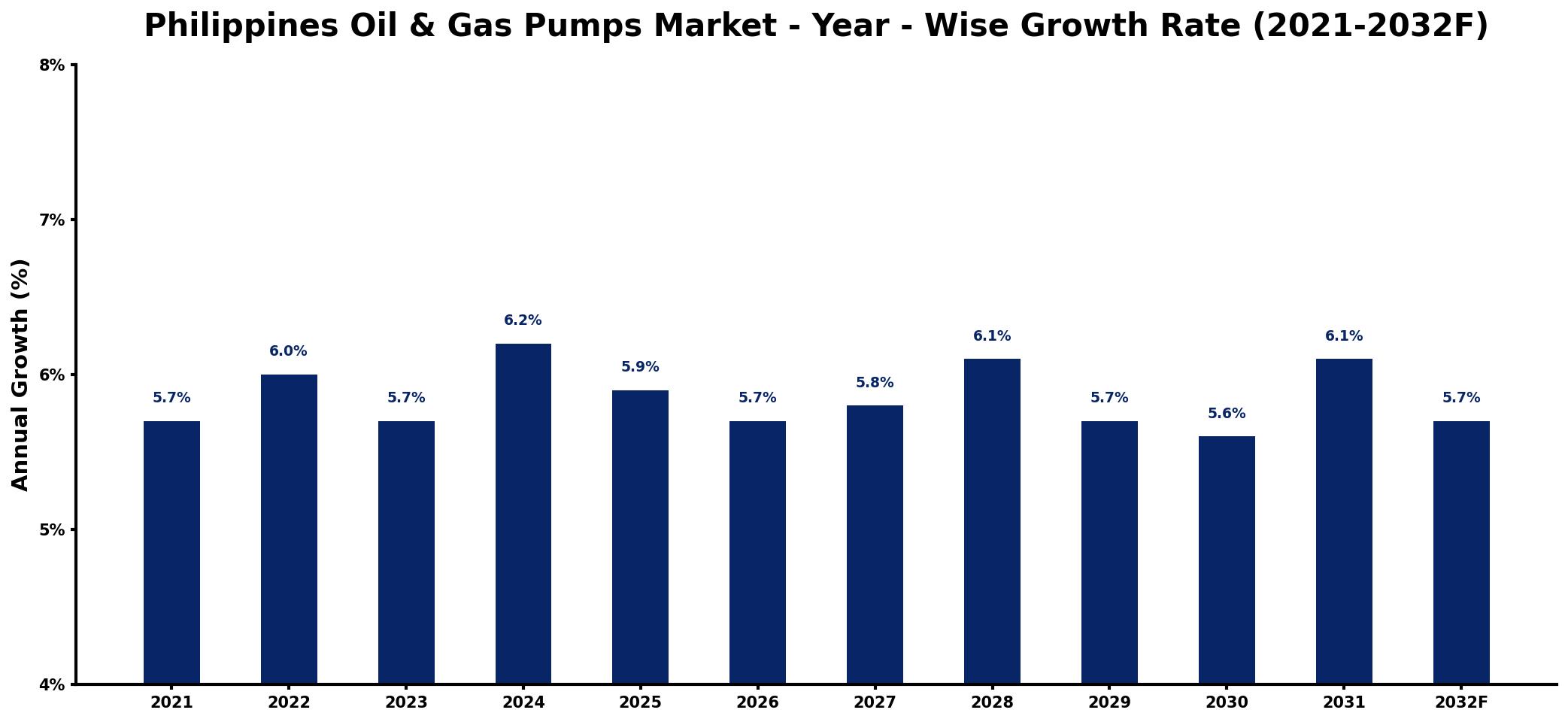
The table below presents the year‑wise growth rates along with the key drivers influencing the market
| Year | Growth Rate | Major Drivers |
| 2021 | 5.7% | Rising industrial infrastructure projects |
| 2022 | 6.0% | Increased energy sector investments |
| 2023 | 5.7% | Growing demand for transportation |
| 2024 | 6.2% | Expansion of renewable energy initiatives |
| 2025 | 5.9% | Boost in construction activities |
| 2026 | 5.7% | Surge in energy efficiency regulations |
| 2027 | 5.8% | Development of urban transportation systems |
| 2028 | 6.1% | Growth in export markets expansion |
| 2029 | 5.7% | Investments in technology advancements |
| 2030 | 5.6% | Increased focus on sustainability practices |
| 2031 | 6.1% | Rising consumer energy awareness |
| 2032 | 5.7% | Emerging markets demand growth |
Note: Market size estimations and growth projections presented in this report are based on 6Wresearch's proprietary forecasting methodology, utilizing the latest available industry data, government publications, and primary research inputs.
Philippines Oil & Gas Pumps Market Synopsis
Currently, technological advancements stand as the strongest force shaping the Philippines Oil & Gas Pumps Market. As operators look to enhance efficiency and reliability in their operations, innovative pump solutions have emerged as vital components in the drive toward modernization. This demand for state-of-the-art pump systems is further fueled by the government's push for increased domestic energy production.
In this evolving landscape, the oil and gas pumps market serves as a cornerstone of the overall energy sector. With infrastructure development progressing steadily, there is a noticeable uptick in the requirement for robust pumping solutions tailored for various applications, including drilling, extraction, and distribution. The interplay of demand growth and technological evolution is expected to continue shaping market dynamics in the coming years.
- Significant market growth driven by rising domestic energy needs.
- Technological advancements enhance pump efficiency and reliability.
- Infrastructure development is pivotal for increasing demand.
- Regulatory frameworks influence market compliance and safety standards.
- Adaptation to emerging applications ensures market resilience.
The Philippines Oil & Gas Pumps Market faces several restraints that can hinder its growth potential. Among these, fluctuations in global oil prices present a significant challenge, often leading to unstable investment patterns within the sector. Additionally, the requirement for advanced pump technologies capable of operating under various conditions remains a crucial consideration, as not all existing equipment can meet these rigorous demands. Furthermore, maintaining compliance with stringent quality and safety standards adds layers of complexity to operations in this competitive market.
Emerging trends in the Philippines Oil & Gas Pumps Market highlight a strong emphasis on sustainability and energy efficiency. Operators are increasingly adopting smart pump technologies that integrate IoT capabilities for real-time monitoring and performance optimization. This shift not only enhances operational efficiency but also aligns with global sustainability goals. Additionally, there is a growing trend toward diversifying applications, with pump systems being repurposed for wastewater management and other industrial processes, creating further market opportunities.
The current landscape offers promising growth and investment opportunities in the Philippines Oil & Gas Pumps Market. As government initiatives aim to bolster local energy production, there is a clear opening for companies that can provide efficient and reliable pumping solutions. Investment in infrastructure development, particularly in underserved regions, presents further avenues for growth. Furthermore, tapping into emerging sectors, such as renewable energy and industrial automation, positions businesses to leverage a multifaceted market approach.
The government of the Philippines has implemented various initiatives aimed at boosting the oil and gas sector, including public investments in energy infrastructure and policies to encourage exploration and production. These initiatives emphasize the importance of enhancing domestic energy supply while ensuring compliance with environmental standards. Such policies provide incentives for both local and foreign investments, thereby fostering a competitive environment conducive to the growth of the oil and gas pumps market.
Looking ahead to the 2026-2032 period, the Philippines Oil & Gas Pumps Market is poised for sustained growth. The persistent demand for energy, coupled with continued investment in infrastructure, will drive the need for advanced pumping solutions. Moreover, the integration of innovative technologies will likely enhance operational efficiencies and expand application areas, thereby reinforcing the sector's resilience. This forward momentum is expected to create a robust environment for market participants, fostering ongoing innovation and collaboration.
Recent industry movements indicate a shift towards modernization and diversification within the Philippines Oil & Gas Pumps Market. Several companies are exploring partnerships aimed at enhancing technological capabilities and expanding product offerings. There is also an evident trend toward investing in localized manufacturing to mitigate supply chain disruptions. Such developments reflect a responsive approach to market dynamics and emerging challenges, ensuring that the sector remains adaptable in a rapidly changing environment.
- 10 Years of Market Numbers
- Historical Data Starting from 2022 to 2025
- Base Year: 2025
- Forecast Data until 2032
- Key Performance Indicators Impacting the Market
- Major Upcoming Developments and Projects
Key Highlights of the Report:
- Philippines Oil & Gas Pumps Market Outlook
- Market Size of Philippines Oil & Gas Pumps Market, 2025
- Forecast of Philippines Oil & Gas Pumps Market, 2032
- Historical Data and Forecast of Philippines Oil & Gas Pumps Revenues & Volume for the Period 2022-2032F
- Philippines Oil & Gas Pumps Market Trend Evolution
- Philippines Oil & Gas Pumps Market Drivers and Challenges
- Philippines Oil & Gas Pumps Price Trends
- Philippines Oil & Gas Pumps Porter's Five Forces
- Philippines Oil & Gas Pumps Industry Life Cycle
- Historical Data and Forecast of Philippines Oil & Gas Pumps Market Revenues & Volume By Type for the Period 2022-2032F
- Historical Data and Forecast of Philippines Oil & Gas Pumps Market Revenues & Volume By Submersible Pumps for the Period 2022-2032F
- Historical Data and Forecast of Philippines Oil & Gas Pumps Market Revenues & Volume By Non-submersible Pumps for the Period 2022-2032F
- Historical Data and Forecast of Philippines Oil & Gas Pumps Market Revenues & Volume By Pump Type for the Period 2022-2032F
- Historical Data and Forecast of Philippines Oil & Gas Pumps Market Revenues & Volume By Centrifugal Pump for the Period 2022-2032F
- Historical Data and Forecast of Philippines Oil & Gas Pumps Market Revenues & Volume By Positive Displacement Pump for the Period 2022-2032F
- Historical Data and Forecast of Philippines Oil & Gas Pumps Market Revenues & Volume By Cryogenic Pump for the Period 2022-2032F
- Historical Data and Forecast of Philippines Oil & Gas Pumps Market Revenues & Volume By Application for the Period 2022-2032F
- Historical Data and Forecast of Philippines Oil & Gas Pumps Market Revenues & Volume By Upstream for the Period 2022-2032F
- Historical Data and Forecast of Philippines Oil & Gas Pumps Market Revenues & Volume By Midstream for the Period 2022-2032F
- Historical Data and Forecast of Philippines Oil & Gas Pumps Market Revenues & Volume By Downstream for the Period 2022-2032F
- Philippines Oil & Gas Pumps Import Export Trade Statistics
- Market Opportunity Assessment By Type
- Market Opportunity Assessment By Pump Type
- Market Opportunity Assessment By Application
- Philippines Oil & Gas Pumps Top Companies Market Share
- Philippines Oil & Gas Pumps Competitive Benchmarking By Technical and Operational Parameters
- Philippines Oil & Gas Pumps Company Profiles
- Philippines Oil & Gas Pumps Key Strategic Recommendations






































