Philippines Refrigeration and Heating Equipment Market Summary
The philippines refrigeration and heating equipment market was estimated at USD 472 Million in 2025 and is projected to reach USD 616 Million by 2032, growing at a CAGR of 4.6% from 2026 to 2032.
Philippines Refrigeration and Heating Equipment Market Year-wise Growth Rate and Key Drivers
This graph highlights how the Philippines Refrigeration and Heating Equipment Market has steadily grown over the past five years, supported by major growth factors.
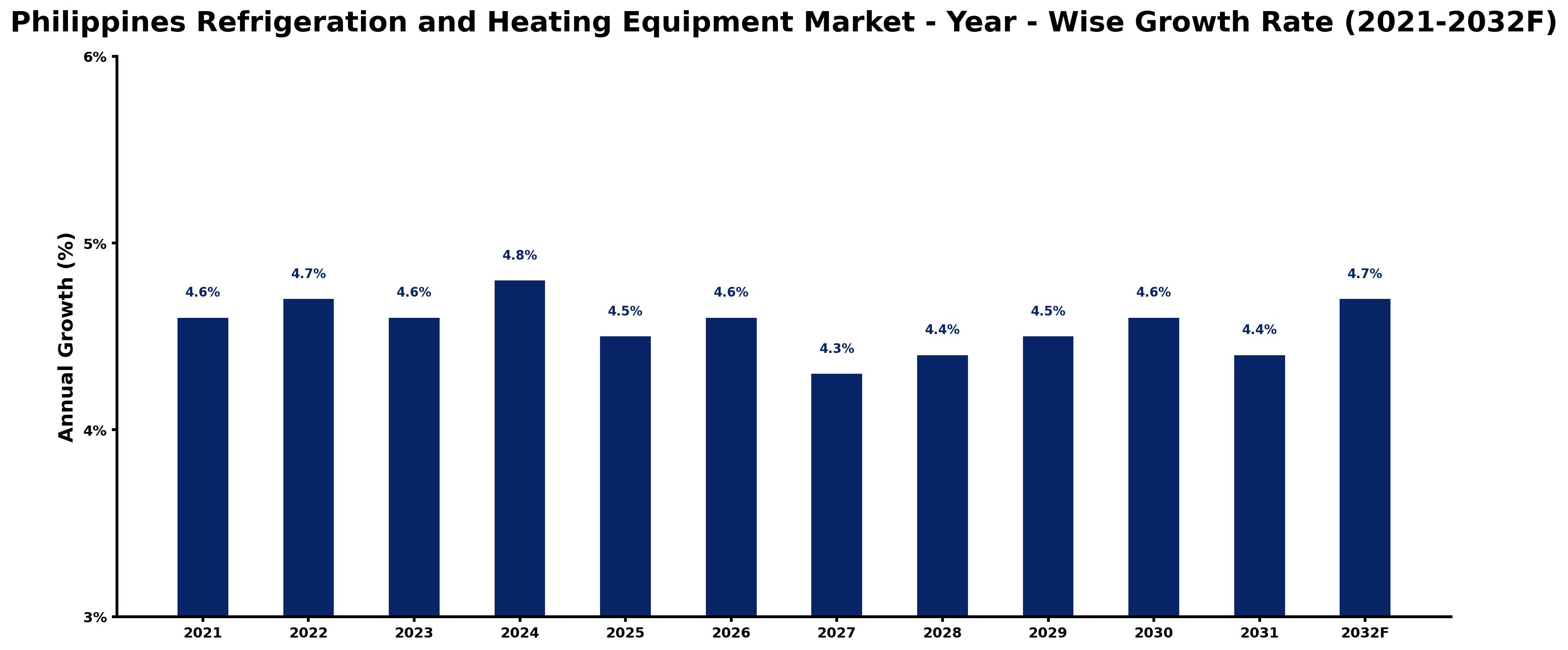
The table below presents the year wise growth rates along with the key drivers influencing the market
| Year | Growth Rate | Major Drivers |
| 2021 | 4.6% | Post-lockdown retail projects sparked a demand for efficient refrigeration solutions. |
| 2022 | 4.7% | Increased urbanization led to more commercial establishments requiring advanced heating systems. |
| 2023 | 4.6% | Technological advancements in energy-efficient equipment attracted both residential and business sectors. |
| 2024 | 4.8% | Intensified competition among local manufacturers fostered innovation and reduced equipment costs. |
| 2025 | 4.5% | Rising temperatures in urban areas influenced the need for reliable cooling systems. |
| 2026 | 4.6% | Corporate sustainability goals motivated investments in eco-friendly refrigeration technologies. |
| 2027 | 4.3% | Expansion of the food and beverage industry drove demand for robust cold storage solutions. |
| 2028 | 4.4% | Rural electrification projects enhanced access to heating and cooling in remote locations. |
| 2029 | 4.5% | Consumer awareness regarding energy efficiency shaped preferences for modern heating equipment. |
| 2030 | 4.6% | Integration of smart technology in appliances created new market opportunities for manufacturers. |
| 2031 | 4.4% | E-commerce growth required efficient logistics solutions, emphasizing refrigeration in transportation. |
| 2032 | 4.7% | Climate adaptation strategies necessitated upgrades in existing heating infrastructure across sectors. |
Note - Market size estimations and growth projections presented in this report are based on 6Wresearch's advanced forecasting approach, validated with industry datasets as of June 2026.
Philippines Refrigeration and Heating Equipment Market Synopsis
The Philippines Refrigeration and Heating Equipment Market is projected to reach 4.6% and witness significant growth during the forecast period (2026-2032). This growth is attributed to several factors, including rising disposable incomes, an increasing population, and a favorable economic environment that encourages investment in luxury goods such as refrigeration and heating equipment. The booming hospitality sector, bolstered by the influx of foreign tourists, further accelerates demand for efficient refrigeration and heating solutions. Additionally, government initiatives aimed at reducing energy consumption are expected to drive innovation and expansion within this market.
Philippines Refrigeration and Heating Equipment Market Growth Drivers
Several key drivers are propelling the growth of the Philippines refrigeration and heating equipment market:
- The rise in disposable income across various demographics enables consumers to invest in high-quality air conditioning and heating systems, stimulating demand for advanced refrigeration solutions.
- Population growth in urban areas, particularly in cities like Manila and Cebu, drives the need for efficient cooling and heating systems in both residential and commercial properties.
- The increasing demand for packaged food products necessitates reliable refrigeration systems to ensure food safety and quality throughout the supply chain.
- Investment in the hospitality sector continues to expand with new hotels, restaurants, and leisure facilities, further fueling demand for advanced heating and refrigeration equipment.
- The shift towards energy-efficient technologies, such as inverter-type air conditioners, is becoming a standard preference among consumers, enhancing market growth.
Philippines Refrigeration and Heating Equipment Market Key Trends
Several trends are emerging within the Philippines refrigeration and heating equipment market that warrant attention:
- Increased adoption of inverter technology in air conditioning units allows for substantial energy savings, appealing to environmentally conscious consumers while minimizing operational costs.
- The popularity of smart home technologies is on the rise, as consumers increasingly integrate connected devices, such as smart thermostats and HVAC systems, into their living spaces.
- Innovations in compressor technology, particularly the development of high-performance models, are opening new avenues for specialized equipment catering to sectors like cold storage and culinary applications in large establishments.
- Consumers are seeking products that offer long warranty periods and robust support, as reliability and after-sales service remain significant purchasing factors.
- Heightened awareness regarding sustainable practices is prompting manufacturers to enhance the energy efficiency of their products to align with consumer preferences and regulatory requirements.
Philippines Refrigeration and Heating Equipment Market Government Investment and Initiatives
The Philippine government has undertaken various initiatives aimed at boosting the refrigeration and heating equipment market:
- Initiatives to improve energy efficiency standards across all industry sectors encourage manufacturers to innovate and invest in energy-efficient technologies and equipment.
- Public spending on infrastructure development creates opportunities for refrigeration and heating equipment manufacturers, particularly in the food and hospitality sectors.
- The government is actively promoting investment through incentives and subsidies, particularly for businesses that adopt energy-saving technologies.
- Regulatory frameworks are being implemented to ensure that refrigeration and heating equipment adheres to international energy efficiency standards.
- Support programs for small and medium enterprises (SMEs) in the refrigeration sector have been established, fostering growth and encouraging local production capabilities.
Philippines Refrigeration and Heating Equipment Market Latest Developments (May 2025 - June 2026)
Recent developments indicate a dynamic shift within the Philippines refrigeration and heating equipment market:
- Innovations in heat pump technology have gained traction, with increased research and development efforts focused on improving efficiency and reducing environmental impact.
- Public awareness campaigns highlighting the importance of energy efficiency are becoming more prevalent, influencing consumer purchasing decisions in favor of advanced refrigeration and heating solutions.
- Collaborations between local manufacturers and international technology firms have emerged, leading to the introduction of cutting-edge products tailored for the Philippine market.
- The hospitality sector's recovery post-pandemic has spurred investment in new equipment, with establishments upgrading to meet modern consumer expectations and sustainability goals.
- Regulatory changes aimed at further promoting energy-efficient appliances have begun to take effect, impacting market offerings and consumer choices.
Philippines Refrigeration and Heating Equipment Market - Key Attractiveness of the Report
- 10 Years of Market Numbers
- Historical Data Starting from 2022 to 2025
- Base Year: 2025
- Forecast Data until 2032
- Key Performance Indicators Impacting the Market
- Major Upcoming Developments and Projects
Key Highlights of the Report:
- Philippines Refrigeration and Heating Equipment Market Outlook
- Market Size of Philippines Refrigeration and Heating Equipment Market, 2025
- Forecast of Philippines Refrigeration and Heating Equipment Market, 2032
- Historical Data and Forecast of Philippines Refrigeration and Heating Equipment Revenues & Volume for the Period 2022-2032F
- Philippines Refrigeration and Heating Equipment Market Trend Evolution
- Philippines Refrigeration and Heating Equipment Market Drivers and Challenges
- Philippines Refrigeration and Heating Equipment Price Trends
- Philippines Refrigeration and Heating Equipment Porter's Five Forces
- Philippines Refrigeration and Heating Equipment Industry Life Cycle
- Historical Data and Forecast of Philippines Refrigeration and Heating Equipment Market Revenues & Volume By Heating equipments for the Period 2022-2032F
- Historical Data and Forecast of Philippines Refrigeration and Heating Equipment Market Revenues & Volume By Heating Pumps for the Period 2022-2032F
- Historical Data and Forecast of Philippines Refrigeration and Heating Equipment Market Revenues & Volume By Furnaces for the Period 2022-2032F
- Historical Data and Forecast of Philippines Refrigeration and Heating Equipment Market Revenues & Volume By Boilers for the Period 2022-2032F
- Historical Data and Forecast of Philippines Refrigeration and Heating Equipment Market Revenues & Volume By Space heaters for the Period 2022-2032F
- Historical Data and Forecast of Philippines Refrigeration and Heating Equipment Market Revenues & Volume By Unitary heaters for the Period 2022-2032F
- Historical Data and Forecast of Philippines Refrigeration and Heating Equipment Market Revenues & Volume By Others for the Period 2022-2032F
- Historical Data and Forecast of Philippines Refrigeration and Heating Equipment Market Revenues & Volume By Cooling Equipments for the Period 2022-2032F
- Historical Data and Forecast of Philippines Refrigeration and Heating Equipment Market Revenues & Volume By Cooling towers for the Period 2022-2032F
- Historical Data and Forecast of Philippines Refrigeration and Heating Equipment Market Revenues & Volume By Chillers for the Period 2022-2032F
- Historical Data and Forecast of Philippines Refrigeration and Heating Equipment Market Revenues & Volume By Coolers for the Period 2022-2032F
- Historical Data and Forecast of Philippines Refrigeration and Heating Equipment Market Revenues & Volume By Air conditioners for the Period 2022-2032F
- Historical Data and Forecast of Philippines Refrigeration and Heating Equipment Market Revenues & Volume By Others for the Period 2022-2032F
- Historical Data and Forecast of Philippines Refrigeration and Heating Equipment Market Revenues & Volume By General Components for the Period 2022-2032F
- Historical Data and Forecast of Philippines Refrigeration and Heating Equipment Market Revenues & Volume By Condensers for the Period 2022-2032F
- Historical Data and Forecast of Philippines Refrigeration and Heating Equipment Market Revenues & Volume By Compressors for the Period 2022-2032F
- Historical Data and Forecast of Philippines Refrigeration and Heating Equipment Market Revenues & Volume By Radiators for the Period 2022-2032F
- Historical Data and Forecast of Philippines Refrigeration and Heating Equipment Market Revenues & Volume By Sensors for the Period 2022-2032F
- Historical Data and Forecast of Philippines Refrigeration and Heating Equipment Market Revenues & Volume By Transducers for the Period 2022-2032F
- Historical Data and Forecast of Philippines Refrigeration and Heating Equipment Market Revenues & Volume By Others for the Period 2022-2032F
- Historical Data and Forecast of Philippines Refrigeration and Heating Equipment Market Revenues & Volume By End-User Industries for the Period 2022-2032F
- Historical Data and Forecast of Philippines Refrigeration and Heating Equipment Market Revenues & Volume By Residential for the Period 2022-2032F
- Historical Data and Forecast of Philippines Refrigeration and Heating Equipment Market Revenues & Volume By Commercial for the Period 2022-2032F
- Historical Data and Forecast of Philippines Refrigeration and Heating Equipment Market Revenues & Volume By Healthcare Industry for the Period 2022-2032F
- Historical Data and Forecast of Philippines Refrigeration and Heating Equipment Market Revenues & Volume By Educational and government institutions for the Period 2022-2032F
- Historical Data and Forecast of Philippines Refrigeration and Heating Equipment Market Revenues & Volume By Others for the Period 2022-2032F
- Philippines Refrigeration and Heating Equipment Import Export Trade Statistics
- Market Opportunity Assessment By Heating equipments
- Market Opportunity Assessment By Cooling Equipments
- Market Opportunity Assessment By General Components
- Market Opportunity Assessment By End-User Industries
- Philippines Refrigeration and Heating Equipment Top Companies Market Share
- Philippines Refrigeration and Heating Equipment Competitive Benchmarking By Technical and Operational Parameters
- Philippines Refrigeration and Heating Equipment Company Profiles
- Philippines Refrigeration and Heating Equipment Key Strategic Recommendations






































