Philippines Semiconductors and Related Devices Market Summary
The philippines semiconductors and related devices market was estimated at USD 1026 Million in 2025 and is projected to reach USD 1908 Million by 2032, growing at a CAGR of 10.7% from 2026 to 2032.
Philippines Semiconductors and Related Devices Market Year-wise Growth Rate and Key Drivers
This graph highlights how the Philippines Semiconductors and Related Devices Market has steadily grown over the past five years, supported by major growth factors.
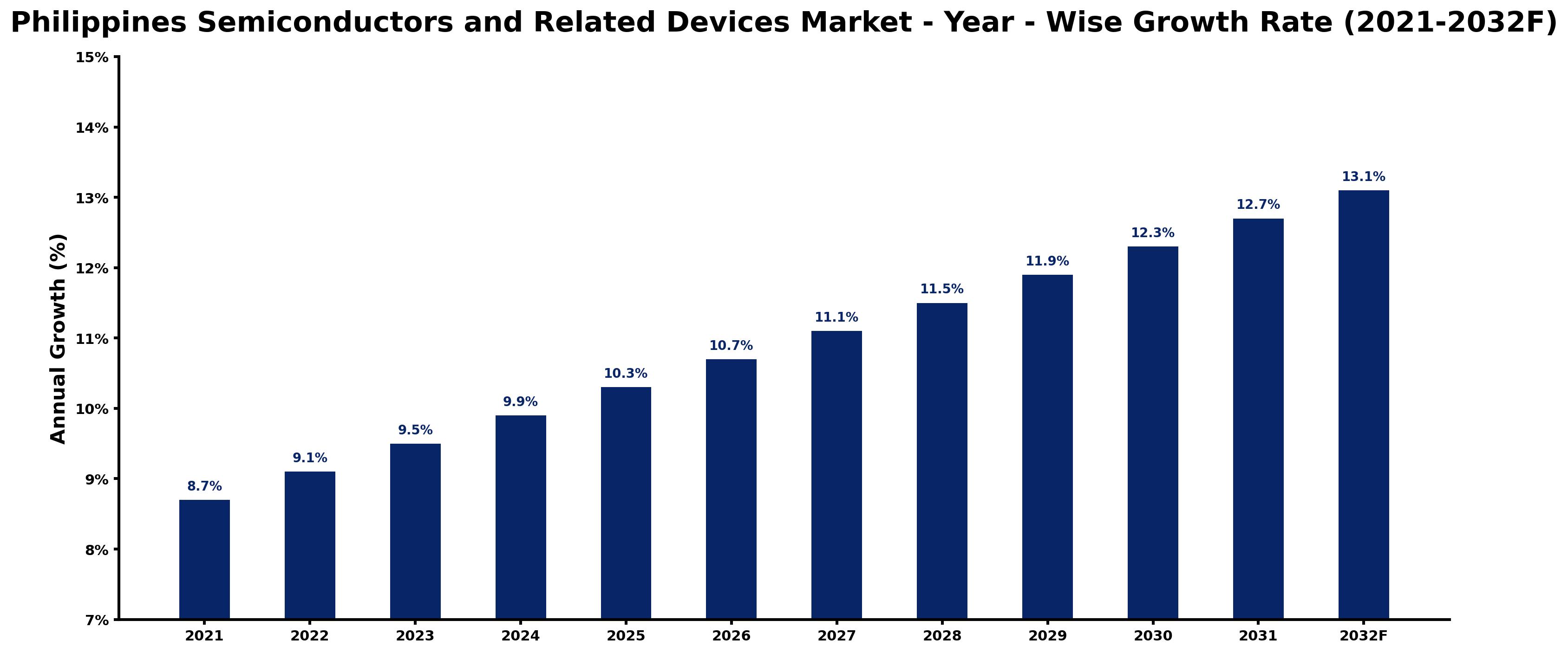
The table below presents the year wise growth rates along with the key drivers influencing the market
| Year | Growth Rate | Major Drivers |
| 2021 | 8.7% | Supply chain disruptions highlighted the need for localized semiconductor production capabilities. |
| 2022 | 9.1% | Increased investments from both local and foreign companies bolstered manufacturing infrastructures across the region. |
| 2023 | 9.5% | The Philippines positioned itself as a key player in the global tech supply chain. |
| 2024 | 9.9% | Collaboration between startups and established firms sparks innovation in semiconductor technologies. |
| 2025 | 10.3% | Enhanced educational programs aimed at engineering students drive skilled workforce development. |
| 2026 | 10.7% | Corporate investments in R&D have resulted in the emergence of new semiconductor applications. |
| 2027 | 11.1% | Regional demand for consumer electronics continues to expand, fueling chip production requirements. |
| 2028 | 11.5% | Partnerships with global tech giants ensure access to advanced semiconductor manufacturing techniques. |
| 2029 | 11.9% | Integration of AI and IoT technologies requires more sophisticated semiconductor solutions and devices. |
| 2030 | 12.3% | Growing interest in electric vehicles creates new opportunities for semiconductor components. |
| 2031 | 12.7% | Resilience in supply chains becomes a priority, leading to diversification of suppliers. |
| 2032 | 13.1% | Sustainability concerns push for greener semiconductor technologies and eco-friendly production methods. |
Note - Market size estimations and growth projections presented in this report are based on 6Wresearch's advanced forecasting approach, validated with industry datasets as of June 2026.
Philippines Semiconductors and Related Devices Market Synopsis
The Philippines Semiconductors and Related Devices Market is projected to reach 10.7% and witness significant growth during the forecast period (2026-2032). This growth trajectory is largely fueled by escalating demand for consumer electronics, including smartphones, tablets, and gaming consoles. Additionally, the rise in automotive production, driven by government initiatives promoting electric vehicles, stands as a key factor in this dynamic market. Another critical influence is the increasing investments by international companies in local manufacturing operations, along with the ongoing development of 5G infrastructure. However, the market may face hurdles stemming from fluctuating prices due to global oversupply.
Philippines Semiconductors and Related Devices Market Growth Drivers
Several factors are propelling the Philippines Semiconductors and Related Devices Market forward:
- The burgeoning demand for consumer electronics has necessitated an increase in semiconductor production, facilitating growth across diverse sectors.
- Government policies aimed at enhancing the electric vehicle segment are driving automotive manufacturers to explore more semiconductor solutions.
- Foreign direct investment from international players, particularly from China, is catalyzing local semiconductor operations, leading to job creation and improved supply chain logistics.
- The emergence of 5G technology necessitates advanced semiconductor components, bolstering market demand as infrastructure develops.
- Collaborative efforts among local firms and multinational corporations are fostering innovation, producing cutting-edge semiconductor technologies.
Philippines Semiconductors and Related Devices Market Challenges and Restraints
Despite favorable growth conditions, the market is not without its challenges:
- The unpredictability of global demand forecasts can lead to overproduction or shortages, impacting pricing strategies across the industry.
- Economic fluctuations may dampen consumer spending on electronics, further affecting semiconductor sales.
- Price sensitivity among consumers can restrict access to high-quality semiconductor technologies, limiting market potential.
- Environmental concerns related to semiconductor manufacturing processes pose a challenge to sustainable operations.
- Geopolitical tensions and trade policies can adversely affect international investments and the flow of materials necessary for production.
Philippines Semiconductors and Related Devices Market Investment Opportunities
The landscape for investment in the Philippines Semiconductors and Related Devices Market is notably compelling due to multiple factors:
- Government incentives aimed at bolstering local manufacturing present a prime opportunity for investors looking to enter the semiconductor sector.
- The shift towards renewable energy, particularly in electric vehicle production, creates demand for innovative semiconductor applications.
- Investment in research and development is crucial, allowing for advancements in cutting-edge semiconductor technologies.
- With the rapid rollout of 5G infrastructure, opportunities abound for firms that specialize in telecommunications semiconductors.
- Establishing partnerships with local firms can enhance market penetration while ensuring access to emerging consumer trends.
Philippines Semiconductors and Related Devices Market Government Investment and Initiatives
The Philippine government has undertaken a variety of initiatives aimed at enhancing the performance of the semiconductors sector:
- Through various economic stimulus programs, the government is facilitating funding for semiconductor-related startups and existing firms.
- Public spending on infrastructure, particularly digital and technological frameworks, is being prioritized to support semiconductor manufacturing.
- Innovation hubs are being developed to create synergies between academia and the semiconductor industry, fostering research collaboration.
- Policies that promote foreign investment include tax incentives and streamlined regulatory processes for multinational companies establishing operations in the country.
- Commitments to workforce development ensure that skills training programs are aligned with the needs of semiconductor manufacturers.
Philippines Semiconductors and Related Devices Market Latest Developments (May 2025 - June 2026)
In recent months, the Philippines Semiconductors and Related Devices Market has experienced noteworthy developments:
- Several international semiconductor firms have announced plans to expand their production capabilities within the Philippines, reflecting increased confidence in local markets.
- The government has launched initiatives aimed at enhancing the skill sets of the workforce, particularly in high-tech manufacturing processes.
- Collaborative partnerships among domestic companies and foreign investors have intensified, particularly in the fields of research and product development.
- Advancements in supply chain logistics have resulted in improved access to raw materials, benefiting local manufacturing operations.
- Regulatory changes have been introduced to improve ease of doing business in the semiconductor sector, attracting further investments.
Philippines Semiconductors and Related Devices Market - Key Attractiveness of the Report
- 10 Years of Market Numbers
- Historical Data Starting from 2022 to 2025
- Base Year: 2025
- Forecast Data until 2032
- Key Performance Indicators Impacting the Market
- Major Upcoming Developments and Projects
Key Highlights of the Report:
- Philippines Semiconductors and Related Devices Market Outlook
- Market Size of Philippines Semiconductors and Related Devices Market, 2025
- Forecast of Philippines Semiconductors and Related Devices Market, 2032
- Historical Data and Forecast of Philippines Semiconductors and Related Devices Revenues & Volume for the Period 2022-2032F
- Philippines Semiconductors and Related Devices Market Trend Evolution
- Philippines Semiconductors and Related Devices Market Drivers and Challenges
- Philippines Semiconductors and Related Devices Price Trends
- Philippines Semiconductors and Related Devices Porter's Five Forces
- Philippines Semiconductors and Related Devices Industry Life Cycle
- Historical Data and Forecast of Philippines Semiconductors and Related Devices Market Revenues & Volume By Types for the Period 2022-2032F
- Historical Data and Forecast of Philippines Semiconductors and Related Devices Market Revenues & Volume By Integrated Circuits for the Period 2022-2032F
- Historical Data and Forecast of Philippines Semiconductors and Related Devices Market Revenues & Volume By Memory Chips for the Period 2022-2032F
- Historical Data and Forecast of Philippines Semiconductors and Related Devices Market Revenues & Volume By Microprocessors for the Period 2022-2032F
- Historical Data and Forecast of Philippines Semiconductors and Related Devices Market Revenues & Volume By Others ? for the Period 2022-2032F
- Historical Data and Forecast of Philippines Semiconductors and Related Devices Market Revenues & Volume By End-users for the Period 2022-2032F
- Historical Data and Forecast of Philippines Semiconductors and Related Devices Market Revenues & Volume By Information Technology for the Period 2022-2032F
- Historical Data and Forecast of Philippines Semiconductors and Related Devices Market Revenues & Volume By Aerospace & Defense for the Period 2022-2032F
- Historical Data and Forecast of Philippines Semiconductors and Related Devices Market Revenues & Volume By Consumer Electronics for the Period 2022-2032F
- Historical Data and Forecast of Philippines Semiconductors and Related Devices Market Revenues & Volume By Automotive for the Period 2022-2032F
- Historical Data and Forecast of Philippines Semiconductors and Related Devices Market Revenues & Volume By Healthcare for the Period 2022-2032F
- Historical Data and Forecast of Philippines Semiconductors and Related Devices Market Revenues & Volume By Others for the Period 2022-2032F
- Philippines Semiconductors and Related Devices Import Export Trade Statistics
- Market Opportunity Assessment By Types
- Market Opportunity Assessment By End-users
- Philippines Semiconductors and Related Devices Top Companies Market Share
- Philippines Semiconductors and Related Devices Competitive Benchmarking By Technical and Operational Parameters
- Philippines Semiconductors and Related Devices Company Profiles
- Philippines Semiconductors and Related Devices Key Strategic Recommendations






































