Philippines Sorghum Market Top 5 Importing Countries and Market Competition (HHI) Analysis
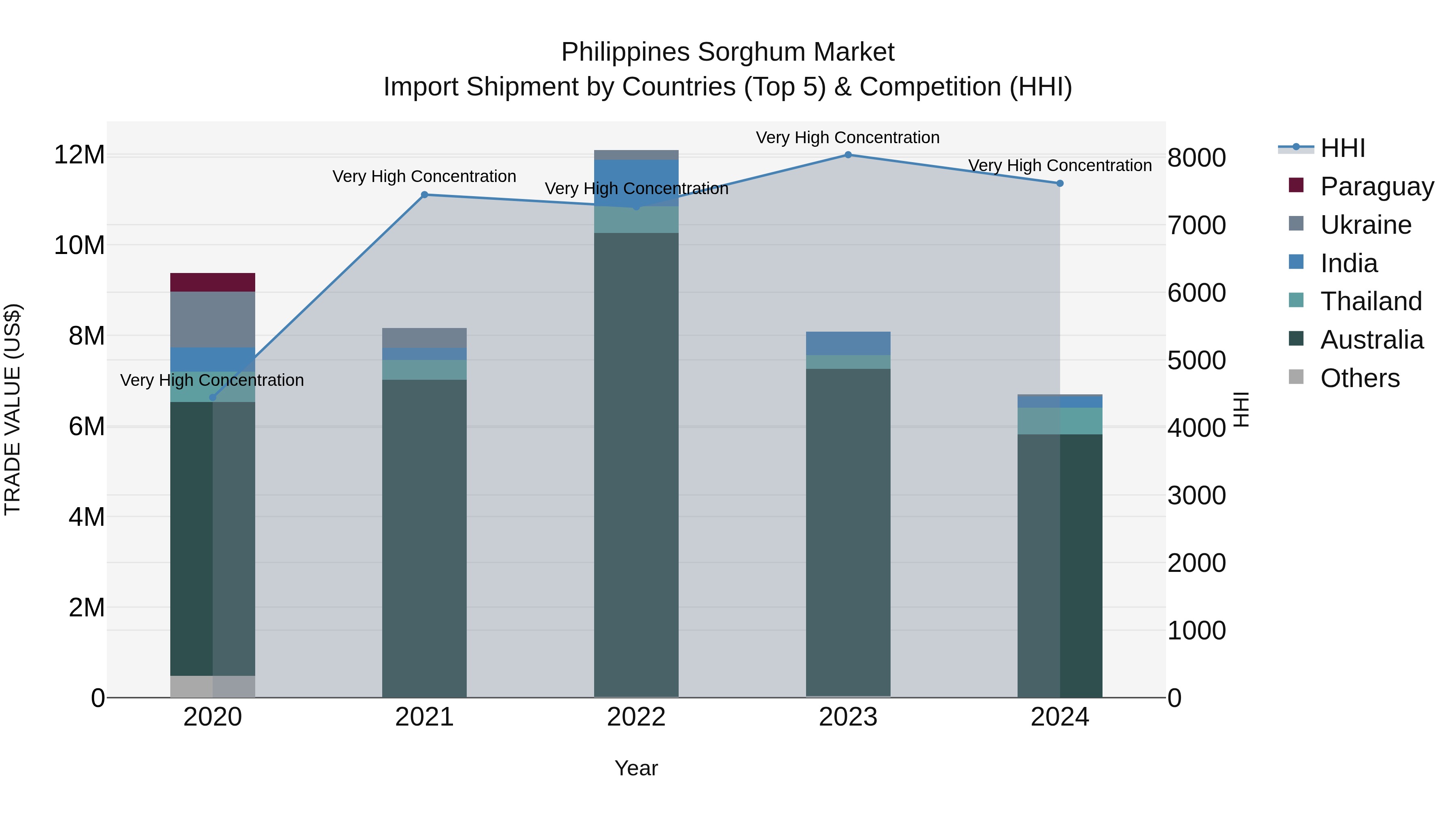
In 2024, the Philippines continued to rely on imports of sorghum, with Australia, Thailand, India, Ukraine, and China emerging as the top exporters. Despite a high concentration with a high Herfindahl-Hirschman Index (HHI), the market saw a declining trend with a negative Compound Annual Growth Rate (CAGR) of -8.09% from 2020 to 2024. The growth rate further decreased by -17.13% in 2024 compared to the previous year, indicating challenges in the sorghum import market in the Philippines.
philippines sorghum market Synopsis
The Philippines sorghum market is gaining attention as a versatile cereal crop with various uses, including food, fodder, and industrial applications. Sorghum`s drought-resistant qualities make it well-suited to the country`s climatic conditions, offering an alternative crop choice for farmers facing water scarcity. Its utilization in both human consumption and livestock feed diversifies agricultural activities and contributes to food security. Research and development efforts to improve sorghum varieties and promote its benefits are key factors driving this market`s expansion.
Drivers of the Market
As a drought-resistant cereal crop, sorghum has gained attention in the Philippines due to its ability to thrive in marginal agricultural lands. The market is driven by its versatility as a food crop, animal feed, and potential biofuel source. Its cultivation is encouraged by its low water requirements and adaptability to changing climate patterns.
Challenges of the Market
The Philippines sorghum market encounters challenges related to cultivation practices, market awareness, and demand. Adapting sorghum to local agro-climatic conditions and promoting its benefits as a versatile crop for food, feed, and industrial use require research and extension efforts. Generating consistent demand and market access for sorghum products pose challenges, especially in the face of competition from established crops.
COVID-19 Impact on the Market
The COVID-19 pandemic had mixed effects on the Philippines sorghum market. While disruptions in transportation and distribution affected supply chains, the market experienced increased interest due to its potential as a resilient and drought-resistant crop. As food security became a concern, the Philippines explored local production of sorghum to reduce dependence on imports. The pandemic highlighted the importance of diversifying food sources, which could drive future growth in the sorghum market.
Key Players in the Market
Sorghum is gaining attention in the Philippines as a drought-resistant crop and a potential ingredient in livestock feed. Key players in the sorghum market include agricultural input companies like Allied Botanical Corporation and East-West Seed Philippines. They provide sorghum seeds and agronomic support to farmers exploring alternative crops.
Key Highlights of the Report:
- Philippines Sorghum Market Outlook
- Market Size of Philippines Sorghum Market, 2024
- Forecast of Philippines Sorghum Market, 2031
- Historical Data and Forecast of Philippines Sorghum Revenues & Volume for the Period 2021-2031
- Philippines Sorghum Market Trend Evolution
- Philippines Sorghum Market Drivers and Challenges
- Philippines Sorghum Price Trends
- Philippines Sorghum Porter's Five Forces
- Philippines Sorghum Industry Life Cycle
- Historical Data and Forecast of Philippines Sorghum Market Revenues & Volume By Type for the Period 2021-2031
- Historical Data and Forecast of Philippines Sorghum Market Revenues & Volume By Grain Sorghum for the Period 2021-2031
- Historical Data and Forecast of Philippines Sorghum Market Revenues & Volume By Forage Sorghum for the Period 2021-2031
- Historical Data and Forecast of Philippines Sorghum Market Revenues & Volume By Biomass Sorghum for the Period 2021-2031
- Historical Data and Forecast of Philippines Sorghum Market Revenues & Volume By Sweet Sorghum for the Period 2021-2031
- Historical Data and Forecast of Philippines Sorghum Market Revenues & Volume By Application for the Period 2021-2031
- Historical Data and Forecast of Philippines Sorghum Market Revenues & Volume By Biofuel for the Period 2021-2031
- Historical Data and Forecast of Philippines Sorghum Market Revenues & Volume By Food for the Period 2021-2031
- Historical Data and Forecast of Philippines Sorghum Market Revenues & Volume By Livestock Feed for the Period 2021-2031
- Historical Data and Forecast of Philippines Sorghum Market Revenues & Volume By Others for the Period 2021-2031
- Philippines Sorghum Import Export Trade Statistics
- Market Opportunity Assessment By Type
- Market Opportunity Assessment By Application
- Philippines Sorghum Top Companies Market Share
- Philippines Sorghum Competitive Benchmarking By Technical and Operational Parameters
- Philippines Sorghum Company Profiles
- Philippines Sorghum Key Strategic Recommendations






































